How does an Employer of Record (EOR) manage payroll taxes in Uzbekistan

TL; DR
Thinking of hiring in Uzbekistan? Here’s the short version: payroll here is not something you want to handle alone.
Every employee paycheck triggers a chain reaction: 12% income tax, social contributions, pension payments, and monthly filings with the State Tax Committee.
One misstep, and you’re looking at fines, audits, or delayed payroll that hurts both your reputation and your team’s trust.
That’s why companies hire through an Employer of Record (EOR).
An EOR becomes your legal employer, handling:
- Payroll tax calculations, withholdings, and remittances
- Employer-side contributions and filings
- Compliance with Uzbek labor law and reporting deadlines
- Audit-ready documentation every month
You still manage your people. The EOR manages the risk.
Introduction
You want to hire in Uzbekistan. But do you want the paperwork too?
Because that’s exactly what’s waiting if you take the long route. Entity setup. Tax registration. Labor code interpretation. Monthly payroll calculations. And don’t even get me started on filing all the social contributions correctly with the State Tax Committee.
At the same time, you don’t want to hand off your hiring to some faceless consultant halfway across the world. You want control. You want speed. And yes, you want it all without accidentally breaking Uzbek labor law.
This is where it gets interesting.
Do you go full ownership mode and build from scratch?
Or do you sidestep the bureaucracy and hire through an Employer of Record (EOR)?
Both paths lead to the same result: a team in Uzbekistan.
But the experience getting there? Night and day.
An EOR becomes the legal employer, taking care of employment contracts, payroll taxes, social contributions, and compliance filings. Your employees are legally employed, taxes are calculated correctly, and your business stays in good standing, all without the overhead of entity setup.
Let’s break down why an EOR isn’t just convenience. It’s risk mitigation, speed, and local expertise all rolled into one solution

Overview of payroll taxes in Uzbekistan
Hiring in Uzbekistan isn’t just about signing contracts and paying salaries—it’s navigating a complex system of taxes and statutory contributions that, if mishandled, can result in fines, audits, and operational headaches. For foreign companies, understanding how payroll taxes work and how an Employer of Record (EOR) manages them is critical for staying compliant while keeping operations smooth.
1. Personal income tax (PIT)
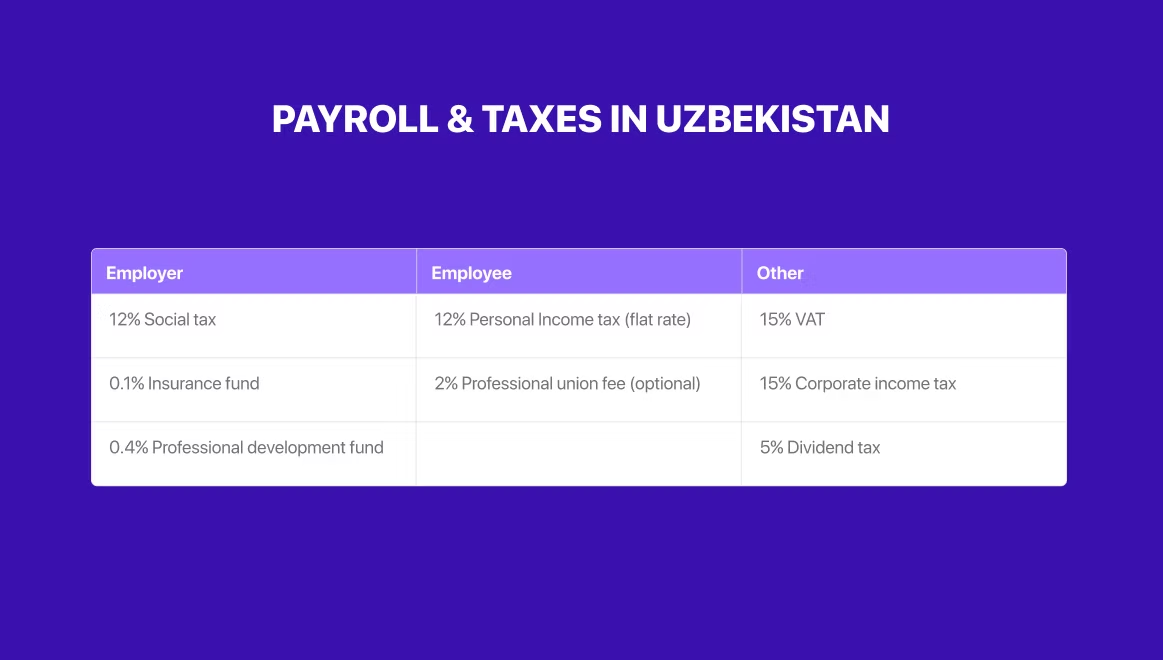
- Rate: Flat 12% of the employee’s gross salary
- Who pays: Deducted from the employee’s salary at source
- Purpose: Funds government programs and is a direct liability on the employee’s pay
- Example: If an employee earns 5,000,000 UZS/month, PIT = 5,000,000 × 12% = 600,000 UZS deducted. Net salary = 4,400,000 UZS before other contributions.
The EOR calculates and withholds PIT for every pay period, ensuring accurate compliance with the State Tax Committee.

2. Social security contributions
Social security in Uzbekistan covers health, disability, and social protection. Contributions are split between employer and employee:
- Employee portion: Typically 7–10% of gross salary
- Employer portion: Around 20% of gross salary, depending on sector
- Payment frequency: Monthly, remitted alongside PIT to the tax authorities
Example: Monthly gross salary = 5,000,000 UZS
- Employee social contribution: 5,000,000 × 7% = 350,000 UZS
- Employer social contribution: 5,000,000 × 20% = 1,000,000 UZS
The EOR ensures both sides are calculated accurately and remitted on time, preventing underpayment and penalties.
3. Pension fund payments
Uzbekistan mandates contributions to the state pension fund:
- Split between employee and employer, typically following the same percentages as Social Security
- Some high-income earners or specific sectors may have caps on contributions, which the EOR automatically applies
- Contributions are recorded and reported monthly to ensure audit readiness
4. Other mandatory contributions
- Depending on the sector, position, or employment type, additional contributions may include:
- Unemployment insurance
- Occupational risk premiums
- Health insurance top-ups required by certain local laws
The EOR identifies all applicable obligations and incorporates them into payroll calculations so your team remains compliant.
5. Payroll taxes vs income taxes
It’s critical to understand the distinction between payroll versus income tax:
| Type | Paid By | Purpose | Impact |
| Personal Income Tax | Employee | Tax on wages | Reduces net salary |
| Payroll Taxes | Employee + Employer | Social security, pensions, and other statutory contributions | Increases total employment cost and funds statutory benefits |
Income tax affects the employee’s take-home pay, while payroll taxes increase the total cost of employment for the employer. Misunderstanding this distinction is a common pitfall for foreign companies.
6. Employer-paid contributions
- Social security (employer portion)
- Pension fund contributions (employer portion)
- Any additional statutory obligations specific to sector or employment type
These contributions are calculated, withheld, and remitted by the EOR, allowing foreign companies to hire employees without setting up a local entity and still maintain full compliance.
Why this matters
Without proper understanding or management, payroll taxes in Uzbekistan can become a compliance risk. Errors in calculation or missed filings can result in:
- Fines and penalties
- Audits by the State Tax Committee
- Back-pay liabilities for employees
An EOR mitigates these risks by providing accurate payroll tax calculations, timely remittances, and full reporting, letting foreign companies focus on growth rather than compliance headaches.

How an EOR manages payroll tax withholding and payments
You’ve hired your team in Uzbekistan. Great. But now comes the part nobody warned you about: income tax, social contributions, pension payments, and monthly filings with the State Tax Committee. Mess this up, and fines, audits, and back-pay claims aren’t just possibilities, they’re guaranteed headaches.
This is where an Employer of Record (EOR) provider in Uzbekistan becomes your legal and operational hero. They step in as the official employer, taking responsibility for all payroll tax obligations while you keep full control of your team.
Withholding employee taxes like a pro
The EOR calculates and deducts personal income tax (12% flat), social security contributions, and pension fund payments from each employee’s gross salary. Every month. Every employee. No guessing. No late submissions.
Example:
- Monthly gross salary: 5,000,000 UZS
- Personal income tax: 5,000,000 × 12% = 600,000 UZS
- Employee social contribution: 5,000,000 × 7% = 350,000 UZS
- Employee pension contribution: 5,000,000 × 10% = 500,000 UZS
Net salary: 3,550,000 UZS
The EOR ensures every deduction is accurate, compliant, and filed on time, so employees are paid correctly and the company stays audit-ready.
Employer-side contributions
EORs also calculate employer obligations, which typically include:
- Social security: ~20% of gross salary
- Pension contributions: ~10% of gross salary
Example: Same 5,000,000 UZS gross salary
- Employer social security: 5,000,000 × 20% = 1,000,000 UZS
- Employer pension contribution: 5,000,000 × 10% = 500,000 UZS
Total employer cost: 6,500,000 UZS
The EOR automatically applies any caps or exemptions for high-income employees, so your costs to use EOR in Uzbekistan are always accurate and compliant.
Monthly tax declaration and payments
EORs handle everything that matters for compliance:
- Prepare payroll tax declarations with employee salaries, PIT, and employer contributions.
- Submit reports electronically through the official State Tax Committee portal.
- Remit all withheld taxes and contributions by the statutory deadline.
- Maintain detailed payroll records ready for audit at any time.
No late filings. No guessing the calculations. No “oops” moments that turn into fines.
Why It Matters
With an EOR, foreign companies can:
- Hire legally without a local entity
- Ensure accurate payroll tax calculations and timely remittances
- Stay fully compliant with Uzbek labor and tax law
- Free HR and finance teams to focus on growing the business instead of chasing regulations
Calculating payroll taxes in Uzbekistan
You’ve hired your team in Uzbekistan. Congratulations.
But now comes the part that makes founders and finance teams break out in cold sweat: calculating payroll taxes correctly, every month, for every employee. Get it wrong, and fines, audits, and back-pay claims are waiting.
Here’s how an Employer of Record (EOR) takes the headache out of it, and how payroll taxes actually work in Uzbekistan.
1. Basic formula for payroll taxes
At its simplest, monthly payroll taxes can be broken down like this:
Gross Salary – Employee Deductions = Net Salary
Total Employer Cost = Gross Salary + Employer Contributions
Where:
- Employee Deductions = Personal Income Tax + Employee Social Security + Employee Pension
- Employer Contributions = Employer Social Security + Employer Pension + Any sector-specific obligations
2. Employee tax calculation example
Suppose an employee earns 5,000,000 UZS per month.
Employee deductions:
- Personal Income Tax (12%): 5,000,000 × 12% = 600,000 UZS
- Social Security Contribution (7%): 5,000,000 × 7% = 350,000 UZS
- Pension Contribution (10%): 5,000,000 × 10% = 500,000 UZS
Total deductions: 600,000 + 350,000 + 500,000 = 1,450,000 UZS
Net salary: 5,000,000 – 1,450,000 = 3,550,000 UZS
3. Employer contribution calculation example
The employer also contributes on top of the gross salary:
- Social Security (20%): 5,000,000 × 20% = 1,000,000 UZS
- Pension Fund (10%): 5,000,000 × 10% = 500,000 UZS
Total employer cost: 5,000,000 + 1,500,000 = 6,500,000 UZS

The EOR calculates these automatically for each employee and applies any caps or thresholds defined by Uzbek law.
4. Caps and thresholds
- Certain contributions, especially pension payments, have upper limits on the taxable base for high-income employees.
- The EOR ensures that contributions do not exceed legal caps, maintaining compliance and preventing overpayment.
Why It Matters
Accurate payroll tax calculation in Uzbekistan affects employee take-home pay, total employment costs, and legal compliance. Partnering with an EOR ensures formulas are applied correctly, thresholds are respected, and payroll is processed accurately every month, keeping your company compliant and stress-free.
Payroll tax reporting and compliance in Uzbekistan
Hiring in Uzbekistan comes with more than just salaries; it comes with monthly payroll filings, tax remittances, and strict compliance requirements. Miss a deadline or miscalculate a contribution, and fines, audits, or back-pay claims aren’t just possibilities; they’re guaranteed headaches.
That’s where an Employer of Record (EOR) steps in. Acting as the legal employer, the EOR takes responsibility for reporting, filing, and remitting all payroll taxes correctly and on time.
Monthly payroll reporting deadlines
EORs handle all reporting obligations to the State Tax Committee (STC), including:
- Payroll Tax Declarations: Submitted monthly with details of employee salaries, withheld personal income tax (12%), and employer social contributions.
- Payment of Withheld Taxes and Contributions: Must be remitted by the 15th of the month following the payroll period.
- Additional Reporting: Annual reconciliation reports and employee tax certificates may also be required.
By managing these deadlines, the EOR ensures payroll remains compliant and employees are accurately accounted for.
Penalties for late or inaccurate filings
Failing to file on time or submitting incorrect payroll data can trigger:
- Fines and interest for late payments or underpayment
- Audits that require retroactive corrections
- Operational and reputational risks for your company
- Potential liability for misclassified employees or missing contributions
An EOR mitigates these risks by applying rigorous checks, accurate calculations, and timely submissions.
Audit preparedness and compliance assurance
EORs maintain comprehensive, audit-ready records, including:
- Detailed payroll calculations for each employee
- Records of withheld personal income tax, social security, and pension contributions
- Electronic submission confirmations and receipts
- Documentation for annual reconciliations
This ensures that, if the STC audits your company, all payroll and tax filings are accurate, organized, and fully compliant.
Benefits of using an EOR for payroll taxes in Uzbekistan
Let’s be honest, payroll taxes in Uzbekistan are not for the faint of heart. Between monthly filings, income tax withholdings, pension deductions, and ever-changing compliance rules, most foreign companies spend more time managing bureaucracy than managing people.
That’s exactly why global employers turn to an Employer of Record (EOR) in Uzbekistan.
An EOR doesn’t just process payroll; it becomes the legal employer for your team in Uzbekistan, taking full responsibility for payroll tax calculations, filings, and payments. It’s how you hire locally without getting buried in tax law, paperwork, or compliance risk.
Simplifies payroll tax compliance
Forget juggling tax rates, contribution formulas, and monthly remittance schedules.
An EOR handles:
- All payroll tax withholdings (12% personal income tax, social and pension contributions)
- Employer-side obligations and filings with the State Tax Committee
- Accurate, audit-ready payroll records every month
You stay compliant. Your employees get paid correctly. Everyone wins.
No entity setup. No bureaucratic delays.
Setting up a legal entity in Uzbekistan can take months, and that’s before you even hire your first employee.
With an EOR, you skip:
- Entity registration and tax office approval
- Opening local bank accounts
- Managing employment contracts under Uzbek labor law
Instead, you hire through a trusted partner who already has the legal infrastructure in place. That means faster hiring, zero red tape, and full compliance from day one.
Local expertise and risk mitigation
EORs live and breathe Uzbek payroll law. They know when rates change, when deadlines move, and how to handle audits if they happen.
They also:
- Prevent underpayment or overpayment of taxes
- Reduce the risk of fines and misclassification penalties
- Provide ongoing compliance monitoring to keep your business protected
Your business operates with confidence, not caution.
Why it matters
For global employers, payroll compliance in Uzbekistan is a make-or-break issue. An EOR eliminates the risk, simplifies the process, and helps you scale your team quickly—without tripping over tax deadlines or legal gray areas.
It’s not just about paying people; it’s about protecting your business.
Conclusion
Hiring in Uzbekistan is easy, until payroll taxes enter the chat.
Between income tax, social contributions, pension payments, and monthly filings, what should be a simple “we hired someone” moment can spiral into weeks of forms, translations, and compliance guesswork. That’s not growth. That’s admin hell.
An Employer of Record (EOR) turns that chaos into clarity. It becomes your legal employer in Uzbekistan, handling payroll tax calculations, filings, and payments so you don’t have to. You stay focused on hiring, scaling, and managing your team—while the EOR makes sure every tenge reaches the right place on time.
For foreign employers, the difference is night and day:
- No local entity. No tax headaches. No missed deadlines.
- Just compliant, on-time payroll, and peace of mind.
If you’re serious about expanding into Uzbekistan without drowning in payroll compliance, Team Up can help.
We handle the complexity, so you can handle the growth.
Book a meeting with our EOR team today to see how we can simplify your hiring and payroll operations in Uzbekistan.
Frequently asked questions
How are payroll tax expenses recorded in Uzbekistan?
Payroll tax expenses in Uzbekistan include income tax, social contributions, and pension fund payments. These are recorded as part of your total employment costs.
When hiring through an Employer of Record (EOR), these expenses are consolidated into one monthly invoice, covering gross salary, employer taxes, and statutory contributions, making accounting and compliance seamless.
What payroll taxes do employers pay in Uzbekistan?
Employers in Uzbekistan contribute the following mandatory payments on top of gross salary:
- Unified Social Payment (USP): 12% of total payroll (covers social insurance, pensions, and healthcare).
- Trade Union Fee (if applicable): 0.3%–0.5% of payroll. These contributions are paid monthly to the tax authorities and social funds.
What payroll taxes do employees pay in Uzbekistan?
Employees are responsible for:
- Personal Income Tax (PIT): 12% flat rate on gross salary.
- Mandatory Pension Contribution: 0.5% of gross salary. The Employer of Record automatically withholds and remits these on behalf of employees each month.
What is the difference between an Employer of Record and a direct employer in Uzbekistan?
A direct employer must establish a legal entity in Uzbekistan, handle tax filings, payroll, and ensure compliance with labor laws.
An Employer of Record (EOR) legally employs staff on your behalf, managing all administrative, payroll, and compliance duties. Your company manages day-to-day operations, while the EOR ensures legal employment under Uzbek law.
Do employers pay regional or municipal payroll taxes in Uzbekistan?
No. Payroll taxes in Uzbekistan are collected at the national level. Employers only need to comply with national labor, tax, and social contribution regulations.
Which payroll taxes must an EOR withhold in Uzbekistan?
An EOR in Uzbekistan withholds and submits the following:
- 12% personal income tax from the employee’s salary
- 0.5% employee pension fund contribution
- 12% employer unified social payment (USP) The EOR ensures correct calculations, reporting, and payments through Uzbekistan’s national tax system.
How does an EOR calculate employer contributions in Uzbekistan?
Employer contributions are calculated as a percentage of total payroll. The Unified Social Payment (12%) is applied to the entire wage bill and includes all mandatory employer-side social charges.
What payroll reporting deadlines must an EOR meet in Uzbekistan?
Payroll taxes and contributions in Uzbekistan must be reported and paid monthly, usually by the 20th of the following month.
An EOR handles all filings electronically via Uzbekistan’s unified tax platform, ensuring there are no delays or penalties.
Do EORs handle pension and social contributions for employees in Uzbekistan?
Yes. A compliant EOR in Uzbekistan manages all employer and employee contributions to the Unified Social Fund and Pension Fund, ensuring every employee is covered by the national social insurance system.
How does using an EOR affect employee tax residency in Uzbekistan?
Tax residency is based on physical presence—anyone staying in Uzbekistan for 183 days or more within a year is considered a tax resident.
An EOR ensures all withholdings are done in line with residency status, preventing double taxation or non-compliance issues.
What are the benefits of using an EOR for payroll and tax compliance in Uzbekistan?
Working with an Employer of Record in Uzbekistan helps you:
- Hire employees without setting up a local entity
- Stay compliant with local labor and tax laws
- Ensure accurate payroll and on-time payments
- Protect intellectual property and employee data
- Avoid fines and penalties from reporting errors
.svg)