


Local vs Global Employer of Record (EOR) in Uzbekistan: A Comprehensive Guide
TL;DR
The strategic expansion of multinational enterprises into the Central Asian corridor has transformed Uzbekistan from a landlocked frontier into a burgeoning epicenter of technological innovation and professional services.
As the most populous nation in the region, with over 36 million citizens, the Republic has implemented an aggressive series of economic liberalizations since 2017, aimed at dismantling the bureaucratic remnants of its pre-independence past.
For global decision-makers, the primary hurdle to accessing this high-potential labor market is not the availability of talent, but the navigation of a sophisticated and rapidly evolving regulatory environment.
The choice between utilizing a Global Employer of Record (EOR) and a localized, direct EOR provider represents the most critical strategic decision in the human capital lifecycle.
This guide provides a comprehensive analysis of the legal, fiscal, and operational variables that define the Uzbek employment landscape for 2025 and 2026, offering a roadmap for organizations seeking to hire at speed while maintaining absolute compliance.
Quick Navigation
- TL;DR
- The Macroeconomic Context: Uzbekistan as a Strategic Frontier
- Defining the Employer of Record (EOR) Construct
- The Global vs. Local EOR Dichotomy: Direct Entities vs. Aggregators
- Regulatory Framework: The 2023 Labor Code Autopsy
- Financial Architecture: Payroll, Taxation, and 2026 Reforms
- The IT Park Ecosystem: A Paradigm Shift in Human Capital
- Operational Logistics: PINFL, EDS, and Banking
- Social Protections and Leave Entitlements
- Risk Mitigation: Misclassification and Termination Protocols
- Cost Engineering: Flat-Rate vs. Percentage-Based Models
- 2026 Strategy: Navigating the Top Providers
- Conclusion: Future of Work in the Uzbek Hub
- Frequently asked questions
The Macroeconomic Context: Uzbekistan as a Strategic Frontier
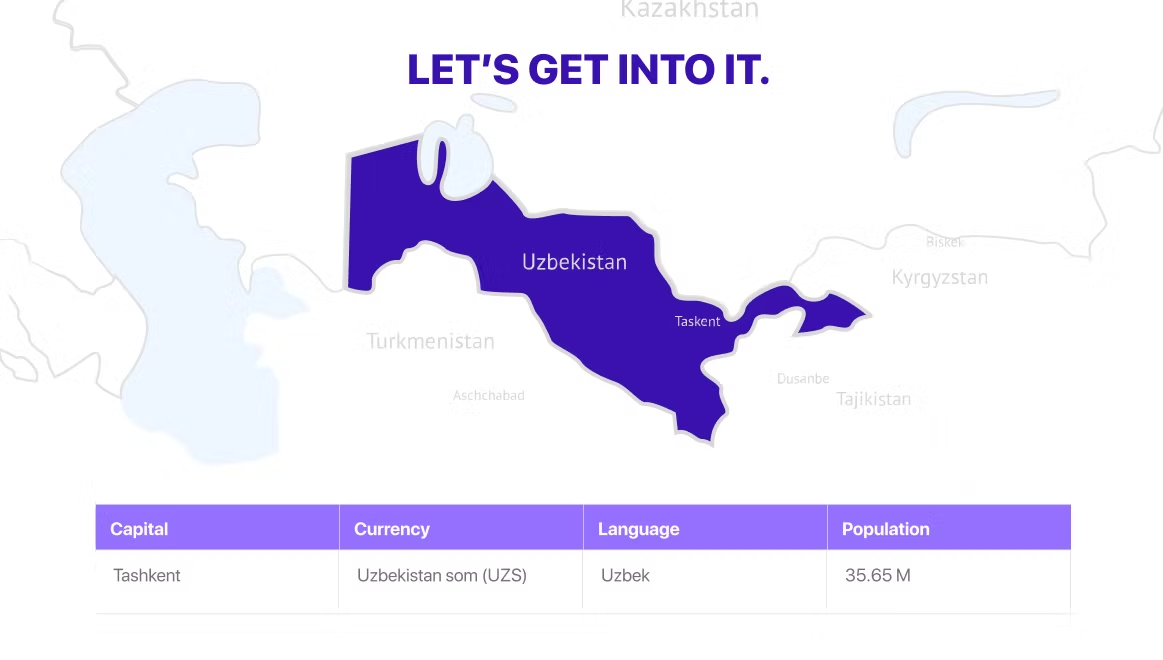
The contemporary Uzbek economy is defined by a shift from a raw-material dependence on gold, natural gas, and cotton toward a diversified service and technology economy. Since 2017, the government has liberalized its currency, streamlined the business climate, and attracted significant foreign direct investment (FDI). This transition is not merely incidental; it is a codified strategy involving the creation of a massive IT ecosystem and a simplified legal framework for foreign businesses. Decision-makers must view the country as a regional trade hub, positioned along the historical Silk Road, which now functions as a digital bridge between Asia and Europe.
The 2025-2026 period represents a peak in this transformation. In autumn 2025, IT Park Uzbekistan welcomed 470 new member companies, with a significant proportion being foreign-capitalized firms from the United States, Germany, China, and the UAE. These entities are projecting over $70 million in export services by the end of 2026, signaling a mature market for highly skilled employment in sectors such as fintech, logistics, and AI development. For organizations hiring in this hub, the primary challenge is achieving "speed to market" without the 6-to-10-week delay typically required for local subsidiary incorporation and compliance setup.

Defining the Employer of Record (EOR) Construct
An Employer of Record (EOR) functions as a third-party legal entity that assumes the formal role of employer for an organization’s workforce in Uzbekistan. While the client company maintains operational control over the employee’s daily activities, the EOR handles all regulatory requirements with the Ministry of Employment and Labor Relations (MELR) and the State Tax Committee. This model is particularly effective for companies testing the market, managing remote teams, or scaling operations without the administrative overhead of a local entity.

Under the 2023 Labor Code, the EOR is responsible for drafting bilingual employment contracts, managing the monthly payroll cycle, remitting mandatory social taxes, and ensuring that all leave and termination procedures strictly adhere to national standards. This partnership mitigates the risk of monetary sanctions resulting from payroll non-compliance and protects the foreign company from the complexities of local human resources management.
| Feature | Employer of Record (EOR) | Traditional Entity Setup |
| Speed to Hire | 2–5 days for local hires. | 6–10 weeks for incorporation. |
| Entity Setup Cost | Included in service fee ($0 upfront). | $2,000–$5,000 in registration/legal fees. |
| Administrative Burden | Outsourced to the EOR. | Managed by internal HR/Legal/Accounting. |
| Legal Liability | Assumed by the EOR. | Retained by the company. |
| Compliance Risk | Minimized by local expertise. | High, due to evolving local regulations. |
The Global vs. Local EOR Dichotomy: Direct Entities vs. Aggregators

For global decision-makers, the choice between a global EOR platform and a localized, direct EOR is often a trade-off between technological convenience and compliance depth.
Global EORs such as Deel, Remote, and Papaya Global offer unified dashboards that centralize human capital data across 150+ countries. However, in Uzbekistan, many global providers function as "aggregators," meaning they do not own a local legal entity but instead outsource employment to third-party firms. This can introduce communication lags, opaque pricing, and a lack of direct accountability for tax filings.
In contrast, local or regional EOR providers like Team Up, ANCOR, or Smart Solutions operate via direct entities registered with the Uzbek Ministry of Justice. These direct providers offer localized HR teams based in Tashkent who understand the intricacies of the my.mehnat.uz portal and the nuances of the 2026 tax reforms. Direct EORs typically provide faster onboarding (3–5 days) and bilingual contracts that are verified against the latest 2023 Labor Code standards.
The Aggregator Model Risks
The aggregator model often relies on off-site contractors to manage payroll, which EY’s 2025 Global Payroll Trends report suggests can lead to a 40% higher error rate compared to localized EORs. Furthermore, because the global platform is one step removed from the local tax authorities, resolving disputes or audits can become a multi-week bureaucratic ordeal.
The Direct Provider Advantage
Direct providers offer "real human accountability" and in-country tax IDs. They can provide bilingual payslips that employees can use for visas or mortgages, a critical factor for talent retention in a competitive market. Furthermore, localized EORs are often members of IT Park themselves, allowing them to pass on significant tax exemptions to the client company that a global aggregator might not be able to facilitate.
Regulatory Framework: The 2023 Labor Code Autopsy

The legislative bedrock of employment in Uzbekistan is the Labor Code (Law No. ZRU-798), enacted on October 28, 2022. This code was designed to modernize the labor market, ensuring a fair balance between worker protections and employer interests. For the EOR in Uzbekistan, the code is a non-negotiable set of rules governing every stage of the employment lifecycle.
Employment Contracts and the Digital Mandate
All employment relationships must be formalized in a written contract, prepared in duplicate and signed by both parties. Since the digital transformation of 2025, the registration of these contracts in the Unified National Labour System (my.mehnat.uz) is mandatory for the formal confirmation of the employer-employee relationship.
| Contract Type | Duration | Primary Use Cases |
| Indefinite (Open-Ended) | No expiration date. | The default standard for permanent roles. |
| Fixed-Term | Up to 3 years. | Project-based work, seasonal roles, or replacement. |
| Short-Term | Up to 2 months. | Highly temporary or emergency tasks. |
Probationary Periods and Training
The Labor Code permits a probationary period to evaluate an employee's suitability for a role, but it must be explicitly stated in the contract.
- Standard Employees: Limited to three months.
- Executive Positions: Extended to six months for managers, chief accountants, and heads of divisions.
- Termination during Probation: Either party may terminate with a three-day written notice.
Financial Architecture: Payroll, Taxation, and 2026 Reforms
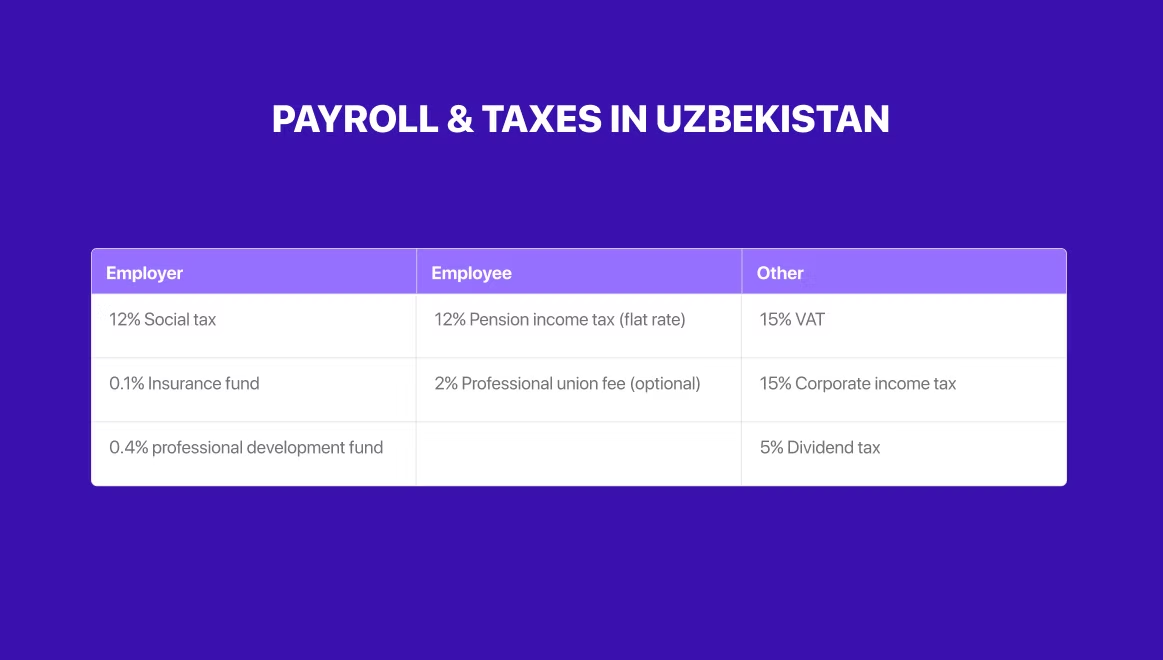
The fiscal obligations of an employer in Uzbekistan are subject to strict statutory regulation, and failure to comply can result in severe financial penalties or the loss of IT Park residency. The tax year runs from January 1 to December 31, and residency for tax purposes is established if an individual is present for 183 days or more in a consecutive 12-month period.
Standard Statutory Contributions (2025-2026)
As of August 1, 2025, the minimum monthly wage is adjusted to 1,271,000 UZS, and the Basic Calculation Base (BCB) is set at 412,000 UZS.
| Contribution Type | Rate | Responsibility |
| Personal Income Tax (PIT) | 12% | Flat rate withheld by the employer. |
| Social Tax (Standard) | 12% | Paid by the employer (25% for budget organizations). |
| Social Insurance | 12% | Employer contribution for state social protection. |
| Individual Pension (INPS) | 0.1% | Deducted from the 12% PIT and sent to individual accounts. |
| Turnover Tax | 4% | Standard rate for entities (reducing to 1% for some small biz in 2026). |
The 2026 Social Insurance Law
Beginning January 1, 2026, a new system of national social insurance will enter into effect. This reform aims to legalize unofficial employment and ensure financial stability through proactive maternity and temporary disability benefits. The social insurance system will be managed through the National Agency for Social Protection, which will automatically account for insured persons and their service years.
Automated Tax Reporting
A fundamental shift in tax administration occurs on January 1, 2026. The State Tax Committee will transition to a fully automated system where tax reports for PIT, social tax, and VAT will be prepared by the tax authorities themselves based on electronic invoices and payroll data. This increases the pressure on EOR providers to maintain real-time accuracy in their digital filings, as an AI-powered risk assessment system will categorize invoices as low, medium, or high risk.
The IT Park Ecosystem: A Paradigm Shift in Human Capital
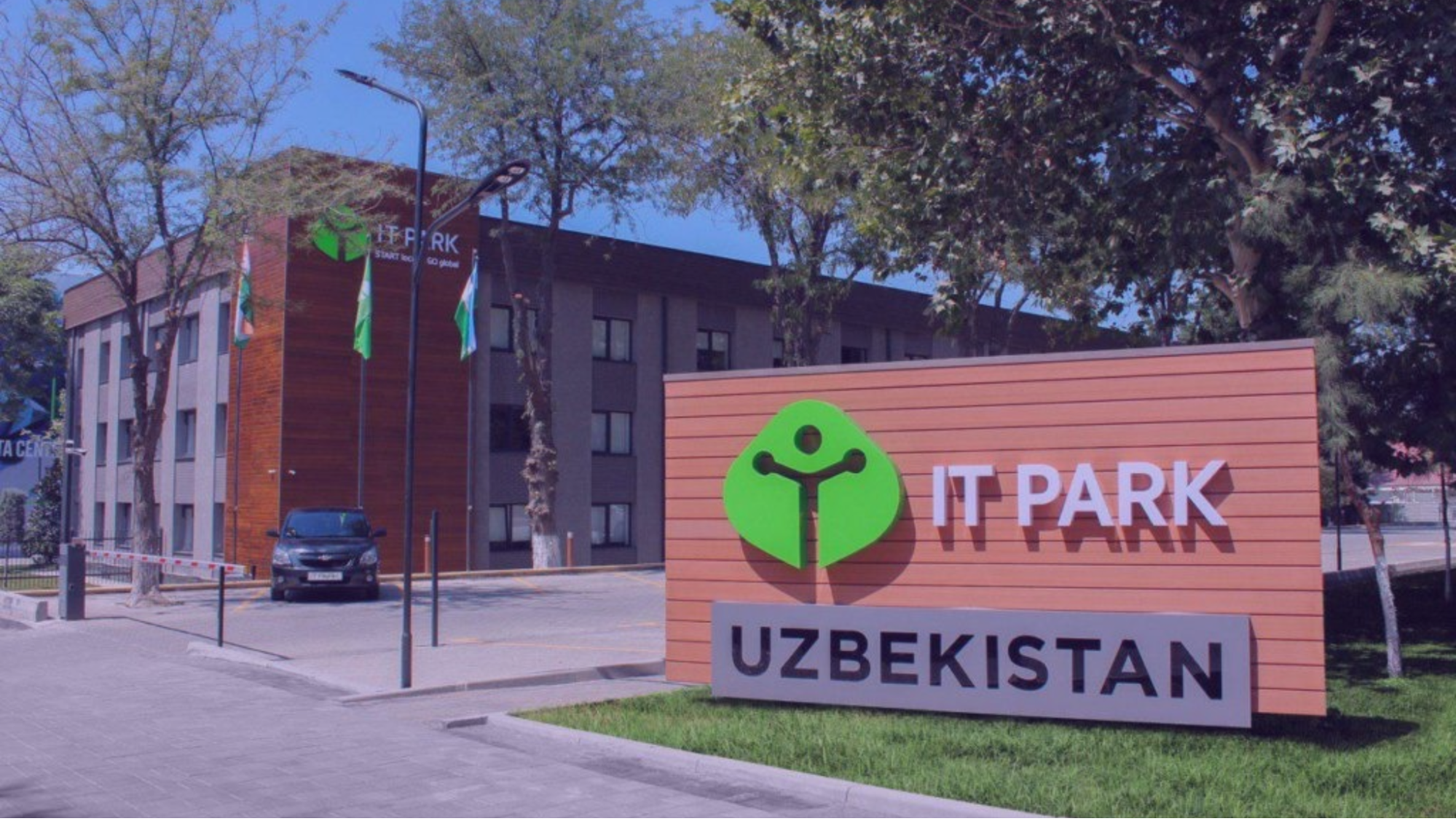
For the technology and BPO sectors, IT Park Uzbekistan serves as both a business environment and a significant tax haven. Member companies, including export-oriented EOR providers, benefit from an unparalleled legal and fiscal regime.
Tax Privileges for IT Park Residents
Organizations that acquire residency status at IT Park enjoy nearly full tax exemption until 2040 in some cases.
- Corporate Income Tax: 0% (vs. standard 15%).
- Social Tax: 0% (vs. standard 12%).
- Personal Income Tax: Reduced to 7.5% for employees (vs. standard 12%).
- VAT on Exports: 0%.
The "Zero Risk" Program
To encourage regional expansion, IT Park launched the "Zero Risk" program, providing technical equipment for up to 50 people, training grants of up to 50%, and coverage of up to 15% of salaries for employees in regional offices. This makes hiring in secondary hubs like Karshi or Samarkand even more cost-effective for foreign firms utilizing an EOR resident.
2026 Resident Requirements
Effective April 1, 2026, new rules will govern IT Park residents. The administration will introduce a differentiated system of contributions based on revenue levels and export activity. This move is intended to prioritize truly export-oriented IT service providers, making it vital for decision-makers to select an EOR that complies with these new export mandates.
Operational Logistics: PINFL, EDS, and Banking
The digital identity of a worker is the critical path for compliant onboarding in Uzbekistan. Foreign specialists and local hires alike must navigate the state’s unified identification systems.
Personal Identification Number (PINFL)
The PINFL is a 14-digit unique identifier mandatory for all legal actions, including bank account openings and contract registration.
- Application: Obtained via Public Service Centers or migration departments.
- Documents: Requires a valid international passport and temporary registration from a hotel or residence.
- Speed: Often issued within hours.
Electronic Digital Signature (EDS)
The EDS (ЭЦП) ensures the legal validity of electronic document management. It is required for signing contracts on the my.mehnat.uz portal and interacting with tax authorities. For foreigners, a PINFL must be obtained before an EDS can be issued.
Remote Banking for Foreigners
As of November 11, 2025, a landmark Central Bank resolution allows foreign specialists working for IT Park member companies to open bank accounts and virtual cards remotely, provided they have a PINFL. This eliminates the need for an in-person visit to a bank branch, a major facilitator for remote expat teams.
Social Protections and Leave Entitlements
Uzbekistan’s labor legislation provides robust social guarantees that the EOR must administer correctly to avoid litigation and reputational damage.
Annual and Public Leave
The annual leave entitlement is generally 21 calendar days, though the Labor Code’s minimum is 15 working days after six months of continuous service.
- Minors and Disabled Workers: Entitled to 30 calendar days.
- Civil Servants: Entitled to 27 calendar days.
Family and Sick Leave
Uzbekistan provides significant protection for maternal health and child care.
- Maternity Leave: 126 days total (70 before, 56 after birth) at 100% pay funded by the social insurance system.
- Sick Leave: No statutory limit on days per year, but paid days are typically restricted to 30 per instance, funded at 60%-100% of the average salary depending on tenure.
- Parental Leave: Unpaid leave is available until the child reaches age two, during which the caregiver may receive state benefits.
Risk Mitigation: Misclassification and Termination Protocols
The "at-will" employment model does not exist in Uzbekistan. Decision-makers must understand that contract cessation is a high-risk administrative procedure.
The Danger of Misclassification
Misclassifying employees as independent contractors can trigger significant fines, back-dated social taxes, and audits from the State Tax Committee. If an individual follows a company schedule or uses company equipment, they are legally an employee. An EOR mitigates this by providing a compliant employment framework from day one.
Termination Procedures and Just Cause
Termination must be for cause, such as redundancy, lack of qualification, or serious misconduct.
- Written Notice: Mandatory. Notice periods vary: two months for redundancy, two weeks for unsuitability, and three days for misconduct.
- Fair Hearing: Terminated employees are often entitled to a warning and a fair hearing before dismissal is finalized.
Severance by Tenure
Severance pay is mandatory for non-misconduct dismissals and is tiered based on the length of service.
| Length of Service | Severance Pay Amount |
| Up to 3 Years | 50% of the average monthly salary. |
| 3 to 5 Years | 75% of the average monthly salary. |
| 5 to 10 Years | 100% of the average monthly salary. |
| 10 to 15 Years | 150% of the average monthly salary. |
| Over 15 Years | 200% of the average monthly salary. |
Cost Engineering: Flat-Rate vs. Percentage-Based Models
Selecting the right EOR pricing model is essential for financial predictability. The "total cost of employment" includes the gross salary, employer-side taxes (approx. 12.1%), and the EOR fee.
Percentage-based Pricing
Some global EOR platforms charge 10%–15% of the employee's gross salary. While this may seem equitable, it "punishes growth." For a senior developer earning €3,500/month, a 12% fee would be €420/month. As the team grows and salaries increase via performance bonuses, the EOR bill scales unpredictably.
Flat-rate Pricing
Localized EORs like Team Up typically offer a flat fee (e.g., €199/month). This model allows for consistent budgeting and ensures that the cost of employment does not "magically increase" when an employee negotiates a higher salary.
Hidden Costs Checklist
Decision-makers should query providers on the following:
- Currency Markup: Is the conversion from USD to UZS at the mid-market rate, or is there a 2-5% hidden markup?
- Security Deposits: Is a one-month salary deposit required?
- Onboarding Fees: Are there one-time setup costs per employee?
2026 Strategy: Navigating the Top Providers
The Uzbekistan EOR market is becoming increasingly crowded, making provider vetting a top priority for 2026.
| Provider | Coverage | Pricing Model | Best For |
| Team Up | Central Asia / MENA | Flat €199/month | Startups; regional hubs. |
| ANCOR | Uzbekistan / regional | By quote | Enterprises need a full HR stack. |
| Deel | Global (150+ countries) | % of salary | Distributed global teams. |
| Remote | Global (100+ countries) | Flat rate | Testing market with 1-5 hires. |
| Smart Solutions | Central Asia | By quote | Migration support; outstaffing. |
Conclusion: Future of Work in the Uzbek Hub
Uzbekistan’s economic transition is not a fleeting trend but a codified legal reality. As the country approaches 2030, the emphasis on digital transparency, automated tax administration, and export-oriented IT services will only intensify. For decision-makers, the Employer of Record model remains the most efficient bridge to this opportunity.
The advantage of a localized, direct EOR in 2026 lies in its ability to navigate the "high-tech manufacturing" tax breaks, the "Zero Risk" regional incentives, and the specificities of the my.mehnat.uz portal.
By selecting a partner that offers bilingual expertise and flat-rate pricing, organizations can focus on their core business operations while the EOR ensures that every hire, whether in Tashkent, Samarkand, or Karshi, is legally protected, correctly paid, and strategically positioned for success in Central Asia’s most dynamic economy.
Frequently asked questions
1. What is the "Digital Mandate" for hiring in Uzbekistan in 2026?
As of January 2026, Uzbekistan has fully implemented Mandatory Electronic Employment Contracts.
- The System: All contracts must be generated and signed via the Unified National Labor System (my.mehnat.uz).
- The E-Signature: Both the employer and the employee must use an Electronic Digital Signature (EDS) to validate the relationship.
- Compliance Risk: A Global EOR that relies on "offline" signatures or generic DocuSign templates is no longer legally compliant in Uzbekistan. Without registration in mehnat.uz, the employee is technically "unregistered," triggering automatic fines.
2. Is there a tax incentive for using a Local EOR in the tech sector?
Yes, and it is significant.
- IT Park Residents: Local EORs that are residents of IT Park Uzbekistan (like Team Up) can pass on massive tax savings.
- Personal Income Tax (PIT): Standard PIT is 12%, but for IT Park members, it is reduced to 7.5%.
- Social Tax: Standard social tax is 12%, but IT Park residents are often exempt or pay a significantly reduced rate.
- The Global Gap: Most global aggregators do not hold IT Park residency themselves. They use generic local partners, meaning you may pay double the tax (24% total burden vs. ~7.5% total burden) compared to a specialized local provider.
3. How does EOR pricing work in Uzbekistan in 2026?
The pricing models have split into two distinct paths:
- Local EOR (Flat-Fee): Providers like Team Up typically charge a flat monthly fee of €199 – €300. This covers payroll, taxes, and mandatory digital filings regardless of the salary.+1
- Global EOR (Percentage-Based): Platforms like Deel or G-P often charge 10–15% of the employee's gross salary or a high flat fee of $599+. In Uzbekistan, where senior dev salaries are rising, this "Global Tax" can make hiring three times more expensive over time.
4. Can I use English-only contracts?
No. Under the Uzbek Labor Code, contracts must be in Uzbek (or Russian) to be legally valid.
- The Local Solution: Local EORs provide bilingual contracts (Uzbek/English) where the Uzbek version is the "master" for the mehnat.uz portal.
- The Global Risk: Many global platforms provide English-only templates with a "translation disclaimer." This is rejected by the mehnat.uz system, leading to registration delays and potential labor audits.
5. What is the mandatory notice period for termination?
Uzbekistan has strict, tenure-based notice periods that must be followed to avoid wrongful termination lawsuits.
- Redundancy/Downsizing: 2 months' notice.
- Lack of Qualification: 2 weeks' notice.
- Gross Misconduct: 3 days' notice (requires heavy documentation).
- Severance: Mandatory severance pay ranges from 50% to 200% of the average monthly salary, depending on the employee's years of service.
6. How do I handle equipment and "Boots on the Ground" needs?
Uzbekistan is a "Logistics-Heavy" market.
- Global EORs usually provide "referrals" to third-party laptop suppliers but do not manage the physical delivery or asset recovery.
- Local EORs handle the Physical Onboarding. This includes buying the laptop locally (avoiding 15% import VAT), delivering it to the employee’s home in Tashkent or Samarkand, and setting up the mandatory local medical insurance.
.svg)


