What Is a PEO? Understanding Professional Employer Organizations in Kazakhstan
Introduction
Let’s be honest: Kazakhstan is not for the faint of heart.
It is a land of massive opportunity, a digital-first economy (look at the Kaspi ecosystem if you don't believe us), and a strategic gateway between East and West.
But it’s also a land where a single missing stamp on a labor contract can result in a bureaucratic headache that lasts months.
If you are looking to hire talent here, you’ve likely stumbled upon the term "PEO." You’re probably wondering, what is a PEO in Kazakhstan, and more importantly, is it a legitimate shortcut or just a clever way to get audited by the Ministry of Labor?
At Team Up, we don’t believe in corporate fluff. We believe in transparency. In Kazakhstan, a Professional Employer Organization (PEO) isn’t just an "outsourced HR department"; it is a specific legal framework governed by "Outstaffing" laws that either protects your business or exposes it, depending on how you play the game.
What is a PEO? The Marmite of Global Hiring
In global hiring, PEOs are Marmite.
Finance teams love them.
Lawyers distrust them.
Inspectors scrutinize them.
A Professional Employer Organization is a company that formally employs staff and “provides” them to a host company under a regulated personnel provision arrangement.
You still:
- Direct the work
- Set KPIs
- Decide on hiring and termination
The PEO:
- Employs the worker on paper
- Runs payroll
- Withholds and remits taxes
- Manages social contributions
In many Western markets, this requires your own local entity.
In Kazakhstan, the rules evolved differently. And that evolution matters.

The Kazakhstan Context: The 2021 Outstaffing Pivot
For years, "outstaffing" in Kazakhstan was the Wild West.
Companies were "borrowing" labor to avoid taxes, and the government eventually had enough. In 2021, the Kazakhstan Labor Code was amended to officially recognize and regulate the "provision of personnel."
If you are looking for a professional employer organization definition in the Kazakh context, you have to look at the "Sending Party" and "Host Party" framework.
To operate legally as a PEO/Outstaffer in 2026, the provider must:
- Be a registered Kazakhstani legal entity.
- Explicitly state "personnel provision services" in their charter.
- Report all contracts to the unified electronic system (Enbek.kz).
If your provider tells you that outstaffing is "informal" or doesn't need a specific contract type, run.
They are setting you up for a massive fine. Kazakhstan’s digital labor system is now so integrated that the tax authorities can spot a mismatch in social contributions in real-time.
PEO vs Employer of Record (EOR) in Kazakhstan. Choose the Bridge Before You Cross
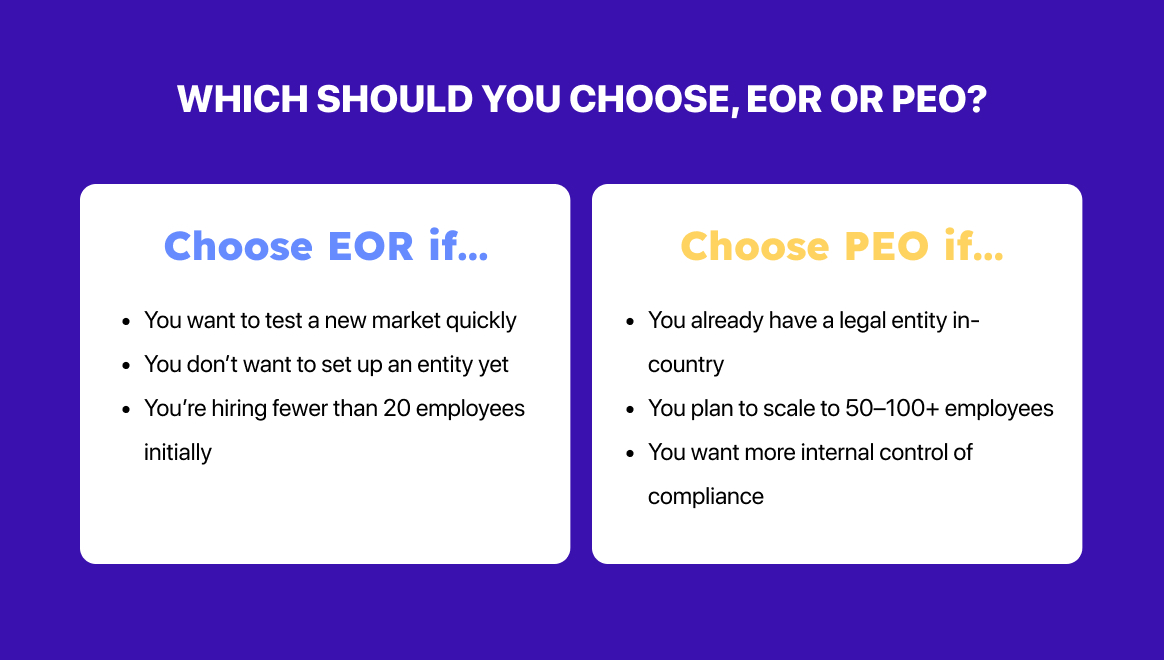
This is the decision point where most foreign founders misstep in Kazakhstan.
Not because the models are confusing.
But because they look similar from the outside and behave very differently once the state gets involved.
In Kazakhstan, the difference between a PEO and an Employer of Record is not operational.
It is a legal exposure.
Employer of Record (EOR). Full Legal Shield, Limited Control
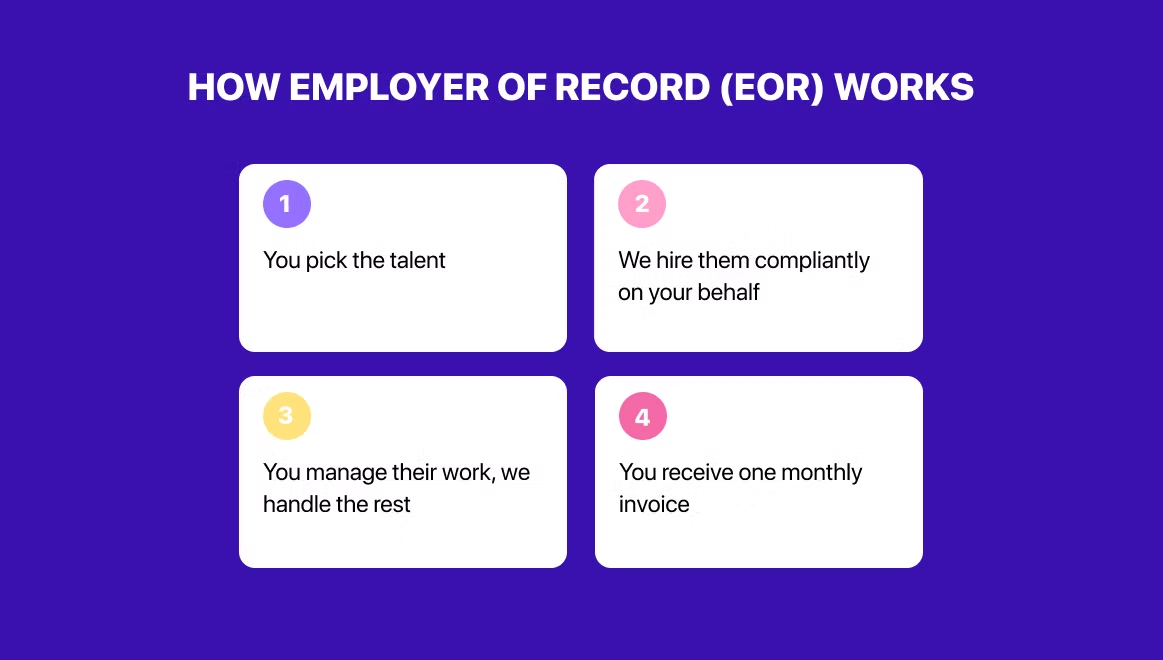
An Employer of Record in Kazakhstan is a fully compliant local company that becomes the legal employer of your team.
You do not need:
- A Kazakh legal entity
- Local tax registration
- Social fund accounts
- Labor law expertise in-house
The EOR:
- Signs employment contracts under Kazakh law
- Registers employees in ESUTD via Enbek.kz
- Runs payroll and pays all taxes and social contributions
- Manages terminations, notices, and severance
- Face inspections and penalties if something goes wrong
Your role:
- Define tasks and performance
- Manage day-to-day work
- Pay a monthly service fee
From a regulator’s perspective, you do not exist as an employer.
This is why EOR service is the lowest-risk entry model for Kazakhstan, especially for:
- First hires
- Market testing
- Small teams
- Companies without local legal capacity
You trade some control and higher per-employee cost for risk containment.
PEO (Outstaffing / Co-employment). Operational Help, Shared Liability
A PEO in Kazakhstan operates under the country’s regulated outstaffing framework.
Here is the critical distinction.
With a PEO:
- You usually already have a Kazakh LLP, branch, or permanent establishment
- The PEO employs the worker on paper and assigns them to you
- You are classified as the Host Party under labor law
The legal reality:
- The PEO is visible to authorities
- You are equally visible
- Liability is shared in theory, but often pushed back to the host company in practice
Why? Because inspectors follow substance over structure.
If:
- The employee reports to you
- Uses your systems
- Follows your internal policies
- Performs core business functions
Then, during disputes or audits, responsibility gravitates toward you.
A PEO helps with execution.
It does not insulate you.
What “Shared Risk” Actually Means in Kazakhstan
“Shared risk” sounds balanced. It is not.
In real enforcement scenarios:
- The PEO explains its calculations
- The host company explains its intent
- The fine still lands on the host company
Typical shared-risk situations:
- Salary parity violations
- Improper termination instructions from the host
- Job function mismatch between contract and reality
- Localization quota breaches
- Discrepancies between payroll data and bank transfers
Authorities do not accept “the PEO told us so” as a defense.
This is why PEOs in Kazakhstan work only when the host company already understands the law.
The "Salary Parity" Rule: The Compliance Trap in Kazakhstan
Here is a piece of "higher truth" that most global PEO providers won't tell you in their sales deck: The Salary Parity Law.
Under the Kazakh Labor Code, an outstaffed employee (the one you hire through a PEO) cannot be paid less than a direct hire doing the same job at your company.
Example: If you have a local Kazakhstani entity with a Senior Dev earning $4,000, you cannot hire a second Senior Dev through a PEO and pay them $3,000 for the same work.
The government views this as wage discrimination. If caught, the "Host Party" (you) and the "Sending Party" (the PEO) are both liable. This is why you need a partner who understands the difference between PEO and EOR in Kazakhstanfrom a local litigation perspective, not just a theoretical one.
What the Law Is Actually Trying to Prevent
Kazakhstan introduced salary parity rules to stop a specific abuse.
For years, companies were:
- Hiring core staff through outstaffing firms
- Paying them less than in-house employees
- Avoiding bonuses, raises, and protections
- Using PEOs to create a “second-class” workforce
The state responded by tying pay, benefits, and conditions to the role, not the contract type.
If two people do the same job, the law expects comparable treatment.
How Salary Parity Is Evaluated in Practice
This is where founders underestimate enforcement.
Kazakhstan does not rely on manual inspections to detect parity violations.
It relies on data.
Authorities compare across systems:
- Job titles in employment contracts (ESUTD)
- Actual functions described in internal documents
- Salary amounts reported for tax and social contributions
- Headcount and structure at the host company
If the system detects:
- Same role
- Same department
- Different pay levels
That is enough to trigger questions.
Intent does not matter. Budget constraints do not matter.
“Market rates” do not matter.
Only internal parity matters.
A Realistic Example. Where Companies Get Caught
You operate a Kazakh LLP.
You employ:
- Senior Backend Developer. $4,000 gross
- Mid-level Developer. $2,500 gross
You then hire through a PEO:
- Another Senior Backend Developer at $3,000 gross
From a business perspective, this looks normal. From a legal perspective, it is not.
The role is the same.
The responsibilities overlap.
The pay is lower.
The authorities treat this as wage discrimination.
And crucially:
- Both the Host Party (you)
- And the Sending Party (the PEO)
are exposed.
Why PEO Sales Decks Avoid This Topic
Because salary parity kills the “cheap PEO” narrative.
Many global PEO providers pitch outstaffing as:
- More flexible
- Lower cost
- Easier to scale
In Kazakhstan, that is only true if parity is maintained.
Once you align salaries:
- Cost savings shrink
- Admin complexity rises
- PEO looks less like a shortcut and more like a structural choice
This is why serious providers talk about parity early.
And unserious ones avoid it completely.
What Counts as “Pay” Under Salary Parity
Another common misunderstanding.
Parity is not limited to base salary.
Authorities look at:
- Gross salary
- Bonuses and incentives
- Allowances
- Paid leave
- Benefits in kind
- Work conditions tied to compensation
You cannot:
- Offset lower salary with “future promises.”
- Compensate informally
- Split pay into creative components to hide gaps
Digital reporting makes this visible.
Who Is Actually Liable When Things Go Wrong
In theory, liability is shared.
In practice, it often flows to the host company.
Why?
Because:
- You define job scope
- You approve salary structures
- You direct the work
- You benefit from the cost difference
The PEO may face penalties.
But the reputational and operational fallout usually lands on you.
This is why “the PEO handled it” is not a defense.
How Competent PEOs Handle Salary Parity
A high-quality PEO in Kazakhstan, like Team Up, will:
- Audit your existing payroll before onboarding
- Map job titles and responsibilities carefully
- Flag parity risks upfront
- Refuse to onboard roles that clearly violate parity
- Push back when you try to underpay
If a provider:
- Does not ask for your internal salary bands
- Does not review job descriptions
- Does not discuss parity explicitly
They are not protecting you.
They are deferring the problem.
Why This Rule Pushes Many Companies Toward EOR First
This is the uncomfortable truth.
For early-stage hiring, EOR often avoids the salary parity trap entirely.
Why?
Because:
- The EOR provider is the sole employer
- There is no internal comparison pool
- Parity is assessed within the EOR’s structure, not yours
Once your team grows and your internal pay structure stabilizes, transitioning to PEO becomes safer.
This is a sequence decision, not a model preference.
2026 Tax Reality Check: What It Actually Costs
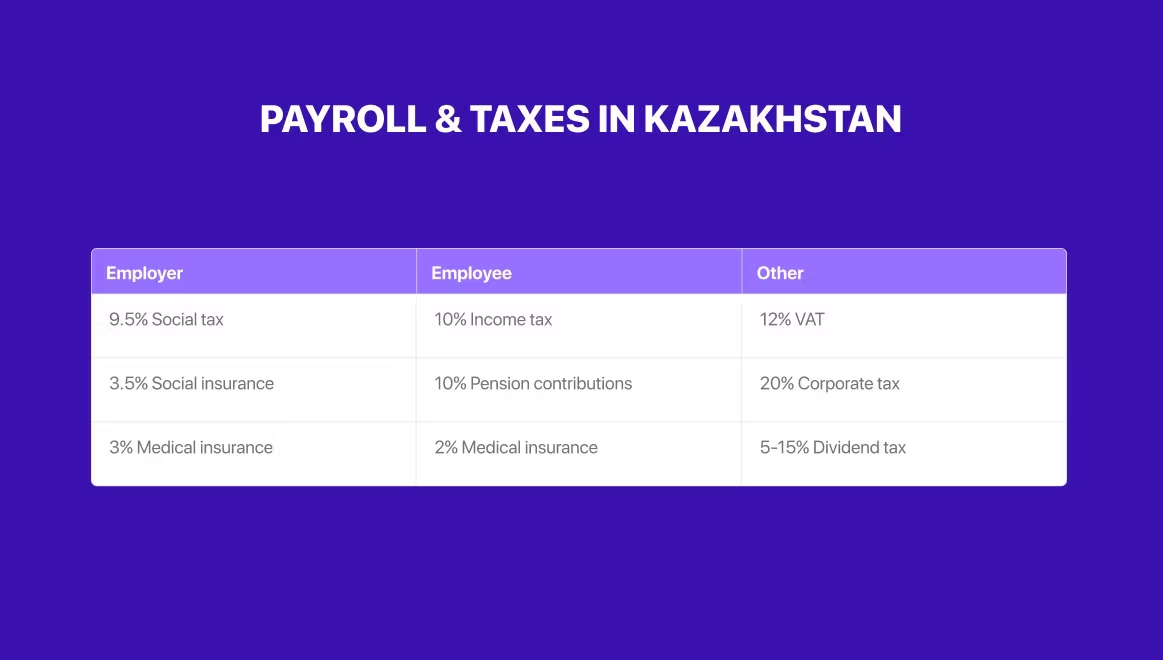
People smell BS when they see "low tax" marketing. Let’s look at the actual numbers for 2026. Hiring in Kazakhstan is relatively affordable compared to Western Europe, but the social burden is increasing.
When a PEO manages your payroll, they are calculating more than just the 10% Personal Income Tax.
| Contribution Type | 2026 Rate | Who Pays? |
| Personal Income Tax (PIT) | 10% | Withheld from Employee |
| Social Tax | 11% | Employer |
| Social Insurance | 5% | Employer (Deductible from Social Tax) |
| Pension (UAPF) | 10% | Withheld from Employee |
| Employer Pension (New) | 3.5% | Employer |
| Medical Insurance (MSHI) | 3% | Employer |
Total Employer Burden: Expect to pay roughly 17% to 21% on top of the gross salary in social taxes and contributions. If a PEO quotes you significantly less, they are likely cutting corners on insurance or misclassifying workers.
PEO Services for Small Businesses
If you’re a startup founder, you’ve likely enjoyed the "small business exemption" in Kazakhstan for a while. It felt like being a kid at a buffet, no one was checking your plate.
But as of late 2025, the rules for PEO services for small businesseshave fundamentally shifted.
Previously, small enterprises were exempt from local labor quotas. Not anymore. If your team (including your PEO hires) exceeds 20 people, you must now hit strict localization targets:
- 70% of your executives and deputies must be Kazakhstani nationals.
- 90% of your technical specialists must be Kazakhstani nationals.
A high-quality PEO doesn’t just run your payroll; they audit your headcount monthly to ensure you don’t accidentally cross that 20-person threshold without a localization plan. If they don’t mention this, they aren’t your partner; they’re just a glorified calculator.
The Number That Changes Everything. 20 Employees.
Once your total headcount exceeds 20 people, the rules change.
And yes, this includes:
- Direct hires
- PEO / outstaffed employees
- Personnel provided through third parties
Kazakhstan does not care how you structure contracts.
It cares about how many people are effectively working for you.
From that point on, localization quotas apply in full.
The Localization Requirements You Can’t Ignore
Once you cross the 20-employee threshold, you must meet the following targets:
- At least 70% of executives and deputy executives must be Kazakhstani nationals
- At least 90% of technical specialists must be Kazakhstani nationals
These are not aspirational targets.
They are compliance requirements.
Failing to meet them can lead to:
- Rejection of new work permits
- Fines
- Mandatory restructuring
- Forced termination of foreign staff
And this is where PEO users get caught.
Why PEO Hires Count Against You
Many founders assume outstaffed employees “don’t really count.”
They do.
Under Kazakhstan law, if:
- The employee works under your direction
- Performs your core business functions
- Is assigned to you as the Host Party
They are counted in your effective headcount.
It does not matter:
- Who signs the paycheck
- Whose logo is on the contract
- How the invoice is structured
From a regulatory perspective, labor is labor.
How the Trap Actually Plays Out in Real Life
This is a common scenario we see.
A startup has:
- 12 direct employees
- 6 engineers hired through a PEO
- 3 contractors are being “converted later.”
On paper, they think they have 12 staff.
In reality, the state sees 21.
Suddenly:
- Localization quotas apply
- Work permits are scrutinized
- New foreign hires get blocked
- Existing permits become harder to renew
And the founder hears about this after the threshold is crossed.
At that point, options are limited and expensive.
Why This Hits Small Businesses Harder Than Large Ones
Large companies plan localization years ahead.
Small businesses scale reactively.
The problem is that Kazakhstan’s system does not care about intent.
It does not ask:
- Are you still small?
- Are you still testing?
- Did you know?
It checks:
- Headcount
- Nationality
- Job classification
And it enforces.
What a Competent PEO Does Differently
A serious PEO in Kazakhstan understands this trap and actively works to prevent it.
That means they:
- Track total effective headcount, not just payroll numbers
- Count PEO staff and direct hires together
- Warn you before you hit 18–19 people
- Ask about the nationality mix and the role distribution
- Help you design a localization plan early
This is not “extra service”. It is basic risk management.
If a PEO only talks about:
- Payslips
- Tax rates
- Invoicing
And never mentions quotas; they are not managing your risk.
They are outsourcing it to future you.
Why “We’ll Fix It Later” Rarely Works
Once quotas apply, fixing the problem is not simple.
You cannot:
- Retroactively reclassify roles
- Instantly replace foreign specialists
- Ignore permit renewals
- Argue that outstaffed roles are “temporary.”
Authorities expect a plan before the threshold is crossed.
This is why experienced advisors push companies to:
- Start with EOR for early hires
- Scale local nationals first
- Transition to PEO only once the structure is stable
Sequence matters.
Hiring Foreigners: The New 15-Day "Patience Test."
Kazakhstan is prioritizing its own. As of September 2025, the government reinstated a mandatory domestic labor market search.
Before your PEO can apply for a work permit for that "rockstar" expat CTO, they must post the job on Enbek.KZ (the national labor exchange) for 15 calendar days.
If a qualified local candidate applies and you reject them without a watertight reason, your work permit application will likely be dead on arrival. This is where they prove their worth by navigating the "reasoning" required to justify an international hire to the local authorities.
"Enbek" and the Death of the Paper Contract
Kazakhstan is more digitally advanced than many G7 nations. The Unified Labor Contract Accounting System (ESUTD) is no longer optional. Every single labor contract, amendment, or termination must be registered digitally.
If your PEO isn’t comfortable with Enbek.kz portal, you aren’t just behind the times—you’re non-compliant. This digital paper trail is exactly how the government monitors the "Salary Parity" rule we discussed earlier. They don't need to visit your office to audit you; they just need to run a script on their database.
Red Flags: How to Spot a "War Crime" PEO
Remember the Marmite analogy.
Some PEO providers are not just bad. They are actively dangerous.
They don’t look dangerous in sales calls.
They look “flexible”, “fast”, and “solution-oriented”.
In Kazakhstan, that usually translates to non-compliant.
When you are vetting PEO service providers in Kazakhstan, these are the red flags that matter.
Not logos. Not testimonials. Not how polished their deck looks.
“We Don’t Need to Post on Enbek”
This is the biggest lie in the market.
Every legal employment relationship in Kazakhstan must be registered in the Unified Labor Contract Accounting System (ESUTD) via Enbek.kz.
That includes:
- Direct hires
- PEO / outstaffed employees
- Contract amendments
- Terminations
If a provider tells you Enbek is “optional”, “only for locals”, or “handled later”, they are setting you up for a compliance breach that is automatically detectable.
Kazakhstan does not audit first. It cross-checks databases first.
If the contract is missing from Enbek, the system already knows.
“The 3.5% Employer Pension Doesn’t Apply to Us.”
This one is subtle. And expensive.
As of 2026, the mandatory employer pension contribution of 3.5% applies to almost all standard employment arrangements.
If a PEO claims:
- They are exempt
- It doesn’t apply to outstaffed workers
- It’s “included elsewhere.”
Ask them to show you the legal basis in writing.
If they are not collecting it, you will not “save money”. You will accumulate arrears.
And arrears in Kazakhstan come with:
- Back payments
- Penalties
- Interest
- Zero sympathy from the authorities
This is one of the most common reasons companies face retroactive payroll corrections.
Generic Contracts. The Silent Liability
Kazakhstan employment contracts are not templates you translate.
They must include specific, local clauses, including:
- Working conditions
- Occupational safety responsibilities
- Equipment provision and liability
- Termination grounds aligned with the Labor Code
- Work location and reporting structure
A “standard US or EU contract” with Kazakh translation is not neutral.
It is actively wrong.
Inspectors look for substance, not formatting.
If a PEO cannot explain why certain clauses exist in Kazakh contracts, they did not draft them properly.
“We Handle Everything”. Without Asking You Anything
This sounds reassuring. It’s not.
A competent PEO in Kazakhstan asks uncomfortable questions:
- What are your internal salary bands?
- Do you have direct hires in similar roles?
- How many people work for you in total?
- What nationalities are they?
- What job titles are used internally?
Why?
Because:
- Salary parity applies
- Localization quotas apply
- Headcount thresholds apply
If a provider does not ask these questions, they are not assessing risk. They are deferring it.
No Discussion of Salary Parity
This is a huge tell.
Any serious PEO in Kazakhstan brings up salary parity early, because it kills most “cheap outstaffing” models.
If they:
- Avoid the topic
- Say it’s “rarely enforced.”
- Claim it only applies to state companies
They are either uninformed or dishonest.
Both are bad.
“We’re Basically a Staffing Agency”
This is not reassurance. It’s a warning.
Staffing agencies and PEOs are not the same under Kazakh law.
Staffing agencies:
- Source candidates
- Do not employ them long-term
- Do not manage payroll and compliance
PEOs:
- Employ workers
- Carry regulatory obligations
- Operate under personnel provision rules
If a provider blurs this line, you risk misclassification.
No Mention of Headcount Thresholds or Localization
If a PEO never asks:
- How many people do you employ today
- How fast do you plan to grow
- How many are foreign nationals
They are ignoring the 20-employee quota trigger entirely.
That is not an oversight.
That is negligence.
A real partner tracks headcount proactively and warns you before you cross thresholds.
The Consultant’s Rule of Thumb
If a PEO sounds too easy, it usually is.
In Kazakhstan:
- Compliance is structured
- Enforcement is digital
- Mistakes are traceable
- Fixes are expensive
A good PEO is conservative, slightly annoying, and obsessed with details.
A bad one sells speed and silence.
And silence is what gets companies fined.
The Verdict. Is Kazakhstan Worth the Effort?
Yes. Unequivocally. But only if you respect how the system actually works.
Kazakhstan is not a “cheap labor” market anymore.
It is a serious talent market with serious expectations on both sides of the contract.
You get:
- A deep pool of engineers, finance specialists, and operations talent
- Strong digital infrastructure
- Predictable tax rules
- A government that prefers compliance over chaos
What you don’t get is forgiveness for shortcuts.
Kazakhstan rewards companies that show up correctly.
And it punishes those who try to game the system.
Why Good Talent in Kazakhstan Cares About Structure
The top 1% of local professionals do not choose jobs based on base salary alone.
They ask about:
- Medical insurance coverage
- Social insurance contributions
- Pension payments
- Contract clarity
- Termination protections
In other words, they care whether you are a real employer or a temporary experiment.
If you want to attract and retain that level of talent, you need to understand how PEO health insurance, benefits, and workers’ compensation in Kazakhstan actually work, not just what’s legally minimum.

That’s where many foreign employers fall short.
What “Doing It Right” Actually Means Here
Doing it right in Kazakhstan is not about over-engineering.
It’s about a few core principles:
- Be honest with the tax authorities
- Register contracts properly and on time
- Pay people fairly relative to their role
- Respect salary parity and localization rules
- Choose structure based on risk, not marketing
If you follow these rules, inspections are usually routine.
If you ignore them, problems compound quietly.
Kazakhstan does not explode.
It accumulates.
And accumulated compliance debt is expensive.
The Partner Question. This Is Where It Usually Breaks
The biggest variable in your Kazakhstan expansion is not the law.
The law is written.
The variable is the partner you choose to implement it.
A good partner:
- Explains uncomfortable rules early
- Pushes back when something is risky
- Prefers slow and correct over fast and fragile
A bad one:
- Promises “flexibility”
- Avoids written explanations
- Optimizes for speed, not survivability
In Kazakhstan, “convenient workarounds” age badly.
Final Reality Check
Kazakhstan is worth the effort if:
- You want access to strong regional talent
- You are willing to play by the rules
- You choose structure deliberately
- You value long-term stability over short-term savings
If that sounds like your company, Kazakhstan can be a strategic win.
If not, the market will eventually remind you why compliance exists.
Quietly. Digitally. And expensively.
A Practical Next Step
If you’re considering hiring in Kazakhstan and still deciding between PEO and Employer of Record, the smartest move is not choosing a provider.
It’s choosing the right structure first.
At Team Up, we help founders and operators map that decision before contracts are signed and risks are locked in. Sometimes that means PEO. Sometimes EOR. Sometimes, delaying both until the setup is ready.
If you want a second set of eyes on your hiring plan. no sales pitch, no pressure. We’re happy to sanity-check it with you.
Getting the structure right early is almost always cheaper than fixing it later.
Frequently Asked Questions
1. What is a PEO in Kazakhstan?
A PEO in Kazakhstan is a company that employs workers under a regulated outstaffing model and assigns them to a host company. The PEO handles payroll, taxes, and HR administration, while the host company manages day-to-day work. Legal responsibility is shared, and in practice, often shifts toward the host company.
This model is governed by Kazakhstan’s labor and outstaffing regulations and is not informal.
2. What does PEO stand for in HR and payroll?
PEO stands for Professional Employer Organization. In Kazakhstan, this typically refers to a personnel provision or outstaffing company that acts as the formal employer for administrative purposes, while the client company directs the employee’s work.
It does not eliminate employer risk.
3. What is the difference between PEO and Employer of Record (EOR) in Kazakhstan?
The difference between PEO and EOR in Kazakhstan is legal responsibility.
With a PEO, you usually have a local entity and share compliance risk. With an EOR, the EOR becomes the legal employer and carries labor, tax, and compliance liability.
This is a risk decision, not a pricing decision.
4. Can a foreign company use a PEO in Kazakhstan without a local entity?
In practice, no.
While outstaffing is regulated, most PEO arrangements assume the client has a local presence or branch. If you do not have a legal entity and want to hire compliantly, an Employer of Record is the safer and cleaner option.
5. How does PEO payroll work in Kazakhstan?
PEO payroll in Kazakhstan includes salary calculation, personal income tax withholding, pension contributions, social tax, social insurance, and medical insurance. Payroll data must align exactly with employment contracts registered in Enbek.kz.
If contracts are wrong, payroll becomes non-compliant automatically.
6. What is the salary parity rule for PEO employees in Kazakhstan?
Under Kazakhstan labor law, an outstaffed employee hired through a PEO cannot be paid less than a direct employee performing the same role at the host company. This includes base salary and other compensation elements.
Violations are treated as wage discrimination and can trigger penalties for both the PEO and the host company.
7. Is a PEO cheaper than an EOR in Kazakhstan?
Not always.
While PEO service fees may appear lower, compliance costs, salary parity requirements, and employer social contributions often narrow the gap. For small teams or early market entry, EOR is often more cost-predictable.
8. What are the risks of using a non-compliant PEO in Kazakhstan?
Risks include:
- Retroactive tax and pension payments
- Fines for unregistered contracts
- Violations of localization quotas
- Salary parity penalties
- Rejected work permits
Kazakhstan’s digital labor systems detect inconsistencies automatically.
9. When does a PEO make sense for small businesses in Kazakhstan?
A PEO makes sense once a company:
- Has a stable local entity
- Employs a growing local workforce
- Understands labor law obligations
- Has a localization and salary structure plan
Before that stage, PEOs often create hidden compliance risk.
10. Should I choose PEO or EOR when hiring in Kazakhstan?
Choose EOR if you want minimal legal exposure and flexibility.
Choose PEO if you already operate locally and want administrative support.
If you are unsure, the safest first step is clarifying where you want legal responsibility to sit, not which model sounds cheaper.
.svg)