Guide to the top 5 trends in Employer of Record services in Kazakhstan for 2026

TL;DR:
You’re busy and expanding into a complex market. Here is the distilled strategy for using an Employer of Record (EOR) in Kazakhstan in 2026, based on the non-negotiable trends:
- The Opportunity: Kazakhstan offers a large, highly-skilled IT and engineering talent pool at a cost-effective rate. The EOR is the essential firewall against the country's bureaucratic and complex Tax Code changes.
- Compliance Shield (2026 Ready): Demand proof that your EOR's technology is pre-engineered for the 2026 progressive PIT scale and the strict new expat work permit rules. Automation is no longer a feature; it is a tax compliance shield.
- Stop Paying the Volatility Tax: Insist on the flat-rate pricing model. Percentage-based fees are volatile and penalize you for employee raises. Predictability is the new standard for managing the EOR cost in Kazakhstan.
- Expat Mobility is Core: The EOR must offer specialized expertise in managing the mandatory 15-day labor market testing process for foreign staff, guaranteeing speed and compliance for your key expat hires.
- Deep Local Expertise: Avoid generic global providers. You need a partner with deep, localized knowledge capable of interpreting the stringent Kazakh Labor Code and proactively managing complex social contributions (UAPF, OSMS).
Introduction: Why EOR Services in Kazakhstan Are Surging in 2026
Kazakhstan is no longer an ancillary market; it is strategically positioned as Central Asia’s fastest-growing hiring market. Global enterprises need access to its highly-skilled talent across critical sectors: engineering, IT, finance, and logistics. The market offers a compelling blend of technical proficiency and cost-effectiveness unmatched by many peers in the Middle East or Eastern Europe.
The challenge, however, is regulatory. Successfully entering Kazakhstan requires navigating complex tax laws, rapidly evolving labor regulations, and significant administrative bureaucracy. The traditional route—establishing a local entity (TOO/LLP), is a guaranteed path to months of delays, unnecessary capital expenditure, and immediate exposure to local legal risk.
This friction is precisely why Employer of Record (EOR) services in Kazakhstan are projected to see accelerated growth through 2026. The EOR model is the mandatory mechanism that eliminates the market entry bottleneck. It allows you to hire talent immediately, compliantly, and without the liability of forming a local legal presence.
You must view the EOR as more than a service; it is the accelerator and the compliance firewall required to capture the market's talent before your competition does.
What is an Employer of Record (EOR) and how it works in Kazakhstan
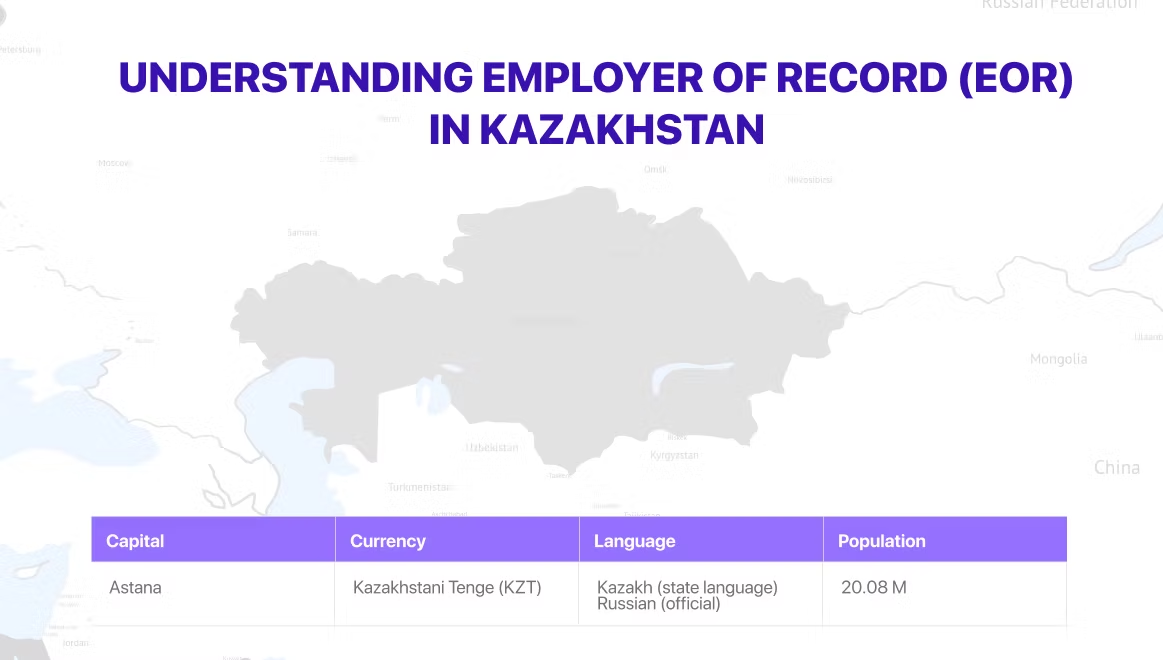
Let's be clear: when operating in Kazakhstan, the EOR is your only compliant legal presence. It is a fundamental transfer of liability that allows you to control the work while the EOR controls the risk.
An Employer of Record (EOR) is the official, registered employer of your staff on paper in Kazakhstan. The EOR's local legal entity executes the employment contract, taking on all legal obligations associated with the Kazakh labor code and tax authority.

The EOR's Critical compliance role in a changing Kazakh environment
While your company maintains full operational control, the EOR is responsible for handling the following duties, which are uniquely challenging in the Kazakh context:
| Compliance Area | EOR Responsibility in Kazakhstan | Regulatory Imperative |
| Tax & Payroll | Calculating and remitting Personal Income Tax (PIT) and contributions to the unified social tax and Mandatory Pension Fund (UAPF). | The New Tax Code (effective January 2026) introduces a progressive PIT scale (10% up to KZT 33.4M/year, 15% above), requiring immediate, precise payroll system recalibration. |
| Contract Management | Drafting legally binding, mandatory bilingual employment contracts (Kazakh or Russian). | Contracts must strictly define probation rules, working conditions, and termination clauses to adhere to the stringent Kazakh Labor Code. |
| Expat Mobility | Sponsoring Work Permit applications for foreign staff and managing required local quotas. | New rules (effective September 2025) mandate a 15-day labor market testing process before a work permit application can be filed, drastically increasing complexity and required lead time. |
| Social Security | Registering the employee and remitting all social contributions accurately and on time to the relevant state funds. | The EOR must handle the complex interplay of the social tax, social contributions, and mandatory medical insurance (OSMS) contributions. |
By outsourcing these duties to the EOR, you eliminate the single largest risk to foreign businesses: the legal requirement to set up a local entity, which is not only slow but instantly subjects you to the full scrutiny of the Kazakh tax authorities.

The top 5 Employer of Record in Kazakhstan trends to master by 2026
If you’re still thinking of an EOR as just a third-party payroll processor, you’re missing the point. In a market as volatile and rapidly changing as Kazakhstan, your EOR must be a regulatory partner built for the future. By 2026, success here hinges on these five trends.
Trend 1: Automation as a tax code compliance shield
Kazakhstan’s tax landscape is not static. It shifts frequently, and compliance relies on precision. The biggest change coming is the progressive Personal Income Tax (PIT) scale slated for introduction in 2026.
This isn't a small adjustment; it’s a complete structural overhaul of individual income taxation.
- The Problem: Traditional, manually updated payroll systems cannot adapt instantly to changes in tax brackets, contribution ceilings (like the Mandatory Pension Fund), or the unified social tax rates. This leads to costly underpayments and fines.
- The Trend: Leading EORs are pivoting to AI-driven automation designed for rapid regulatory adaptation. Their systems must instantly integrate changes from the New Tax Code into payroll calculations before the first salary run of 2026. This transforms automation from a feature into an essential compliance shield.
- Actionable Insight: Demand proof that your EOR's platform can handle the new progressive PIT scale today, not just promise an update later.
Trend 2: Work Permit Sponsorship as a Core Expertise
Accessing highly skilled foreign talent (expats) in Kazakhstan is becoming significantly more restrictive. New rules tightening the local labor market, including a strict 15-day job posting requirement and adherence to quotas, are making the work permit process a minefield.
- The Problem: The process of securing a work permit is complex, subject to local quotas, and demands perfect execution of the labor market testing process (effective late 2025). Failure means losing top talent and facing government sanctions.
- The Trend: The EOR role is shifting from passive sponsor to active global mobility expert. Companies are demanding EORs that provide end-to-end management, including handling the mandatory vacancy posting test and ensuring all documentation aligns with the Ministry of Labour's stringent requirements.
- Actionable Insight: An EOR that treats the work permit as a simple administrative task is not suitable. You need a partner that actively manages the labor market test and local quota adherence.
Trend 3: Flat-Rate Pricing Eliminates Volatility Tax
Here’s the thing about percentage-based EOR pricing in a high-growth market like Kazakhstan: it penalizes your success. As you hire highly-paid engineers or finance expats, your compliance cost skyrockets, even though the administrative work remains the same.
- The Problem: The EOR cost in Kazakhstan becomes unpredictable, making budget forecasting unreliable, especially for scaling startups and global firms placing high-value talent.
- The Trend: The market is firmly pivoting to flat-rate, transparent pricing. You pay one consistent, predictable monthly fee per employee. This eliminates the "volatility tax" and treats compliance as a manageable fixed cost.
- Actionable Insight: If an EOR proposal includes a percentage-based fee, reject it. Predictability is the new standard for efficient international finance.
Trend 4: EORs as Talent Strategy Consultants
The EOR used to just pay the bills. Now, it must help you win the talent war. Kazakhstan's competitive talent market, particularly in Almaty and Astana, demands more than statutory benefits.
- The Problem: Providing only the mandatory social contributions (like UAPF and basic medical insurance) will not attract or retain high-skilled professionals sought after in the oil & gas and fintech sectors.
- The Trend: EORs are expanding into full people operations consultation. This includes advising clients on locally competitive, enhanced benefits packages (e.g., premium private health insurance, educational stipends) and even incorporating recruitment and sourcing services to fill critical technical roles.
- Actionable Insight: Your EOR should be able to tell you exactly what benefits your competitors are offering in Astana, not just what the law requires.
Trend 5: Data Security and Digital Sovereignty
Kazakhstan maintains stringent data protection standards, especially concerning the movement and storage of citizen data. As global operations expand, the integrity of employee and payroll data is paramount.
- The Problem: General cloud storage and inconsistent security protocols expose clients to risks of data breaches and violations of local digital sovereignty rules, which carry high reputational and financial costs.
- The Trend: There is a heightened focus on EORs securing ISO-certified data systems and robust access controls. Furthermore, clients are demanding predictive compliance tools that monitor for anomalies in tax and social security filings, turning reactive problem-solving into proactive risk mitigation.
- Actionable Insight: Demand clear documentation on where your Kazakh employee data is stored, who has access, and what specific certifications guarantee its security. This is non-negotiable for modern compliance.
Why Kazakhstan should be your next expansion market

We have established that the EOR in Kazakhstan is the compliant mechanism; now, let’s solidify the strategic justification. Ignoring Kazakhstan means ignoring the strategic advantage of accessing the strongest talent pool in Central Asia, backed by aggressive government investment plans through 2028.
Strategic pillar A: The technical talent advantage
Kazakhstan offers an unmatched combination of skill, cost, and availability, particularly for companies in IT, finance, and engineering.
- Engineering Depth: Universities in Almaty and Astana are consistently producing a technically proficient, digitally fluent workforce. This talent is often globally competitive, having been trained under international standards, yet their average wages remain significantly lower than those in Western Europe or the GCC (Gulf Cooperation Council) nations.
- Multilingual Capability: Given Kazakhstan’s geopolitical position, a high percentage of the professional workforce is multilingual, often fluent in Russian, Kazakh, and English, a crucial asset for managing regional operations and international teams.
- Youth and Digital Focus: Government efforts, particularly through initiatives like the Astana International Financial Centre (AIFC) and various digital hubs, have cultivated a young, dynamic talent ecosystem focused on fintech and innovation.
Strategic Pillar B: Macroeconomic Growth and Investment
The economic trajectory is shifting focus from purely raw materials to diversified, value-added sectors, backed by significant state commitment.
- 2026–2028 Macroeconomic Plan: The government has unveiled a sweeping plan aimed at sustained growth of at least 5% annually, prioritizing technology, engineering, and petrochemicals. This signals stability and major investment in infrastructure and human capital.
- The Investment Order Program (2026): This new program aims to stimulate domestic production, attract foreign capital into manufacturing and agriculture, and reduce import dependency. Companies using an EOR to rapidly staff local projects can position themselves to benefit from the associated economic buoyancy.
- Geographic Nexus: Kazakhstan serves as a vital logistics and trading corridor between China, Russia, and Europe. This strategic access makes it an ideal regional hub for supply chain management and international distribution.
The EOR model provides the necessary structure to quickly capitalize on this strategic convergence without committing to the years of bureaucratic overhead traditionally required.

How EOR services protect companies from legal & compliance risks
The core value of an EOR in Kazakhstan is its function as a liability shield. The market’s complexity is not just an inconvenience; it is a source of severe legal and financial risk that the EOR must entirely absorb.
The dangers of misclassification in Kazakhstan
This is the single greatest risk for any foreign firm operating remotely. Kazakhstan’s courts adhere to the principle of substance over form. They examine the nature of the working relationship, not just the title on the contract.
| Risk Category | Non-Compliance Action | Potential Consequence |
| Misclassification | Hiring a full-time, integrated employee as an independent contractor (to save on social tax). | Reclassification by authorities, leading to fines, back taxes, retroactive social contributions, and employee lawsuits for benefits. |
| Contract Flaws | Using an English-only contract or failing to include specific statutory clauses on probation rules. | Contract deemed invalid under the Kazakh Labor Code, exposing the company to wrongful termination claims. |
| Termination Risk | Terminating an employee without strictly adhering to the Labor Code's grounds for dismissal (e.g., redundancy procedures). | Mandatory reinstatement of the employee, payment of back wages, and substantial court-ordered damages. |
The EOR as the Legal Firewall
An EOR manages these risks by becoming the registered legal employer (the TOO/LLP). They handle the full and ongoing compliance, from drafting mandatory bilingual employment contracts that withstand local scrutiny, to making precise, on-time PIT and social contributions remittance.
In the event of a labor court dispute or a tax authority audit, the EOR's local entity is the party held responsible, effectively insulating the foreign client company from direct liability. The EOR does not just process payroll; it shoulders the entire legal burden.

How Team Up helps you secure strategic advantages in Kazakhstan
For expansion into a complex market like Kazakhstan, the EOR must transition from compliance manager to strategic advantage generator. Team Up leverages its deep, local structure to ensure compliance is not just achieved, but optimized for cost-efficiency.
Proactive tax and social contribution management
The cost of labor in Kazakhstan is competitive, but the employer's share of contributions can be complex. We ensure you never overpay or miss a deadline.
- Managing the Unified Social Tax: We meticulously calculate and remit the combined social tax, social contributions, and mandatory medical insurance (OSMS), ensuring 100% adherence to constantly shifting base rates and ceilings.
- 2026 Tax Code Readiness: Our systems are pre-engineered for the progressive PIT scale change. We ensure your payroll remains compliant automatically from January 1, 2026, removing the largest transition risk.
- Expat Labor Market Test Support: We actively manage the new 15-day labor market testing requirement for expats, ensuring your work permit applications are legally sound and submitted without delay, securing your key talent faster.
The Team Up advantage
We eliminate the volatility risk inherent in percentage-based pricing. Our flat-rate model provides total cost clarity, a necessity for budgeting accurately in this region.
- Flat-Rate Pricing: You pay one predictable monthly fee per employee. This guarantees cost stability, allowing you to give raises or bonuses to your top IT and dev teams without seeing your EOR fee increase.
- Bilingual, Local Support: Our in-country HR managers provide direct, expert support in Kazakh and Russian, ensuring rapid response times that generic global EOR call centers cannot match.
Final Check: Do you want to pay a variable fee that penalizes your growth, or a fixed cost that guarantees your compliance?
Conclusion: Choosing the best Employer of Record services in Kazakhstan
Kazakhstan represents a powerful growth opportunity, provided you enter the market correctly. The Employer of Record model is the only structure that enables immediate, compliant hiring, turning a regulatory obstacle into a strategic advantage.
The Non-Negotiable EOR Checklist for 2026:
- Compliance Shield: The EOR must prove their technology is ready for the 2026 progressive PIT scale and the new expat work permit rules.
- Pricing Stability: Insist on the flat-rate pricing model to ensure predictable budget management and eliminate the volatility tax.
- Local Mastery: Demand a partner with deep, localized expertise capable of navigating the strict Kazakh Labor Code, not a generic global outsourcing solution.
The choice is simple: move fast, compliant, and protected, or move slow and assume all the risk yourself.
Ready to launch your team in Kazakhstan? Partner with Team Up. We provide the fixed-cost, full-compliance solution designed for immediate, protected growth in Central Asia. Book a consultation today.
Frequently asked questions (FAQ)
What makes the Employer of Record in Kazakhstan essential for compliance?
The EOR is essential because it is the legal employer, navigating the frequently changing Kazakh Labor Code and tax regulations, including the strict rules around the 2026 progressive PIT scale. This shields your foreign company from direct liability and ensures accurate, on-time submissions of the unified social tax and pension contributions.
How does the New Tax Code 2026 affect my payroll if I use an EOR?
The EOR's automated systems are responsible for adapting instantly to the New Tax Code 2026, specifically the introduction of the progressive PIT scale. This guarantees correct calculation of your employees' Personal Income Tax and ensures your company avoids penalties for underpayment during the structural transition.
What is the biggest risk of choosing an EOR with percentage-based pricing in Kazakhstan?
The biggest risk is unpredictable cost volatility. Percentage-based fees increase automatically whenever you give a raise to your high-skilled talent. The market trend is toward a flat-rate pricing model to provide budget certainty and eliminate the "volatility tax" on your growth.
How does an EOR handle the complex expat work permit rules in Kazakhstan?
A modern EOR acts as a global mobility expert. They manage the strict 15-day labor market testing process (mandatory before application) and serve as the official local sponsor, ensuring all documentation adheres to local quotas and minimizes delays in securing key foreign talent.
What is the primary difference between the Kazakh Labor Code and Western employment law?
The Kazakh Labor Code is prescriptive and favors the employee, especially regarding termination. Contracts must be bilingual (Kazakh/Russian) and adhere strictly to statutory rules on probation and severance. An EOR ensures every contract and process meets these non-negotiable local standards.
How does using an EOR protect against misclassification fines in Kazakhstan?
The EOR removes misclassification risk by issuing a full legal employment contract, establishing a clear employer-employee relationship. This prevents the Kazakh authorities from reclassifying your contractors as employees and subsequently fining you for unpaid back taxes and mandatory social contributions.
What should startups prioritize when evaluating EOR service providers in Kazakhstan?
Startups should prioritize EORs offering flat-rate pricing (for predictable scaling) and highly automated systems for speed. They should also look for partners who can advise on competitive, localized, enhanced benefits packages to attract top IT and dev teams.
How does an EOR help companies access the skilled IT and engineering talent?
Beyond compliance, EORs now act as talent strategy consultants. They advise on competitive local compensation and enhanced benefits necessary to win over the best IT and engineering talent in hubs like Almaty and Astana, effectively leveraging their local market insights.
Why is AI-driven automation a key trend for EORs in Kazakhstan?
AI is essential because it provides a compliance shield against Kazakhstan's frequently changing tax and social contribution rates. Automation ensures real-time accuracy in payroll calculations, instantly adapting to structural changes like the 2026 Tax Code to prevent costly filing errors.
What are the main employer social contributions an EOR manages in Kazakhstan?
The EOR manages the employer’s share of the unified social tax (which includes social tax and contributions) and the Mandatory Social Medical Insurance (OSMS) contributions. They ensure accurate remittance of these funds to the relevant government bodies, avoiding fines and securing employee benefits.
.svg)