What Is a PEO? Understanding Professional Employer Organizations in Azerbaijan
Introduction
If you’re searching for what is a PEO in Azerbaijan, you’re already deeper in the hiring process than most people admit. You have real candidates. Real timelines. Real pressure to “not mess this up.” And now you’re trying to decode whether PEO is the easy answer or the trapdoor disguised as convenience.
Let’s start clean.
A PEO in Azerbaijan is not a magic hiring shortcut. It’s not a way to “hire fast without dealing with compliance.” And it’s definitely not a replacement for having a legal presence in the country.
A PEO is a tool, one that works in specific conditions and fails quietly when those conditions aren’t there.
This guide explains exactly what a PEO is in Azerbaijan, how it works legally, and why most early-stage foreign companies end up choosing Employer of Record (EOR) instead. Not because EOR is trendy, but because it removes the friction PEO quietly creates.
No fluff. No generic HR definitions. Let’s get into the reality.
What Is a PEO?
A Professional Employer Organization (PEO) in Azerbaijan is a company that provides HR and payroll support to small businesses that already operate locally. The keyword here is “already.”
Because in Azerbaijan:
- A PEO does not replace your company
- A PEO does not become the employer
- A PEO does not let you hire without a legal entity
Instead, a PEO enters a co-employment relationship with your company.
That means two things happen at once:
- Your Azerbaijani entity remains the legal employer.
- The PEO handles parts of HR and payroll administration.
You still sign employment contracts.
You still hold labor law liability.
You still answer to the tax authorities if something goes wrong.
This is the part that no sales page says loudly: A PEO supports the employer. It does not protect the employer.
If you don’t have an entity in Azerbaijan, don’t try to make a PEO fit. It won’t. You’re looking for an EOR, the model designed for hiring without establishing a company.
What Does PEO Mean in HR and Payroll?
People love turning PEO into all sorts of meanings. Quick reality check.
In HR, PEO means:
- Administrative support
- Payroll processing
- Documentation consistency
- Compliance guidance
In payroll, PEO means:
- Running the numbers
- Calculating taxes
- Generating payslips
What PEO doesn’t mean, anywhere, but especially in Azerbaijan, is “taking responsibility.”
That responsibility stays with the employer, which is… your company.
A PEO organizes the work.
You own the consequences of that work.
Important distinction.
Especially in a country like Azerbaijan, where the Ministry of Labor does not treat documentation sloppily.

How a Professional Employer Organization Works in Azerbaijan
If you want to understand PEO properly, forget the marketing claims and look at the operational sequence. Because that sequence tells you exactly whether PEO fits your expansion plan.
Here’s what actually happens:
Step 1: You register a legal entity in Azerbaijan
An LLC is the most common structure. You complete tax registration, set up accounting, get banking in order, all the basics.
Without this step, PEO is off the table.
Step 2: You hire employees under your entity
Your company signs the employment contract.
Your company becomes the legal employer.
Your company takes on labor and tax compliance.
Step 3: You contract a PEO
You outsource the admin layer, not the employer layer.
A PEO can handle:
- HR paperwork
- Payroll routines
- Leave tracking
- Benefit administration
Step 4: You remain responsible for everything with legal weight
That includes:
- Employment classification
- Terminations and disputes
- Contract accuracy
- Payroll correctness
- Social insurance contributions
- Labor inspections
This is where PEO gets misunderstood.
It makes operations smoother.
It does not make you less accountable.
If something is misreported, the authorities don’t contact the PEO.
They contact the employer of record, you.
PEO vs Your Team: Who Handles What in Azerbaijan?
This is the section that usually saves founders from choosing the wrong model. Because “shared responsibility” sounds comforting until you actually map the responsibilities.
Payroll Administration
PEO handles:
- Monthly payroll processing
- Payslips
- Payroll documentation
- Standardized workflows
Your team still handles:
- Salary structures
- Bonus and incentive logic
- Contractor vs employee classification
- Data accuracy
- Any payroll errors caught by the authorities
In Azerbaijan, payroll mistakes cause more long-term compliance issues than tax rate misunderstandings. Most errors start with structure, not execution. And structure is your responsibility.

Benefits Administration
PEOs can help coordinate:
- Private health insurance
- Local perk programs
- Employee allowances
But the employer still decides:
- What benefits exist
- How they are documented
- How they affect compensation
- How they terminate
In Azerbaijan, benefit documentation influences severance rights. One poorly worded clause can turn a “perk” into an entitlement.
A PEO manages processes, not legal positioning.
Tax Filing & Compliance
PEO supports your filings.
They do not absorb tax risk.
Your company is the one that:
- Holds the tax registration
- Submits payroll data
- Gets audited
- Explains discrepancies
In Azerbaijan, the State Tax Service expects consistency. A PEO can help you process payroll, but if your internal data is off, the fines do not shift to them.
HR Management
PEOs manage HR workflows. You manage humans.
They handle:
- Documentation
- Leave tracking
- Onboarding admin
You handle:
- Performance
- Terminations
- Salary changes
- Disciplinary action
And in Azerbaijan, termination rules are very strict.
One mistake can turn an exit into a legal dispute quickly.
PEO helps smooth the system.
It does not stand between you and the consequences of HR decisions.
PEO Payroll in Azerbaijan: What It Covers and What It Doesn’t
Payroll is where people assume the most, and get burned the fastest.
PEO covers:
- Salary calculations
- Income tax and social contribution calculations
- Payslip creation
- Monthly payroll workflows
PEO does NOT cover:
- Liability for mistakes
- Misclassification cleanup
- Contract inconsistencies
- Retroactive corrections demanded by authorities
If a payment is miscategorized.
If a contract contradicts compensation.
If an employee disputes a termination.
The Ministry doesn’t ask, “Which PEO did you use?”
They ask, “Why did your company do this?”
The Legal Reality: When PEO Is Allowed in Azerbaijan
This is the rule most companies wish someone had told them earlier:
A PEO in Azerbaijan is only compliant if you already have a legal entity in the country.
That’s it.
If you are:
- Hiring your first employees
- Testing the Azerbaijan market
- Avoiding entity obligations
- Wanting to hire quickly
- Uncertain about long-term presence
Then PEO is the wrong tool.
This is exactly why Employer of Record (EOR) exists to help companies hire locally without assuming employer obligations prematurely.
PEO vs EOR in Azerbaijan
If you take nothing else from this guide, take this.
Azerbaijan does not treat employer status casually.
Either you are the employer, or you’re not.
There is no gray area where a PEO steps into your shoes.
And that is why the “PEO vs EOR” decision matters more here than in Western markets.
Let’s break down the difference with the level of detail that founders, CFOs, and HR leaders actually need.
PEO in Azerbaijan = You Are the Employer
A PEO does not change the legal relationship between you and the employee.
With a PEO:
- Your Azerbaijani entity signs the employment contract
- Your entity remits taxes
- Your entity is inspected if something seems off
- Your entity is named in disputes
- Your entity must comply with labor codes
- Your entity carries liability for payroll mistakes
The PEO supports your admin tasks.
You still shoulder all the risk.
This model works only when:
- You already operate in the country
- You understand local employment realities
- You have internal oversight for compliance
- You’re committed long-term
That is not most foreign companies entering Azerbaijan.
EOR in Azerbaijan = Team Up Is the Employer

With EOR in Azerbaijan:
- Team Up hires the employee under our Azerbaijani entity
- Team Up signs the contract
- Team Up handles payroll, taxes, social contributions
- Team Up takes on the legal risk
- Team Up owns compliance and documentation
- You focus purely on managing work
No entity.
No local payroll system.
No legal employer obligations.
No managing HR paperwork.
No risk around terminations or documentation gaps.
The entire point of EOR provider is to remove the burden that PEO assumes you can carry.
The model decision becomes obvious:
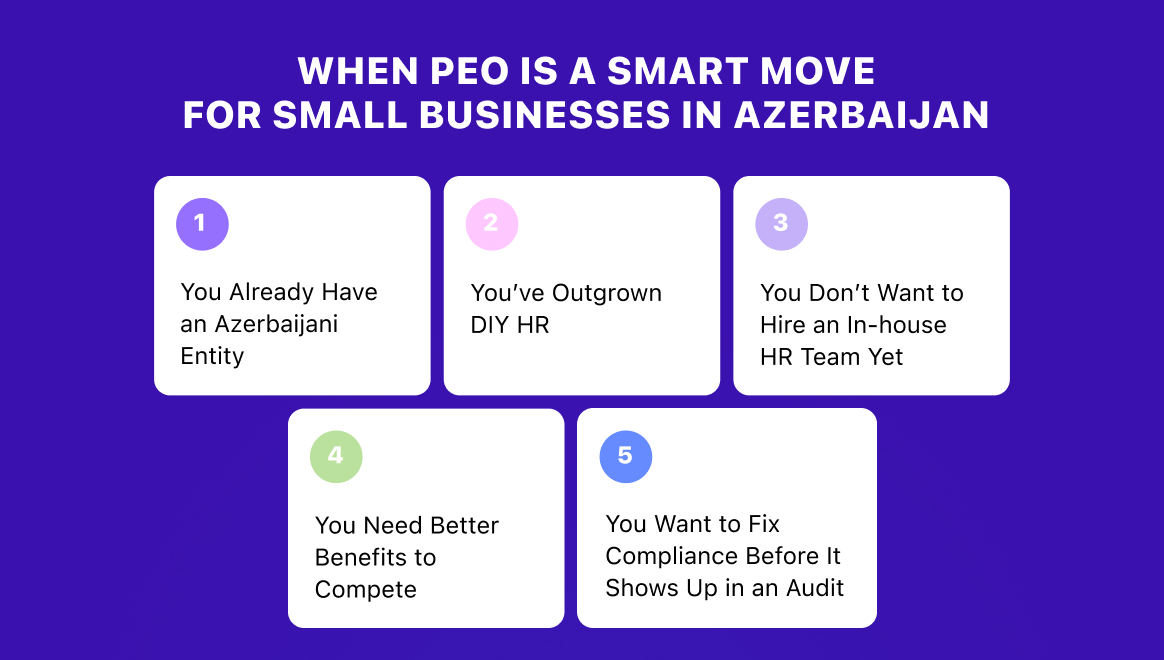
PEO is for small businesses that have already built employer infrastructure.
EOR is for small businesses that don’t want to build it prematurely.
This isn’t about cost.
It’s about risk, speed, stability, and the legal weight of being an employer in Azerbaijan.
The Real Benefits of Using a PEO in Azerbaijan (When the Fit Is Right)
We’re not anti-PEO. We’re anti-using-the-wrong-tool.
A PEO is powerful when you’re the type of company it was designed for.
If not, it’s like installing enterprise software when you truly needed a login form.
Here are the real, grounded, not-marketing benefits of PEO in Azerbaijan.
1. A PEO stabilizes your HR operations once you already have an entity
Running an entity in Azerbaijan comes with:
- Mandatory HR files
- Standard employment contracts
- Social Fund reporting
- Labor inspector documentation readiness
- Strict termination procedures
If you already operate here, those operational pieces pile up fast.
A PEO does not remove responsibility, but it creates structure that prevents chaos later.
2. A PEO reduces your internal admin burden
Founders underestimate how much time payroll consumes.
In Azerbaijan, payroll involves:
- Gross–net calculations
- Withholding accuracy
- Social contribution logic
- Currency conversions
- Payslip distribution
- Monthly submission timing
A PEO handles the repetition so your team isn’t constantly firefighting.
3. Better processes = fewer compliance mistakes
Most compliance issues aren’t caused by “breaking the law.”
They’re caused by:
- Sloppy recordkeeping
- Wrong salary categorization
- Missing signatures
- Poorly documented terminations
- Misaligned bonus structures
A PEO enforces consistency through templates and workflows.
It won’t save you from intentional shortcuts.
But it will protect you from operational negligence, the most common cause of fines.
4. Supports headcount growth
When your team grows past 10–15 employees, payroll and HR admin become full-time roles.
A PEO lets you scale without building HR internally yet.
That’s a real financial advantage for mid-stage companies.
5. Stronger employee experience
Employees in Azerbaijan value reliability.
Delayed payroll, poor onboarding, and inconsistent documentation erode trust quickly.
A PEO’s structure creates:
- Faster onboarding
- Contract consistency
- Predictable payroll cycles
- Clear leave/benefit processes
That leads to better retention, especially in competitive sectors like engineering, finance, and energy.
Misconceptions Foreign Teams Repeat About PEOs in Azerbaijan
These are the mistakes we see companies make every quarter.
Let’s remove the confusion.
“PEO lets us hire in Azerbaijan without an entity”
No.
This is not possible legally.
If a company claims otherwise, they’re describing EOR but calling it PEO.
“PEO takes responsibility for payroll compliance”
Absolutely not.
PEOs support the process.
They do not take liability.
When the tax authority has questions, they come to the employer of record, your entity.
“PEO and EOR offer the same results; EOR is just more expensive”
Incorrect.
PEO = employer is you
EOR = employer is Team Up
That one shift changes the legal, financial, and operational footprint of your entire expansion.
What looks “cheaper” in PEO is usually:
- entity setup costs
- local accounting
- internal HR oversight
- legal costs
- audit exposure
- banking compliance
- long-term maintenance
EOR collapses all of that into one predictable structure.
“We’ll start with PEO and switch later”
This only makes sense if you already have an entity and want to optimize operations.
If you don’t have an entity yet, you’re setting yourself up for:
- contract rewrites
- reclassification
- employee migrations
- payroll transitions
- legal cleanups
Most companies underestimate how disruptive that is.
EOR → PEO is smooth.
PEO → EOR is messy.
A Clean, Practical Decision Checklist (No Guessing Required)
If you're deciding between PEO and EOR services in Azerbaijan, here is the only checklist that matters.
Choose PEO if:
- You already have a legal entity in Azerbaijan
- You are committed to long-term local operations
- You want HR and payroll taken off your internal team’s workload
- You have someone internally who understands employer obligations
- You are comfortable holding legal and tax liability
Choose EOR if:
- You do not have a local entity
- You want to hire your first employees
- You want predictable compliance with zero risk exposure
- You need speed (hire in days, not weeks)
- You want to test Azerbaijan without committing to incorporation
- You don’t want to deal with entity setup, accounting, or HR infrastructure yet
If you’re not sure
EOR is almost always the safer starting point.
You can transition to PEO later, when operations justify entity ownership.
This is exactly how disciplined companies expand.
Where Team Up Fits (Without Sounding Like a Brochure)
Team Up isn’t here to “sell PEO vs EOR” like a menu.
We’re here because companies expanding into Azerbaijan don’t have time for preventable compliance mistakes.
Our role as a regional Employer of Record partner is straightforward:
- We become the legal employer for your hires in Azerbaijan
- We handle payroll, taxes, contracts, and compliance
- We remove the need for entity setup
- We carry the employer risk so you don’t hold it prematurely
- We keep operations clean so you can scale without distractions
And when the time comes, when you’ve validated the market, grown your team, and are ready for an entity, we help transition into a PEO model smoothly.
No disruption.
No legal cleanup.
No employee uncertainty.
Just a clean, stable evolution of your hiring strategy.
Because the goal isn’t to choose a model.
The goal is to expand in Azerbaijan without creating problems you’ll have to fix later.
Frequently Asked Questions
1. What is a PEO in Azerbaijan?
A PEO in Azerbaijan is a Professional Employer Organization that provides HR and payroll administration for companies that already have a local Azerbaijani entity. The PEO manages payroll and HR processes, but your company remains the legal employer and carries full compliance liability.
2. What does PEO stand for in HR?
PEO stands for Professional Employer Organization. In HR, it refers to a service partner that handles administrative employment tasks such as payroll, HR documentation, leave tracking, and benefits coordination, without becoming the employer of record.
3. Can a PEO hire employees in Azerbaijan without a local entity?
No. A PEO cannot legally hire employees in Azerbaijan unless your company already has a registered local entity. If you need to hire without opening a company, the correct model is Employer of Record (EOR).
4. What is the difference between PEO and EOR in Azerbaijan?
The difference is legal responsibility. With a PEO, your entity is the employer of record and holds all compliance risk. With an EOR, the EOR becomes the legal employer, allowing you to hire in Azerbaijan without creating a local entity and shifting compliance responsibility away from your company.
5. How does PEO payroll work in Azerbaijan?
PEO payroll in Azerbaijan involves calculating salaries, generating payslips, managing tax withholding, and supporting monthly reporting. While the PEO executes payroll operations, your company remains responsible for accuracy, classification, and compliance with Azerbaijani labor and tax law.
6. Is PEO payroll in Azerbaijan fully compliant?
PEO payroll can be compliant only if your underlying structure is correct. The PEO processes payroll, but your company is still responsible for contract accuracy, proper classification, and correct tax filings. Compliance liability does not transfer to the PEO.
7. What services do PEO companies provide in Azerbaijan?
PEO services in Azerbaijan usually include:
- Payroll processing
- Payslip preparation
- HR documentation
- Employee onboarding support
- Leave tracking
- Benefits coordination
They do not provide legal employer status or remove compliance obligations from your company.
8. Is a PEO cheaper than an Employer of Record in Azerbaijan?
Not necessarily. PEO may appear cheaper if you already have an entity and internal HR resources. But an EOR eliminates the costs of entity formation, accounting, legal oversight, and employer liability. When you factor in risk and administrative overhead, EOR is often more cost-effective for early-stage expansion.
9. When does a PEO make sense in Azerbaijan?
A PEO is the right choice when:
- You already operate a local entity
- You have long-term hiring plans in Azerbaijan
- You need structured payroll and HR operations
- You can manage employer responsibilities internally
It is not ideal for first hires, testing the market, or companies without local infrastructure.
10. Can a company switch from EOR to PEO later in Azerbaijan?
Yes. Many companies start remote hiring in Azerbaijan through an EOR and transition to a PEO once they establish a local entity. Starting with EOR ensures compliant hiring and smooth operations while you decide whether local incorporation makes sense.
.svg)