


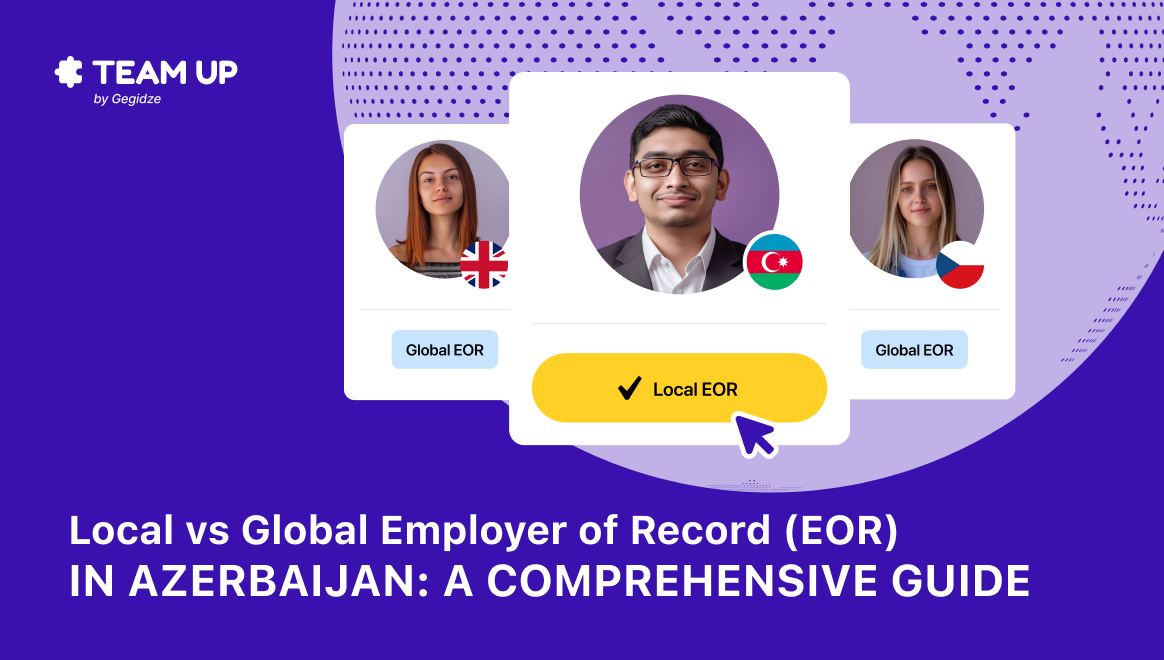
Local vs Global Employer of Record (EOR) in Azerbaijan: A Comprehensive Guide
TL;DR
In international hiring, “global” is often sold as shorthand for “simple.” In Azerbaijan, that assumption breaks fast.
When a platform claims it can hire in 180 countries, it is not actually operating in 180 countries. In Azerbaijan, it is usually coordinating a local third party through layers of software, approvals, and delayed responsibility.
That distinction matters here more than in most markets.
Azerbaijan is a digitally enforced, document-heavy, inspection-forward employment environment. Contracts are registered. Payroll is reconciled against tax systems. Terminations are procedural. Labor inspectors do not rely on explanations. They rely on records.
Choosing between a local and a global Employer of Record in Azerbaijan is not an operational preference. It is a decision about who carries legal exposure when the system flags something.
This guide explains how both models actually behave in Azerbaijan in 2026, where costs hide, how terminations and inspections work in practice, and how to choose without guessing.
Quick navigation
- TL;DR
- Employer of Record in Azerbaijan. What it really means
- Why companies hire in Azerbaijan. And where they misread it
- Local vs Global Employer of Record in Azerbaijan. How the models really work
- Local vs Global EOR in Azerbaijan: Navigating a "Zero-Trust" Legal System
- The 2026 Payroll Pivot: Navigating Azerbaijan's New Progressive Tax
- Terminations and labor inspections in Azerbaijan. A practical playbook
- Decision matrix. Local vs Global EOR for Baku hiring
- Building a Compliance Shield in Baku: The Team Up Advantage
- Summing Up: Don't Be a Tourist in a Strict Market
- Frequently Asked Questions
Employer of Record in Azerbaijan. What it really means
An Employer of Record in Azerbaijan is not a payroll vendor. It is a legal employer operating inside the Azerbaijani labor and tax system.
When you hire through an EOR in Azerbaijan:
- The EOR becomes the official employer under Azerbaijani law
- The employment relationship is registered and traceable
- Payroll, taxes, and social contributions are filed locally
- Compliance failures attach to the legal employer, not the UI
You control the work. The EOR controls the legal exposure.
That distinction is not theoretical. In Azerbaijan, employment relationships are visible to the state in ways many founders underestimate.

Why companies hire in Azerbaijan. And where they misread it
Azerbaijan attracts international teams for real reasons.
Why hiring in Azerbaijan makes sense
- Strong engineering and technical talent pool in Baku
- Competitive salary levels compared to Eastern Europe
- Time zone overlap with Europe and MENA
- Growing tech and energy-adjacent digital talent
- Government investment in digital infrastructure
Where teams misjudge Azerbaijan is tone.
Azerbaijan is business-friendly, but it is not casual. Employment compliance here is structured, procedural, and monitored. The country has invested heavily in e-government systems, and employment data flows through them.
The risk is not aggressive enforcement.
The risk is automated detection plus procedural penalties.

Local vs Global Employer of Record in Azerbaijan. How the models really work
The global EOR model in Azerbaijan
Global EOR platforms optimize for coverage.
What they offer:
- One master agreement
- One dashboard
- Consolidated reporting
- Standard onboarding flows
In Azerbaijan, this usually means:
- Contracts drafted off-platform, then registered later
- Payroll logic configured centrally with local overrides
- Employment execution handled by a local partner
This model can work for:
- One-off hires
- Short-term experiments
- Situations where Azerbaijan is not strategic
Where it struggles is accountability.
When something breaks, responsibility is split between:
- The platform
- The local partner
- The payroll processor
You are left coordinating the coordination.
The local EOR model in Azerbaijan
Local EORs are built around direct execution.
How they operate:
- Employment through a locally owned Azerbaijani entity
- Contracts drafted and executed for local enforcement
- Payroll and tax filings handled in-country
- Direct interaction with authorities when needed
There is no abstraction layer.
When payroll needs correction, it is corrected locally.
When an inspector asks questions, the legal employer answers.
When a termination is challenged, documentation is already in place.
This matters more in Azerbaijan than in most markets.
Local vs Global EOR in Azerbaijan: Navigating a "Zero-Trust" Legal System
Azerbaijan operates under a civil law system that is notoriously rigid, highly formalized, and increasingly digitized. In 2026, the Azerbaijani government doubled down on its "Zero-Trust" approach to labor relations. For international companies, this means that a "close enough" approach to compliance is a fast track to a flagged filing, a compliance visit, or a bank transfer delay when the paperwork does not match the system.
If you are choosing between a Local and Global EOR, you aren't just choosing a service provider; you are choosing how much legal liability you are willing to outsource. Here is what the strictness of the Azerbaijani system means for both models.

1. The "E-Gov" Fortress: The Electronic Information System (EIS)
In Azerbaijan, an employment contract does not exist in the eyes of the law until it is registered in the Ministry of Labour and Social Protection’s electronic portal (e-social.az).
- The Strictness: An employee cannot legally step into your office (or log onto your Slack) until their contract is digitally registered and a notification is received. Working without this is classified as "illegal labor," carrying heavy fines per employee.
- The Global EOR Reality: Most global aggregators do not have direct access to the e-social.az portal. They rely on a local subcontractor to do the filing. This creates a dangerous "lag time." If the global platform says "hired" but the local partner hasn't hit "submit" on the state portal, you are technically breaking the law.
- The Local EOR Advantage: We live inside the EIS portal. Local EORs like Team Up ensure that the digital registration happens in real-time, providing you with the official state notification number before the employee starts their first task.
2. The Language Mandate: Azerbaijani or Nothing
According to the Labor Code of the Republic of Azerbaijan, all employment documentation must be in the state language (Azerbaijani).
- The Strictness: While you can have a "side-by-side" English translation, the Azerbaijani version is the only one that holds weight in a court of law or during a State Tax Service audit. If there is a discrepancy, the local version wins.
- The Global EOR Reality: Global platforms often use English-first templates with "generic" translations. These frequently fail to use the precise legal terminology required by Azerbaijani judges, making your IP protection or termination clauses potentially unenforceable.
- The Local EOR Advantage: We provide ironclad, legally vetted bilingual contracts. We ensure that the Azerbaijani legal nuances—especially regarding Intellectual Property (IP) transfer- are airtight and local-court-proof.
3. Advantages of Utilizing Local Employer of Record (EOR) Services
In a strict system, proximity to the regulator is your greatest shield.
- Direct Entity Accountability: Local EORs own their Azerbaijani legal entity. When the State Labor Inspectorate conducts an audit, we are the ones standing in the room. There is no "middleman" to hide behind.
- IT-Specialized Status: As of 2026, many local EORs (including Team Up) operate under specialized statuses that allow for significant social insurance discounts and 0% profit tax for tech activities. We pass these savings directly to you.
- Document Management: From "Labor Books" (which are now digital but still require manual oversight) to mandatory health check-up records, a local EOR manages the physical and digital trail that Azerbaijan's strict bureaucracy demands.
4. Advantages of Global EOR Services
Global platforms are built for broad, low-stakes coverage.
- Centralized Reporting: If you have one hire in Baku and 50 in London, a global UI makes your consolidated reporting easier.
- Vendor Consolidation: It simplifies your procurement if you only want to manage one contract for 10+ countries.
- Standardized Onboarding: They offer a "one-click" experience that feels modern, even if the "back-end" compliance in strict markets like Azerbaijan is often outsourced.
5. The Strategic Pivot: Payroll & The "2026 Progressive Tax"
Azerbaijan’s strictness extends to its banking. All salaries must be paid in Azerbaijani Manat (AZN) via local bank transfer.
- The Trap: As of January 1, 2026, the transition to progressive income tax (3%, 10%, 14%) has created a math problem that many global platforms haven't solved.
- The Risk: If your global EOR uses a flat 0% or 14% rate because they haven't updated their "Azerbaijan module," you will face an audit from the State Tax Service within 90 days. In Azerbaijan, tax errors are not just settled with a check; they often involve the freezing of local bank accounts
.
Decision Matrix: The Operator’s Choice
| Fact | Local EOR (Team Up) | Global EOR Platform |
| Legal Liability | We are the legal employer in Baku | They are an "aggregator" of partners |
| EIS Portal Access | Direct and Instant | Indirect and Delayed |
| 2026 Tax Rates | Automatically Applied | Often "Global Template" Estimates |
| IP Protection | Local-Court Enforceable | Jurisdictional Ambiguity |
| Cost | Flat Fee (€199/mo) | High Fee or % of Salary |
Don't be a tourist in a strict market
Azerbaijan is a "High-Trust, High-Verify" environment. The government welcomes your investment, but they expect you to respect the code. Choosing a local specialist like Team Up means you are building a foundation on local expertise, not a global "proxy."
Ready to build a compliant, cost-effective team in Baku without the "Global" markup?

The 2026 Payroll Pivot: Navigating Azerbaijan's New Progressive Tax
For seven years, remote hiring in Azerbaijan’s private sector felt like a tax-free honeymoon. But as of January 1, 2026, that holiday is officially over. The expiry of the 0% income tax incentive for non-oil/gas sector employees has triggered the most significant payroll transformation in a decade.
If your EOR partner is still using 2025 calculators, your company is effectively "tax-blind." In a strict legal system like Baku’s, ignorance of these new rates isn't just an oversight; it’s a liability that the State Tax Service (STS) will resolve through automated audits and frozen accounts.
1. The 2026 Progressive Income Tax (PIT) Schedule
Azerbaijan has moved away from the 0% flat rate to a tiered, progressive model. This structure is designed to be a "soft landing" before rates increase further in 2027 and 2028.
| Monthly Gross Income (AZN) | 2026 Tax Calculation |
| Up to 2,500 | 3% of gross salary |
| 2,501 – 8,000 | 75 AZN + 10% of the amount exceeding 2,500 |
| Above 8,000 | 625 AZN + 14% of the amount exceeding 8,000 |
Operator’s Note: The 3% bracket is a transitional gift. In 2027, this jumps to 5%, and in 2028, it hits 7%. A local EOR factors this "tax creep" into your three-year budget projections, whereas a global platform's generic quote often ignores these upcoming escalations.
2. Social & Medical Insurance: The 2026 "High-Earner" Relief
To balance the reintroduction of income tax, the government has introduced some relief for high-income talent, specifically for salaries exceeding 8,000 AZN.
- Social Insurance (SSPF): While wages up to 8,000 AZN remain subject to the standard 10% (employee) and 15% (employer) rates on the portion over 200 AZN, the combined rate for the portion above 8,000 AZN has dropped from 25% to 21%.
- Mandatory Health Insurance (MHI): In a massive win for high-earning tech talent, the contribution on amounts above 2,500 AZN has been slashed from 4% to 1% (split evenly between employer and employee).
3. The 16-Day Rule: Banking & Disbursement
Azerbaijan’s Labor Code is rigid about how and when people get paid.
- Bi-Monthly Payments: Technically, the law requires salaries to be paid in two installments (advance and final) with an interval not exceeding 16 days.
- Currency Mandate: Every Qapik must be paid in Azerbaijani Manat (AZN) via a local bank. Paying in USD or EUR to an offshore account is a violation that global EORs often overlook until a local bank blocks the transfer.
4. Why Global EORs are "Failing" the 2026 Audit
The biggest risk with global platforms in Baku right now is Registration Lag. Because Azerbaijan uses the Electronic Information System (EIS), every salary change, even a 1% cost-of-living adjustment, must be registered in the state portal before the bank transfer is made.
Global aggregators, who often lack direct login access to the e-social.az portal creates a mismatch between what the bank pays and what the state sees. In the 2026 era of Horizontal Monitoring, this mismatch triggers an automatic STS investigation.
Pricing behavior in Azerbaijan in 2026. What you really pay
This is where most companies miscalculate.
Local EOR pricing in Azerbaijan
Local EORs price based on actual execution cost.
Typical structure:
- Flat monthly fee per employee
- Pricing aligned with the Azerbaijani payroll and compliance efforts
- No percentage-of-salary markup
Typical range:
- €199 to €450 per employee per month, depending on scope
What’s usually included:
- Legal employment under a local entity
- Payroll processing and filings
- Contract management and amendments
- Ongoing compliance support
The key feature is predictability.
If salaries increase, EOR fees stay flat.
Global EOR pricing in Azerbaijan
Global platforms' price for reach.
Typical structure:
- $599+ per employee per month
- Or a percentage of salary
- Add-ons for local adjustments, terminations, or changes
The problem is not the headline price.It’s how pricing behaves as you scale.
As salaries rise:
- Percentage-based fees rise with no added work
- Flat global fees ignore local simplicity
Azerbaijan is not a high-complexity payroll market. Global pricing treats it like one.

Cost behavior over time. A simple example
One employee in Baku.
Local EOR
- €300/month
- €3,600/year
- Flat
Global EOR
- $650/month
- $7,800/year
- Often plus add-ons
Multiply by 5 hires. Then 10.
This is why Azerbaijan is often the market where CFOs start asking harder questions.
Terminations and labor inspections in Azerbaijan. A practical playbook
This is where EOR quality is revealed.
Terminations in Azerbaijan
Azerbaijan’s Labor Code is protective and procedural.
Key realities:
- Terminations require valid legal grounds
- Documentation matters more than intent
- Notice periods and severance rules must be followed exactly
Common termination grounds:
- Redundancy
- Performance issues (documented)
- Contract expiration
- Mutual agreement
What goes wrong:
- Missing warnings
- Incorrect notice periods
- Poorly documented cause
Local EORs build termination documentation before it’s needed. Global EORs often react after the fact.
Labor inspections in Azerbaijan
Inspections are not rare. They are structured.
Inspectors typically review:
- Employment contracts
- Payroll records
- Tax filings
- Working hours compliance
- Termination documentation
What inspectors do not accept:
- “The platform handles it”
- Missing records
- Retroactive fixes
If your EOR cannot produce documents immediately, the problem becomes yours.
Decision matrix. Local vs Global EOR for Baku hiring
| Decision factor | Local EOR | Global EOR |
| Speed to first hire | Fast | Fast |
| Scaling beyond 2–3 hires | Strong | Weak |
| Payroll accuracy | High | Variable |
| Pricing predictability | High | Low |
| Termination handling | Direct | Partner-based |
| Inspection readiness | Strong | Mixed |
| Accountability | Clear | Fragmented |
How to choose like an operator
Choose a global EOR if:
- You are hiring one person only
- Azerbaijan is not strategic
- Speed matters more than depth
Choose a local EOR if:
- You are building a team in Baku
- You expect growth, changes, or exits
- You want predictable cost and clean compliance
The biggest mistake is choosing a global model for a local problem.
Building a Compliance Shield in Baku: The Team Up Advantage
In Azerbaijan’s "Zero-Trust" legal environment, compliance isn't a one-time setup; it’s an ongoing defensive posture. As we have seen, the 2026 landscape marked by the Progressive Tax Pivot, the "mygov.az" digital mandate, and the newly enforced Remote Work legal definitions leaves no room for "proxy" employment or generic global templates.
This is where the distinction between an aggregator and an operator becomes critical. Team Up doesn't just provide a dashboard; we provide the local legal infrastructure that acts as your shield in Baku.
1. The "Local First" Infrastructure
While global platforms "rent" their compliance from third-party partners, Team Up owns its Azerbaijani entity. This means:
- Direct Access to the EIS Portal: We register your employees on the state's Electronic Information System (EIS) instantly. There is no middleman lag that could trigger "illegal labor" fines (which in 2026 can reach up to 10,000 AZN per unregistered worker).
- Bilingual Legal Depth: Our contracts aren't just translated; they are architected in Azerbaijani and English to meet the strict linguistic requirements of the Ministry of Labour while protecting your global IP standards.
2. Strategic Tech Sector Incentives
Azerbaijan is hungry for tech talent, and the government has created a "walled garden" of incentives for the industry.
- IT Tech Park Passive Benefits: We help our clients navigate the 0% Profit Tax and reduced social security burdens available to certified IT projects.
- The 2026 Progressive Shield: We manage the tiered withholding (3%, 10%, 14%) automatically, ensuring that your high-earning developers don't wake up to a "tax shock" because a global platform forgot to update its 2025 logic.
3. The "Boots on the Ground" Employee Experience
In Baku, culture is built on trust. When an employee has a question about their Mandatory Medical Insurance (MHI) or their 21-day statutory leave accrual, they shouldn't be talking to a bot in a different time zone.
- Physical Presence: We handle the local equipment procurement, the mandatory medical check-ups, and the digital signature (ASAN Imza) setups that global platforms simply cannot do from afar.
- Termination Support: Azerbaijan's Labor Code is notoriously protective. We manage the delicate "notice and severance" requirements—protecting you from the 3-month salary payouts often mandated by local courts for incorrect dismissals.
Summing Up: Don't Be a Tourist in a Strict Market
The Azerbaijan of 2026 is a "High-Verify" market. The rewards for building a team in Baku are massive: access to the Caspian tech corridor, a 3% starting tax rate, and a highly skilled, loyal workforce. But the entry price is surgical compliance.
Choosing Team Up means moving past the "travel agent" model of global expansion. We don't just book your employees a "room" in Baku; we build the house they work in, ensuring it's fully compliant, cost-optimized, and legally airtight.
Stop Guessing. Build with a Local Operator.
The 2026 progressive tax rates are already in effect. Whether you are migrating a legacy team from a global platform or hiring your first Baku-based lead, do it with the team that actually owns the infrastructure.
Frequently Asked Questions
Is Azerbaijan’s income tax holiday still in effect?
No. As of January 1, 2026, the seven-year income tax holiday for the private non-oil sector has expired. It has been replaced by a progressive tax schedule (3% up to 2,500 AZN; 10% for the next bracket; and 14% for income above 8,000 AZN). While the initial 3% rate is low, it is scheduled to increase annually, reaching 7% by 2028.
What is the "E-Gov" registration requirement for new hires?
Azerbaijan uses a strict Electronic Information System (EIS) managed by the Ministry of Labour (e-social.az). An employment contract is not legally valid until the employer registers it in this portal and receives a digital notification. Global EORs often face "registration lag" because they lack direct portal access, which can technically result in "illegal labor" fines for your company.
Can I hire remote workers in Azerbaijan legally?
Yes. In a landmark January 2026 amendment to the Labor Code, Azerbaijan officially codified "Remote (Distant) Work." This allows employees to perform functions using electronic means outside the employer's premises. However, remote conditions must be specifically detailed in the bilingual employment contract and registered in the state portal to be valid.
How does the mandatory health insurance (MHI) work in 2026?
As of 2026, MHI rates are tiered:
- For income up to 2,500 AZN: 2% from the employee and 2% from the employer.
- For the portion above 2,500 AZN: The rate drops to 0.5% for both parties. This "high-earner relief" makes Azerbaijan particularly attractive for senior tech talent.
What are the mandatory notice periods for termination?
Termination in Azerbaijan is highly regulated by tenure:
- Less than 1 year: 2 weeks' notice.
- 1 to 5 years: 4 weeks' notice.
- 5 to 10 years: 6 weeks' notice.
- More than 10 years: 9 weeks' notice.Additionally, statutory severance pay (often 1.0x to 2.0x average monthly salary) is mandatory for redundancies or company liquidations.
Are there specific leaves for fathers and families in 2026?
Yes. The 2026 amendments introduced 14 calendar days of paid paternity leave for men upon the birth of a child. Furthermore, the concept of an "Employee with Family Responsibilities" now provides legal protection and flexibility for those caring for sick relatives, ensuring they are not discriminated against in shift scheduling.
Why is a Local EOR better for "Horizontal Monitoring"?
The Azerbaijani State Tax Service (STS) launched Horizontal Monitoring in 2026—a real-time, cooperative compliance program. Local EORs like Team Up participate directly in this program, sharing real-time data with the state to resolve tax positions instantly. Global aggregators typically lack the local entity substance to join this program, leaving them vulnerable to traditional, retrospective audits.
.svg)


