Payroll Outsourcing in Portugal: How It Works, What It Covers, and When to Use It

Our guide to EOR vs payroll outsourcing in Portugal compared both models at a structural level. This article goes deeper into payroll outsourcing alone. It covers what the service includes in a Portuguese context, what statutory obligations a provider handles on your behalf, and where the model reaches its limits.
Portugal layers payroll with social security contributions, withholding tax brackets, meal allowances, and holiday pay rules that foreign employers rarely encounter at home. A payroll outsourcing provider processes those calculations and filings. You keep the legal employer status. That distinction shapes everything: liability, contract ownership, and regulatory exposure all stay with you.

How Payroll Outsourcing Works in Portugal
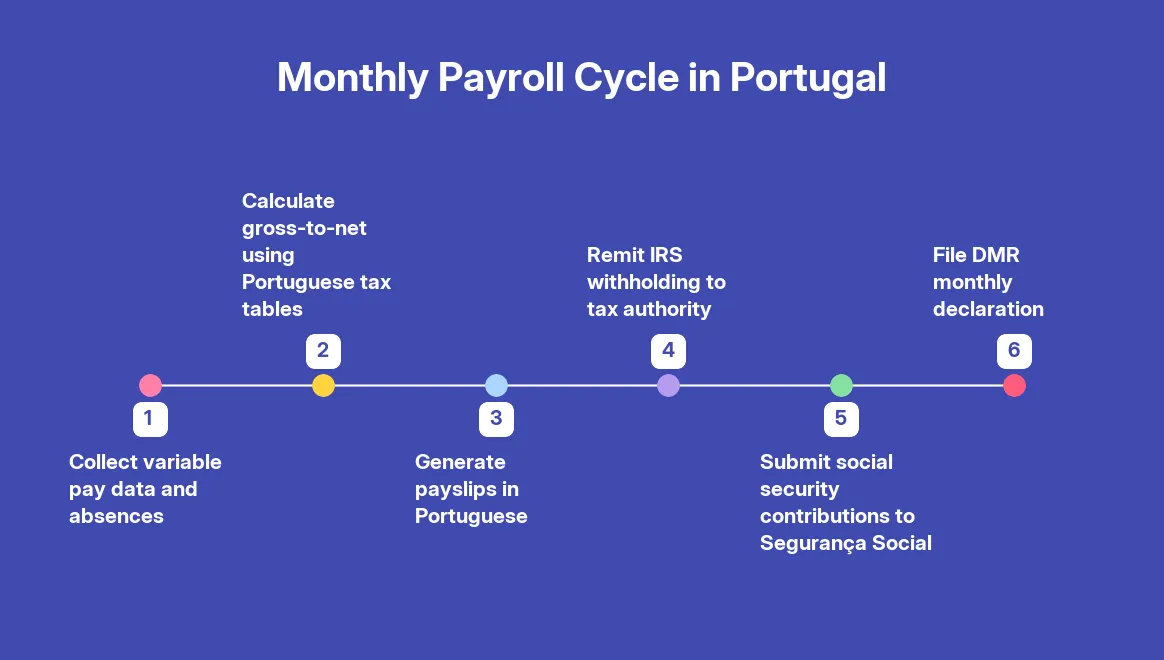
Payroll outsourcing in Portugal delegates the mechanical side of employment administration to a third party. Your company remains the employer. The provider calculates gross-to-net pay, withholds taxes, remits social security contributions, and files monthly declarations.
The Operating Model
You supply headcount data, salary figures, and any variable compensation each cycle. The provider runs payroll against Portuguese tax tables and contribution schedules. Outputs include payslips in Portuguese, bank payment files, and statutory filings to the Autoridade Tributária e Aduaneira (the Portuguese tax authority) and Segurança Social.
This model requires you to already have a legal entity registered in Portugal. Without one, you cannot hold employment contracts or register employees with social security. Companies that lack an entity need an employer of record in Portugal instead.
What You Retain
Contractual authority stays with you. You draft employment agreements, set compensation, manage performance, and handle termination. The provider never becomes the legal employer. That separation matters because Portuguese labor courts look at who holds the contract when disputes arise.
A London-based fintech with a Lisbon office of 12 engineers used payroll outsourcing for its first two years of operation. The company owned the Portuguese entity and managed HR directly. The provider handled payslip generation, tax withholding, and monthly Segurança Social declarations. When the team grew to 25, the company brought payroll in-house. The transition took roughly six weeks.
Portuguese Payroll Obligations Your Provider Must Handle
Portugal's payroll framework involves more statutory layers than most Western European countries. A provider that only calculates net pay and issues bank transfers misses critical compliance steps.
Tax Withholding: IRS and Surcharges
Portuguese employers withhold Imposto sobre o Rendimento das Pessoas Singulares (IRS) from each employee's salary. The withholding tables are published annually by the tax authority and vary by marital status, number of dependents, and income bracket. Your provider must apply the correct table each January when new rates take effect.
Employees can also request adjustments to their withholding rate. The provider must track these individual elections and apply them accurately each month.
Social Security Contributions
The employer contribution rate to Segurança Social sits at 23.75% of gross salary. Employees contribute 11%. These rates have been stable structural features of the Portuguese system. Your provider remits the combined amount by the 20th of the following month.
Certain contract types carry different rates. Fixed-term contracts, for instance, attract a higher employer surcharge. First-employment contracts for young workers may qualify for temporary reductions. A competent provider flags these variations automatically.
Holiday Pay and Christmas Allowance
Portuguese law entitles employees to subsídio de férias (holiday allowance) and subsídio de Natal (Christmas allowance). Each equals one month's base salary. These are not discretionary bonuses. They are statutory payments.
Holiday allowance must be paid before the employee's vacation period begins. Christmas allowance is due by December. Some employers split both into 12 monthly installments, but this requires the employee's written agreement.
Meal Allowance Treatment
The subsídio de alimentação (meal allowance) receives favorable tax treatment up to a threshold set annually by the government. Amounts paid via meal card enjoy a higher tax-exempt ceiling than cash payments. Your provider must track the payment method and apply the correct exemption.
The cost structure and trade-offs of each model differ significantly once you factor in these statutory extras that sit outside base salary.
When Payroll Outsourcing Fits and When It Falls Short
Payroll outsourcing is not a universal solution. It fits certain company profiles well and creates gaps for others.
Strong Fit Scenarios
Companies with an existing Portuguese entity and a stable local team benefit most. The entity handles legal compliance. The provider handles arithmetic and filings. This split works cleanly when your HR team understands Portuguese labor law well enough to manage contracts, benefits, and terminations.
A German e-commerce company with a Porto warehouse of 40 staff outsourced payroll from day one. The company's in-house HR team in Berlin managed contracts and employee relations. The Portuguese payroll provider processed monthly runs, filed social security returns, and generated annual tax certificates. The arrangement worked because Berlin had enough labor law knowledge to own the compliance decisions.
Where It Falls Short
| Scenario | Payroll Outsourcing | EOR |
|---|---|---|
| No Portuguese entity | Cannot operate | Provides legal employer |
| First hire in Portugal | Entity setup takes months | Hire within days |
| Work permit sponsorship | You sponsor directly | EOR sponsors as employer |
| Employment contract drafting | Your responsibility | EOR drafts and owns |
| Termination compliance | You manage | EOR manages |
| Ongoing HR advisory | Usually not included | Typically included |
Companies hiring their first Portuguese employee face a timing problem. Entity registration, tax authority enrollment, and social security setup take three to nine months. Payroll outsourcing cannot begin until that process completes.
Foreign employers unfamiliar with Portuguese termination rules face a different risk. Portugal's labor code restricts dismissal grounds and mandates specific severance calculations. A payroll provider processes the final paycheck. It does not advise you on whether your termination is legally defensible.
For companies needing employee benefits guidance alongside payroll, an EOR or a PEO model provides more comprehensive coverage. A standalone payroll services provider handles the numbers but not the strategy.
Choosing a Provider: What to Evaluate

Not all Portuguese payroll providers offer the same depth. The market ranges from solo accountants to multinational outsourcing firms.
Compliance Depth
Ask whether the provider handles only monthly payroll runs or also manages annual obligations. These include the Modelo 10 annual income declaration, the Relatório Único (a comprehensive annual labor report), and individual IRS certificates for employees. Some providers treat these as add-on services at additional cost.
Technology and Reporting
Modern providers offer portal access where you can view payslips, download reports, and track contribution payments. Legacy providers still operate via email and spreadsheet. The technology gap matters when your finance team in another country needs real-time visibility into Portuguese payroll costs.
Scalability and Local Knowledge
A provider handling 5 employees and a provider handling 500 operate differently. Ask for client references in your industry and headcount range. Portuguese payroll has sector-specific nuances. Construction, hospitality, and technology each carry different collective bargaining agreements that affect minimum pay, overtime rules, and benefit entitlements.
Watch out: Some Portuguese payroll providers do not hold professional liability insurance. If a filing error triggers penalties from the tax authority or Segurança Social, you bear the cost unless your contract explicitly assigns liability to the provider.

FAQs
Can a payroll outsourcing provider handle Portuguese independent contractor payments?
Contractor payments in Portugal follow different tax rules than employee payroll. Contractors issue recibos verdes (green receipts) and handle their own IRS and social security obligations. A payroll provider can process your payment to the contractor, but the withholding and compliance sit with the contractor. Misclassifying an employee as a contractor triggers back-payments of social security contributions plus penalties from ACT, the Portuguese labor inspectorate.
What happens if the payroll provider misses a Segurança Social filing deadline?
Late social security submissions attract interest charges calculated daily from the deadline. The liability falls on your Portuguese entity, not on the provider, unless your service agreement includes an indemnification clause. Most standard payroll outsourcing contracts in Portugal cap the provider's liability at the annual service fee. Review the liability cap before signing. Some providers offer penalty insurance as an add-on.
Does payroll outsourcing cover Portuguese employee stock option reporting?
Stock option exercises and RSU vestings create taxable events under Portuguese IRS rules. Most payroll providers can include these amounts in the monthly payroll calculation if you supply the data. The complexity arises with cross-border equity plans where the grant, vesting, and exercise occur across different tax jurisdictions. In those cases, you may need a separate tax advisor alongside your payroll provider.
How do Portuguese payroll providers handle mid-month hires or terminations?
Portuguese labor law requires pro-rata calculation for partial months. The provider divides the monthly salary by 22 working days (or 30 calendar days, depending on the contract) and pays only for days worked. Holiday and Christmas allowances also accrue proportionally from the start date. Termination pay requires a separate final settlement calculation including accrued but untaken vacation days. Confirm that your provider's system handles partial-month scenarios without manual overrides.
What to Watch Next
Portuguese payroll rules shift each January when new IRS withholding tables and social security thresholds take effect. The government also periodically adjusts meal allowance exemption ceilings and minimum wage levels. Build a calendar that flags December for reviewing upcoming changes with your provider. If your team in Portugal is growing beyond 10 employees, compare the total cost of outsourced payroll against bringing the function in-house or moving to a co-employment model under a PEO arrangement.
If you need a payroll compliance review for your Portuguese team, TeamUp can walk you through the obligations specific to your setup. Schedule a consultation.
Written by the TeamUp Editorial Team.
.svg)