Payroll Outsourcing in France: Benefits, Limitations, and What to Expect

Our parent guide to EOR vs payroll outsourcing in France mapped the structural differences between the two models. It covered definitions, key distinctions, and decision criteria. This article goes deeper on one question: what does each model actually cost you in practice, and where does each one break?
Every hiring model in France carries hidden trade-offs. An EOR absorbs legal employer risk but limits your control over employment terms. Payroll outsourcing preserves that control but leaves compliance liability on your desk. The right choice depends on which trade-offs you can afford. This article breaks down each model's advantages and weaknesses with concrete cost anchors, liability mechanics, and operational scenarios specific to France's labor code.
EOR Advantages and Where They Fall Short

What an EOR Does Well in France
An EOR becomes the legal employer of your workers in France. That single fact eliminates the heaviest compliance burden foreign companies face. France's Labour Code runs over 10,000 articles. Collective bargaining agreements layer on top, varying by industry. The EOR absorbs all of that.
A Toronto-based fintech company hired its first two engineers in Lyon through an employer of record in France in 2024. The entire process took 11 business days from signed offer to first working day. Setting up a French entity would have taken three to six months, including registering with URSSAF, selecting a mutuelle provider, and enrolling in the applicable convention collective.
Speed matters most when you need one to ten hires. The EOR holds the SIRET number, manages payroll declarations, and files the Déclaration Sociale Nominative monthly. You direct the work. They carry the employer obligations.
Where the EOR Model Gets Uncomfortable
Control is the primary trade-off. The EOR owns the employment contract. Your workers sign with the EOR entity, not with your company. That means the EOR sets the contractual framework. You can request specific terms, but the EOR must approve them against French labor law.
Intellectual property assignment also requires careful structuring. French courts recognize strong employee protections around IP created during employment. The EOR contract must include explicit IP assignment clauses that hold up under French civil code provisions. Not every EOR handles this well.
Cost scaling is another friction point. EOR fees work at small team sizes. A company running 40 employees through an EOR in France pays per-employee monthly fees that compound quickly. At that scale, the total annual cost of EOR fees alone can approach the fixed cost of establishing a local entity.
Watch out: French law requires employers to fund a mutuelle (complementary health insurance) covering at least 50% of the premium. If your EOR's mutuelle plan does not meet the convention collective minimum, employees can challenge the coverage. Verify the specific plan details before signing.
Payroll Outsourcing: Strengths and Structural Limits
The Control Advantage
Payroll outsourcing keeps you as the legal employer. You own the employment contracts. You decide compensation structures, bonus schemes, and termination terms. The payroll provider processes calculations and filings.
This matters in France because of how dismissal law works. The Labour Code requires a specific procedure for any termination: a convocation letter, a preliminary meeting, a notification letter with stated cause, and mandatory notice periods. As the legal employer, you control the timing and strategy of workforce changes. A payroll provider cannot overrule your decisions the way an EOR might need to protect its own legal position.
A Berlin SaaS company with a French subsidiary used payroll outsourcing to manage a 15-person sales team in Paris. The provider handled monthly DSN filings, calculated employer social contributions, and processed the annual declaration of employment income. The company retained full authority over promotions, salary adjustments, and team restructuring.
Where Payroll Outsourcing Leaves You Exposed
The payroll provider does not carry legal risk. That stays with you. France imposes employer liability for incorrect social contribution calculations, late DSN filings, and non-compliant employment contracts. URSSAF audits can go back three years. Penalties for underpayment of social contributions include surcharges and interest.
You also need in-house or advisory expertise on French labor law. The payroll provider calculates what you tell it to calculate. It does not typically advise on whether your termination procedure complies with the convention collective or whether your overtime policy meets sectoral requirements.
For companies exploring flexible structures, a hybrid EOR and payroll model in France can bridge these gaps. The EOR handles the first hires while you build the entity infrastructure to support payroll outsourcing at scale.
Cost Structures Compared: What You Actually Pay For
French employment carries some of the highest employer-side social charges in Europe. Employer contributions include allocations to health insurance, retirement, unemployment, and family benefits. The combined rate sits above 40% of gross salary for most employee categories. That cost exists regardless of whether you use an EOR or payroll outsourcing.
The difference is what you pay on top.
| Cost Element | EOR Model | Payroll Outsourcing |
|---|---|---|
| Employer social charges | Included in EOR invoice | You pay directly to URSSAF |
| Monthly service fee | Per-employee flat fee | Per-payslip or monthly retainer |
| Entity setup cost | None required | You bear full incorporation cost |
| Legal compliance monitoring | Included | Separate legal counsel needed |
| Mutuelle administration | EOR selects and manages plan | You select and contract directly |
| DSN filing | EOR files as legal employer | Provider files on your behalf |
| Termination cost exposure | EOR absorbs some procedural risk | Full liability rests with you |
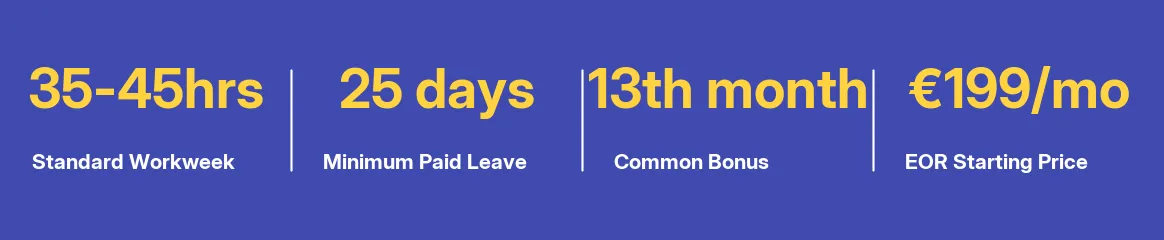
EOR pricing in France typically falls between €400 and €800 per employee per month at most global providers. Team Up's EOR starts at €199 per month per employee in its core markets like Georgia. French market rates run higher due to the regulatory complexity, but the per-employee model remains consistent.
Payroll outsourcing fees in France generally range from €15 to €50 per payslip. That looks cheaper on paper. Add the cost of French legal counsel, entity maintenance, annual audits, and compliance monitoring. The total cost of ownership often exceeds EOR fees for teams under 15 employees.
A practical breakpoint exists around 15 to 20 employees. Below that, the EOR's all-inclusive model usually costs less than maintaining a full entity with payroll outsourcing. Above that, the per-employee EOR fee starts to exceed the largely fixed costs of entity operation.
Operational Control and Employer Liability Trade-Offs

Day-to-Day Management Differences
With an EOR, your operational relationship with employees looks similar to direct employment. You assign work, set objectives, and manage performance. The distinction is administrative. The EOR issues payslips, manages leave accrual, and handles the 13th-month payment if the convention collective requires it.
Under payroll outsourcing, you manage the same daily operations plus the employment administration. You decide policy. You respond to employee disputes. You handle inspections from the Inspection du Travail.
A Munich digital agency expanding into France chose the EOR path specifically because French labor inspections require the legal employer to produce employment records on demand. The agency's German HR team had no capacity to manage French-language documentation requirements. The EOR handled three inspection requests in the first 18 months.
Liability Boundaries That Matter
French employment liability extends beyond payroll accuracy. Employers must comply with mandatory profit-sharing obligations once they reach the 50-employee threshold. They must fund the Comité Social et Économique at that same threshold. The obligation to provide employee benefits in France through a compliant mutuelle and prévoyance system applies from the first hire.
Under an EOR, these obligations fall on the EOR entity. Your risk exposure is limited to the commercial contract between your company and the EOR. Under payroll outsourcing, every one of these obligations is yours. The payroll provider may calculate the numbers, but URSSAF holds you responsible for the outcome.

FAQs
Can I switch from an EOR to payroll outsourcing mid-contract in France?
Yes, but the transition requires careful handling. French employees on EOR contracts must receive new employment contracts from your entity. Under French law, transferring an employee to a new legal employer triggers Article L1224-1 protections. The employee's accrued rights, seniority, and leave balances must transfer intact. Most transitions take 60 to 90 days to execute properly, including mandatory employee consultation periods.
Does an EOR in France handle convention collective compliance automatically?
A competent EOR identifies the applicable convention collective based on the company's registered activity code. France has over 700 active conventions collectives. Each sets specific rules for minimum salaries by job classification, overtime rates, and mandatory bonuses. Not all EOR providers have equal depth here. Ask your EOR which convention collective they will apply and verify the classification matches your employees' actual roles.
What happens if URSSAF audits a company using payroll outsourcing?
URSSAF directs the audit at the legal employer, which is your entity. The payroll provider is not a party to the audit. If the provider made calculation errors, you bear the financial consequences. You can pursue contractual remedies against the provider afterward, but URSSAF surcharges and interest accrue against your company in the meantime. Build an indemnification clause into your payroll outsourcing agreement.
Are there French-specific risks that make one model clearly safer than the other?
France's strict dismissal procedures create the sharpest risk differential. A wrongful dismissal claim under the Labour Code can result in damages calculated on the Barème Macron scale, which sets minimum and maximum indemnities by seniority. Under an EOR, the EOR entity faces this exposure. Under payroll outsourcing, your entity pays. For companies without French labor law expertise in-house, the EOR model provides a meaningful compliance buffer during the first years of market entry.
What to Monitor Next
France updates its social contribution rates and convention collective terms annually. The 2026 cycle will bring revised employer charge thresholds. Track URSSAF publications for rate changes and check your applicable convention collective for updated salary minimums. If your team in France is approaching 15 employees under an EOR, start modeling the total cost of entity setup against projected EOR fees. The breakpoint shifts with each new hire. Run those numbers quarterly, not annually.
If you are weighing EOR costs against entity setup for your French team, request a cost comparison from Team Up.
Written by Team Up — people-first EOR and hiring partner across 20+ countries.
.svg)