How to Onboard and Manage Teams via EOR in France

An employer of record lets you hire in France without spending months setting up a local entity. A London fintech needed two data engineers based in Lyon within three weeks. Registering a French SAS would have taken 8 to 12 weeks. Through an EOR, both engineers started on compliant CDI contracts in 9 business days.
France's Code du Travail governs every employment relationship in the country. It requires written contracts, mandates 25 days of paid annual leave, enforces a nationally reviewed minimum wage, and layers employer social contributions on top of gross salary. Getting any of these wrong triggers penalties from URSSAF and labour inspectorates. An EOR absorbs that compliance burden by acting as the legal employer on French soil while you direct the employees' daily work.
This article covers how the EOR model works operationally in France, what onboarding looks like step by step, and where the real risks sit. It also walks through cost structures and provider selection criteria specific to French labour law.
What Is an Employer of Record (EOR)?

Employer of Record Definition and Core Concept
An employer of record is a third-party organization that becomes the legal employer of your workforce in a target country. The EOR signs the employment contract, runs payroll, withholds taxes, and remits social contributions. You retain full control over the employee's tasks, deliverables, and reporting lines.
This creates a tripartite relationship. The EOR holds the legal employment obligation under French law. The client company directs the work. The employee performs that work under the client's operational management. For a deeper breakdown of how EOR hiring works in France, the structural mechanics are the same across industries.
A mid-size SaaS company in Berlin hired four customer success managers in Paris through an EOR. The EOR registered each employee with URSSAF, filed the DPAE declaration, and issued CDI contracts referencing the applicable collective bargaining agreement. The Berlin company managed daily standups and KPIs directly. Six months later, it had added two more hires under the same structure.
What a Record of Employment Means in Practice
The term "record of employment" refers to the documentary trail that proves an employment relationship existed. In France, this includes the contrat de travail, pay slips (bulletins de paie), DPAE filings, and social security registration records.
When you use an EOR, these records sit with the EOR entity. That matters for audits, termination disputes, and regulatory inspections. The EOR maintains them in compliance with French data retention rules under GDPR and the Code du Travail. You receive copies, but the EOR is the party on record with French authorities.
How EOR Services Work in France

The Tripartite Workflow: EOR, Client, and French Employee
The EOR operates as the French-registered employer. It handles every statutory obligation that French law assigns to the employer. Your company signs a service agreement with the EOR. The EOR signs the contrat de travail with the employee. Daily work direction flows from you to the employee.
A Toronto e-commerce brand wanted a single marketing manager based in Marseille. The EOR drafted a CDI contract, registered the employee with URSSAF within 48 hours of the hire decision, and processed the first payroll cycle within 10 business days. The Toronto company set project goals and reviewed performance directly.
France requires all employers to file a Déclaration Préalable à l'Embauche (DPAE) before the employee's first day. The EOR files this. It also enrolls the employee in the mandatory health, pension, and unemployment insurance schemes.
French Payroll, Tax Withholding, and Social Contributions via EOR
French payroll carries some of the highest employer-side social charges in Europe. Contributions cover health insurance, pension, unemployment, family allowances, and workplace accident insurance. The EOR calculates and remits these every month.
Since 2019, France operates a prélèvement à la source system. Income tax is withheld directly from the employee's salary. The EOR applies the tax rate provided by the French tax authority for each employee. This differs from how payroll outsourcing works in France, where the client entity remains the legal employer.
Mandatory Employment Contracts Under French Law
France requires a written employment contract for every hire. The two main types are:
- CDI (Contrat à Durée Indéterminée): The permanent, open-ended contract. This is the default under French law. No end date is specified.
- CDD (Contrat à Durée Déterminée): A fixed-term contract. French law restricts CDDs to specific situations, such as temporary replacement or seasonal activity. Renewal is capped.
An EOR typically issues CDI contracts unless a genuine legal basis for a CDD exists. Misusing a CDD can result in automatic reclassification to CDI status by a French labour court.
EOR vs PEO in France: Key Structural Differences
| Dimension | EOR | PEO |
|---|---|---|
| Legal employer | The EOR entity in France | Your company (or co-employment) |
| Local entity required | No | Yes, in most PEO arrangements |
| Payroll liability | EOR bears full liability | Shared or retained by client |
| Employee contracts | EOR signs the contrat de travail | Client signs or co-signs |
| Speed to first hire | Typically 5 to 10 business days | Requires existing entity setup first |
| Best for | Companies with no French presence | Companies with a French entity seeking HR support |
The structural difference is who holds the legal employer status. With an EOR, you hire compliantly without a local entity. The EOR's French entity is the employer on paper. With a PEO, you must already have a registered entity in France. The PEO co-manages HR functions, but your entity remains the employer of record.
This distinction matters for liability. If URSSAF audits payroll, the EOR faces the inspection. In a PEO model, your company faces it. A US healthcare analytics firm chose an EOR over a PEO specifically because it had no French entity and needed a bioinformatics researcher in Strasbourg within two weeks. Establishing a SAS in France would have delayed the hire by months.
French co-employment rules also add complexity to PEO models. France's labour courts have historically scrutinized arrangements where two entities share employer obligations. The EOR model avoids this by placing all employment obligations on one entity.
EOR Costs, Risks, and Considerations for France

How EOR Pricing Is Structured and What Drives Costs
EOR providers typically charge using one of two models: a flat monthly fee per employee or a percentage of gross salary. Both approaches exist across the market. EOR fees in France tend to sit toward the higher end of market ranges because French employer social contributions are among the steepest in Europe.
The flat-fee model gives cost predictability. You pay the same amount regardless of salary level. The percentage model scales with compensation, which can inflate costs for senior hires. Beyond the provider fee, you pay the employee's gross salary plus all statutory employer contributions. The EOR remits these to URSSAF and pension funds on your behalf.
Cost drivers specific to France include collective bargaining agreement obligations, mandatory profit-sharing schemes for companies above certain headcount thresholds, and supplementary health insurance (mutuelle) that every French employer must provide. For details on statutory benefits EORs handle in France, the mutuelle requirement alone adds measurable cost.
Employer of Record Risks: Compliance, Control, and Dependency
The EOR model carries real risks. The first is misclassification exposure. If French authorities determine that the EOR arrangement masks a direct employment relationship with your company, both entities face penalties. The risk increases when you control schedules, tools, and discipline in ways that look like a direct employer.
IP ownership requires explicit contractual language. French law defaults certain intellectual property rights to the creator. Your service agreement with the EOR must include an IP assignment clause that holds up under French civil code provisions.
Vendor lock-in is a practical concern. Transferring employees from one EOR to another means terminating and rehiring under French law. That triggers notice periods, potential severance, and re-enrollment with social security. A 12-person team transition can take 6 to 8 weeks if notice periods and URSSAF re-registration timelines overlap.
Watch out: France mandates employee representation bodies (CSE) once headcount reaches a threshold set by law. If your EOR pools employees from multiple clients into a single entity, those pooled numbers can trigger CSE obligations that neither you nor the EOR anticipated.
Pros and Cons of Using an EOR to Hire in France
The advantages are speed and compliance delegation. You skip entity formation, avoid direct URSSAF exposure, and onboard employees in days rather than months. You also gain access to workers across France without understanding every applicable collective bargaining agreement yourself.
The disadvantages are cost, reduced control, and dependency. EOR fees sit on top of already-high French employment costs. You cannot directly manage statutory employment decisions like termination. And you rely on a single provider to maintain compliance with one of Europe's most complex labour codes. For companies planning to hire more than 15 to 20 employees in France, the break-even point for entity formation versus ongoing EOR fees often tips toward establishing your own subsidiary. The right choice depends on team size, timeline, and how long you plan to operate in the French market. Companies needing work visa sponsorship in France add another layer of provider dependency to the calculation.
How to Onboard a French Employee Through an EOR
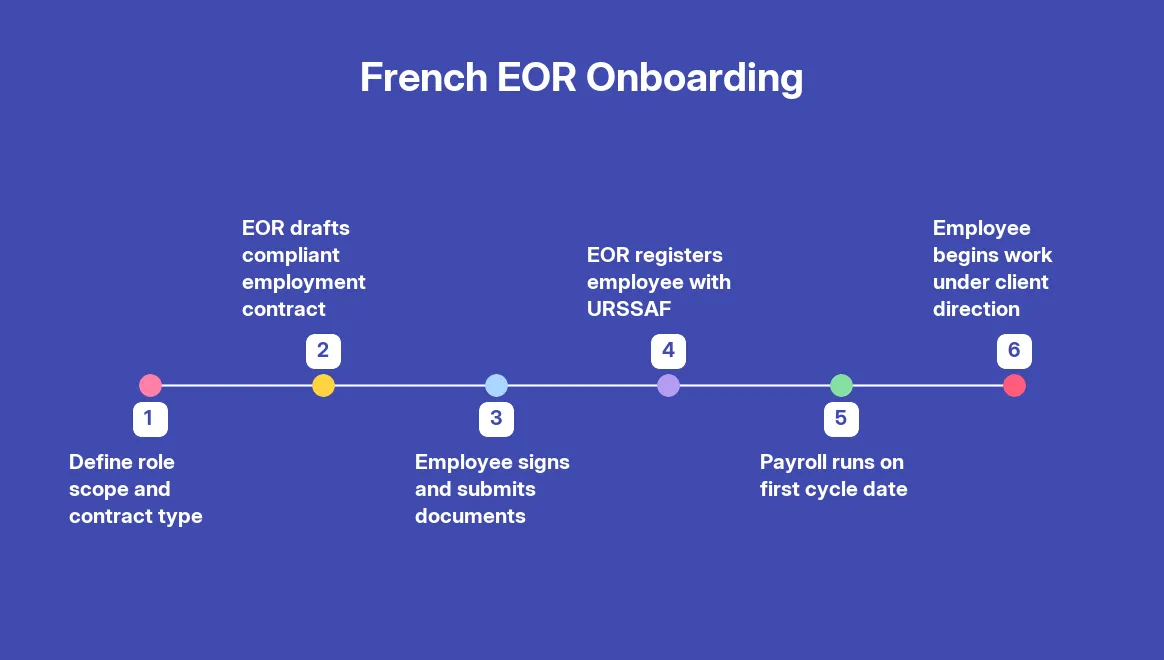
The process starts before the contract draft. You define the role, reporting structure, compensation package, and whether the position calls for a CDI or CDD. The EOR needs this detail to build a contract that satisfies both the Code du Travail and any applicable collective bargaining agreement (convention collective). France assigns nearly every role to a specific convention collective based on the employer's industry classification. Getting this wrong can trigger back-pay claims years later.
Once the contract is signed, the EOR handles registration with URSSAF, France's social security collection body. This registration generates the employee's social security number if they do not already hold one. For non-EU nationals, the EOR must also verify the employee's titre de séjour or coordinate a work visa application before the start date.
A Munich-based fintech company onboarded two compliance analysts in Paris through an EOR in 11 business days. Both were French nationals with existing social security numbers. The EOR matched their roles to the convention collective for financial services, set up payroll deductions, and enrolled them in the mandatory mutuelle (supplementary health insurance). Within six months the team had grown to five.
The day-to-day management model is straightforward. You direct the employee's work. The EOR handles payroll, tax filings, benefits administration, and statutory leave tracking. The employee's formal employer remains the EOR, but operational control sits with you.
Choosing an EOR Provider for France: What to Compare
Selecting an employer of record in France requires evaluating factors that go beyond monthly fees. The French labor environment carries structural complexity that separates capable providers from those selling compliance they cannot deliver.
| Factor | What to check | Why it matters in France |
|---|---|---|
| Entity type | Own entity vs partner network | Own-entity providers control compliance directly |
| Convention collective expertise | Provider maps roles correctly | Wrong classification creates retroactive liability |
| Mutuelle and prévoyance | Provider arranges compliant plans | Mandatory supplementary health and disability coverage |
| Payroll cycle | Monthly, by the last business day | Late payment triggers URSSAF penalties |
| CSE awareness | Provider monitors headcount thresholds | Employee representation obligations activate at 11 employees |
| Offboarding capability | Provider manages rupture conventionnelle | French terminations require formal process or mutual agreement |
Ask every provider how they handle convention collective mapping. France has over 700 active conventions collectives. Each one sets minimum salaries, overtime rules, bonus structures, and notice periods that override the Code du Travail's default provisions. A provider that applies generic contract terms without convention collective alignment exposes you to claims from employees or labor inspectors.
A Toronto e-commerce company switched EOR providers in France after discovering its original provider had classified four customer support agents under the wrong convention collective. The correction required retroactive salary adjustments covering 14 months. The replacement provider, operating through an owned entity in France, completed the reclassification and back-pay process in three weeks.
Compare how each provider handles employee benefits and insurance. French law mandates both a mutuelle (supplementary health plan) and prévoyance (disability and death coverage). The quality of these plans affects recruitment. Candidates in competitive sectors expect coverage that exceeds the legal minimum. Providers offering only baseline plans may struggle to attract the talent you need.
The distinction between EOR and payroll outsourcing in France also matters at the selection stage. A payroll-only provider processes numbers but does not carry employer liability. An EOR assumes that liability. Make sure you are comparing like with like.
FAQs
Can a French employee hired through an EOR later be transferred to our own French entity?
Yes, but the transfer is not a simple administrative move. French law under Article L.1224-1 of the Code du Travail applies TUPE-equivalent protections when an employee moves between employers as part of a business transfer. The employee's existing contract terms, seniority, and accrued rights must carry over. Most EOR agreements include novation clauses that define how and when this transfer happens. Without those clauses, you risk needing to terminate and rehire, which triggers severance obligations and a new probation period negotiation.
What happens if the EOR provider exits the French market or becomes insolvent?
The employees remain employed under French law regardless of the EOR's commercial situation. French labor courts treat the employment relationship as binding on the employer entity. If that entity becomes insolvent, the AGS (Association pour la Gestion du régime de garantie des créances des Salariés) guarantees unpaid wages up to a statutory ceiling. Your contractual exposure depends on the EOR agreement. Best practice is to require escrow payroll accounts, step-in rights allowing you to appoint a replacement EOR, and a 90-day portability window for all employment records.
Does using an EOR trigger French employee representation obligations for our company?
Employee representation thresholds are calculated at the EOR's level, not yours. If the EOR employs 11 or more people across all its clients in France, it must establish a Comité Social et Économique (CSE). This means your five employees could inherit CSE consultation rights because the EOR's total French headcount crossed the threshold. A Berlin SaaS firm discovered this when its EOR's CSE required consultation before implementing a remote-work policy change affecting all the EOR's French employees, including the client's team.
Can an EOR hire a French employee on a CDD (fixed-term contract) for an indefinite project?
No. French law strictly limits CDD grounds to replacement of an absent employee, seasonal work, or a temporary increase in activity. An EOR cannot issue a CDD simply because you prefer contractual flexibility. Total CDD duration, including renewals, is capped. If a labor court finds the CDD lacked valid grounds, it requalifies the contract as a CDI retroactively. The employee gains full CDI protections from day one of the original CDD. Either the EOR or the client can face this claim, and the employee can initiate proceedings at any point during or after the contract.
How does GDPR apply when employee data is shared between an EOR and a non-EU client company?
The EOR typically acts as the data controller for employment data under GDPR. When it transfers payroll, health, or HR records to a client headquartered outside the EU, a Standard Contractual Clause (SCC) or equivalent transfer mechanism must be in place. A US logistics company was fined by CNIL after an audit revealed it received French employee payroll data from its EOR without documented SCCs. The fine applied to both parties. Ensure your EOR agreement specifies transfer mechanisms, data retention limits, and the legal basis for every category of shared data.
Can an EOR in France sponsor a work visa for a non-EU national the client company has already identified?
Yes. The EOR, as the legal employer, files the work permit application with the relevant préfecture on behalf of the candidate. The process typically takes 6 to 12 weeks depending on the préfecture and nationality. One complexity: France requires the employer to demonstrate it could not fill the role with an EU candidate for certain permit categories. The EOR handles this labor market test. If the candidate holds a Passeport Talent (for highly skilled roles above a salary threshold), the labor market test is waived, significantly accelerating the timeline.
What collective bargaining agreement applies if the client company's industry differs from the EOR's registered activity?
The applicable convention collective follows the EOR's registered NAF code (Nomenclature d'Activités Française), not the client company's industry. This creates a mismatch risk. If the EOR is registered under a general staffing code, the convention collective may set lower minimum salaries or different leave entitlements than the client's own sector would require. Sophisticated EOR providers register specific NAF codes aligned to their clients' industries or maintain multiple registrations. Ask your provider which NAF code your employees fall under and verify that its convention collective terms meet your compensation expectations.
What to Watch Next
France's labor regulatory calendar does not pause. The government reviews the SMIC annually, typically effective January 1. Any increase cascades through convention collective minimums, overtime calculations, and social security contribution bases. Monitor the Ministry of Labour's publications each December for the confirmed adjustment.
Proposed reforms to CDD renewal rules and remote-work frameworks are under discussion in the National Assembly. If adopted, they would change how EORs structure fixed-term contracts and expense reimbursement for remote employees. Track the official Journal Officiel for enacted legislation.
Your concrete next step: audit your current EOR agreement for convention collective mapping accuracy, CSE threshold exposure, and GDPR transfer documentation. If any of those three areas lack specificity, raise them with your provider before your next payroll cycle.
.svg)