


How to Compare EOR Providers in France: A Practical Evaluation Guide for 2026
Our guide to onboarding and managing teams via EOR in France covered the full hiring lifecycle. It explained what an EOR does, how onboarding works, and what costs to expect. This article goes deeper on one critical decision: which EOR provider to choose.
France's labor code is among the most prescriptive in the EU. Collective bargaining agreements layer additional obligations on top. Dismissal procedures carry real financial exposure. These factors mean provider selection in France demands sharper scrutiny than in most markets.
The wrong choice surfaces months later. It shows up as a missed convention collective classification, a botched rupture conventionnelle, or a surprise surcharge buried in your invoice. This article breaks down what to compare across four dimensions: legal structure, labor law depth, pricing transparency, and service scope.
Entity Ownership and Legal Accountability in France
Why Ownership Structure Matters
Not every EOR provider holds its own legal entity in France. Some operate through local partner companies or shell intermediaries. This distinction affects your employees directly.
When an EOR owns its French entity, it registers with URSSAF, files declarations sociales nominatives (DSN) monthly, and answers to the French labor inspectorate. The provider bears the consequences of non-compliance. A partner-based model inserts a third party between you and the compliance risk.
That third party may cut corners you never see. A Munich-based fintech discovered this when its partner-model EOR failed to apply the correct Syntec convention collective to three developers. The reclassification cost exceeded four months of combined salary.
Questions to Ask About Entity Structure
Start with a direct question: does the provider operate a société par actions simplifiée (SAS) or similar registered entity in France? Ask for the SIRET number. Verify it on the French government's open business registry.
Then dig into operational depth. Does the provider employ its own HR and payroll staff in France, or does it outsource those functions? In-country teams catch issues faster.
| Comparison Factor | Owned Entity Model | Partner/Intermediary Model |
|---|---|---|
| Legal employer | Provider's French SAS | Third-party local company |
| URSSAF registration | Provider holds directly | Partner holds |
| DSN filing | Provider files | Partner files |
| Client visibility | Full audit trail | Limited, filtered through partner |
| Liability in disputes | Provider bears directly | Split or unclear |
| Reclassification risk | Lower (direct control) | Higher (less oversight) |
Team Up owns legal entities in its core EOR markets, giving clients direct compliance accountability rather than partner-network exposure. For companies building French teams alongside hires in markets like Turkey or Eastern Europe, single-provider consistency simplifies governance.
French Employment Law Expertise: The Non-Negotiable Filter
Convention Collective Knowledge Is the Real Test
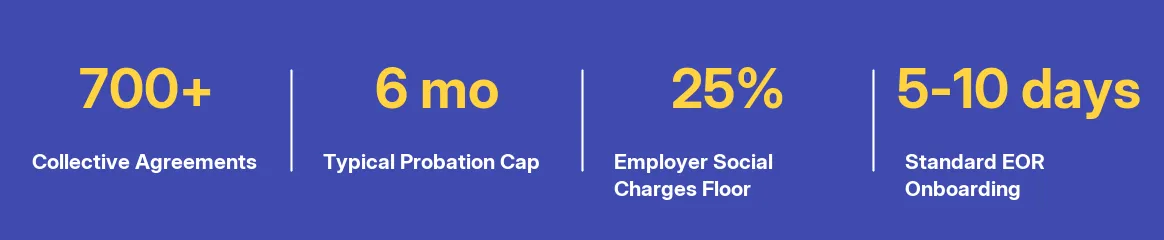
France's Code du travail sets the floor. Collective bargaining agreements raise it. Over 700 conventions collectives exist. Each one prescribes minimum salaries by job classification, overtime rules, notice periods, and supplementary benefits.
Your EOR must identify the correct convention collective for each employee. Getting this wrong is not a technicality. It exposes the employee to underpayment claims and exposes the legal employer to back-pay liability plus penalties.
Ask prospective providers how they determine convention collective applicability. The answer should reference the company's principal activity code (code APE/NAF) and the specific employee role. Generic answers like "we handle all compliance" are red flags.
Dismissal and Contract Termination Competence
France does not permit at-will termination. Every dismissal requires a cause réelle et sérieuse. The procedural requirements include a formal convocation letter, a preliminary meeting, a cooling-off period, and a written notification. Missing any step can render the dismissal invalid.
The hidden risks of using an EOR in France include underestimating how costly a botched termination becomes. Prud'hommes (labor courts) regularly award damages for procedural failures alone.
A strong EOR provider will walk you through the rupture conventionnelle process as an alternative. This mutually agreed separation carries its own formalities. The DREETS must homologate the agreement within 15 business days. Your provider should manage this end to end.
Probation Period Rules
French law caps trial periods based on employee classification. Cadres (managers/executives) receive a different maximum than non-cadres. The applicable convention collective may shorten these statutory maximums further.
Your EOR should confirm the exact probation duration before drafting the employment contract. It should also flag whether renewal is permitted under the relevant convention collective. Some agreements prohibit renewal entirely.
Cost Structures and Hidden Fees in French EOR Contracts
Base Fee Versus Total Cost
Most EOR providers quote a monthly per-employee fee. In France, this fee rarely tells the full story. Employer social contributions in France rank among the highest in the EU. The combined employer charges for social security, unemployment insurance, complementary health, and retirement typically exceed 40% of gross salary.
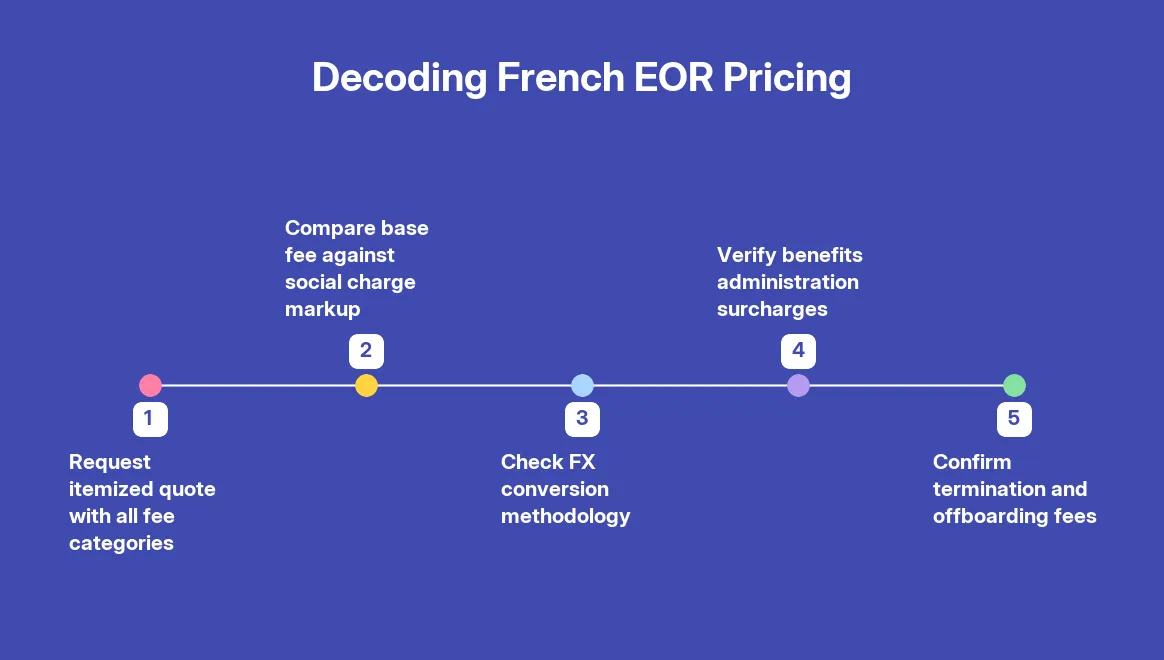
Some providers fold these charges into their fee. Others pass them through at cost plus a markup. The difference materially affects your total employment cost. Request an itemized breakdown that separates the management fee from statutory charges.
Foreign Exchange and Payment Terms
If you pay invoices in USD or GBP while your French employees receive euros, currency conversion creates margin. Some providers embed a markup of 1-3% in the exchange rate without disclosing it explicitly.
Ask for the FX methodology in writing. The cleanest approach uses the European Central Bank reference rate on the invoice date with a disclosed spread. Opaque "proprietary rates" cost you money every pay cycle.
EOR fees across the French market typically fall between €400 and €700 per employee per month for the management fee alone. That range excludes social charges and benefits. Providers quoting below that range may be recovering margin through FX spreads, benefits markups, or termination fees.
Termination and Offboarding Costs
France's severance framework creates real financial exposure. Statutory severance (indemnité légale de licenciement) applies after eight months of tenure. The convention collective may prescribe higher amounts. Your EOR contract should specify who bears these costs and how they are invoiced.
Some providers charge a separate offboarding fee on top of statutory severance. Others include it in the monthly fee structure. Clarify this before signing. A four-person team reduction in France can generate five-figure termination costs that catch unprepared companies off guard.
Evaluating Service Scope Beyond Payroll

Benefits Administration Depth
French law mandates employer-funded complementary health insurance (mutuelle). The minimum coverage levels are set by the ANI agreement. Many convention collectives require higher coverage.
Your EOR should handle mutuelle selection, enrollment, and ongoing administration. Ask whether the provider offers a single group policy or allows employee choice among multiple plans. Also confirm how they manage employee benefits and insurance obligations for portabilité, the mandatory continuation of health and provident coverage after contract termination.
Immigration and Mobility Support
Hiring non-EU nationals in France requires a work authorization. The EOR, as legal employer, must file the autorisation de travail request with the DREETS. Processing times vary by prefecture but typically run four to eight weeks.
A capable provider manages the full work visa and immigration process from document collection through receipt of the titre de séjour. Providers that outsource immigration to a separate law firm add cost and coordination friction.
Reporting and Transparency
French payroll generates a bulletin de paie with over 30 line items. Your employees receive this monthly. You should receive consolidated reporting that shows gross-to-net calculations, employer charges by category, and year-to-date totals.
Ask for a sample report before signing. If the provider cannot show you a detailed cost breakdown per employee per month, their reporting infrastructure may not meet the standard France demands.

FAQs
Can I switch EOR providers in France without disrupting my employees?
Yes, but the process requires a formal employment transfer. French law treats EOR switches as a change of employer. The outgoing EOR must terminate the contract, and the incoming EOR issues a new one. Employees retain their acquired seniority under certain conditions. Plan for a 30-60 day transition window. Coordinate closely with both providers to avoid gaps in social security coverage or mutuelle enrollment.
Does the EOR's convention collective classification affect my employee's retirement benefits?
Directly. The convention collective determines the employee's cadre or non-cadre status. That classification drives which complementary retirement scheme (AGIRC-ARRCO tier) applies and the contribution rates. An incorrect classification means the employee accrues retirement points at the wrong rate. Correcting this retroactively requires back-payments and administrative rework with the pension fund.
What happens if my EOR provider's French entity faces financial difficulty?
Your employees become creditors of the EOR's French entity. France's AGS guarantee fund covers unpaid wages and severance up to statutory caps. But the process takes months. You would need to transfer employees to a new legal employer quickly. Include a contractual provision requiring the EOR to notify you immediately of any insolvency proceedings or financial distress affecting its French operations.
How should I evaluate an EOR's data protection compliance for French employees?
French employees fall under GDPR. The EOR processes sensitive personal data including salary details, health insurance records, and social security numbers. Verify that the provider has a designated Data Protection Officer and a documented processing agreement. Ask where payroll data is stored. Data transfers outside the EU require Standard Contractual Clauses or an adequacy decision. The CNIL actively enforces these requirements in France.
What to Monitor as Your French Team Grows
Choosing the right EOR provider is the first decision. Monitoring performance is the ongoing one. Track convention collective reclassifications as roles evolve. Audit DSN filings quarterly. Review FX margins against ECB reference rates each billing cycle.
France's labor environment shifts with each new décret and avenant to convention collectives. Your provider should flag changes proactively, not reactively. If you reach five or more employees in France, start evaluating whether a direct entity or co-employment PEO arrangement makes financial sense long-term.
If you are comparing EOR providers for your French hiring plans, Team Up can walk you through a country-specific cost breakdown. Request a consultation.
Written by the Team Up editorial team. Team Up is a people-first EOR and nearshoring partner helping companies across North America, Europe, and the Middle East hire compliantly in 20+ countries.
.svg)


