


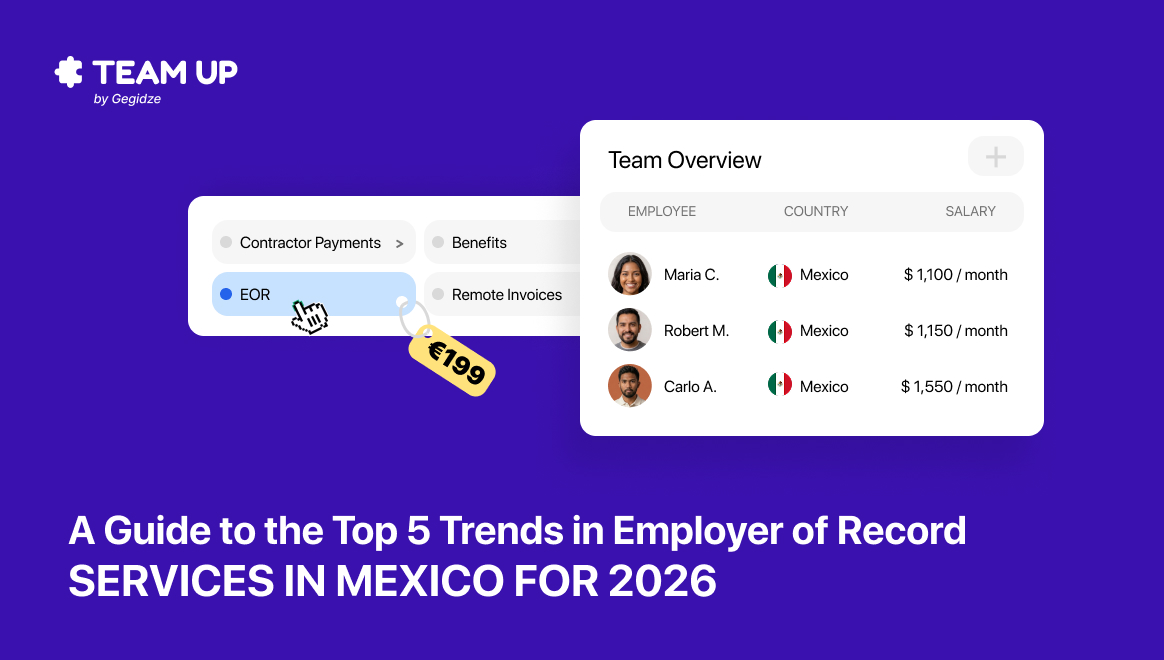
A Guide to the Top 5 Trends in Employer of Record Services in Mexico for 2026
Intro
Mexico is the United States' largest trading partner, home to more than 130 million people, and the default nearshoring destination for companies that need time zone alignment, USMCA advantages, and skilled technical talent at a significant cost differential. The opportunity is obvious.
What is less obvious, until you try to hire someone, is how Mexico's compliance framework works. The Federal Labor Law. Five government agencies. REPSE registration. CFDI 4.0 payslips. PTU profit sharing. Aguinaldo. Strong termination protections that can make a mishandled exit cost three months of salary plus twenty days per year of service.
Employer of record services in Mexico exist to absorb that complexity. And in 2026, they are the tool most international companies reach for first when they decide to build a Mexico team. Here are the five specific reasons why, with the Mexico-specific context that makes each one more than a generic EOR talking point.
The Context: Mexico's EOR Moment in 2026
Mexico processed $36 billion in foreign direct investment in 2023, with nearshoring continuing to accelerate. The EOR model is especially valuable for nearshoring projects, where speed to market matters more than long-term entity strategy. Companies choose an EOR in Mexico when they want Mexican talent without the cost and risk of opening an S. de R.L. or S.A. de C.V.
Why Mexico became a leading nearshoring destination for global companies
But speed to market is only one of five reasons. The other four — compliance certainty in a post-2021 reform environment, immigration sponsorship for foreign nationals, talent cost advantages at 65–75% below US equivalents, and financial flexibility in an unvalidated market- each have Mexico-specific drivers that make EOR distinctly valuable here compared to most other markets.

Reason #1: Hire Employees in Mexico in Days Instead of Waiting for Entity Setup

Here is the competitive reality of Mexico tech hiring in 2026. A strong backend engineer in Guadalajara's Silicon Valley ecosystem receives multiple simultaneous offers. They move quickly. The company that can confirm, contract, and onboard within a week gets the hire. The company is still waiting for its S. de R.L. de C.V. to clear the Public Registry of Commerce.
Mexico entity setup — notarization, Public Registry filing, RFC registration, IMSS employer account, INFONAVIT enrollment, bank account — takes 6–16 weeks in realistic timelines. During that window, the candidate you identified has accepted another offer.
How EOR helps companies validate Mexico hiring before incorporation
An EOR already has all of it. Team Up's Mexico entity holds active registrations with SAT, IMSS, INFONAVIT, and AFORE. CFDI 4.0 payroll infrastructure is live. When you identify a candidate, Team Up can issue an LFT-compliant employment contract and begin IMSS onboarding within 24–72 hours.
That speed advantage is not just about individual hires. It compounds when Mexico is a market-testing phase. Hiring through an EOR to evaluate a nearshoring model for 3–6 months — before committing to the entity investment — requires zero entity work. Three engineers in Monterrey, validated, scaling; or three engineers in Tijuana, underperforming, exited cleanly. You get the evidence before you commit the capital.
The Mexico-specific acceleration: entity setup in Mexico is actually less expensive than in India, Brazil, or the Philippines — but the timeline penalty is the same. 6–16 weeks is a real cost in competitive hiring markets, regardless of whether the entity fees are $3,000 or $30,000.

Reason #2: Stay Compliant With Mexico's REPSE and Labor Law Requirements
This is the Mexico-specific reason that does not exist in any other market in this cluster.
April 2021 changed the outsourcing compliance landscape in Mexico permanently. The reform prohibited generic personnel-leasing and created the REPSE (Registro de Prestadoras de Servicios o Obras Especializados) — the federal registry of specialized service providers. Any company providing specialized services or specialized work to third parties in Mexico must be REPSE-registered.
How EOR providers reduce labor law and compliance exposure
This matters for EOR in two ways that raise the compliance stakes significantly:
The non-deductibility consequence: Service fees paid to a non-REPSE-registered provider are not deductible for Mexican corporate income tax. For a company paying MXN 60,000/month in EOR fees on a 10-person team, that is MXN 720,000/year in potentially non-deductible service costs — creating an effective tax surcharge on the entire EOR engagement.
The joint liability consequence: Companies that use non-REPSE-registered specialized service providers become jointly liable for all unpaid IMSS contributions, SAT obligations, and labor entitlements of the workers. This is not a theoretical risk — it is a structured enforcement mechanism the STPS actively applies under the November 2025 inspection protocol, with fines exceeding MXN 4 million (~$200,000) per affected worker for serious violations.
Why this makes EOR more valuable than entity setup in the early phase: An EOR with verified REPSE registration absorbs this compliance risk as the legal employer. Your company has no direct IMSS account, no REPSE exposure, and no joint liability. The EOR's compliance is the only compliance that matters for your Mexico employment relationship.
Why REPSE compliance matters for foreign companies hiring in Mexico
An own entity — for all its long-term advantages — requires you to manage REPSE for any specialized service providers you engage, maintain your own IMSS/INFONAVIT accounts with correct SBC calculations, and ensure CFDI 4.0 payslips are generated and uploaded for every biweekly payroll cycle. Miss any of these, and the compliance exposure is yours.
The verification test: Before signing with any Mexico EOR, ask for the REPSE number and verify it on the STPS portal (repse.stps.gob.mx). An EOR that cannot provide this immediately is not compliant. Team Up holds and maintains active REPSE registration for its Mexico operations.
Reason #3: Manage Payroll, Taxes, and Statutory Benefits Without Compliance Risk
This is the capability gap that surfaces most clearly when companies try to bring foreign talent into their Mexico operations — and it is the reason that makes EOR the only path in specific hiring scenarios.
Sponsoring a Temporary Resident Visa with Work Authorization (autorización para trabajar) in Mexico requires the sponsoring party to be a registered legal employer recognized by INM (Instituto Nacional de Migración) — with active IMSS and SAT compliance. Without a registered Mexican entity, your company cannot sponsor. The INM application cannot be filed in your name.
Why foreign employees need an INM-recognized employer
This matters for three growing 2026 scenarios:
Nearshoring leadership deployment: A US company builds a Guadalajara engineering team and wants to deploy a US director of engineering to lead it. No Mexican entity. INM sponsorship through Team Up's Mexico entity provides the work authorization. The director can legally work in Mexico from month one — not after a 6-month entity setup.
Knowledge transfer specialists: A European company nearshoring to Monterrey wants to send a German industrial engineering specialist for a 12-month knowledge transfer. Without a Mexican entity, the work authorization sponsorship goes through Team Up's entity. No client entity needed.
International talent into Mexico: A company wants to hire a highly qualified Colombian engineer who is relocating to CDMX. The engineer needs work authorization from a Mexican employer. Team Up's entity sponsors the work authorization as the employer of record. The client company has no Mexico entity — and does not need one.
The sponsorship-first sequencing: Work authorization must be confirmed before the employment relationship begins. Payroll cannot legally start before INM authorization is in place. An EOR that runs payroll before immigration authorization creates an unauthorized employment relationship — not a clerical oversight.
Team Up manages the full INM work authorization sequence as part of the Mexico EOR engagement: offer letter, INM request, Temporary Resident Visa coordination, post-arrival registration, and permit renewal tracking. Budget 4–8 weeks for the full process.
Reason #4: Sponsor Work Permits and Visas Without Opening a Mexican Entity

This is the fundamental economic case for Mexico nearshoring — and EOR is the mechanism that makes it accessible without entity overhead.
How EOR providers sponsor work permits and visas in Mexico
The cost differential is real and verified:
| Role | Guadalajara / Monterrey (via EOR) | US equivalent | Advantage |
| Mid-level software engineer | MXN 55,000/month (~$2,750 total employer cost) | ~$10,833/month | ~75% |
| Senior engineer/team lead | MXN 90,000/month (~$5,800 total employer cost) | ~$14,167/month | ~59% |
| QA engineer (mid-level) | MXN 35,000/month (~$2,150 total employer cost) | ~$7,500/month | ~71% |
| Finance analyst | MXN 45,000/month (~$2,700 total employer cost) | ~$6,250/month | ~57% |
Total employer costs include IMSS, INFONAVIT, SAR, ISN, Aguinaldo accrual, vacation premium, and Team Up's EOR fee from €199/month. Not just the salary.
Even at Mexico's 30–40% statutory employer contribution overhead, the total cost of employment for Mexican professionals is dramatically lower than US equivalents across every category. The USMCA advantage — zero-tariff integration with US markets, shared time zones, and cultural proximity — makes Mexico the default nearshoring destination for US technology companies in 2026.
Hiring through an EOR in Mexico offers rapid LATAM nearshoring entry, access to manufacturing and tech talent pools, reduced regulatory risk, compliance with strict employment protections, and flexible scaling without Sociedad Anónima entity complexity.
Why EOR specifically for the cost advantage: The cost savings exist whether you use EOR or an entity. But accessing them in the first 12–18 months of market entry requires a model that does not front-load $2,000–$20,000+ in entity costs and 6–16 weeks of setup time before the first engineer is onboarded.
How EOR simplifies immigration compliance for international hires
EOR converts the Mexico cost advantage into an immediately accessible operational reality. The total employer cost for a five-person Mexico engineering team through Team Up starts from approximately $14,400/year in EOR service fees — before a dollar of entity overhead.
The talent hub specifics matter:
- Guadalajara (Jalisco): ISN 2.5% — one of the lower state payroll tax rates among major tech hubs. Strong software engineering, fintech, and hardware design talent.
- Monterrey (Nuevo León): ISN 3%. Industrial engineering, manufacturing management, and finance. Bilingual professionals with a US-aligned work culture.
- Mexico City (CDMX): ISN 3%. Deepest talent pool across all categories. Highest salary expectations.
- Tijuana (Baja California): ISN 2%, Northern Border minimum wage applies (MXN 440.87/day vs. national MXN 315.04/day). US Pacific time alignment. BPO and bilingual support teams.
The EOR calculates and remits ISN at the correct per-state rate for your team's actual location — not a blended national rate that over-charges in some states and under-charges in others.
Reason #5: Test the Mexico Market Before Committing to a Local Entity
The fifth reason companies choose EOR for Mexico is the one CFOs most appreciate once they see the entity wind-down timeline.
Mexico offers genuine, accessible entity setup. An S. de R.L. de C.V. costs $2,000–$8,000 to incorporate — relatively low compared to India ($15,000–$40,000) or Brazil ($20,000–$50,000+). The break-even between EOR and entity in Mexico sits at approximately 10–15 employees, earlier than most other emerging markets.
This means the financial flexibility argument for EOR in Mexico is not about avoiding entity costs indefinitely. It is about validating the market before committing to the entity — and keeping capital available while that validation is happening.
The Mexico validation question:
- Will the talent quality in your target city match the technical requirements of your team?
- Does the time zone and communication pattern actually work for your US or European parent company?
- Can you retain Mexico-based employees competitively, or will turnover cost more than the salary savings?
- Is the output from your Mexico team genuinely at the level that justifies scaling to 15+ people?
None of these questions can be answered by research. They require 6–12 months of operational data.
The financial risks of opening a Mexican entity too early
EOR's specific financial protection in Mexico:
If the market does not validate, the exit from an EOR engagement is:
- Standard notice period
- EOR manages compliant offboarding — final pay, pro-rated aguinaldo, vacation, vacation premium
- IMSS baja filed
- No entity to dissolve, no Public Registry filing, no bank account to close, no ongoing RFC obligations
How EOR reduces exit costs if expansion plans change

The total cost of a failed Mexico pilot through EOR: the EOR fees, the employee salaries and statutory contributions for the period, and the statutory entitlements on exit. That is it.
The total cost of a failed Mexico pilot through an entity: all of the above, plus the entity wind-down (12–24 weeks, additional legal fees), ongoing RFC and SAT obligations until dissolution is complete, and the reputational complications of an unresolved entity with IMSS and INFONAVIT outstanding contribution questions.
The capital deployment argument: The $2,000–$8,000 saved on entity setup in the first 12 months is not the primary financial argument for Mexico EOR — that number is modest. The primary argument is the working capital that does not need to be tied up in entity infrastructure while the market is being validated. For a company deploying capital across multiple markets — Mexico alongside the Caucasus, India, or Southeast Asia — keeping that capital liquid until the market evidence supports the entity commitment is the rational CFO position.
What Changes When EOR Is the Right Answer for Mexico
Each of the five reasons above is specifically Mexico in 2026. The speed advantage maps to Mexico's competitive tech talent markets in Guadalajara and Monterrey. The compliance reason is the post-2021 REPSE framework that does not have a direct equivalent in any other market in this cluster. The immigration sponsorship reason applies to the growing number of US and European companies deploying international talent into Mexico operations. The cost reason reflects Mexico's specific USMCA-driven nearshoring moment. And the financial flexibility reason is calibrated to Mexico's relatively accessible entity break-even, which makes EOR the right model for validation phases specifically.
Together, they explain why: Hiring through an EOR in Mexico is now a core hiring solution for international companies that want to employ local talent without setting up a Mexican legal entity.
Team Up's Mexico EOR covers all five. REPSE-registered operations. CFDI 4.0 payslips. LFT-compliant contracts. Full statutory benefits — Aguinaldo, PTU, vacation, vacation premium. INM work permit sponsorship. From €199 per employee per month.
And if Mexico is one hub in a multi-market expansion — alongside Georgia, Armenia, Kazakhstan, Turkey, India, or the Philippines — Team Up's 20+ country platform covers all of it from one engagement.
A US company with engineers in Tbilisi, QA in Yerevan, and nearshoring developers in Guadalajara manages one Team Up engagement — one invoice, one compliance calendar, one account team.
200+ businesses. 4,000+ talent placed. 92% client retention over five years. Trusted by HP, Armani Exchange, Jack & Jones, Telia, and Wizzair.
When EOR Is Not the Right Answer for Mexico
An honest guide acknowledges the cases where a different model makes more sense.
You have 15–20+ employees in Mexico with a confirmed 3+ year commitment. The entity's break-even in Mexico is earlier than in most markets. At this scale, entity economics compete directly with EOR fees. Register the entity, transition employees, and run payroll through a REPSE-registered payroll provider.
You need IMMEX manufacturing program benefits. The IMMEX (Maquiladora) program provides import duty exemptions for manufacturers that import materials and re-export finished goods. IMMEX certification requires a registered Mexican entity. EOR cannot substitute.
Government or regulated-sector contracts require a locally incorporated counterparty. EOR employment infrastructure is not the same as a registered legal entity for contracting purposes.
Your Mexico operations will have strong profits and you want PTU calculated on your entity's full profitability. PTU under EOR is calculated on the EOR entity's P&L. For operations with significant profit generation, the direct entity allows PTU to be calculated on your actual Mexico profit, which may benefit employees more than the EOR model.
Start with the Right Model for Your Mexico Moment
Mexico's five-reason EOR case is grounded in real compliance, real numbers, and a real market moment that is not slowing down.
Speed — because Guadalajara talent does not wait for entity paperwork. REPSE compliance — because the 2021 reform made the post-2021 compliance environment materially more consequential than most companies realize before their first STPS audit. Immigration sponsorship — because INM work authorization requires a registered employer that an EOR already is. Cost access, because the 65–75% salary advantage is only operational if you can hire compliantly and quickly. Financial flexibility, because validating a Mexico nearshoring model before the entity commitment is the rational approach for any company entering a new market.
Team Up's Mexico EOR platform starts from €199 per employee per month. REPSE-registered. CFDI 4.0 compliant. Full LFT statutory benefits. INM immigration coordination. Multi-market platform covering 20+ countries from one engagement.
Frequently Asked Questions
Why is REPSE registration specifically important for Mexico EOR — and not for EOR in other markets?
The April 2021 Reforma a la LFT created REPSE specifically for Mexico. It banned generic personnel-leasing and required all specialized service providers, including EORs, to register with the STPS. Non-REPSE service fees are not deductible for Mexican corporate income tax, and clients that use non-REPSE providers become jointly liable for all unpaid IMSS and SAT obligations. No equivalent framework exists in Georgia, India, Kazakhstan, or the Philippines.
Can an EOR sponsor Mexican work authorization for foreign nationals without the client having a local entity?
Yes. Team Up's Mexican entity holds the INM-recognized registered employer status required to sponsor Temporary Resident Visa with Work Authorization applications. The client company has no direct employer presence in Mexico — the INM sponsorship runs through Team Up. Budget 4–8 weeks for the full INM authorization process. Payroll cannot legally begin before INM authorization is confirmed.
At what headcount should a company consider transitioning from EOR to a Mexican entity?
Mexico's accessible entity setup ($2,000–$8,000) and modest annual compliance overhead ($6,000–$20,000/year) means the EOR-to-entity crossover occurs at approximately 10–15 employees — earlier than in India, the Philippines, or Brazil. At 10–15 employees with a confirmed 3-year presence, entity economics begin competing with EOR fees. Below that threshold, or during market validation phases, EOR is almost always more cost-efficient on total first-year cost.
Is the 65–75% cost advantage real when total employer contributions are included?
Yes. Total employer cost in Mexico — including IMSS (~22%), INFONAVIT (5%), SAR (~2%), ISN by state (2–3%), aguinaldo accrual, vacation premium, PTU provision, and Team Up's EOR fee from €199/month — runs approximately $2,750–$5,800/month for mid-to-senior technical roles depending on city and seniority. The equivalent US roles cost $7,500–$14,000+/month. Even at the higher end, the Mexico total employer cost through Team Up is 59–71% below the US equivalent.
How does the multi-market EOR model work for companies expanding into Mexico and other regions simultaneously?
Team Up's 20+ country platform covers Mexico alongside owned entities in Georgia, Armenia, Azerbaijan, Turkey, India, Kazakhstan, Uzbekistan, and Germany (Eastern Europe), plus the Philippines, Latin America, and additional coverage markets. One engagement covers all markets — one invoice, one account team, one compliance calendar. Companies building teams across Mexico and the Caucasus or India through separate EOR providers face three separate service agreements, three invoicing relationships, and three compliance monitoring streams. Team Up consolidates all of that from €199/month per employee across every market.
.svg)


