


Employer of Record (EOR) vs Setting Up Your Own Entity in Mexico: Which is Better?
Intro
Companies entering Mexico face a decision that looks simple: set up your own entity or use an EOR, but that hides significant complexity. The wrong choice at the wrong stage costs real money: wasted legal fees, capital tied up in an entity you close within eighteen months, or EOR fees that accumulate past the point where direct employment would have been cheaper.
This article gives you an honest comparison. Not "EOR is always better" and not "entity is the professional choice." The right answer depends on your headcount trajectory, your timeline, your risk tolerance, and, critically in Mexico, how you navigate the 2021 outsourcing reform and the November 2025 STPS inspection protocol that changed how enforcement actually works.
Employer of record services are the right model for many Mexico hiring scenarios. They are not the right model for all of them. Here is how to tell which applies to you.

What You Are Choosing Between
Employer of Record (EOR) Mexico
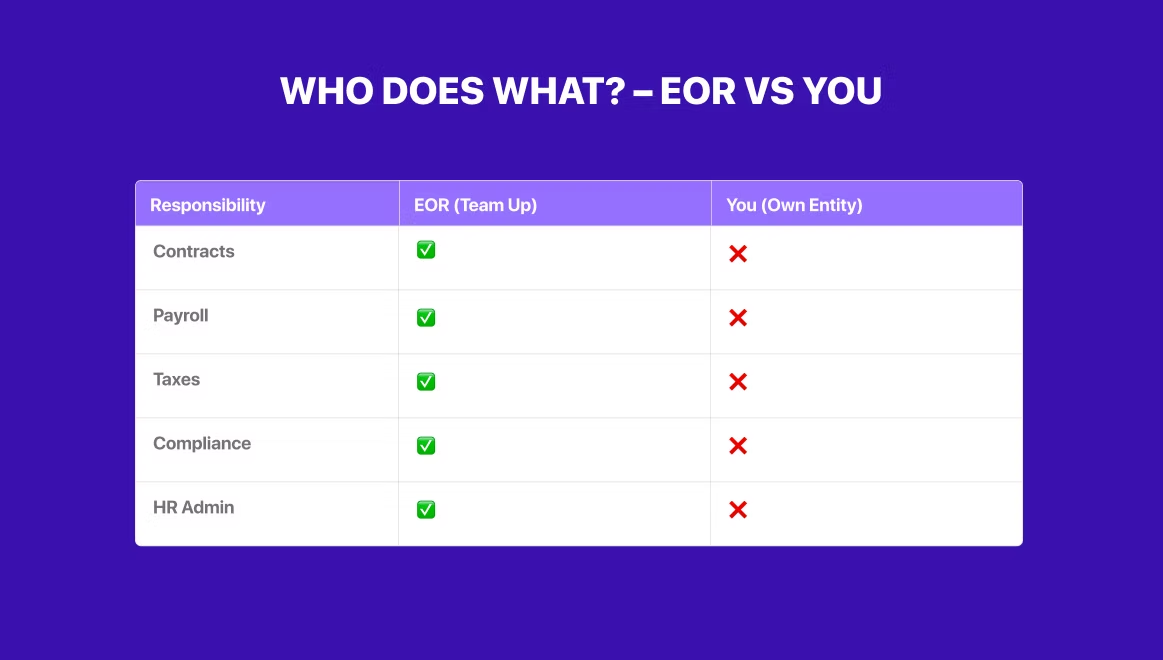
The EOR becomes the legal employer under Mexico's Federal Labor Law. The EOR signs employment contracts, registers with IMSS and INFONAVIT, files with SAT using CFDI 4.0 digital payslips, withholds ISR income tax, and handles all statutory benefits — aguinaldo, PTU, vacation, vacation premium, and state payroll tax (ISN). Your company directs the employee's work. You have no direct employer relationship under Mexican law.
Own Entity Mexico
Your company incorporates a Mexican legal entity, almost always an S. de R.L. de C.V. (similar to a US LLC) or S.A. de C.V. (similar to a C-corp). Your entity gets its RFC (Registro Federal de Contribuyentes — Mexico's tax ID), opens Mexican bank accounts, registers with SAT, IMSS, and INFONAVIT, and signs employment contracts directly with your employees. You own every compliance obligation. You also own every strategic advantage that comes with direct market presence.
The structural question: This is not "which service is better." It is "which structure fits where you are in your Mexico journey." Both models have legitimate use cases. The answer changes as you scale.

The Mexican Entity Landscape: S. de R.L. vs S.A. de C.V.
Before comparing EOR and entity, understand which entity type you would actually use.
S. de R.L. de C.V. (Most Common for Foreign-Owned Companies)
The S. de R.L. de C.V. is the Mexican equivalent of a US LLC — the structure used by the majority of foreign-owned Mexican subsidiaries.
Key characteristics:
- Minimum share capital: No fixed legal minimum. MXN $3,000 (~$180) is technically sufficient. Notaries typically recommend MXN $10,000–$50,000 for banking credibility.
- Governance: Simpler than the S.A. — no board requirement, simpler statutes
- Tax treatment: Can elect check-the-box treatment for US federal tax purposes — treated as a disregarded entity or partnership
- Formalities: Fewer ongoing corporate formalities than S.A.
Best for: Technology companies, professional services, shared services, nearshoring operations where the parent is a US or European company
S.A. de C.V.
The S.A. de C.V. is Mexico's stock corporation structure — appropriate for companies anticipating local capital raises, complex ownership structures, or eventual public market access.
Key characteristics:
- Minimum share capital: MXN $50,000
- Governance: Requires a board of directors, an annual shareholders' meeting, statutory auditor
- More complex ongoing corporate maintenance than S. de R.L.
Best for: Companies planning significant local investment, third-party equity participation, or eventual Mexico-listed presence. For most nearshoring operations, the S. de R.L. is the more practical choice.
The 2021 Reform and November 2025 STPS Protocol: Why the Compliance Landscape Changed
This context matters for every company considering either model — because the 2021 reform and November 2025 STPS protocol changed what "compliant" actually means in Mexico.
The 2021 Outsourcing Reform (Reforma LFT, April 2021)
Mexico banned labor-only outsourcing and replaced it with a specialized services framework:
- Generic personnel supply is prohibited — an EOR or outsourcing firm must provide specialized services or specialized work, not just supply labor
- REPSE registration is mandatory for all specialized service providers (including EOR providers)
- PTU is now capped at the higher of 3 months' salary or the average PTU of the prior 3 years
- Joint liability applies — companies that use unregistered REPSE providers become responsible for all unpaid labor and social security obligations.
- A monthly information exchange between the service provider and client is required.
The November 2025 STPS Inspection Protocol
In November 2025, Mexico's labor ministry (STPS) issued a new standardized inspection protocol for subcontracting arrangements. Key changes:
- Standardize how inspectors verify REPSE registration during labor inspections
- Introduced clear criteria for identifying prohibited labor-only staffing arrangements
- Fines for non-compliance can exceed MXN 4 million (~$200,000) per affected worker for serious violations
What this means for EOR selection: Any EOR without active REPSE registration is not legally compliant as of 2021, and is now subject to standardized STPS audit procedures with significantly higher fine exposure. Verify REPSE status on the STPS public portal (repse.stps.gob.mx) before signing with any EOR provider.
What this means for entity owners: If your Mexican entity uses any subcontracted or outsourced labor for non-core activities, your entity must also comply with REPSE requirements for any providers you engage. Own-entity compliance is not simplified by the reform — it adds a layer of due diligence for any outsourcing relationships.
Timeline Comparison: How Long Until Your First Hire?
EOR timeline: 24–72 hours from decision to offer letter. IMSS registration and CFDI 4.0 setup: a few additional days. First payroll cycle: the next regular biweekly payroll date.
Entity setup timeline in Mexico
| Step | Time |
| Notarized articles of incorporation | 1–2 weeks |
| Public Registry of Commerce filing | 1–3 weeks |
| SAT / RFC registration | 1–2 weeks |
| Bank account opening (KYC process) | 2–6 weeks |
| IMSS employer registration | 1–2 weeks |
| INFONAVIT / SAR registration | 1–2 weeks |
| REPSE registration (if needed) | 2–4 weeks |
| Total realistic timeline | 6–16 weeks |
The competitive cost of waiting: During the 6–16 week entity setup window, the position you want to fill is open. The candidate you identified has other options. In Mexico's Guadalajara and Monterrey technology markets, strong mid-level engineers move quickly. A company using EOR can confirm and onboard within days. A company mid-entity setup cannot.
The hidden setup cost: Beyond legal fees, factor in the opportunity cost of delayed team productivity. A 12-week delay for an MXN 50,000/month engineer represents MXN 150,000 in deferred productivity contribution — before the engineer has produced a single line of code.
Cost Comparison: What Each Model Actually Costs in Mexico
The True Cost of a Mexican Entity
One-time setup costs:
| Cost item | Amount |
| Notary fees (constitutional documents, protocolization) | MXN 15,000–40,000 (~$750–$2,000) |
| Public Registry of Commerce | MXN 3,000–10,000 (~$150–$500) |
| SAT/RFC registration | Minimal (government fee) |
| Legal counsel (entity structure, shareholder agreements) | MXN 20,000–100,000 (~$1,000–$5,000) |
| Bank account opening | MXN 2,000–5,000 (~$100–$250) |
| REPSE registration (if required) | MXN 3,000–8,000 (~$150–$400) |
| Total setup range | ~MXN 43,000–163,000 (~$2,150–$8,150) |
Lower than many markets. Mexico's S. de R.L. entity setup is not as expensive as, say, an Indian or Brazilian entity. This is why the EOR vs. entity break-even crossover in Mexico occurs at a lower headcount than in most other emerging markets.
Annual ongoing compliance costs in Mexico
| Compliance item | Annual cost |
| External accounting (monthly SAT filings, CFDI, IMSS SUA) | MXN 60,000–180,000 ($3,000–$9,000) |
| Annual corporate tax return (ISR) | MXN 20,000–50,000 ($1,000–$2,500) |
| Annual legal counsel (employment contracts, disputes) | MXN 30,000–120,000 ($1,500–$6,000) |
| REPSE annual renewal and reporting | MXN 5,000–15,000 ($250–$750) |
| Payroll software / CFDI generation | MXN 10,000–30,000 ($500–$1,500) |
| Total annual compliance range | ~MXN 125,000–395,000 (~$6,250–$19,750/year) |
Mexico entity break-even: Mexico's lower entity setup cost means the break-even crossover — where entity economics become more favorable than EOR fees — occurs at approximately 10–15 employees with a confirmed long-term presence. This is the Mexico-specific figure cited consistently in the 2026 analysis. Lower than India (15–20 employees), much lower than Brazil (20–30+ employees), and lower than most Western European markets.
EOR Cost in Mexico
Team Up's multi-market platform covers Mexico from €199 per employee per month as a starting rate.
Market range for Mexico EOR: $249–$600+ per employee per month, depending on the provider.
Total employer cost comparison — 5 engineers, MXN 50,000/month gross each:
| Cost component | EOR (Team Up) | Own Entity |
| EOR service fees (12 months) | ~MXN 840,000 (~$42,000) | None |
| Entity setup (one-time) | None | ~MXN 80,000 (~$4,000) |
| Annual compliance | None | ~MXN 200,000 (~$10,000) |
| Statutory employer contributions | Same (30–35% overhead) | Same (30–35% overhead) |
| First-year total (ex. payroll) | ~$42,000 | ~$14,000 |
At 5 employees, the entity is cheaper in Year 1 — because Mexico's entity setup is relatively low-cost and the ongoing compliance per employee is modest. This is the Mexico difference from markets like India or the Philippines, where entity setup is much more expensive.
Now run the same comparison at 3 employees:
At 3 employees, EOR fees total ~$25,200/year. Entity setup + annual compliance: ~$14,000–$29,750/year. The gap narrows significantly. Add the 6–16 week setup delay, the opportunity cost of delayed hiring, and the team time required to manage entity compliance internally, and EOR wins again at 3 employees on total value, even if not purely on fee comparison.
The honest conclusion: Mexico's entity setup is accessible enough that the financial break-even happens earlier than in most other emerging markets. But financial break-even is not the only criterion. The factors below determine whether entity setup is actually the right call, even above the 10–15 employee threshold.
The Compliance Liability Comparison in Mexico
Entity: You Own Every Obligation
With your own Mexican entity:
- IMSS non-registration fines: up to MXN 350 per day per unregistered employee
- Late IMSS contribution remittances: surcharges of 1.13% per month on unpaid amounts
- Late ISR filings: 25% surcharge plus 0.75% monthly interest on unpaid amounts
- CFDI 4.0 compliance failure: MXN 1,120–14,070 per missing or incorrect CFDI receipt
- REPSE non-compliance with service providers: fines up to MXN 4 million per affected worker (November 2025 protocol)
- LFT termination violations: indemnización triple (3 months + 20 days/year + seniority premium) for unjustified dismissals
- INFONAVIT late contributions: surcharges and interest on unpaid amounts
Every one of these compliance obligations lands on your entity. The accounting firm you hire to manage IMSS SUA filings is your agent — not your liability shield.
EOR Mexico: Compliance Transfers to the Provider
With an EOR, the compliance obligations transfer to the EOR as the registered employer:
- IMSS registration and remittances: the EOR's employer accounts
- SAT CFDI 4.0 compliance: the EOR's filing obligation
- State ISN remittances: the EOR handles per-state
- REPSE registration: the EOR must hold and maintain this
- Termination procedures: the EOR executes under LFT requirements
- PTU calculations and payments: based on EOR entity financials
The client company retains:
- Corporate income tax on its own profits
- Permanent establishment risk (if employees make business decisions or conclude contracts)
- The business decisions behind any termination (EOR executes; you decide)
- VAT/IVA obligations on its own operations
The November 2025 enforcement context: Following the STPS inspection protocol update, EOR providers without REPSE registration face structured audit risk with fine exposure exceeding MXN 4 million per affected worker. This enforcement reality makes provider selection — specifically REPSE verification — more consequential in 2026 than at any point since the 2021 reform.
What Only an Entity Enables in Mexico (Where EOR Has Limits)
An honest comparison acknowledges the specific capabilities that only a Mexican entity provides.
- PTU on your own profits: One of the most commercially significant EOR-specific dynamics in Mexico: PTU (profit sharing) is calculated on the EOR entity's profits — not your company's profits. If your company has strong global profitability but Mexico operations are cost-center only, PTU through the EOR may be lower than it would be under a direct entity arrangement. This can either benefit or disadvantage employees depending on the EOR's profit structure — worth understanding before you decide.
- IMMEX manufacturing program: Companies that import materials temporarily for manufacturing and re-export benefit from the IMMEX (Industria Manufacturera, Maquiladora y de Servicios de Exportación) program, which provides import duty exemptions. IMMEX certification requires a registered Mexican entity. EOR does not qualify. For manufacturing and export operations, an entity is typically required.
- Special Economic Zone benefits: Mexico's northern border zone has different minimum wages (higher than the national minimum) and some tax incentives for registered entities. Accessing these benefits in a structured way requires a registered entity in the zone.
- Complete HR program control: With your own entity, you define your employment terms, compensation structures, equity participation, and employer brand in Mexico. EOR contracts use the EOR's standard LFT-compliant framework. Highly customized compensation — profit participation schemes, option plans, non-standard commission structures — are more cleanly implemented through direct employment.
- Client and government contracts: Some Mexican clients or government procurement require contracting with a locally incorporated legal entity. An EOR cannot substitute for this in regulated sectors or government procurement contexts.
The Transition: Moving From EOR to Entity in Mexico
Most companies that use EOR in Mexico eventually reach the point where entity setup makes sense. The transition is manageable, but requires planning.
The process:
- Register the Mexican entity (S. de R.L. de C.V. for most cases): notarization, Public Registry, RFC, IMSS, INFONAVIT, and bank account. Budget 6–12 weeks.
- Obtain REPSE registration if required for your specialized service activities.
- Transition employees from EOR employment to entity employment. Two options:
- Novation: The employment contract is transferred to the new entity, preserving continuous service tenure. Severance calculation clock continues uninterrupted.
- Terminate and rehire: EOR employment ends with compliant separation (accrued benefits paid). New employment begins under the entity. Tenure clock resets — reducing long-term indemnización exposure but requiring all accrued benefits to be settled.
- Transfer IMSS and INFONAVIT accounts to the entity.
- Configure CFDI 4.0 payslip generation on the entity's RFC.
Timeline: 30–60 days per employee for a smooth transition with proper legal documentation.
The tenure decision is the most consequential: Under novation, a 2-year EOR employee enters entity employment with 2 years of recognized service. If that employee is later terminated unjustifiably, the indemnización triple is calculated on the full 4-year tenure (2 EOR + 2 entity). Under terminate-and-rehire, the tenure clock resets — reducing future liability but requiring all accrued annual leave, vacation, and vacation premium to be paid at separation.
The right approach depends on your employment relationship quality and long-term team stability. If you are confident in the team, novation preserves the employment relationship trust. If there are performance questions, terminate-and-rehire clears the slate cleanly.
Side-by-Side Comparison: EOR vs. Entity in Mexico
| Criteria | EOR (Team Up) | Own Entity (S. de R.L. de C.V.) |
| Legal employer | Team Up (EOR entity) | Your Mexican entity |
| Time to first hire | 24–72 hours | 6–16 weeks |
| Setup cost | None | ~MXN 43,000–163,000 (~$2,150–$8,150) |
| Annual compliance cost | Included in EOR fee | ~MXN 125,000–395,000 (~$6,250–$19,750) |
| REPSE registration | EOR holds and maintains | Required if using specialized service providers |
| Break-even headcount (Mexico) | Below 10–15 employees | At 10–15+ employees with long-term commitment |
| IMSS/INFONAVIT liability | EOR's employer accounts | Your entity's accounts |
| CFDI 4.0 payslips | EOR generates and uploads to SAT | Your entity's obligation |
| PTU calculation | Based on EOR entity P&L | Based on your entity's P&L |
| ISR withholding | EOR withholds and remits | Your entity withholds and remits |
| Work permit sponsorship | EOR sponsors directly | Your entity sponsors |
| IMMEX / manufacturing incentives | Not available | Available with certification |
| Exit flexibility | Standard notice, no entity to dissolve | 6–12 month wind-down |
| HR program customization | EOR standard LFT framework | Full control |
| Multi-market consolidation | Yes (Team Up covers 20+ countries) | Separate entity per country |
| Best for | Market testing, <15 employees, multi-market teams | Confirmed long-term 15+ employees, manufacturing, government contracts |
The Financial Model at Different Headcounts
The break-even point in Mexico shifts the math compared to most other markets. Here is the honest picture.
3 employees, MXN 50,000/month gross each:
- EOR fees (Team Up, 12 months): ~$25,200
- Entity cost (Year 1: setup + compliance): ~$8,150–$27,750
- Verdict: EOR within range of entity cost in Year 1. EOR wins on speed and flexibility. Entity saves $0–$19,050 but costs 6–16 weeks and requires ongoing management.
10 employees, MXN 50,000/month gross each:
- EOR fees (12 months): ~$84,000
- Entity cost (Year 1): ~$8,150–$27,750
- Entity cost (Year 2+, ongoing only): ~$6,250–$19,750
- Verdict: At 10 employees, the entity is meaningfully cheaper in Year 2+. If you are confident in the headcount, begin entity planning at this scale.
20 employees, MXN 50,000/month gross:
- EOR fees (12 months): ~$168,000
- Entity annual compliance: ~$6,250–$19,750
- Verdict: Entity is clearly more economical. With 20 employees with confirmed long-term presence, the entity investment pays off within 3–4 months of operation.
The Mexico-specific conclusion: Mexico's lower entity setup cost means companies should consider entity transition earlier than in most other markets — at 10–15 employees rather than the 15–25 employee threshold typical elsewhere. But "consider" is not the same as "always do." The speed advantage, exit flexibility, and compliance risk transfer of EOR still matter. Run the actual numbers with your specific salary levels, state (ISN rate varies), and EOR provider's pricing.

The Right Model for Your Mexico Stage
In most emerging markets, the EOR vs. entity decision is straightforward at low headcount: EOR wins. Mexico is more nuanced because entity setup is more accessible here than in India, the Philippines, or Brazil.
The honest answer:
Use EOR when: You are testing the market (1–10 employees), hiring is urgent, and you cannot absorb a 6–16 week setup delay; you need work permit sponsorship for foreign nationals before an entity is established, you want clean exit flexibility, or the Philippines is part of a multi-market expansion where consolidation matters.
Use entity when: You have confirmed 10–15+ employees with 3+ year commitment, you need IMMEX manufacturing benefits, you have government or regulated-sector contracts requiring a local entity, or PTU calculation on your own entity's profits is strategically important.
Start with EOR, transition when ready: The most common outcome. Use Team Up's Mexico EOR while the market validates. Start entity setup at 10–12 employees. Transition at 15 when the entity is fully operational. EOR costs during the validation phase are the cost of not committing $8,000+ and 12 weeks to an unproven market.
Team Up's Mexico EOR starts from €199 per employee per month. REPSE-registered operations. CFDI 4.0 payslips. LFT-compliant contracts. Full statutory benefits, Aguinaldo, PTU, vacation, vacation premium, and ISN. Immigration coordination for foreign national hires.
And if Mexico is one hub in a broader multi-market expansion, Team Up's 20+ country platform covers all of it from one engagement.
Frequently Asked Questions
What is the REPSE requirement, and why does it matter for both EOR and entity decisions in Mexico?
REPSE (Registro de Prestadoras de Servicios o Obras Especializados) is the federal registry of specialized service providers established by Mexico's 2021 outsourcing reform. Any EOR providing specialized services must hold active REPSE registration — without it, the client becomes jointly liable for all unpaid labor and social security obligations. With its November 2025 inspection protocol update, STPS now enforces REPSE compliance through standardized audits with fines exceeding MXN 4 million per affected worker. Always verify REPSE status before signing with any EOR provider.
At what headcount does entity setup become cheaper than EOR in Mexico?
Mexico's lower entity setup cost makes the break-even crossover occur at approximately 10–15 employees, earlier than most other emerging markets. At this headcount with confirmed long-term presence, annual entity compliance cost ($6,250–$19,750/year) amortizes well below EOR service fees. Below 10 employees or with uncertain long-term commitment, EOR is almost always more cost-efficient in total first-year cost. At 3–5 employees, the gap is narrower than in markets like India or the Philippines — run the Mexico-specific math with your provider's actual pricing.
How is PTU calculated differently for EOR vs. entity employment in Mexico?
PTU (Participación de los Trabajadores en las Utilidades) is 10% of the legal employer's annual taxable profit. Under EOR, PTU is calculated on the EOR entity's profit — not your company's. Under entity employment, PTU is calculated on your entity's profit. For companies with strong global profitability but Mexico operations structured as cost centers (engineering teams, support operations), the EOR's PTU calculation may result in lower PTU distributions than a direct entity. This is both a financial consideration and an employee communication consideration — employees accustomed to higher PTU may be disappointed.
What does the EOR to entity transition look like in Mexico?
The transition involves registering the entity (6–12 weeks), obtaining REPSE registration if required, and transferring employees through either novation (preserving continuous tenure) or termination-and-rehire (resetting the tenure clock with full accrued benefit settlement). Novation is recommended for stable, long-term teams — it preserves the employment relationship and avoids the lump-sum benefit settlement cost at termination. Terminate-and-rehire makes sense when there are performance considerations or when resetting the severance clock has strategic value. Budget 30–60 days for a clean transition with proper documentation.
Can Team Up's EOR cover Mexico alongside other markets I'm building in?
Yes. Team Up's 20+ country platform covers Mexico operations alongside owned entities in Georgia, Armenia, Azerbaijan, Turkey, India, Kazakhstan, Uzbekistan, and Germany (Eastern Europe). For companies building teams in Mexico alongside the Caucasus, Central Asia, or India, Team Up consolidates compliance across all markets under one invoice and one account team. Starting from €199 per employee per month.
.svg)


