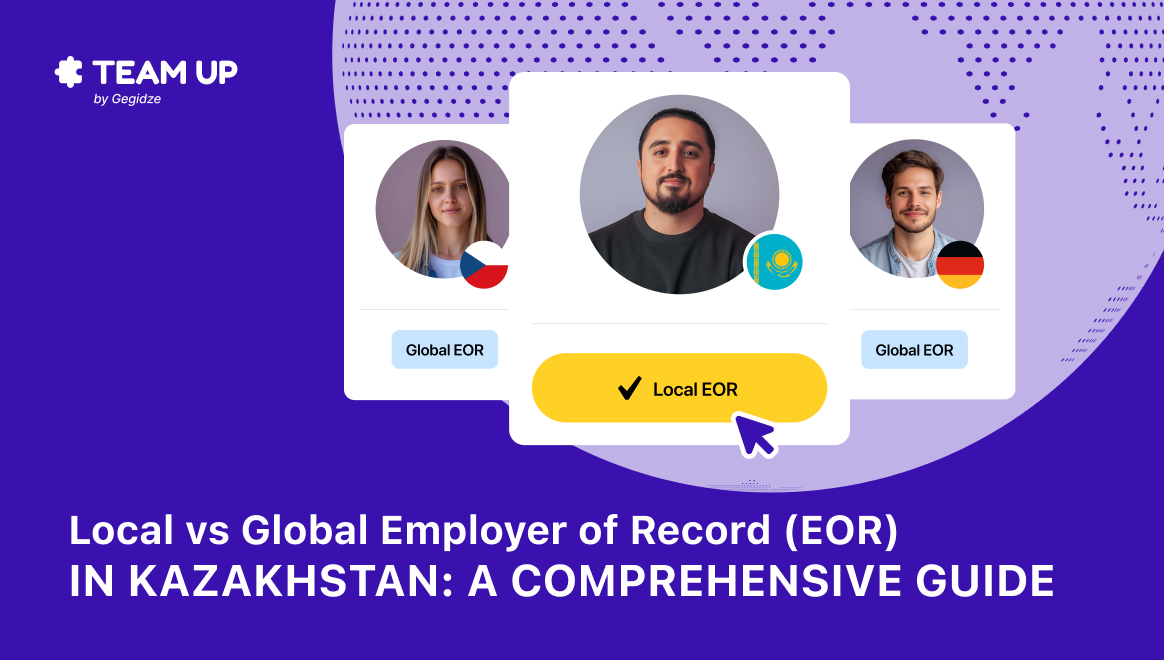
Local vs Global Employer of Record (EOR) in Kazakhstan: A Comprehensive Guide
TL;DR
- Hiring in Kazakhstan without a local entity is 100% possible – and legal – if you use an Employer of Record (EOR). An EOR becomes the local employer on paper, handling all Kazakh payroll, taxes, and compliance so your team can work for you without you setting up a subsidiary. This guide breaks down how that works in Kazakhstan.
- Kazakhstan is emerging as a talent hub in Central Asia. Companies hire here for its skilled, bilingual workforce (95% speak Russian, and 22% speak English as well as Kazakh), competitive salaries (minimum wage is only KZT 85,000, about $180), and business-friendly environment (ranked 28th globally for ease of doing business).
- Local vs Global EOR – know the difference. A local EOR (like regional provider Team Up) has its own entity in Kazakhstan, on-the-ground experts, and bilingual support. A global EOR platform might cover Kazakhstan via third-party partners – fine for basic needs, but it can stumble on local nuances (think: a developer in Shymkent asking about a public holiday and getting a shrug).
- Kazakhstan’s government systems require deep integration. Every employment contract must be registered on the national portal (enbek.kz) within 5 business days. Payroll taxes must be filed in tenge, contributions paid to state pension and insurance funds, and all documents issued in Kazakh or Russian. A good EOR handles these seamlessly – from obtaining your hire’s tax ID and bank card in 10–14 days, to digitally signing contracts with government-approved e-signatures.
- Compliance in 2026 is no joke. Kazakhstan has tightened payroll enforcement: employers must now pay a new 3.5% pension contribution (up from 1.5% in 2024), and the government is using digital tools to crack down on “shadow” employment. Misclassifying an employee as a “contractor” or missing a social insurance payment can trigger audits and back-tax penalties. In short, doing it properly is the only option.
- Labor laws are strict on terminations and inspections. There’s no “at-will” firing in Kazakhstan – every termination must follow just cause and procedures (typically 1 month notice and statutory severance of 1–2 months’ pay for redundancies). State labor inspectors can show up to review your employment records (like that ULARS contract registry).
- Pricing: local EORs favor flat fees, global EORs often use percentage markups. Many providers charge a flat monthly rate per employee (roughly €199–€599 in Kazakhstan), which covers everything. Some global EORs advertise low fees but then stack hidden costs.
- Decision time – local or global, Almaty or Astana? If you need to hire fast in Almaty with rock-solid legal compliance, a local EOR with its own Kazakh entity will shine. If you are expanding across 10 countries at once and value one streamlined platform, a global EOR might be acceptable (just don’t expect deep local hand-holding).
Quicknavigation
- TL;DR
- What “Employer of Record” Means in Kazakhstan
- Why Companies Hire in Kazakhstan
- Local vs Global EOR: How Each Model Works in Kazakhstan
- EOR Integration with Kazakhstan’s Government Platforms and Legal Infrastructure
- 2026 Payroll Enforcement and Tax Compliance Realities
- EOR Pricing in Kazakhstan: Flat Fees vs Percentage Models
- Decision Matrix for Hiring in Almaty, Astana, and Beyond
- Final Takeaway
What “Employer of Record” Means in Kazakhstan

An Employer of Record (EOR) in Kazakhstan is a third-party organization that hires employees on your behalf under Kazakh law.
In practice, your employees work for you day-to-day, but legally they are employed by the EOR’s local Kazakh entity.
The EOR takes on all the heavy lifting of local employment so you don’t have to set up a company in Kazakhstan.
What the EOR Arrangement Covers
What does this arrangement cover?
Essentially everything required by Kazakh labor and tax regulations:
- Issuing a compliant employment contract in Kazakh (and/or Russian) language
- Registering that contract with the government
- Onboarding the employee onto local payroll
- Administering monthly salary payments with all required withholdings
The EOR withholds income tax and pension contributions, pays the employer’s social taxes, files the monthly reports, and ensures the hire is fully on the books in Kazakhstan’s system.
On paper, the EOR is the “employer of record” for tax and compliance purposes, while you direct the employee’s work and retain them as part of your global team.
Why an EOR Is Mandatory in Kazakhstan
Crucially, Kazakhstan’s laws do not allow foreign companies to just hire someone locally without a local entity or representative.
You either need to incorporate in-country or use an EOR that already has an entity.
There’s no legal grey area here.
If you try to hire someone as an independent contractor but treat them like a full employee, Kazakh authorities can:
- Reclassify that person as your employee
- Hit you with back taxes and penalties
- Even invalidate your IP rights (since an informal contractor agreement might not be recognized under Kazakh law)
In short, to hire “real” employees in Kazakhstan, you need a legal employer in Kazakhstan.
An EOR gives you exactly that – instantly and without the time and expense of establishing your own subsidiary.
The EOR service provider as Your Shield
Think of a Kazakh EOR as your shield and service provider.
You manage the projects, targets, and day-to-day work of your team member in Kazakhstan.
The EOR handles the bureaucracy and liability:
- Labor contracts
- Tax IDs
- Work permits (if your hire isn’t a local citizen)
- Payroll in local currency
- Compliance with the Kazakh Labor Code
If anything goes wrong legally – an audit, a dispute, a change in law – the EOR is there to handle it with their local experts.
You get the benefits of a Kazakhstan-based team without stepping into the Kazakh tax office or learning what an “MZP” or “ULARS” means.
(For the record: ULARS is Kazakhstan’s Unified System for recording employment contracts – more on that soon.)
And MZP is the monthly minimum wage, one of many local acronyms an EOR will navigate so you don’t have to.

Why Companies Hire in Kazakhstan

The short answer is people, potential, and practicality:
Skilled Talent Pool
Kazakhstan boasts a well-educated, highly skilled workforce, especially in engineering, IT, and finance.
The country produces thousands of STEM graduates annually, and many professionals have experience in international projects.
English proficiency is on the rise – an estimated 15% (and growing) speak English, and about 22% of the population is trilingual in Kazakh, Russian, and English.
In our experience, language barriers for tech and professional talent are minimal; plenty of developers in Almaty or Astana can integrate with an English-speaking team.
(Russian remains the dominant business language, spoken by 95% of people, which is why having contracts and HR support in Russian/Kazakh is a must – your EOR will handle that.)
Cost Efficiency
Hiring in Kazakhstan can significantly stretch your budget compared to hiring in Western Europe or North America.
Salaries for comparable roles are substantially lower.
For example, the minimum monthly wage is just KZT 85,000 (about $180) as of 2025.
A mid-level software engineer might earn perhaps 40–50% of what they would demand in, say, Germany or the UK (exact figures vary, but the cost of living and salary expectations in Kazakhstan are decidedly lower).
Beyond salaries, employment costs like taxes are relatively moderate: personal income tax is a flat 10% and employer social contributions (detailed later) are reasonable by EU standards.
In short, you can build a high-caliber team in Kazakhstan at a fraction of the cost of an equivalent Western team.
This cost advantage, without compromising on talent quality, is a huge draw for startups and multinationals alike.
Strategic Location & Time Zone
Straddling Europe and Asia, Kazakhstan is in GMT+5/+6 time zones, which means a team in Kazakhstan can cover a lot of ground for global operations.
For a European company, a 3–5 hour time difference can actually facilitate near-continuous workflow (Kazakh team members can progress work during Europe’s early morning or late night).
For U.S. companies, a Kazakh team can effectively “follow the sun,” tackling tasks while the U.S. is offline.
Many companies leverage Central Asia as a bridge, your Kazakh employees can collaborate with European and Asian offices in their overlapping workday, and even hand off work to the Americas by end of their day.
Plus, geographically, Kazakhstan is central for accessing other emerging markets in the CIS and Asia.
Business-friendly Environment
Kazakhstan has made significant reforms to welcome foreign investment and improve its business climate.
It consistently ranks as one of the top economies in the region for ease of doing business – 28th out of 190 countries in the World Bank’s Doing Business report (as of 2019).
The government offers incentives in sectors like IT (e.g., the Astana International Financial Centre and Astana Hub offer tax benefits and simplified visas for tech companies).
Bureaucracy has been streamlined in many areas; for instance, registering a local LLC can be done in a matter of days.
Of course, hiring through an EOR means you personally skip even that minor bureaucratic hassle, but it’s good to know you’re operating in a country that values ease of business.
Political and economic stability are also positives – Kazakhstan is the largest economy in Central Asia, rich in natural resources and with a steadily diversifying economy.
Regional Reach
If Kazakhstan is your first foray into Central Asia/Caucasus, it can be a springboard to other markets.
A cool part about working with a regional EOR like Team Up is that once you’ve hired in Kazakhstan, expanding to neighboring countries (like Uzbekistan, Georgia, or Azerbaijan) can be as simple as adding another employee under their local entity.
In other words, today Almaty, tomorrow the region – without having to learn a whole new system.
Many fast-growing companies choose Kazakhstan as a base to tap into talent across Eurasia.
Local vs Global EOR: How Each Model Works in Kazakhstan

Not all EOR services are created equal.
In Kazakhstan, the difference between a local EOR and a global EOR provider can mean the difference between a smooth experience and a compliance headache.
Let’s break down how each model works:
Local EOR (Regional Specialist)
This is an EOR provider that actually operates in Kazakhstan with its own local company and staff.
For example, Team Up (which operates across the Caucasus and Central Asia) has a fully registered Kazakhstan LLC, real offices with real people in-country, and deeply understands Kazakh labor law.
When you partner with a local EOR specialist, your employee is hired through the EOR’s own Kazakh entity, and everything is handled in-house.
Contracts are bilingual (Kazakh/Russian and English), compliant with local templates, and won’t fall apart under legal scrutiny.
The local EOR’s HR and legal team can answer your questions on the spot (in English or Russian).
Need to know how overtime pay works in Almaty, or whether June 6 is a public holiday in Kazakhstan?
They’ll tell you without skipping a beat.
High-Touch Support from Local EORs
Local EORs also tend to offer high-touch support.
Onboarding isn’t just an automated email – it’s a human-driven process that might include helping your new hire get a tax identification number, set up a bank account for their salary, or even delivering a work laptop to their doorstep.
Because the local EOR “lives and breathes” Kazakhstan, they can proactively keep you updated on law changes (e.g. new pension rules) and handle any issues with authorities directly.
Importantly, pricing is usually transparent and flat (more on pricing later).
For example, Team Up charges a flat €199 per employee per month, with no mysterious add-ons.
The value proposition here is local expertise, no middlemen, and no BS.
As Team Up cheekily puts it, no shell company drama, no vague promises – just compliance done right.
Global EOR (Big-Platform Provider)
These are the well-known “one-stop” platforms (think Deel, Remote, Papaya Global, Velocity Global, etc.) that offer EOR services across dozens of countries.
Their model in Kazakhstan is often different under the hood.
Many global EORs do not have their own entity in Kazakhstan – instead, they partner with a local firm to employ your staff (sometimes through multiple layers of partners).
You as the client interface with the global platform (nice dashboard, single point of contact), and the platform in turn sub-contracts the employment locally.
In practical terms, your employee still gets a local contract and payroll, but the people handling it on the ground might not be the company whose logo is on the platform.
Support and Expertise Trade-Offs
What are the implications?
First, support and expertise can be a mixed bag.
The global EOR’s selling point is that you get a unified experience globally – one software, standardized processes.
That’s great if you’re hiring in 10 countries at once and need consistency.
However, the trade-off is often local nuance.
For example, if your developer in Shymkent (a city in southern Kazakhstan) has a question about how her maternity leave works or whether she can carry over unused vacation, the global provider’s representative might not know offhand.
They may need to “check with their local partner” or consult a script.
As one comparison put it, the local nuance gets glossed over.
Standardization vs Flexibility
Global EORs also might not adapt their standard templates much.
You’ll get a solid employment contract for Kazakhstan, but any special requests (“Can we add a clause about vesting equity?”) could be met with some friction if it deviates from their norm.
In essence, a global EOR prioritizes breadth over depth.
They cover many countries, but they may not dive deep into each country’s intricacies.
If you run into a very Kazakh-specific scenario – say, an employee needs guidance on a housing stipend taxation or a question about the Unified Social Fund – the global EOR might struggle to give a quick, authoritative answer.
Automation and On-the-ground Reality
Secondly, global EORs often rely on automation for efficiency.
Onboarding might be self-service through a platform.
This is efficient, but if any step requires real-world intervention (like dealing with the government portal or a bank), it’s ultimately the local partner doing it.
In Kazakhstan’s case, certain things just need a human touch.
For instance, issuing an electronic signature (to sign the employment contract) or coordinating a medical check if required for a job role.
A local EOR’s team would walk your hire through it, whereas a global EOR might send instructions and hope the hire figures it out or defer to their partner.
Accountability and Risk
Accountability is another aspect.
If something goes wrong – maybe a payroll filing was missed or an employee complaint arises – with a local EOR, you know exactly who is accountable.
The EOR itself is directly involved.
With a global EOR using partners, the risk is a bit of finger-pointing behind the scenes (“Our local partner didn’t inform us of X”).
From the client perspective, you might experience a delay in resolving issues because your queries pass through extra layers.
Which Model Makes Sense?
To be clear, global EOR providers can and do successfully employ people in Kazakhstan every day.
They are perfectly legal and often quite competent.
But you should be aware of the model.
You’re trading some local agility for global convenience.
If you are only hiring in Kazakhstan (or a few countries in the region), a local EOR will likely give you a smoother ride.
If Kazakhstan is one of 20 countries in your expansion roadmap and you value one centralized platform, a global EOR could be a fit.
Just ensure you ask them pointed questions:
- Do you have your own entity in Kazakhstan?
- How do you handle Kazakh language support?
- What’s your process for registering a contract with the government?
The best global EORs will have solid answers and perhaps even hybrid approaches.
Some are now investing in opening their own Kazakhstan entities due to client demand.
EOR Integration with Kazakhstan’s Government Platforms and Legal Infrastructure

One thing you learn quickly about hiring in Kazakhstan: the government is very present in the employment process.
There are digital systems and rules for everything, from contract registration to pension fund payments.
A reliable EOR will seamlessly integrate with all these platforms, acting as your experienced local pilot through Kazakhstan’s bureaucratic landscape.
Here are key government touchpoints and how an EOR deals with them:
ULARS (Unified System for Recording Employment Contracts)
Kazakhstan requires every official employment contract to be registered in a central database called ULARS, accessible via the Electronic Labor Exchange (enbek.kz).
When you hire someone through an EOR, within 5 working days of signing the contract the EOR must enter the contract details into ULARS.
This includes the parties’ info (employer BIN, employee ID), job title, start date, contract term, etc.
If you were hiring on your own, failing to register could eventually trigger warnings or fines (labor inspectors check this), but with an EOR you don’t even need to know ULARS exists – they handle the integration automatically.
Top EORs may even have their HR systems tied via API to ULARS for instant registration.
The benefit for you? Full compliance and transparency – your employee’s status is recorded with the government, protecting both of you.
(Employees can even check their own contract info via the eGov.kz portal, which is a nice assurance that everything’s legit.)
Bilingual Contracts and Official Templates
Kazakhstan’s Labor Code has specific requirements for employment contracts.
They should contain certain clauses (job role, salary, work hours, etc.) and be in the local language.
Kazakh is the state language, and Russian is commonly accepted as well – in practice many companies do bilingual contracts in Kazakh and Russian.
A good EOR will provide a dual-language contract (Kazakh/Russian) with an English translation for your reference.
This ensures that the contract is enforceable locally (courts will only honor the Kazakh/Russian text) and you understand what’s in it.
The contract will follow the standard format that Kazakh authorities expect, with any custom terms carefully vetted against local law.
For example, if you need an IP ownership clause or a non-compete agreement, the EOR will integrate it in a way that aligns with Kazakh civil law.
Remember, local formality is key – an EOR knows which stamps, signatures, or electronic signatures are needed.
Kazakhstan has a National Certification Authority for digital signatures (NCA), and many documents can be signed electronically.
EORs often have corporate e-signatures to sign contracts on their side, while employees may sign via SMS or a one-time code.
All this happens in the background to you – from your perspective, your hire signs the contract and is good to go.
But under the hood, the EOR is making sure, for instance, that the contract is signed with a valid NCA-backed digital signature (so it’s considered legally signed).
Tax Registration and Employee IDs
Every employee in Kazakhstan needs an Individual Identification Number (IIN) for tax and pension purposes.
Kazakh citizens have this from birth.
Foreigners need to get one when they start work.
An EOR will ensure your new hire has an IIN.
If the person is a local, they already have it – the EOR collects it.
If the person is a foreigner relocating or working locally, the EOR will obtain an IIN for them.
This process might involve a passport copy and an application to the State Revenue Committee.
Additionally, if your hire is foreign and working in KZ, a work permit or proper visa might be needed, depending on their status.
An EOR can sponsor and arrange those as the legal employer.
All these IDs and permits are then used to register the person in payroll systems.
As a concrete example, Team Up’s onboarding in Kazakhstan typically takes 10–14 days, during which they handle contracts, get tax IDs, and even set up local bank cards for the employee’s salary.
So by the time your engineer or sales rep starts work, they’re fully “papered” – registered with authorities and able to be paid.
Payroll and Tax Portals
Kazakhstan’s tax authority (the State Revenue Committee) and its social funds (for pension, social insurance, and medical insurance) are largely digitized.
Employers file monthly reports for income tax and social contributions, usually through an online cabinet or integrated accounting software.
A local EOR will have the necessary software (often 1C or similar local payroll systems) to calculate and file all the required items.
They will calculate the personal income tax (with any applicable deductions), the social tax, pension contributions, and so on.
They then submit the reports electronically and make payments to the government.
From your perspective, the beauty is you get one invoice from the EOR – often in your currency (USD or EUR) – and you pay that.
The EOR takes care of converting to tenge and disbursing the funds inside Kazakhstan to the employee and tax authorities.
For instance, that invoice might show: Net salary $X, plus 10% tax, plus 3% medical, plus 11% social tax, etc.
The EOR handles paying each part to the right place.
No wrestling with Kazakhstan’s online banking or worrying about exchange rates.
The EOR even provides pay slips to your employee as required by law.
“Government for Citizens” Integration
Kazakhstan consolidates a lot of social payments via a state entity called the Government for Citizens.
This acts as a one-stop for pensions, insurance, and related contributions.
Employers have to remit pension and insurance contributions to this fund under each employee’s name.
An EOR integrates with this by submitting each employee’s details and the amounts each month.
They ensure that, for example, your employee’s 10% pension deduction is credited to their personal pension account at the Unified Accumulative Pension Fund (UAPF).
They also ensure the employer’s pension contribution (3.5% in 2026) is paid in.
The same applies to mandatory medical insurance – 2% from the employee and 3% from the employer to the social health insurance fund.
These may sound like acronyms and minutiae, but they matter.
If an employer doesn’t pay into the funds, the employee might be marked as “uninsured” or lose pension accruals, which can cause complaints and legal issues.
A local EOR’s payroll system will tick all these boxes automatically.
Local Employment Policies
A subtle part of integration is that an EOR, as the employer, needs to uphold Kazakh labor standards in practice.
This includes maintaining documentation like time sheets, vacation records, and possibly a local labor order book.
Some companies still do this digitally.
If the Labor Inspectorate ever asks, the EOR should be able to present the required records.
EORs also integrate with platforms for reporting vacancies or workforce movements if required by law.
For example, in some cases, large employers need to report workforce statistics to authorities.
These are things you as a client never see, but they provide peace of mind that compliance is being maintained.
E-Government Services
Kazakhstan has an Egov.kz portal, where many services are available, from business registration to tax statements.
An EOR will use their credentials to obtain necessary clearances.
For example, before terminating an employee, an employer might need to obtain a statement that the employee isn’t on maternity leave from the Social Fund.
These are edge cases, but they underscore that your EOR is essentially plugged into the government’s grid on your behalf.
They ensure that any required notifications are handled.
This can include informing the employment center about mass layoffs or updating residency info for foreign workers.
2026 Payroll Enforcement and Tax Compliance Realities
Welcome to 2026, where Kazakhstan’s payroll and tax rules are more robust (and strictly enforced) than ever.
In recent years, the government has stepped up efforts to modernize the system, increase social contributions, and crack down on non-compliance.
Here’s what you need to know about the current reality, and how an EOR keeps you on the right side of it:
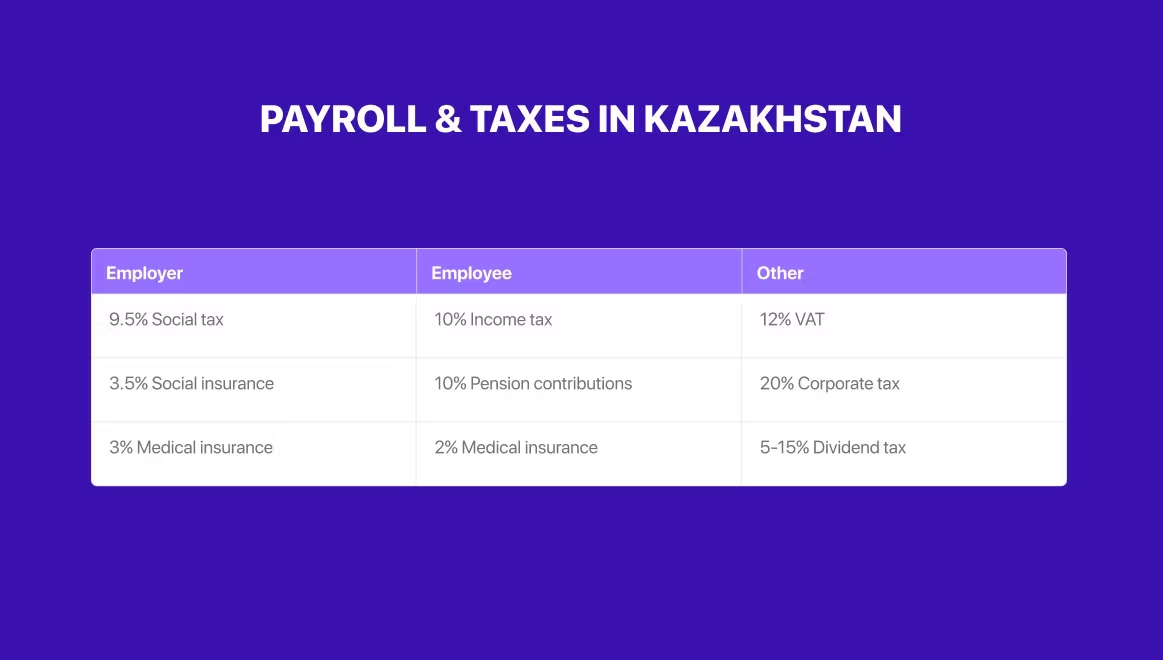
Tax and Contribution Overview
Hiring an employee in Kazakhstan triggers a number of taxes and mandatory contributions.
By law, these must be calculated and remitted either monthly or quarterly.
In 2026, the key components include:
Personal Income Tax (PIT) in Kazakhstan
Flat 10% of the employee’s taxable income.
This is withheld from the employee’s salary each month.
It’s straightforward arithmetic, but compliance means registering the employee with the tax authorities and filing monthly payroll reports.
The PIT is relatively low (one of Kazakhstan’s draws), but don’t let that fool you – it must be remitted on time, and the reporting must be accurate, or penalties apply.
Typically, the EOR will deduct 10% from gross salary and pay it to the State Revenue Committee for you.
Social Tax and Social Contributions (Employer’s Burden)
This is essentially the payroll tax the company pays on top of salaries.
As of 2025/2026, the employer social tax is effectively 11% of gross salary (11% is the rate, but the first 5% of that goes into social insurance fund, leaving 6% net to budget).
Additionally, in 2026 employers must contribute 3% for mandatory medical insurance (OMIC) and 3.5% for employer’s pension contribution.
Summing up, for a typical employee the company pays roughly 17.5% on top of salary in various contributions.
There are caps based on the “Monthly Calculation Index” (MCI) and minimum wage – for instance, social insurance contributions are capped at 7 * minimum wage – but an EOR’s payroll system handles those automatically.
The important part: these rates have been changing.
The social tax was 9.5% a couple years ago and increased to 11%.
The employer pension started at 1.5% in 2024 and rose to 3.5% in 2026.
The government has announced further increases (it will be 5% by 2028).
This means compliance isn’t “set and forget”.
You need to stay updated.
An EOR does that for you, adjusting payroll calculations whenever a new law hits, so you’re never underpaying (and risking arrears) or overpaying (losing money unnecessarily).
Employee Contributions
Apart from the 10% PIT, employees also have 10% pension deducted from their salary (this goes to their personal pension account), and 2% medical insurance deducted.
So an employee’s take-home pay is gross minus 12% (pension + medical) minus 10% PIT, roughly.
The EOR ensures these deductions happen and the money is forwarded to the right funds.
If an employee checks their account on the pension fund website (yes, that’s a thing here), they will see the contributions credited – a sign of a compliant employer.
It’s worth noting for employees: these contributions benefit them (pension savings, healthcare coverage), so it’s important they are paid correctly.
A good EOR takes pride in not only avoiding fines, but in treating your employees as any top local employer would, fulfilling all obligations so the employees have no issues (like trouble getting medical care or a mortgage due to missing contributions).
Monthly Calculation Index (MCI) and Caps
The MCI is a unit (adjusted annually for inflation) that Kazakhstan uses to set thresholds for various taxes and benefits.
In 2026, the MCI is KZT 4,325.
Many contribution caps are expressed as multiples of MCI or the minimum wage.
For example, the cap for calculating pension contributions is 50 * minimum wage – beyond that salary, additional income isn’t subject to pension.
Similarly, social insurance capped at 7 * minimum wage, etc..
What this means is if you have a high-earning employee, there’s a ceiling beyond which some contributions stop increasing.
But calculating that correctly is tricky if you’re not familiar.
The EOR’s job is to ensure if someone’s making, say, KZT 3,000,000 a month, they don’t over-deduct pension beyond the cap.
Conversely, if someone’s salary changes mid-year, the EOR prorates contributions properly.
The mention of MCI in the law can confuse newcomers – it’s essentially a way Kazakhstan indexes fines and contributions.
Miss a detail on these caps or index updates, and you could either pay too little (hello penalties) or upset your employee by deducting too much.
As Team Up quipped, the rules change, contributions have caps, and they’re tied to the MCI.
Miss something, and your business could face audits or fines.
Exactly so.
Enforcement and Audits
Kazakhstan’s tax authorities and pension fund have become increasingly vigilant.
With everything being reported online now, discrepancies get noticed.
For instance, if you fail to pay an employee’s pension one month, the UAPF (pension fund) might flag it and that could prompt a review.
The tax office can and will conduct audits, especially if an employee is improperly treated as a contractor.
Remember, the government’s stance is clear: if someone works like an employee, they must be employed and all payroll taxes paid.
The authorities have even been known to use bank transfer data to identify regular monthly payments to individuals and cross-check if those individuals are registered as employees.
2026 brings a new Tax Code and a push to bring more people into the formal system.
The tax authorities launched special regimes for self-employed to encourage them to register and pay into pensions.
All of this means they are actively looking for those trying to “fly under radar”.
In short, if you tried to skirt the system, 2026 Kazakhstan is not the place or time to do it.
EOR service providers as compliance shield
An EOR service provider in this environment is invaluable.
They will keep you updated on changes (for example, they’d alert you that employer pension went up by 1% this year, affecting your costs).
More importantly, they’ll simply implement the changes without you needing to worry.
If the government issues a new decree, say, a bonus tax break or a change in reporting forms, the EOR adapts.
They also handle the actual audit risk.
If an audit occurs, it’s usually the local employer (the EOR) that gets audited.
And as long as you’ve been working through the EOR, there should be nothing to hide.
Indeed, with Team Up’s model, your audit exposure is zero – they are the inspected party, not you.
They have all the payroll records, and you won’t be the one scrambling to pull together compliance documents for inspectors in Kazakh or Russian.
Real-world Scenario
Imagine it’s mid-2026 and Kazakhstan decides to introduce, say, a new unemployment insurance contribution (hypothetically).
If you’re on your own, you might not even hear about it until a year later when a penalty arrives.
If you’re with an EOR, you’d get a concise update: “Hey, there’s a 1% new contribution starting next month; we’ll handle it and here’s how it affects the invoice.”
Done.
This kind of thing has happened.
For example, the gradual introduction of the employer pension from 2024 was communicated by good providers well in advance, so clients weren’t caught off guard by slightly higher costs.
Special Cases
If you hire certain categories of employees, compliance can have extra steps.
For example, hiring a pregnant woman or a new mother?
Kazakh law provides generous maternity leave (fully paid by the state for ~126 days, plus up to 3 years unpaid leave with job protection).
An employer must properly document and report the maternity leave to the social authorities so the employee gets her state benefits.
An EOR absolutely will know how to do this, ensuring your team member gets her due.
If you ever have to terminate someone (we’ll cover termination next), having complied with all payroll obligations strengthens your position.
No claims of unpaid dues can complicate the process.
The Reality in 2026
The reality in 2026 is that Kazakhstan’s employment compliance is thorough but manageable – if you know the system.
The government is actually making it easier in some ways through digitalization (no more paper queues for filing taxes).
But that also means there’s a digital trail for everything.
The mantra is: pay on time, pay correctly, and you’ll sleep well.
An EOR makes that happen in the background.
They treat a 12% social tax and a 2% health deduction as not just line items, but as a trust.
Trust that your company is doing right by its Kazakh team and the country’s laws.
Break that trust, and you face fines or worse.
Uphold it, and you build a reputation as a compliant international player.
EOR Pricing in Kazakhstan: Flat Fees vs Percentage Models
Let’s talk money – specifically, what you pay an EOR and how different providers structure fees.
Pricing might not be the sexiest topic, but it’s often the deciding factor for CFOs comparing EOR options.
The key is to look beyond the headline fee and watch for hidden costs.
In Kazakhstan, as in other markets, EOR pricing typically comes in two flavors:
1. Flat Monthly Fee per Employee
This model is straightforward – you pay a fixed fee for each employee, each month.
For example, Team Up advertises €199 per employee per month in Kazakhstan.
Other providers might be €300, €500, etc., depending on their service level.
The beauty of a flat fee is transparency and predictability.
You know exactly what the service will cost every month, regardless of the employee’s salary.
Flat fees usually bundle all standard services:
- Onboarding
- Contracts
- Monthly payroll processing
- Tax filings
- Offboarding
There shouldn’t be extra charges unless you request some special one-off service outside the norm.
Local/regional EORs tend to favor flat fees as a selling point (“no percentage markups, no surprises”).
It aligns with a no-nonsense approach.
2. Percentage of Payroll
Some global EOR providers charge a fee as a percentage of the employee’s salary (often between 10% to 15%).
For instance, if your employee’s gross cost (salary + employer contributions) is $2,000, a 10% fee would be $200.
This model can sometimes look attractive for lower-paid employees but can become very expensive for higher-paid roles.
If you’re hiring a senior developer at $5,000/month gross cost, that same 10% is $500.
Percentage models often have a minimum floor too (e.g., “10% or $300, whichever is higher”).
Global platforms sometimes effectively use a percentage even if they quote a flat fee by factoring in average salaries.
Others explicitly list a percentage.
One rationale for percentage pricing is that it scales with complexity – a higher salary often means slightly more work (calculating bigger taxes, maybe more benefits?), but honestly, the work difference isn’t huge.
It’s often just a way to align with what the market will bear.
From a client perspective, percentage fees can punish you for paying your people well.
If you plan to hire top-tier talent in Kazakhstan at globally competitive salaries, a flat fee is usually more economical.
Hidden Costs to Watch For
Regardless of flat or percentage, ask each provider what’s included and what’s extra.
Here are some potential add-ons or hidden costs some EORs might have:
Onboarding or Setup Fees
A one-time charge when you add a new employee.
Some providers might say,m “Our fee is $300/month flat, plus $500 initial setup per employee.”
Others don’t charge setup at all.
If you plan to scale from 1 to 20 employees, those setup fees add up.
Always ask:
Do you charge an initial onboarding fee per hire?
Offboarding Fees
Similar to the setup, but when an employee is terminated.
This could be justified by the extra work of closing accounts, final calculations, etc., but many EORs consider it part of the service.
Hidden offboarding fees might not be advertised.
You’d find out in the contract fine print.
Ask:
Any fees for terminating an employee or closing out an employment?
Currency Conversion Markups
If you pay the EOR in USD or EUR, but they pay salaries in KZT, there’s a conversion.
The interbank rate might not be what you’re charged.
Some providers might bake in a few percentage points as a forex margin.
It’s not always disclosed as a “fee,” but it means you effectively pay more.
For example, if 1 USD = 480 KZT official, they might invoice you at 470 KZT rate – that difference is their gain.
A transparent provider will either use mid-market rates or explicitly tell you their conversion policy.
Benefits Administration Costs

If you offer extra benefits (like private medical insurance, gym memberships) via the EOR, there might be additional fees.
For instance, global EORs often can procure local health insurance but at a markup or admin fee.
Same for equipment or expense reimbursements.
Some may handle them but charge a bit for the service.
Clarify what happens if you want to provide additional perks:
Does the flat or percentage fee cover administering benefits, or is there an extra charge?
Payroll Tax Handling Fees
This one is rare in EOR, since it’s core to the service.
Still, ensure that all mandatory contributions and filings are included in the fee.
A shady scenario would be an EOR quoting a low fee but then saying:
“Oh, processing the monthly tax filings is extra.”
Reputable ones include it.
The fee should cover full compliance, not just cutting payslips.
Volume or Multi-Country Discounts
Not a cost, but an opportunity.
If you have multiple hires or plan to expand to other countries with the same provider, you might negotiate better rates.
Local EORs sometimes have flexibility to lower the per-head fee as you scale.
Global EORs might have standard volume pricing tiers.
It’s worth asking:
If I add more team members, can we revisit the fee?
Service Tier Differences
Watch out for words like “Basic vs Premium package.”
Some EORs have tiered services.
The basic might be cheap but could omit things like legal support in disputes or a certain level of HR assistance.
The premium at higher cost might include those.
This is more common in large enterprise providers.
In SME-focused ones, usually one size fits all.
Annual vs Monthly Billing
Some providers might ask for fees quarterly or annually up front.
This can happen especially if they give a discount.
Understand the payment terms, since it affects cash flow.
Most providers bill monthly, aligned with payroll.
Kazakhstan-specific Cost Context
The fees mentioned (like €199) are in line with local or regional EORs.
Global players might charge more due to overhead or because Kazakhstan is a less common destination.
Team Up’s research indicated that most EOR providers in Kazakhstan charge between €199 and €599 per month per employee.
That’s a broad range.
Typically, a global provider with a flashy platform might be at the higher end (~€500), while a lean local operator is at the lower end (~€200).
It might be worth asking:
If a provider is quoting €600, what are they offering that the €200 provider isn’t?
Often the answer lies in technology or global integration rather than any difference in local compliance.
Compliance is binary – you either do it right or you don’t.
Cost Visibility and Risk
One hidden cost of not using an EOR is the potential fines and remediation costs if you mess up.
Hiring directly “cheaper” can lead to expensive outcomes later.
Lawyers, back payments, audits.
We’ve seen companies lured by a lower percentage fee with a global EOR, only to later face issues because that provider’s partner messed up a filing.
Then they had to bring in advisors to clean up.
Reliability saves money.
Flat vs Percentage in Practice
Let’s do a quick math example.
Suppose you have an employee with a gross salary of $1,500/month.
Add employer contributions (~17.5%), that’s ~$1,765 total gross cost.
If a global EOR charges 10%, their fee is $176.
If a local EOR charges $220 flat, the global looks cheaper in this case.
Now imagine a senior manager at $4,000/month gross.
Total cost maybe $4,700 with taxes.
10% = $470 fee.
The flat $220 is less than half that.
As you hire more senior roles, flat wins out.
If your team will grow and include higher-paid members, a percentage model can quietly become a big line item.
It’s like a tax on payroll that grows as you give raises or hire top talent.
Many CFOs prefer flat for this reason.
It encourages predictability.
Transparency Check
The hallmark of a trustworthy EOR, especially local ones, is forthrightness about pricing.
They’ll happily enumerate:
“Our fee is X, and this covers A, B, C. The only extra you’d ever pay is government pass-through costs like work permit fees or specific benefits premiums if you opt for them, and we’d always discuss those.”
If a provider is cagey – “Let’s discuss pricing on a call” and won’t give even a ballpark publicly – that could be a red flag.
It might indicate higher fees or variable charges they tailor per client.
In the comparison of Top 5 EORs, a point was:
Is pricing always “talk to sales” or do they put numbers out there?
Team Up, for instance, plasters €199 on their site.
Pretty direct.
The Hidden Cost of Bad Service
Beyond fees, consider the hidden cost of choosing a weak provider.
If an EOR is slow to respond or makes frequent mistakes, that costs you time and stress.
If an employee’s pay is late or wrong, that can lead to dissatisfaction or turnover.
Those intangible costs might dwarf a $100 savings in monthly fee.
So price should be weighed with quality.
Sometimes paying a bit more to a provider with a better track record saves money in the long run.
Ideally, you want both.
A fair price and excellent service.
That often exists with regional specialists.
Negotiating
Don’t be afraid to negotiate with EORs.
Especially if you have multiple employees or multi-country needs.
Many will come down a bit or throw in an extra service.
The EOR space is competitive now.
Kazakhstan is an emerging market for it.
Your business is valuable.
Use that leverage.
Decision Matrix for Hiring in Almaty, Astana, and Beyond
Kazakhstan is a vast country (9th largest in the world by land area), and where your employees are located can slightly influence your hiring strategy.
Let’s break down considerations for hiring in the major hubs – Almaty and Astana (Nur-Sultan) – versus other regions, and how that might factor into choosing an EOR or employment model.
Think of this as a mini decision matrix, although thankfully Kazakhstan’s labor laws are national (no regional differences in law), so it’s more about practical and talent differences.
Almaty – The Commercial & Tech Hub

Almaty is the largest city, the former capital, and still the cultural and business heart of Kazakhstan.
It’s often the top choice for companies hiring remotely in KZ because:
Talent availability
Almaty has the highest concentration of skilled professionals, especially in IT, finance, marketing, etc.
The city produces lots of multilingual talent and hosts branches of international companies.
If you’re looking for software developers, designers, or finance analysts, Almaty’s talent pool is deep.
Expectation management
Salaries in Almaty are the highest in Kazakhstan (alongside Astana), due to the higher cost of living and competition.
If you hire in Almaty, expect to pay a bit more than you would for the same role in a smaller city – but still much less than Western cities.
Also, candidates in Almaty often expect good benefits and modern workplaces.
They’ve seen the Googles and Microsofts set up shops or at least heard of them, so offering things like private health insurance or flexible hours can help attract top candidates.
An EOR can advise on the current market rates and benefits norms in Almaty.
Infrastructure
Almaty has excellent internet, co-working spaces, and a community of remote workers.
If you needed to provide a co-working desk for an employee, it’s easy in Almaty (and your EOR can arrange memberships at top co-works).
Also, flights in and out for any meetups are plentiful – Almaty’s international connections are quite good.
Decision factor
If speed and scale are your priority – e.g., hire 5 developers in a month – Almaty is your best bet because of talent availability.
A local EOR in Almaty (like Team Up’s presence) can onboard people quickly since they’re right there to assist with paperwork or deliver equipment.
Almaty is also where a local EOR’s own HQ might be, meaning direct support is right there.
As one guide put it: Need to onboard fast in Almaty with airtight legal protection? You’ll want an EOR with a local entity and real expertise – in other words, someone who really knows Almaty.
Astana (Nur-Sultan) – The Capital City

Astana is the political capital, home to the government and many large corporate headquarters.
Key traits:
Talent availability
Astana (recently renamed back to Astana from Nur-Sultan) has a growing young professional scene, buoyed by government initiatives and the Astana International Financial Centre (AIFC) – a hub trying to attract fintech and finance firms.
You’ll find plenty of English-speaking finance lawyers, policy experts, and engineers here, too.
The talent pool is a bit smaller than Almaty’s, but still very significant.
Astana also draws people from all over the country for government jobs, so it has a mix.
Salaries and expectations
Similar to Almaty in many ways, perhaps slightly lower in some fields, but not by much.
The cost of living can be lower except housing, which can be pricey in the city.
If you’re hiring someone who interacts with government or needs to be in capital (say a regulatory affairs manager, or a rep for your company), Astana is obvious.
Many bilingual (Kazakh-English) professionals are in Astana due to government needing those skills.
Infrastructure
Astana is a planned city with modern infrastructure – good internet, etc.
One consideration: the climate.
Winters are brutally cold.
This might make remote work from home challenging if, say, power/internet issues occur during storms.
It’s not a deal-breaker, but it’s something a local EOR would know: providing a good UPS or backup internet for an Astana remote worker in winter might be wise!
Co-working spaces exist but fewer than Almaty.
Decision factor
If you need roles tied to government relations or you find a great candidate in Astana, go for it – an EOR can hire anywhere.
There’s no legal difference.
The only potential downside of hiring in Astana is that the population size is smaller (~1.2M vs Almaty’s 2M), so for very specialized roles, the talent pool might be thinner.
But thanks to internal migration, Astana is full of ambitious folks from all provinces.
For some companies, a mix is nice: have some team members in Almaty, some in Astana, and maybe let them meet occasionally (an hour and a half flight apart).
Other Cities (Shymkent, Karaganda, Atyrau, etc.) – The “Beyond”
Many other cities have universities and industries:
Shymkent
Third largest city, a cultural and commercial center in the south.
Growing tech scene, though smaller.
If you had operations dealing with Uzbekistan or Kyrgyzstan, Shymkent is near those borders.
Karaganda, Pavlodar, etc.
Industrial cities, good for engineering talent (mining, mechanical, etc.), though those folks often relocate to bigger cities for better jobs.
But remote work has allowed some to stay put.
Atyrau / Aktau
Oil industry hubs in the west.
A lot of oil & gas engineers and project managers there.
If you’re an energy company, you might target those regions.
Remote villages
It’s even possible to hire someone who lives in a smaller town or village.
They’ll need decent internet and probably will work from home exclusively.
Kazakhstan’s internet coverage is pretty good in most populated areas, but not universal.
When hiring outside Almaty/Astana, consider:
Salary differentials
Generally, salaries are lower in smaller cities.
Hiring a developer in a smaller town might save you some money, but only if you find one.
Often, the best talent from small towns moves to Almaty/Astana for opportunity, or they’re open to working remotely for you if they can stay home (which is a perk for them).
So you might snag a great person in, say, Karaganda at a slightly lower cost simply because their local cost of living is lower and they’re happy not to move to Almaty.
But don’t count on huge differences; top talent everywhere knows their worth.
EOR support
A local EOR can still support remote employees anywhere.
They might courier contracts or have the employee use the digital signature system.
They might not have a physical office in that small city, but they manage via online means.
Ensure your EOR can provide things like shipping of IT equipment nationwide, and knows how to handle any local nuances (e.g., registering a resident of, say, Aktobe in the pension system – it’s the same national system, but local branch might be involved).
For context, Team Up has local entities in multiple countries, but within KZ they likely coordinate centrally.
That’s fine because KZ is unitary in law.
Labor inspections in regions
If you only have one employee in a smaller city, the chance of a random inspection is low, but not zero.
However, inspectors can travel or handle things centrally.
If something arises, the EOR’s presence in Almaty/Astana will cover it.
They may not have an office in the small town, but they coordinate with authorities.
For example, if an inspector in Shymkent queries about your employee there, the EOR will likely communicate with them by sending documents or having their regional partner respond.
Team Up’s own note in a provider comparison was: pick an EOR that “won’t ghost you when you need support in Russian at 4 pm on a Thursday” – basically, you want someone responsive regardless of where the issue arises.
onboard them in days there. Good choice: Local EOR, Almaty.
You also want one business development person working with government clients – Astana is ideal for that profile. EOR can hire in Astana no problem. Good to have a local presence through EOR.
You’re considering a customer support rep who could be anywhere (maybe even in a smaller city where wages are lower). Your EOR finds you a candidate in Shymkent who’s excellent and happy to work remotely from there. Great, you hire them. EOR couriers a laptop to Shymkent, registers it, done.
Final Takeaway
In sum, what do founders and CFOs get wrong?
Often it’s underestimating the need for local compliance and expertise, or trying to take shortcuts that backfire.
They might also focus on the wrong criteria (like cost over quality) or fail to leverage the EOR properly.
But you, having read this guide, are now equipped to get it right.
You know that in Kazakhstan, you should hire through a proper EOR from the get-go, respect the local laws and norms, choose a provider that offers transparent pricing and real local know-how, and maintain good communication.
Do that, and you’ll avoid the pitfalls that have tripped up others.
To quote a bit of local-flavored wisdom: hiring in Kazakhstan isn’t a wild steppe if you have a reliable guide.
Team Up and similar regional EORs position themselves as exactly that – the reliable guide so you don’t get lost.
The founders and CFOs who “get it right” are the ones who partner with the right people and respect the process, rather than fight it or ignore it.
Frequently asked questions
1. What is the biggest compliance shift in Kazakhstan in 2026?
The most critical change is the USREC (Unified System for Registration of Employment Contracts) enforcement. All employers must register contracts, terminations, and amendments on the state portal hr.enbek.kz within 5 business days.
- The New Liability: Starting March 12, 2026, failure to register or untimely entry results in administrative fines ranging from KZT 259,500 to KZT 648,750 (~$550–$1,400) depending on business size.
- Why it matters for EOR: A Global EOR that subcontracts to a local partner often has a "communication lag." If they don't hit "submit" on the portal within that 5-day window, your company is legally exposed.+1
2. Is there a "Global Tax" when hiring in Kazakhstan?
Yes. In 2026, the pricing structures between Local and Global EORs have diverged significantly.
- Local EOR (e.g., Team Up, MetaHR): Typically charges a Flat Fee (e.g., €199–€300/month). They operate through their own Kazakh entities and offer direct billing.
- Global EOR (e.g., Deel, Remote): Usually starts at $599/month or a percentage of salary (10-15%). This "success tax" means as your employee’s salary grows, your EOR fee balloons without any added service.
3. How do the new 2026 tax rates affect my budget?
As of January 1, 2026, Kazakhstan implemented a new Tax Code. While the Individual Income Tax (IIT) remains a flat 10%, employer-side costs have evolved.
- Standard Employer Burden (~22%):
- Social Tax: 11% (increased in some sectors)
- Social Insurance: 3.5%
- Medical Insurance (MSHI): 3%
- Mandatory Pension (OPC): 10% (employee-borne) + additional employer pension contributions for specific categories.
The "IT Exemption": If you use a Local EOR that has Astana Hub residency, you may be eligible for significant tax exemptions (0% Corporate Income Tax and reduced social taxes). Most Global EORs do not pass these specific local incentives through to the client.
4. Can I use English-only contracts in Kazakhstan?
No. Under the Kazakhstan Labor Code, all employment contracts must be in Kazakh or Russian.
- The Trap: Global EORs often provide a "standard English template" with a loose translation.
- The Solution: A Local EOR provides ironclad bilingual contracts (Kazakh/Russian + English). In 2026, the USREC portal requires specific fields (IIN, position codes, start dates) that must match the local language version exactly, or the registration will be rejected.
5. What is the "15-Day VAT Refund" rule for 2026?
Kazakhstan has extended its Digital VAT pilot through the end of 2026. This allows for automated VAT refunds within 15 working days (down from 75 days) if the company uses the Digital Tenge system.
- Local EORs are integrated into these local banking and e-invoicing systems, ensuring your service fees are processed correctly.
- Global EORs often struggle with the "Digital Tenge" requirements, leading to VAT complications and slower expense reimbursements.
6. Termination in Kazakhstan: How strict is it?
Kazakhstan is highly protective of workers. You cannot terminate "at will."
- The Procedure: For disciplinary reasons, you must request a written explanation and allow the employee 2 working days to respond.
- The Risk: If an EOR doesn't document this in the state portal correctly, the employee can challenge the dismissal in a labor court. Local EORs provide "on-the-ground" HR support to manage these sensitive procedures; Global EORs often handle this via email tickets from another time zone.
.svg)