How to Onboard and Manage Teams via EOR in Portugal

An employer of record lets a foreign company hire in Portugal without registering a local entity. A London-based fintech firm needed two product designers in Lisbon within 14 days. Setting up a Portuguese subsidiary would have taken months. Through an EOR, both designers were on payroll within 10 business days, and the team grew to five within the quarter.
Portugal attracts distributed teams for good reasons. The country follows EU employment directives, offers a deep talent pool in tech and creative roles, and operates under a well-codified labor framework. But Portuguese employment law carries obligations that catch foreign employers off guard. Statutory leave, social security contributions, fixed-term contract limits, and termination protections all require local compliance from day one.
This article covers the mechanics of using an EOR in Portugal. You will find how the model works under the Portuguese Labor Code, what onboarding actually looks like, how daily team management splits between you and the EOR, and where the financial and operational risks sit.

What Is an Employer of Record?

Employer of Record Meaning and Legal Definition
An Employer of Record (EOR) is a third-party company that legally employs workers on behalf of a client business in a foreign country. The EOR signs the employment contract, runs payroll, withholds taxes, and files statutory contributions. Your company directs the employee's daily work. The EOR carries the legal employer obligations.
This split matters. The client controls what gets done. The EOR controls how employment law gets followed. A US SaaS company hiring a data analyst in Porto does not need to understand Portuguese social security filing deadlines. The EOR handles that obligation directly.
The model works because Portuguese law recognizes the entity that signs the contract as the employer. The client company does not appear on Portuguese payroll registers. It does not file with the Segurança Social. It does not draft contracts under the Código do Trabalho. The EOR does all of that.
EOR vs PEO: A Structural Distinction
An EOR model is distinct from a Professional Employer Organization (PEO). The difference is structural, not cosmetic. A PEO enters a co-employment arrangement. You must already have a local entity. The PEO shares employer responsibilities with your existing legal presence.
An EOR replaces the need for that entity entirely. You have no Portuguese subsidiary, no branch office, no fiscal registration. The EOR is the sole legal employer. For companies hiring their first employee in Portugal, this distinction determines feasibility. A PEO co-employment solution requires you to already be established locally. An EOR does not.
Why Companies Use an EOR Instead of a Local Entity
Incorporating in Portugal takes time. Registration with the commercial registry, tax authority enrollment, social security setup, and bank account opening can stretch across several months. A Berlin e-commerce company that needed a Portuguese customer support team of four could not wait that long. Through an EOR, the first hire started in 8 days. The entity question became irrelevant.
EOR fees across the region typically fall between €200 and €600 per employee per month. Entity setup costs run into thousands in legal, accounting, and registration fees before you pay a single salary. For teams under 15 people, the math usually favors the EOR model.
How EOR Services Work in Portugal

Portugal's Legal Employment Framework and the Labor Code
Portugal's primary employment legislation is the Labor Code (Código do Trabalho). This framework governs contracts, working hours, leave entitlements, termination rules, and collective bargaining. Portugal is a member of the European Union and follows EU employment directives on worker protections, data privacy, and anti-discrimination.
Employment contracts in Portugal can be fixed-term or open-ended. The Labor Code defaults to open-ended contracts. Fixed-term contracts require objective justification. Portugal observes a statutory probationary period for new employees, and the length varies by contract type and role seniority. Portugal mandates both employer and employee contributions to the Segurança Social. The contribution percentages are set by statute and revised periodically. Confirm current rates with the Segurança Social portal before budgeting.
An EOR operating in Portugal must comply with every provision of this framework. There is no lighter-touch regime for foreign-sponsored employment.
What an EOR Handles on Your Behalf in Portugal
The scope of employer of record services in Portugal is broad. The EOR drafts compliant employment contracts under the Código do Trabalho. It registers employees with the Segurança Social. It calculates and withholds IRS (personal income tax) each month. It processes payroll in euros and issues Portuguese payslips.
Beyond payroll, the EOR manages statutory leave tracking. Employees in Portugal are entitled to a minimum of 22 working days of annual leave per year. The EOR enforces that floor. It also tracks public holidays, sick leave documentation, and parental leave entitlements under Portuguese law.
A Toronto-based consulting firm with three analysts in Lisbon did not have an HR team familiar with Portuguese labor obligations. Their EOR handled contract renewals, annual leave accrual, holiday pay calculations, and year-end tax reporting. The firm's internal team focused on project delivery.
Global EOR Services vs Local Portuguese EOR Providers
Global EOR platforms cover dozens of countries. Local Portuguese providers cover one. The trade-off is depth versus breadth. A global provider gives you one contract and one invoice for employees across multiple markets. A local provider may offer deeper relationships with Portuguese authorities and faster issue resolution.
Team Up covers Portugal as part of its 20+ country footprint while maintaining the in-country compliance depth that purely global platforms often lack. The key question when evaluating providers is entity ownership. Does the EOR operate through its own legal entity, or does it subcontract to a local partner? Subcontracted arrangements add a layer between you and the entity that actually employs your people.
Onboarding Employees in Portugal via EOR
| Dimension | EOR Model | Local Entity Model |
|---|---|---|
| Legal employer | EOR (third party) | Your own Portuguese subsidiary |
| Setup timeline | 5-10 business days | 2-6 months |
| Entity registration required | No | Yes (commercial registry, tax authority, Segurança Social) |
| Ongoing admin burden | EOR manages payroll, tax, compliance | Your team or local accountant manages everything |
| Scalability for small teams | Cost-effective for 1-15 employees | Fixed overhead regardless of team size |
| Direct control over entity | Limited to operational direction | Full legal and financial control |
Pre-Onboarding: Selecting an EOR and Defining the Role
Choosing an EOR starts with two questions. Does the provider hold its own legal entity in Portugal, or does it rely on a local partner? And does it have demonstrable experience with your contract type, whether fixed-term or open-ended?
Before the EOR drafts any contract, you define the role. Job title, compensation package, working hours, benefits beyond statutory minimums, and reporting structure all need documentation. A Chicago healthtech startup hiring a remote QA engineer in Porto provided these details to their EOR on a Monday. The EOR returned a compliant draft contract by Wednesday. That two-day turnaround is typical for straightforward roles.
Contract Drafting and Statutory Compliance Requirements
Portuguese employment contracts must include specific clauses under the Labor Code. The contract states the employee's workplace, job description, compensation, working schedule, and contract duration. For fixed-term contracts, the objective justification must appear in writing.
The EOR registers the employee with the Segurança Social before the start date. It also files with the Portuguese tax authority so IRS withholding can begin from the first payroll cycle. Skipping either registration creates compliance exposure from day one.
Timeline: How Long Does EOR Onboarding Take in Portugal?
Onboarding through an EOR in Portugal typically completes in 5 to 10 business days. That timeline covers EOR selection, contract drafting, employee document collection, Segurança Social registration, and payroll system enrollment.
The variable is document readiness. If the employee provides identification, tax number (NIF), and bank details promptly, the process stays at the shorter end. Delays usually come from NIF issuance for foreign nationals or bank account setup. A Singapore-based mobile gaming studio onboarded a Portuguese community manager in 7 business days. The employee had an existing NIF, which eliminated the most common bottleneck.
What New Hires Experience During the EOR Onboarding Process
From the employee's perspective, the experience mirrors a standard Portuguese hire. They receive a contract written in Portuguese, compliant with the Código do Trabalho. Their payslip comes from the EOR entity. Their Segurança Social contributions appear under the EOR's employer registration.
The client company handles the operational onboarding. Equipment, access credentials, team introductions, and project briefings come from you. The EOR handles the legal and payroll infrastructure. Most employees report that the distinction is invisible after the first pay cycle. The benefits and insurance provisions through an EOR match what a direct Portuguese employer would provide, because the statutory floor is the same.
Managing Teams Through an EOR in Portugal

How Day-to-Day Management Is Divided Between Client and EOR
You manage the work. The EOR manages the employment. That boundary sounds clean. In practice, it requires coordination.
You assign tasks, set deadlines, run performance reviews, and decide promotions. The EOR processes any compensation changes, updates the employment contract if the role changes, and ensures the new terms comply with the Labor Code. A Dutch digital agency managing four EOR-employed designers in Lisbon runs daily standups, quarterly reviews, and annual salary adjustments. Each salary change goes through the EOR for contract amendment and payroll update.
The EOR does not manage your team's output. It does not attend your sprint planning. It handles the legal and financial backbone so you can focus on the operational side.
Handling Leave, Overtime, and Statutory Entitlements
Employees in Portugal are entitled to a minimum of 22 working days of annual leave per year. That is a statutory floor, not a ceiling. Your EOR tracks accrual and ensures compliance. Portuguese law also provides for holiday pay and a Christmas subsidy, both of which the EOR calculates and disburses.
Overtime rules under the Código do Trabalho carry specific pay premiums and annual caps. The EOR enforces those limits. If your project workload pushes an employee beyond the statutory overtime threshold, the EOR flags the issue before it becomes a violation. Parental leave, sick leave, and bereavement leave all follow codified rules. The EOR manages documentation and ensures correct payment during each leave type.
Performance Management and Termination Procedures Under Portuguese Law
You run performance management. The EOR ensures that any employment consequence of that process complies with Portuguese law. Portugal's termination protections are among the strongest in the EU. Dismissal without just cause is not permitted under the Labor Code. Severance obligations apply, and the calculation follows a statutory formula tied to tenure and compensation.
If you need to terminate an employee, the EOR manages the legal process. It drafts the required documentation, calculates severance, provides the mandatory notice period, and handles the Segurança Social deregistration. A Munich-based SaaS company needed to end a contract with an underperforming analyst in Lisbon. The EOR managed the entire process over six weeks, including the required disciplinary procedure under Portuguese law.
Maintaining Company Culture with a Remote EOR-Employed Team
EOR-employed team members work for your company in every practical sense. They report to your managers. They use your tools. They attend your meetings. The legal employer is the EOR, but the cultural employer is you.
Companies that succeed with distributed EOR teams in Portugal invest in the same practices that work for any remote team. Regular video calls, async documentation, quarterly in-person meetups, and clear career progression paths matter more than the legal structure behind the payslip. A Stockholm edtech company with six EOR-employed developers in Portugal runs biannual offsites in Lisbon. Retention across that team has held steady for over two years.
Watch out: Portuguese employees on fixed-term contracts gain additional protections as their contract approaches renewal limits. If you plan to keep someone long-term, converting to an open-ended contract early avoids the legal complexity of hitting the maximum renewal threshold under the Labor Code.
Scaling and Transitioning Your EOR-Managed Team in Portugal
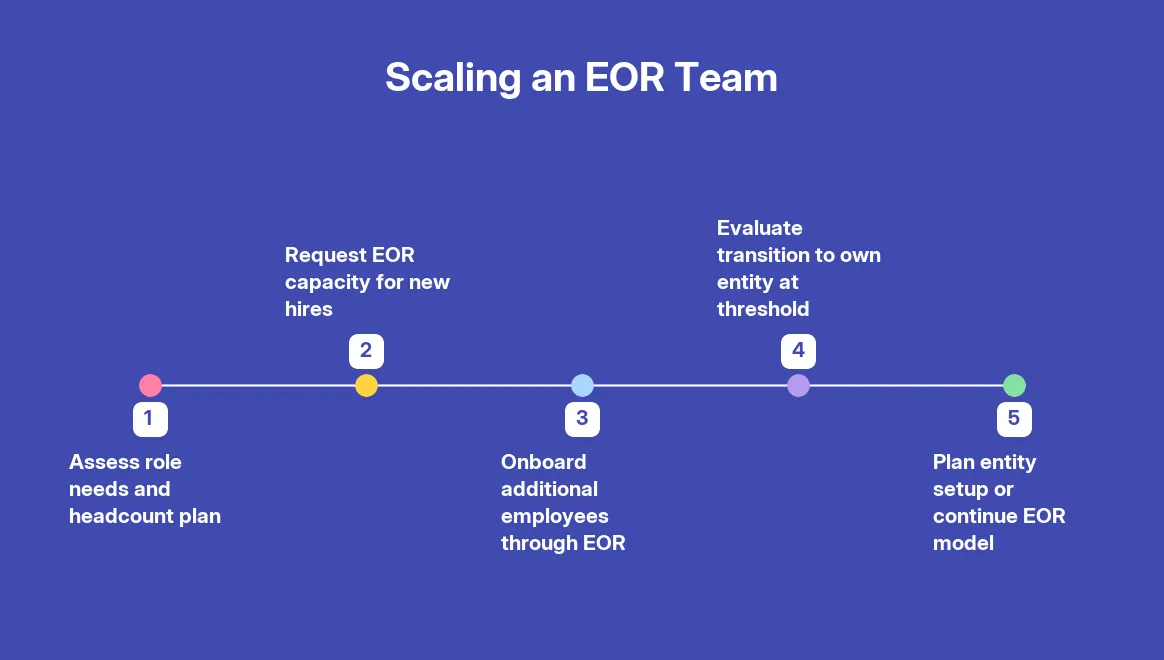
Scaling from one or two hires to a full team in Portugal follows a different operational rhythm than the initial onboarding. A Dutch fintech company started with two compliance analysts in Lisbon through an EOR. Within five months it had grown to seven employees across Lisbon and Porto. The EOR handled each new hire's contract and payroll registration without the company needing to revisit its corporate structure.
The practical trigger for evaluating a transition from EOR to your own entity depends on headcount, cost, and strategic intent. Most companies find that below 15 to 20 employees, the EOR model remains more cost-effective than incorporating a Portuguese subsidiary. Entity setup in Portugal typically takes three to six months from initial filing to operational readiness. During that period, the EOR continues as legal employer.
If you decide to transition, the process requires careful handling. Portuguese labor law treats any change of employer as a potential transfer of undertaking. Employees must give consent or the transfer must meet conditions under the Labor Code's provisions on business transfers. Your EOR should coordinate the migration of employment contracts, accrued leave balances, and seniority entitlements.
Some companies run a hybrid model. They keep certain roles on the EOR while building their own entity for others. A Swedish e-commerce company kept its customer support staff on an EOR arrangement while incorporating a Portuguese subsidiary for its growing engineering team of twelve. That split gave them time to establish local HR capacity without disrupting existing employees.
Comparing EOR with Other Hiring Models in Portugal
Choosing the right employment structure depends on your timeline, team size, and appetite for administrative overhead. The EOR model is one of several paths. Each has distinct trade-offs under Portuguese law.
| Factor | EOR | Own Entity (Subsidiary) | Staffing Agency (Trabalho Temporário) | Independent Contractor |
|---|---|---|---|---|
| Legal employer | EOR entity in Portugal | Your subsidiary | Staffing agency | No employer relationship |
| Setup timeline | Days | 3-6 months | Weeks (via agency contract) | Immediate |
| Compliance ownership | EOR | Your HR/legal team | Agency (limited scope) | You and the contractor |
| Contract duration | Open-ended or fixed-term | Open-ended or fixed-term | Temporary assignments only | Project-based |
| Scalability | High, no entity needed | High, but admin-heavy | Limited by assignment rules | Limited by misclassification risk |
| Employee benefits | Full statutory | Full statutory | Partial, agency-dependent | None required |
| Best for | 1-20 employees, market entry | 15+ employees, long-term commitment | Short-term project staffing | Genuinely independent specialists |
The staffing agency model carries a specific legal constraint in Portugal. Temporary agency work falls under a separate regulatory framework with strict rules on assignment duration and renewal. Agencies must hold a specific license from the Portuguese labor authority. An employer of record in Portugal operates under standard employment law with no assignment ceiling tied to agency regulations.
Contractor engagement is the fastest path but the riskiest. Portugal's labor inspectorate, the ACT, actively investigates misclassification. If a contractor works fixed hours, uses your tools, and reports to your managers, the ACT can reclassify that relationship as employment. The financial exposure includes back-payment of social security contributions, tax penalties, and potential compensation for the worker.
Watch out: A reclassified contractor in Portugal triggers retroactive Segurança Social contributions from both the employer and employee share. The liability period can extend back several years, and the employing entity bears the full burden of unpaid contributions plus interest.
For companies testing the Portuguese market with their first two or three hires, the EOR eliminates entity-formation risk entirely. You hire through EOR services within days and scale or exit without winding down a legal entity. A Canadian SaaS company used this approach to hire a product manager in Porto. Eight months later, with four more roles filled, the company began its subsidiary incorporation knowing the team was already productive and compliant.
FAQs
Can a foreign company use an EOR in Portugal if it already has a registered branch there?
Having a registered branch (sucursal) in Portugal does not automatically prevent you from using an EOR. The risk is permanent establishment scrutiny. Portuguese tax authorities may question why a company with a local branch employs staff through a separate entity. If the branch performs activities in the same sector as the EOR-employed workers, the arrangement could trigger conflicting employer-of-record liability. Get a written opinion from a Portuguese tax advisor before running both structures simultaneously. The dual-track model is legally possible but requires careful structuring.
What happens to Portuguese employees if the EOR provider becomes insolvent or exits the market?
EOR employees are legally employed by the EOR's Portuguese entity. If that entity enters insolvency, employees fall under Portuguese insolvency proceedings. They become creditors for unpaid wages, accrued leave, and severance. The client company has no automatic legal obligation to absorb them, but operationally you lose your workforce. Before signing with any EOR, negotiate a client-protection clause that specifies a transition mechanism. This clause should define notice periods, data handover timelines, and the process for transferring employment contracts to a replacement EOR or your own entity.
Does using an EOR in Portugal affect an employee's eligibility for Portuguese unemployment benefits?
EOR employees qualify for unemployment benefits (subsídio de desemprego) from Segurança Social on identical terms as directly hired workers. The EOR registers them as regular employees and remits social security contributions monthly. Eligibility depends on contribution history. The employee must have at least 360 days of registered contributions within the 24 months preceding unemployment. The triggering event matters too. Voluntary resignation generally disqualifies the employee. Involuntary termination, redundancy, or contract expiry triggers eligibility, subject to the standard application process through IEFP.
Can an EOR employ a non-EU national in Portugal on behalf of a foreign client?
Yes, but the immigration layer adds complexity. The EOR acts as the legal employer and signs the employment contract. For work visa and residence permit applications, the employing entity must meet specific criteria set by SEF (now AIMA). Portugal's Tech Visa program requires the employer to be a certified company or an incubator-backed startup. The EOR must determine whether its own certification qualifies. For standard work permits, the EOR submits the sponsorship declaration and labor market test documentation. Timelines for non-EU work permits in Portugal typically run six to twelve weeks from application to approval.
What is the difference between an EOR and a staffing agency in the Portuguese legal context?
Portuguese law regulates temporary agency work (trabalho temporário) under specific legislation separate from the Código do Trabalho's standard employment framework. A staffing agency supplies workers for fixed temporary assignments and must hold a license from the labor authority. Assignment durations face statutory caps and renewal limits. An EOR employs workers under standard open-ended or fixed-term contracts with no assignment-length ceiling tied to the temporary work framework. The EOR is the permanent legal employer. The staffing agency is an intermediary for time-limited placements. Confusing the two models can trigger licensing violations and worker reclassification.
How do collective bargaining agreements interact with EOR employment in Portugal?
Portugal has extensive collective bargaining agreements (Convenções Coletivas de Trabalho, or CCTs) that set terms above the statutory minimum. These cover salary floors, working hours, overtime rates, and specific benefits by sector. A qualified EOR must identify which CCT applies to each role based on the sector classification of its Portuguese entity and the employee's function. If the EOR's entity is registered under a broad commercial classification, the applicable CCT might differ from what the client expects. Failing to apply the correct CCT exposes the EOR to labor inspectorate enforcement and employee claims for back-pay of any shortfall between actual and CCT-mandated compensation.
Can an EOR in Portugal handle co-employment alongside a PEO arrangement?
The EOR and PEO models serve different structural needs. In Portugal, a PEO requires the client to have its own local entity, since PEO is a co-employment arrangement where both parties share employer responsibilities. An EOR is the sole legal employer. Running both models simultaneously for different employee groups is possible if you have a Portuguese entity for PEO-covered staff and use the EOR for roles outside your entity's scope. The key constraint is avoiding overlapping employer obligations for the same employee. Portuguese labor law does not recognize dual legal employers for a single worker.
What to Watch Next
Portugal's labor regulatory environment is shifting. The government has signaled reforms to remote work legislation that may affect employer obligations around equipment costs and workspace allowances for employees working from home. Changes to fixed-term contract renewal limits have also been debated in parliament.
Monitor updates from the ACT on misclassification enforcement. Inspection activity has increased year over year, and penalties for disguised employment relationships are growing steeper.
Your concrete next step: audit your current team structure in Portugal against the applicable CCT for each role. If you are unsure which agreement applies, ask your EOR to provide a written confirmation of the CCT classification for every employee. That single document protects you from the most common compliance gap in Portuguese EOR arrangements.
.svg)