EOR vs Payroll Outsourcing in Portugal: What's the Difference?
Your Amsterdam fintech company just found a senior product designer in Lisbon. She is ready to start in two weeks. You have no Portuguese entity, no local payroll infrastructure, and no time to incorporate one before she accepts another offer. Two models can solve this problem, but they solve different parts of it.
An employer of record becomes the legal employer of your hire in Portugal. It owns the compliance burden. A payroll outsourcing provider processes salary calculations and tax filings but leaves every legal obligation with you. The distinction sounds technical. In practice, it determines who faces liability when something goes wrong under Portugal's Labor Code.
This article breaks down the legal mechanics, risk profiles, and cost structures of both models for companies hiring in Portugal. It covers when each model fits and where each one breaks.
What Is an Employer of Record?

Employer of Record Meaning and Definition
An employer of record is a third-party organization that becomes the legal employer of a worker on behalf of a client company. The client directs daily work. The EOR holds the employment contract, runs payroll, withholds taxes, administers benefits, and carries liability for compliance with local labor law.
In Portugal, that means the EOR assumes employer-of-record liability under the Código do Trabalho. It signs the employment agreement. It registers the worker with Portuguese Social Security. It files IRS withholding returns. The client company never appears as the statutory employer.
A London recruitment agency used this model to place two account managers in Porto through an EOR in 7 days. Neither the agency nor the workers needed to wait for entity registration. The EOR's existing Portuguese legal presence absorbed the compliance layer from day one.
What Does an EOR Actually Do? (Beyond Payroll)
Payroll is only one function. EOR services generally cover onboarding, contract drafting, benefits administration, and offboarding. That scope matters in Portugal, where employment contracts must comply with specific statutory requirements around trial periods, working time, and termination procedures.
The EOR drafts compliant contracts. It enrolls workers in mandatory social insurance. It manages statutory leave entitlements. It handles termination procedures when engagements end. Each of these carries legal exposure that the EOR absorbs.
Is an Employer of Record the Same as a PEO?
No. A professional employer organization uses a co-employment model. Both the PEO and the client share employer responsibilities. The client typically retains a local entity, and the PEO handles HR administration under that shared structure.
An EOR takes full legal employer status. The client needs no entity in Portugal at all. That distinction drives the entire decision for foreign companies entering the Portuguese market. If you already operate a Portuguese entity and want co-employment HR and payroll support, a PEO fits. If you have no entity and want to hire compliantly, the EOR model exists for exactly that purpose.
What Is Payroll Outsourcing in Portugal?

How Payroll Outsourcing Works Operationally
Payroll outsourcing delegates payroll processing tasks to a third-party provider. The provider calculates gross-to-net pay, applies IRS withholding, computes Social Security contributions, generates payslips, and files periodic returns with Portuguese tax authorities.
Both EOR and payroll outsourcing involve a third-party provider managing payroll calculations and disbursements. The operational mechanics look similar from the employee's perspective. Salary arrives on time. Tax is withheld. Contributions are remitted.
A German e-commerce company with an existing Lisbon subsidiary outsourced payroll for its 14-person Portuguese team to reduce internal HR workload. The provider processed monthly payroll and filed quarterly returns. The company's finance team stopped spending 20 hours per month on Portuguese payroll reconciliation within the first cycle.
What Payroll Outsourcing Does Not Cover
With payroll outsourcing, the client company remains the legal employer and retains all employer liability. The payroll provider does not sign employment contracts. It does not manage termination procedures. It does not represent the company before Portuguese labor authorities.
If a terminated employee files an unfair dismissal claim, the client company defends it. If Social Security contributions are miscalculated, the client company owes the shortfall. The payroll provider processes numbers. The legal consequences stay with you.
When Payroll Outsourcing Makes Sense for Portugal-Based Entities
Payroll outsourcing in Portugal typically requires the company to already have a registered legal presence. You need a Portuguese entity, a Portuguese tax identification number, and Social Security registration before a payroll provider can process anything.
This model fits companies that have already incorporated in Portugal and want to offload the administrative weight of payroll management and processing. It does not solve market entry. It solves operational overhead for companies that have already entered.
EOR vs Payroll Outsourcing: Key Differences
| Dimension | Employer of Record | Payroll Outsourcing |
|---|---|---|
| Legal employer status | EOR is the statutory employer | Client company remains employer |
| Entity requirement | No Portuguese entity needed | Requires existing Portuguese entity |
| Compliance liability | EOR assumes compliance burden | Client retains all legal liability |
| Scope of service | Contracts, payroll, benefits, onboarding, offboarding | Payroll calculations, filings, disbursements only |
| Worker onboarding | EOR drafts contracts and registers workers | Client handles contracts and registration |
| Suitability for market entry | Built for foreign companies without local presence | Built for companies already operating in Portugal |
Legal Employer Status: Who Holds the Liability?
This is the structural divide. An EOR assumes employer-of-record liability under Portugal's Labor Code. It answers for contract compliance, statutory benefits, termination procedures, and tax obligations. The client company directs the work. The EOR owns the legal relationship.
With payroll outsourcing, nothing transfers. You remain the employer. The provider is a service vendor processing your payroll. If Portuguese labor inspectors audit your employment practices, they audit you. Not your payroll provider.
A Canadian SaaS company hiring its first three engineers in Lisbon through an employer of record in Portugal avoided this liability entirely. The EOR held the contracts, filed returns, and managed statutory benefits. The company focused on product development while compliance sat with the EOR.
Compliance Scope: What Each Model Covers in Portugal
Portugal is a member of the European Union and subject to EU employment law directives. That adds a layer of regulation beyond the domestic Labor Code. Anti-discrimination directives, working time regulations, and data protection under GDPR all apply to employers operating in Portugal.
An EOR covers this full spectrum. It monitors regulatory changes, updates contracts, and adjusts benefits administration as requirements evolve. A payroll provider covers payroll math. The rest is yours.
Entity Requirements and Market Entry Implications
Using an EOR allows a foreign company to hire in Portugal without establishing a local legal entity. Entity setup in most EU markets takes 3 to 9 months from first filing to operational status. An EOR bypasses that timeline entirely. Onboarding through an EOR typically completes in 5 to 10 business days.
Payroll outsourcing cannot substitute for entity formation. It presupposes that the entity already exists. For companies testing the Portuguese market with one or two hires, entity incorporation rarely justifies the cost and delay.
Risks and Limitations to Consider

EOR-Specific Risks in the Portuguese Employment Context
The EOR model introduces vendor dependency. Your employment relationships sit inside another company's legal structure. If the EOR provider faces financial distress or exits the Portuguese market, your workers' contracts are directly affected. Transition planning matters.
Co-employment risk is another consideration. If the client company exercises too much direct control over employment terms, working hours, or disciplinary actions, Portuguese labor authorities could reclassify the arrangement. The client could be deemed the actual employer despite the EOR contract. This risk increases when the client bypasses the EOR on day-to-day employment decisions.
Control limitations are structural, not accidental. The EOR sets employment terms within Portuguese legal boundaries. You cannot unilaterally modify contract clauses, benefits packages, or termination procedures. The EOR must approve changes that affect its compliance exposure.
Risks of Payroll Outsourcing When Legal Employer Obligations Are Retained
Payroll outsourcing carries a different category of risk. The provider processes payroll according to the data and instructions you provide. If your headcount data is wrong, contributions are miscalculated. If your employment contracts violate Portuguese labor standards, the payroll provider has no obligation to flag it.
You carry the audit risk. Portuguese tax authorities and Social Security will hold the employer accountable for any underpayment or filing error. Your contract with the payroll provider may include indemnification clauses, but enforcement depends on the provider's financial capacity and the contract terms.
Misclassification, Co-Employment, and Transition Risk
Both models carry misclassification exposure if workers are improperly classified as contractors rather than employees. Portugal's labor authorities apply substance-over-form tests. If a worker functions as an employee, the relationship will be treated as employment regardless of what the contract says.
Watch out: Switching from an EOR to your own Portuguese entity mid-engagement requires terminating the EOR's employment contracts and re-hiring workers under your entity. Portuguese labor law treats this as a new employment relationship. Accrued entitlements, seniority, and notice periods may reset or trigger additional obligations depending on how the transition is structured.
Transition risk also applies when switching EOR providers. The outgoing provider must terminate contracts. The incoming provider must issue new ones. Workers experience a legal employment gap unless the handover is coordinated precisely. For teams receiving employee benefits and insurance through an EOR, continuity of benefits coverage during transition requires explicit planning.
How to Choose Between an EOR and Payroll Outsourcing in Portugal
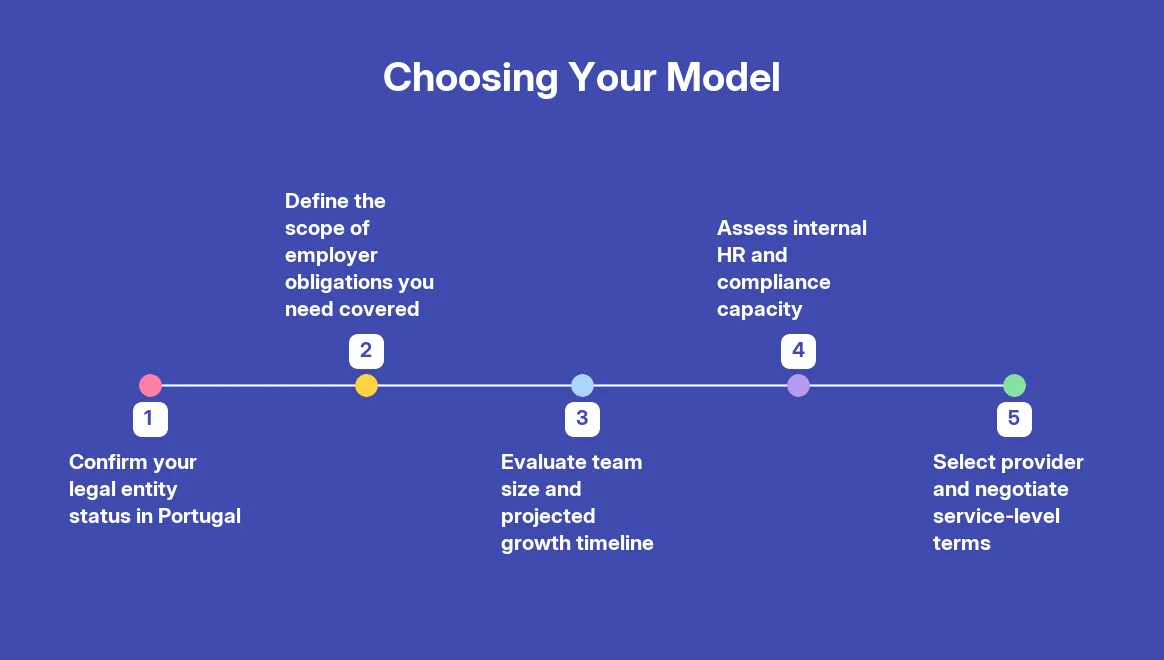
The first question is binary. Do you have a registered legal entity in Portugal? If the answer is no, payroll outsourcing is not available to you. Portuguese payroll providers require a contracting entity that holds employer status under the Código do Trabalho. Without one, the only compliant path to hiring is an employer of record in Portugal.
If you already operate a Portuguese entity, the decision shifts to scope. A company with an established HR department, in-house legal counsel familiar with Portuguese labor law, and a finance team comfortable with Segurança Social filings may only need payroll processing delegated. That points to payroll outsourcing.
The breakpoint sits at operational capacity. A Munich fintech with a Lisbon subsidiary hired its first five Portuguese employees through an EOR in 2024. When the team grew to fourteen, the company registered its own entity and moved to payroll outsourcing. The transition took eleven weeks. This pattern repeats across mid-market companies scaling into Portugal.
Team size projections matter. For one to five hires with no entity, an EOR handles everything from contract drafting through benefits. For ten or more employees in a market where you plan a permanent presence, entity incorporation plus payroll outsourcing often becomes more cost-effective over a two-year horizon. The middle ground requires honest assessment of internal bandwidth. If your team cannot manage Portuguese termination procedures, holiday accrual tracking, or annual reporting to Autoridade Tributária, outsourcing payroll alone leaves compliance gaps that an EOR would fill.
Growth timeline shapes the economics. Short engagements favor EOR. Long-term presence favors entity ownership with selective outsourcing.
Cost Structure and Operational Trade-Offs
Pricing models differ between the two services. That difference affects both cash flow timing and total cost of employment across a twelve-month cycle.
| Factor | EOR Model | Payroll Outsourcing |
|---|---|---|
| Entity required | No | Yes |
| Entity setup cost | None for client | Incorporation, legal, and registration fees |
| Monthly service fee | Per-employee flat fee | Per-payslip or monthly retainer |
| Employer liability holder | EOR provider | Client company |
| Benefits administration | Included | Typically excluded |
| Termination management | Handled by EOR | Client manages with legal counsel |
| Time to first hire | 5 to 10 business days | Weeks to months (entity dependent) |
| Ongoing compliance updates | Provider-managed | Client must monitor and implement |
A London digital agency hired two UX designers in Lisbon through an EOR. Monthly service fees covered local employee benefits, payroll, and tax filings. The agency estimated that incorporating a Portuguese entity would have cost between €3,000 and €8,000 in legal and registration fees alone, before any employee was onboarded. For a two-person team on a twelve-month engagement, entity incorporation made no financial sense.
The cost calculus reverses at scale. A SaaS company with twenty employees in Porto running through an EOR pays twenty individual per-employee fees monthly. The same company operating its own entity with a payroll outsourcing contract pays a single retainer or per-payslip fee. The crossover point varies by provider, but the direction is consistent. Larger teams with long time horizons recover entity setup costs within twelve to eighteen months.
Watch out: Some payroll outsourcing contracts in Portugal exclude meal allowance (subsídio de refeição) administration from their standard scope. If your compensation package includes non-salary benefits, confirm whether your payroll provider handles them or whether you need a separate benefits administrator.
One cost often overlooked in both models is the expense of compliance failures. Under the EOR model, the provider absorbs regulatory penalties. Under payroll outsourcing, fines for late Segurança Social contributions or incorrect IRS withholding land on the client entity. The liability allocation difference is not theoretical. It carries direct financial exposure.
For companies exploring co-employment structures, it is worth noting that PEO arrangements carry a different cost profile and legal standing than either pure EOR or payroll-only models in Portugal.
FAQs
Can a foreign company hire employees in Portugal without setting up a legal entity?
Yes. An EOR becomes the legal employer on the company's behalf, removing the entity requirement for both EU and non-EU companies. Non-EU companies should assess permanent establishment risk more carefully. If the Portuguese hire routinely concludes contracts or exercises binding authority for the foreign company, tax authorities may deem a PE exists regardless of the EOR arrangement. Extended EOR engagements amplify this risk. The employee's role and decision-making authority determine the threshold.
Is an employer of record the same as a PEO in Portugal?
No. The US-style PEO co-employment model does not have explicit statutory footing under Portuguese labor law. Portugal does not recognise joint-employer arrangements in the way US federal and state frameworks do. An EOR in Portugal operates as the sole legal employer under a distinct contractual structure. The client directs the employee's daily work, but all employer obligations sit with the EOR entity. This makes the legal architecture fundamentally different from co-employment.
What happens to the employment contract if we switch from an EOR to our own Portuguese entity mid-engagement?
Portuguese law includes transfer-of-undertaking protections similar to the EU's TUPE directive. When an employee moves from an EOR to a client's newly registered entity, continuity-of-service rights typically apply. The employee retains accrued seniority, leave balances, and contractual terms. Formal written notice is required. In some contractual structures, the employee's explicit consent is needed. Renegotiating salary or benefits during the transfer is possible but cannot reduce terms below what the employee held under the EOR contract.
Does payroll outsourcing in Portugal cover mandatory benefits administration, or only salary disbursement?
Most payroll outsourcing providers draw their operational boundary at salary processing and statutory deduction calculation. Benefits administration sits outside standard payroll-only scope. The subsídio de refeição is a common example. EOR contracts typically bundle meal allowance management, transport subsidies, and health insurance coordination into their service. A payroll-only contract usually does not. If your compensation structure includes non-salary benefits, you will need a separate benefits administrator or an EOR model that includes benefits management.
What are the tax implications for the client company when using an EOR in Portugal?
The EOR handles all Portuguese employer tax obligations. The client company does not file Portuguese tax returns or register with Autoridade Tributária. The key risk is permanent establishment exposure. Under OECD Model Convention principles adopted in Portugal's bilateral tax treaties, a PE can be triggered if the employee habitually exercises authority to conclude contracts on the client's behalf. This varies by treaty. If your employee has signatory authority or negotiates deals for the foreign company, seek PE analysis specific to your home country's treaty with Portugal.
How long does it take to start paying an employee through an EOR versus setting up payroll outsourcing in Portugal?
EOR onboarding typically completes in five to ten business days. The EOR drafts the employment contract, registers the employee with Segurança Social, and runs the first payroll cycle within that window. Payroll outsourcing requires an existing entity. If you are incorporating from scratch, entity registration with the Registo Comercial, tax registration, and Segurança Social employer enrollment can take four to twelve weeks depending on documentation completeness. Your first payroll run cannot happen until the entity is fully operational.
Can we use an EOR for some employees and payroll outsourcing for others in Portugal?
Yes. This hybrid model is common among companies transitioning from EOR to entity-based operations. A company might keep its initial hires under the EOR while onboarding new employees directly through its freshly registered entity with payroll outsourcing support. The administrative complexity increases because two separate employer entities exist for the same workforce. Coordination on benefits parity, internal equity, and reporting consolidation requires deliberate planning. Some companies run this hybrid for six to twelve months during the transition period.
What to Watch Next
Portugal's labor regulatory environment continues to evolve under EU directive transpositions. The EU Pay Transparency Directive will require employers in Portugal to disclose salary ranges and report on gender pay gaps within the coming years. Companies using EOR arrangements should confirm whether their provider's reporting infrastructure supports these obligations.
Remote work regulation in Portugal has tightened since the amendments to the Código do Trabalho covering telework. Employers bear specific obligations around equipment provision, expense reimbursement, and the right to disconnect. These apply regardless of whether the legal employer is an EOR or your own entity.
Your concrete next step: audit your current team size, entity status, and twelve-month growth plan in Portugal. Map each role against the decision framework above. If you are hiring your first Portuguese employee this quarter with no entity in place, start with an EOR provider and revisit entity incorporation once your team exceeds the crossover threshold for your budget.
.svg)