EOR Pricing Models in Canada: Flat Fee vs. Percentage of Salary Explained

Our guide to EOR costs in Canada covers the full cost structure of using an Employer of Record. It touches on pricing models at a high level. This article goes deeper into the two dominant pricing structures: flat fee per employee and percentage of salary. You will learn how each model behaves under real Canadian payroll conditions. You will see where one model saves money and where the other quietly erodes your budget. The goal is to give you enough detail to negotiate from a position of strength.
How the Two Pricing Models Work in Practice

Flat Fee Per Employee
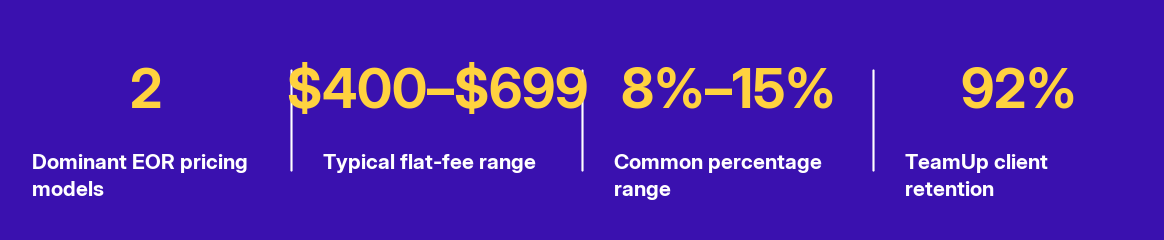
The flat-fee model charges a fixed monthly amount per employee. That amount stays the same whether your Canadian hire earns CAD 55,000 or CAD 160,000. Most EOR providers serving Canada price flat fees between USD 400 and USD 699 per employee per month. Some providers with owned entities in their core markets start lower. Team Up, for example, starts at €199 per employee per month in its owned-entity markets.
The flat fee typically covers payroll processing, statutory deductions under the Canada Revenue Agency framework, employment agreement drafting, and basic HR administration. What it does not cover matters just as much. Benefits administration, provincial workers' compensation premiums, and immigration support often sit outside the base fee.
A Toronto-based fintech company hiring five engineers through a flat-fee EOR at USD 500 per month pays USD 2,500 monthly in EOR fees. That cost stays predictable even when those engineers receive raises.
Percentage of Salary
The percentage model calculates the EOR fee as a share of each employee's gross salary. The typical range across the Canadian market falls between 8% and 15% of gross compensation. Some providers define "gross" differently. Some include only base salary. Others fold in bonuses, commissions, and taxable benefits.
This distinction matters in Canada because employer-side statutory costs already add a meaningful layer. Canada Pension Plan contributions, Employment Insurance premiums, and provincial health taxes are all calculated as percentages of salary. Stacking a percentage-based EOR fee on top of percentage-based statutory costs compounds the total employer burden.
For a software developer earning CAD 120,000, a 10% EOR fee adds CAD 12,000 annually. That same employee under a USD 500 flat fee costs USD 6,000 per year in EOR charges. The gap widens as salaries climb.
Where Each Model Creates or Destroys Value
| Factor | Flat Fee | Percentage of Salary |
|---|---|---|
| Cost predictability | Fixed monthly amount | Fluctuates with raises and bonuses |
| Impact of salary increases | None | Fee rises proportionally |
| Low-salary roles | Higher relative cost | Lower absolute cost |
| Senior hires (CAD 130K+) | Clear savings | Significant premium |
| Budget forecasting | Straightforward | Requires compensation modeling |
| Provider incentive alignment | Neutral to salary level | Provider benefits from higher salaries |
When Flat Fees Win
Flat fees deliver the most value when you hire mid-to-senior professionals. Canada's tech salaries illustrate this clearly. A senior full-stack developer in Vancouver or Toronto commands CAD 130,000 to CAD 160,000. At a 10% EOR rate, the fee alone reaches CAD 13,000 to CAD 16,000 per year. A flat fee of USD 550 per month totals USD 6,600 annually. The savings compound across a team.
Companies scaling from three to ten employees in Canada also benefit. The flat fee makes headcount planning straightforward. You multiply the per-employee fee by the team size. No salary-band analysis required.
When Percentage Fees Make Sense
Percentage-based pricing can work for lower-salary roles where the absolute fee stays manageable. A customer support specialist earning CAD 48,000 pays a 10% fee of CAD 4,800 per year. That falls below what many flat-fee providers charge.
The model also suits short-term project hires where the total engagement lasts three to six months. The percentage fee scales down naturally with a shorter timeline. Flat-fee providers sometimes impose minimum contract terms that offset any savings.
Watch out: Some percentage-based providers in Canada define "gross compensation" to include employer-side statutory contributions like CPP and EI. That means you pay a percentage fee on costs that are themselves percentages of salary. Ask for the exact calculation base before signing.
The Hidden Incentive Problem
Percentage-based models create a structural misalignment. Your EOR earns more when your employees earn more. That does not mean your provider will inflate salaries deliberately. But it removes the incentive to challenge above-market compensation benchmarks. When evaluating whether an EOR or incorporation fits better, this incentive structure deserves weight in the decision.
Choosing the Right Model for Your Canadian Hiring Plan

Start with your compensation data. List every role you plan to hire in Canada over the next 12 months. Assign realistic salary ranges based on provincial benchmarks.
Run both calculations side by side. For each role, compute the annual cost under a representative flat fee and a representative percentage rate. Sum the totals across your planned team. The crossover point where flat fees become cheaper than percentage fees typically falls around CAD 60,000 to CAD 70,000 in annual salary, depending on the specific rates quoted.
Factor in growth. If you plan to promote employees or adjust salaries for inflation, the percentage model quietly raises your EOR costs. The flat-fee model absorbs those changes.
Consider the full compliance picture in Canada. Provincial variations in employer health taxes, workers' compensation, and vacation pay entitlements all affect total cost. Some EOR providers bundle provincial compliance into their base fee. Others charge separately. The pricing model matters less than the total landed cost per employee.
Finally, ask about volume discounts. Flat-fee providers often reduce the per-employee rate at five, ten, or twenty-five employees. Percentage providers may negotiate the rate down by one or two points at scale. Neither discount matters unless you compare it against the total cost across your actual team composition.

FAQs
Can I switch from a percentage model to a flat fee mid-contract?
Most EOR contracts in Canada allow renegotiation at renewal. Switching mid-term usually requires mutual agreement and a transition period of 30 to 60 days. Some providers charge an early termination fee if you switch before the minimum term ends. Review your service agreement for change-of-terms clauses before assuming flexibility.
Do percentage-based EOR fees apply to equity compensation or stock options in Canada?
Typically not. Most percentage-based providers calculate fees on cash compensation only. Stock option exercises that create a taxable benefit under the Income Tax Act may trigger additional payroll processing fees. Clarify this before granting equity to EOR-employed staff in Canada. The tax withholding obligations on stock options are complex enough without fee surprises.
How do provincial differences in Canada affect which pricing model is better?
Provincial employer health taxes vary. Ontario charges the Employer Health Tax on payroll above a threshold. British Columbia and Quebec have their own structures. A percentage-based EOR may or may not include these provincial costs in the base rate. If excluded, your effective rate climbs higher than the quoted percentage. Always request a province-specific cost breakdown before comparing models.
What to Watch Next
Canadian provinces continue adjusting employer-side contribution rates and thresholds. Quebec's QPIP and Ontario's EHT exemption limits shift periodically. These changes affect the total cost gap between flat-fee and percentage models. Before locking into a multi-year EOR agreement, model your costs under both structures using current provincial rates. If your team will span multiple provinces, request a province-by-province breakdown from your EOR provider. The right pricing model depends on your team's salary profile today and where you expect it to move over the next two years.
If you want a province-specific cost comparison for your Canadian team under both pricing models, request an estimate from Team Up.
Written by Team Up — EOR, payroll, and compliance for companies hiring across 20+ countries.
.svg)