


How to Choose the Right Employer of Record Provider in Canada

Our compliance checklist for EOR services in Canada covers the legal obligations every employer of record must meet. This article goes deeper into the evaluation process itself. Choosing the wrong EOR in Canada creates liability that compounds across provinces. The right provider handles CRA remittances, provincial employment standards, and benefits administration without gaps. Below, you will find a structured framework for vetting providers, a comparison table for side-by-side scoring, and contract red flags that signal operational weakness.
Due Diligence Framework for Canadian EOR Selection
Verify Provincial Coverage Depth
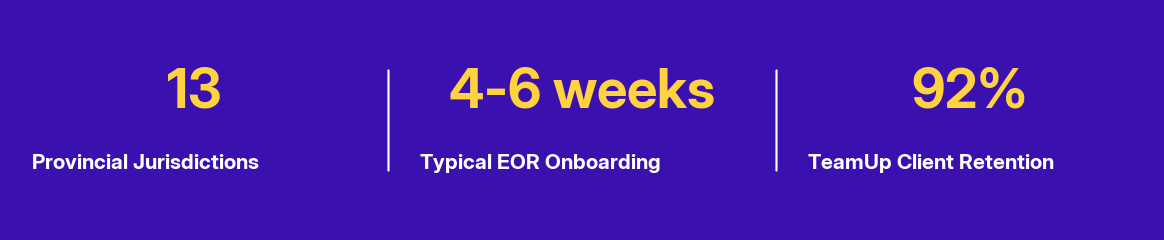
Canada's employment law splits across 13 provinces and territories. Each jurisdiction sets its own minimum wage, overtime rules, statutory holidays, and termination standards. An EOR that covers Ontario but treats Alberta the same way will generate compliance failures within months.
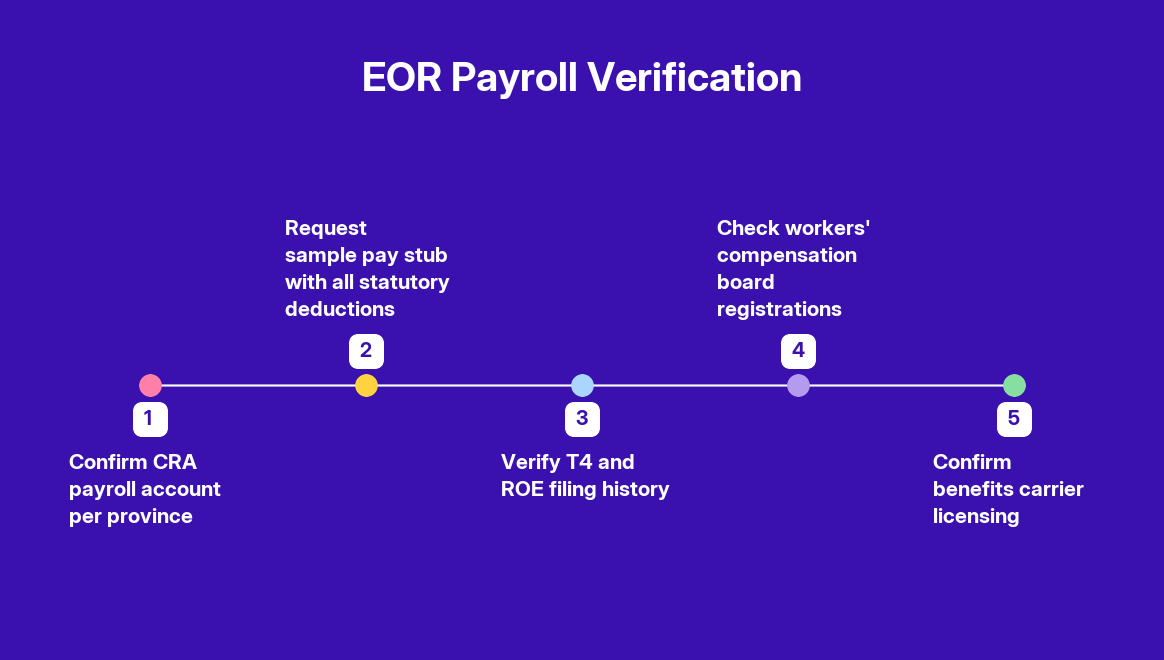
Ask prospective providers which provinces they have active payroll accounts in. A provider operating through a single federal entity without provincial registrations is cutting corners. You need confirmation of active CRA business numbers for each province where your employees work.
A fintech company hiring three engineers in British Columbia and two in Quebec needs a provider fluent in both common-law and civil-law employment frameworks. Quebec's Act Respecting Labour Standards imposes distinct French-language requirements for employment contracts. The same EOR must handle BC's different statutory holiday calendar. Providers who lump these together expose you to complaints at provincial labour boards.
Assess Payroll and Tax Infrastructure
Canadian payroll is not a single calculation. Each pay cycle involves CPP contributions, EI premiums, federal and provincial income tax withholding, and provincial workers' compensation premiums. The EOR must calculate these correctly per province and remit on CRA's schedule.
Request a sample pay stub from the provider. It should show CPP deductions, EI deductions, federal tax, and provincial tax as separate line items. If the provider bundles deductions into a single "statutory" line, that is a sign of simplified processing that may not survive a CRA audit.
T4 filing accuracy matters. Ask the provider how many T4 amendments they filed in the previous tax year. A high amendment rate suggests systemic payroll errors. ROE issuance for terminated employees must happen within five calendar days. Late ROEs delay your former employees' EI claims and create complaints.
For a deeper breakdown of each compliance step, see the complete EOR compliance checklist for employers in Canada.
Comparing EOR Providers on Canadian-Specific Criteria
Scoring Criteria That Matter
Not every EOR differentiates on the same features. The table below isolates the criteria most relevant to Canadian operations.
| Criteria | What to Look For | Warning Sign |
|---|---|---|
| Provincial payroll accounts | Active accounts in each province of hire | Single federal-only registration |
| French-language compliance | Quebec contracts and communications in French | English-only templates for Quebec |
| Workers' compensation | Provincial WCB/WSIB registrations | No proof of coverage or clearance letters |
| Benefits administration | Licensed group benefits carrier in province | Offshore benefits broker with no Canadian license |
| Termination handling | Province-specific notice and severance calculations | One-size-fits-all termination formula |
| Data residency | Canadian-hosted payroll data or compliant cross-border transfers | No clarity on where employee data is stored |
Weigh Operational Presence Over Country Count
Global EOR providers in Canada often list the country on a coverage map without maintaining dedicated Canadian staff. A provider with in-country HR professionals will catch provincial nuances that a centralized offshore team misses.
Ask where the provider's Canadian employment law counsel is based. An employment lawyer in Toronto does not automatically understand Québec's civil-code framework. Providers who maintain separate Quebec-qualified counsel demonstrate genuine depth.
Team Up owns legal entities in its core markets and staffs in-country offices. That model matters in any jurisdiction. When evaluating employer of record services in Canada, the same principle applies. Direct presence beats an aggregator relationship routed through a third-party partner.
Red Flags and Deal-Breakers in EOR Contracts

Indemnification Gaps
Read the indemnification clause before anything else. A strong EOR contract indemnifies your company against penalties from the EOR's own payroll or tax filing errors. If the contract shifts CRA penalties back to you for the provider's mistakes, walk away. That clause reveals the provider's confidence in their own compliance infrastructure.
Hidden FX and Payroll Markups
Some providers embed a margin in the CAD-to-USD exchange rate. Others add a percentage on top of statutory contributions as "administration." Request a fee breakdown that separates the management fee from statutory costs. If the provider cannot produce that breakdown, their pricing lacks transparency.
Watch out: Some EOR contracts include automatic renewal clauses with 90-day notice windows. Missing the window locks you into another year, even if you are migrating employees to your own Canadian entity. Check the renewal and termination terms before signing.
Inadequate Offboarding Provisions
Canadian termination law varies sharply by province. Ontario's Employment Standards Act sets minimum notice periods based on years of service. BC uses a different scale. Federal employees under the Canada Labour Code follow yet another framework. Your EOR contract should specify which provincial standard applies to each employee and who carries the severance liability. If the contract is silent on province-specific termination costs, the provider has not built their Canadian operations to handle exits properly.

FAQs
Can an EOR in Canada sponsor work permits for foreign employees?
An EOR can support the Labour Market Impact Assessment process as the employer of record. The EOR's CRA business number appears on the LMIA application. Processing times vary by province and ESDC stream. Confirm that the provider has successfully completed LMIA-based hires before, because errors in the application delay work permits by months.
What happens if my EOR provider misclassifies a worker in Canada?
CRA can reassess the employer for unpaid CPP, EI, and income tax withholding. Penalties include the missed contributions plus interest from the original due date. Your contract should specify that the EOR bears financial liability for classification decisions they made. If the contract is silent, you share the exposure.
How do I transition employees from an EOR to my own Canadian entity?
The transition requires issuing new employment contracts under your entity. Each employee's service continuity affects termination entitlements, so coordinate the handover carefully. The EOR must issue final T4s and ROEs for the period of their employment. Budget 6 to 10 weeks for a clean transition that avoids gaps in benefits or payroll.
What to Watch Next
Provincial employment standards shift regularly. Ontario and BC both adjust minimum wage and statutory holiday rules on predictable cycles. Monitor CRA payroll remittance thresholds annually, as crossing certain thresholds changes your remittance frequency. If you are building a Canadian team across multiple provinces, start your provider evaluation with the provincial depth criteria above. The EOR market in Canada rewards specificity over breadth.
If you need a compliance-ready evaluation of EOR providers for your Canadian hiring plan, request a consultation with Team Up.
Author: Team Up Editorial Team Team Up is a people-first EOR and nearshoring partner, helping businesses across North America, Europe, the Middle East, and Singapore hire proven talent across 20+ countries.
.svg)


