EOR vs. Incorporating in Canada: Which Option Makes Financial Sense?

Our guide to EOR costs in Canada covered the full pricing landscape for employer of record services. This child article goes deeper on one specific decision: when does paying monthly EOR fees make more financial sense than setting up your own Canadian entity?
The answer depends on team size, hiring timeline, and operational commitment. A three-person team and a thirty-person team face fundamentally different cost equations. This article breaks down the real numbers behind each model so you can identify the crossover point for your situation.
The Cost Structure of Canadian Incorporation vs. EOR Engagement
What Incorporation Actually Costs
Registering a federal corporation through Corporations Canada costs a few hundred dollars. That fee misleads many companies into thinking incorporation is cheap.
The filing fee is the smallest line item. You also need a registered office address in Canada. You need a Canadian business number from the Canada Revenue Agency. You need payroll accounts for CPP, EI, and income tax remittance. Provincial registration follows if you operate in specific provinces.
Legal fees for articles of incorporation, shareholder agreements, and employment contracts typically run several thousand dollars. Accounting setup for Canadian payroll, T4 filing, and GST/HST registration adds more. A Toronto-based law firm handling a standard incorporation for a foreign parent company quotes between $5,000 and $15,000 for legal work alone, depending on complexity.
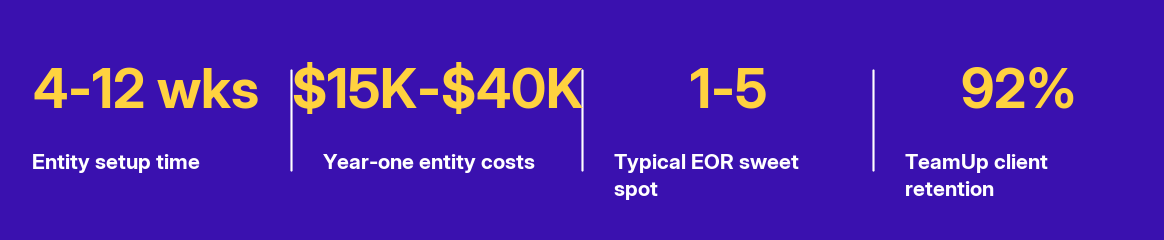
Then come the recurring costs. Monthly bookkeeping, annual corporate tax filings (T2), payroll processing, and a compliance review cycle that does not pause. Expect $15,000 to $40,000 in total first-year costs before you pay a single employee.
What an EOR Engagement Costs
EOR providers charge a monthly per-employee fee. As explained in our comparison of flat-fee vs. percentage pricing models, most Canadian EOR engagements fall between $400 and $700 per employee per month under a flat-fee structure.
That fee covers payroll processing, statutory remittances, employment contracts compliant with provincial labour standards, and benefits administration. You pay no incorporation costs. You maintain no registered office. You file no T2 return.
The trade-off is clear: lower fixed costs, higher per-head variable costs.
| Cost Factor | Own Entity | EOR |
|---|---|---|
| Setup | $15K–$40K year one | $0 |
| Monthly per employee | $200–$500 (payroll + admin) | $400–$700 |
| Legal/accounting | $5K–$15K annually | Included |
| Wind-down if you exit | $5K–$20K | 30-day notice |
| Time to first hire | 4–12 weeks | 5–10 business days |
Team Size and Timeline: The Breakeven Calculation
Small Teams Stay on EOR Longer
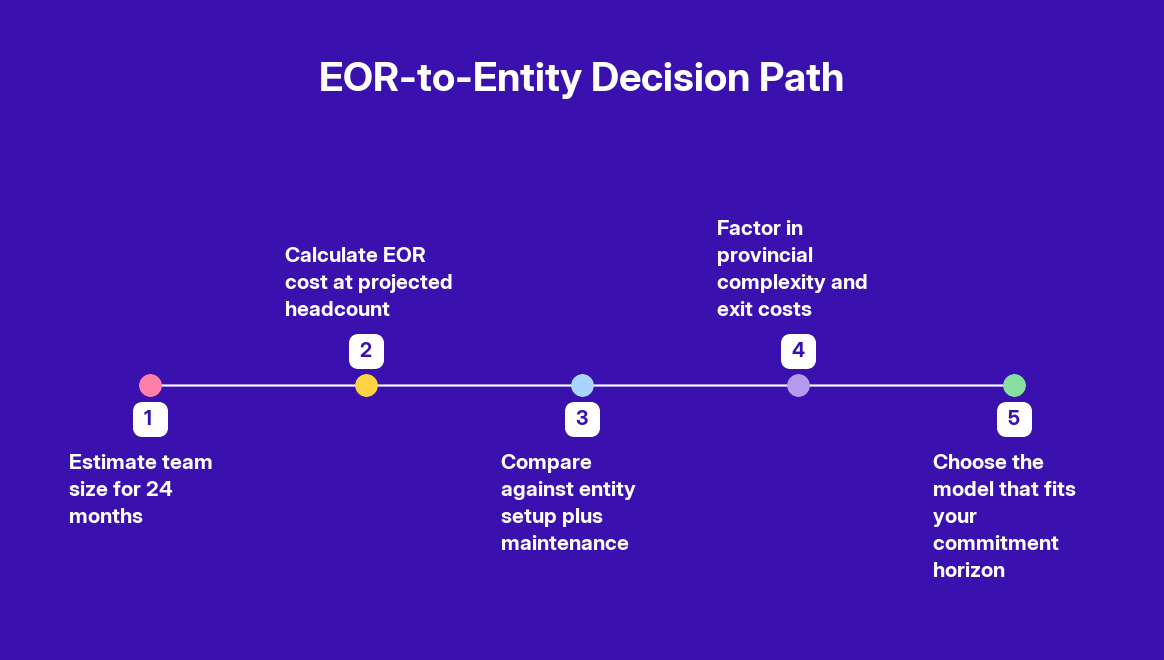
The math favours an EOR for small teams. Consider a US fintech company hiring two developers in Ontario. At $600 per employee per month, the annual EOR cost is $14,400. Entity setup alone would exceed that figure in year one.
Even in year two, when setup costs are behind you, the ongoing accounting, legal, and administrative burden for a two-person entity easily reaches $8,000 to $12,000 annually. Add the management time your finance team spends on Canadian compliance. The breakeven point does not arrive.
For teams of one to five employees, the EOR model typically costs less for the first two to three years. Often longer.
Larger Teams Shift the Equation
At ten employees, the EOR bill reaches $60,000 to $84,000 per year. A mature Canadian entity with proper payroll infrastructure costs $25,000 to $40,000 annually to maintain. The entity becomes cheaper per head.
The crossover typically falls between six and ten employees, depending on your EOR provider's pricing tier and the complexity of your provincial obligations. Companies operating in multiple provinces face higher entity costs because each province has distinct employment standards legislation.
A Berlin-based SaaS company that started with three Canadian hires through an employer of record in Canada scaled to twelve within eighteen months. At that point, incorporating made sense. The EOR had already handled onboarding, provincial compliance setup, and benefits enrolment. The transition to an owned entity was smoother because employment contracts and payroll records were already clean.
The Timeline Factor
Speed matters independently of cost. Entity incorporation takes four to twelve weeks. During that window, your competitor hires the candidate you are still processing paperwork for.
An EOR onboards employees within five to ten business days. If you need a senior engineer in Vancouver next month, an EOR delivers. Your incorporation filing does not.
Strategic Scenarios Where the Choice Is Clear

Testing a New Market
If Canada is an experiment, the EOR is the right call. You might hire two customer success managers in Toronto to test Canadian market demand. If the experiment fails after eight months, you give notice to the EOR and exit cleanly.
Winding down a Canadian entity is not clean. You must file final tax returns, deregister payroll accounts, settle outstanding CRA obligations, and potentially deal with Employment Standards Act severance requirements at the provincial level. Budget $5,000 to $20,000 and three to six months for a proper wind-down.
Long-Term Strategic Commitment
If Canada is a core market and you plan to hire fifteen or more people within two years, incorporate early. The per-head savings compound. You also gain direct control over benefits design, equity compensation plans, and employer branding. Choosing among EOR providers in Canada still makes sense as a bridge. Use the EOR for your first hires while the entity is being set up. Then transition employees to your own payroll once the infrastructure is ready.
Regulatory Complexity as a Factor
Some industries face regulatory requirements that only a direct entity can satisfy. Federal government contracts, certain financial services licences, and regulated healthcare roles may require the employer to hold specific Canadian registrations. Confirm with your legal team whether an EOR-based employment structure meets your sector's requirements before committing.
Watch out: Some Canadian provincial and federal procurement contracts require the employer to be a registered Canadian entity. An EOR arrangement may disqualify your bid even if the employee is based in Canada and fully compliant on payroll and tax.

FAQs
Can I start with an EOR and transfer employees to my own entity later?
Yes. Most EOR agreements allow employee transfer with thirty to ninety days' notice. The key step is drafting new employment contracts under your entity that preserve continuity of service. Under most provincial employment standards legislation, service continuity affects severance and termination entitlements. Get legal advice on the transfer to avoid inadvertently resetting employee tenure.
Does an EOR affect my ability to claim Canadian R&D tax credits?
The Scientific Research and Experimental Development (SR&ED) program requires the claimant to be a Canadian taxpayer. If your employees work through an EOR, the EOR entity is the legal employer and taxpayer. You cannot claim SR&ED credits unless you incorporate and employ the staff directly. For R&D-heavy teams, this tax incentive alone can justify the cost of incorporation.
What happens to employee benefits during a transition from EOR to own entity?
Benefits coverage depends on your EOR's group plan and your new entity's plan. Gaps can occur if enrolment periods do not align. Best practice is to negotiate a transition window where both plans overlap for thirty days. Provincial health insurance (like OHIP in Ontario) continues regardless, but supplemental health, dental, and life insurance need explicit transition planning.
What to Monitor Next
Canadian federal and provincial payroll thresholds change annually. CPP contribution rates, EI premiums, and provincial tax brackets all shift. Whether you use an EOR or your own entity, build an annual compliance review into your Q4 calendar. If your team is approaching the six-to-ten-employee range, start modelling entity costs now rather than waiting for the crossover to become obvious.
If you need a cost comparison tailored to your Canadian headcount and timeline, TeamUp can model both scenarios for you. Request a cost analysis.
Written by the TeamUp editorial team. TeamUp is a people-first EOR and nearshoring partner, helping companies across North America, Europe, and the Middle East hire compliantly in 20+ countries — with owned entities across the Caucasus, Central Asia, Turkey, India, and Eastern Europe.
.svg)