10 strategic benefits of using Employer of Record (EOR) services in for 2026
TL;DR
Employer of record services used to be a workaround. Companies would use them to move fast in a new market before they had an entity set up, then transition employees once the subsidiary was registered. The EOR was a bridge, not a destination.
That framing has changed. In 2026, EOR is a core workforce strategy, one that boards and CFOs now evaluate on its own merits, not as a temporary fix. A VP of HR at one scaling SaaS company described it plainly: "We hire first, learn the market, and only commit to an entity if it actually makes sense. Not the other way around."
That reversal is happening across industries. And it is driven by a set of strategic advantages that compound in exactly the markets where international expansion is accelerating most — Georgia, Armenia, Azerbaijan, Turkey, India, Kazakhstan, Uzbekistan, Egypt.
This article makes the case: ten specific, measurable reasons why EOR is not just easier than entity setup, but often smarter.
Why Employer of Record (EOR) Is a Strategic Decision in 2026
The numbers tell the story of a structural shift, not a trend.
The global EOR market reached $6.82 billion in 2025 and is growing at 9.24% annually. Among companies already hiring internationally, 54% use or plan to use an EOR — surpassing fully owned entities as the dominant model. The three most cited reasons: 65% use EOR to reduce compliance risk, 63% to reduce entity setup costs, and 51% to access global talent.
At the same time, the regulatory environment has tightened. Labor laws are being updated at an average of 187 changes per decade per country. Cross-border employment compliance concerns increased by 29% year-over-year. Misclassification enforcement is more coordinated. And 87% of companies planning international expansion in 2026 say meeting local tax and employment regulations will be their hardest task.
The result: EOR is no longer a convenience product for companies that cannot be bothered with compliance. It is a risk management layer, a speed advantage, and a financial lever — all at once.
Here are the ten benefits, with the evidence to back each one.

10 Benefits of Employer of Record Services
1. Enter New Markets Without Entity Setup Delays

Setting up a legal entity in a new country is not fast. In most markets, the process takes three to nine months: business registration, tax ID setup, social insurance enrollment, banking, regulatory approvals, local director appointment. In some countries with multi-ministry sign-off requirements, longer.
During those months, your competitors are not waiting. They are hiring the engineers, account managers, and operations leads you were planning to bring on board. Talent, especially in fast-moving markets like India's tech sector or Georgia's growing startup ecosystem, does not hold offers open for nine months.
An EOR already has the legal entity registered. The bank accounts exist. The payroll infrastructure is live. The compliance relationships with local authorities are established. When you identify a candidate you want to hire, the EOR can issue a compliant offer letter within 24–48 hours for standard markets. Onboarding takes days, not months.
That speed is not just convenient. In competitive talent markets, it is the difference between hiring the person you wanted and losing them to a company that could move faster.
Practically speaking, a company that identifies a strong engineering lead in Tbilisi on a Tuesday can have a compliant employment contract issued by Thursday through an EOR with an owned Georgia entity. The same hire through entity setup requires the company to wait for its subsidiary to be registered, banked, and operationally ready — and Georgia's new Special Labour Permit requirement, introduced in March 2026, has added a step that a company without in-country expertise would likely miss entirely.
2. Avoid High Entity Setup Costs
Entity setup is expensive. The range is wide because it depends heavily on the country — but even at the lower end, the costs are meaningful for any company in a growth phase.
A typical entity setup involves: legal fees for incorporation and registration, government filing fees, minimum capital requirements (some jurisdictions mandate significant share capital), local director appointment and compensation, bank account setup, tax registration, social insurance enrollment, and ongoing annual compliance maintenance.
Total upfront cost: $20,000–$250,000, depending on the country. Annual ongoing compliance: $30,000–$80,000 per country, per year. Timeline: 3–9 months before the first hire can legally be made.
Now compare that to EOR. The service fee ranges from $199–$800 per employee per month, depending on the provider and market. No upfront capital. No legal incorporation. No local director on the payroll. No entity to wind down if the market does not work out.
For a company hiring its first five people in India, the choice is clear. India-specialist EOR providers charge $150–$250 per employee per month. Five employees over twelve months = $9,000–$15,000 in EOR service fees. Entity setup in India, covering legal fees, corporate registration, PAN/TAN registration, EPF and ESIC setup, and initial compliance costs, typically runs $15,000–$40,000 before a single payroll cycle runs.
The break-even crossover — where entity setup costs less per employee than ongoing EOR fees — sits around 15–20 employees in most single-country scenarios. Below that, EOR wins on cost almost every time.
3. Stay Compliant With Local Labor Laws
Here is the compliance problem in plain terms: every country in your hiring footprint has its own labor code, tax system, social insurance structure, and employment regulations — and those rules change constantly.
In 2026 alone, across the markets most relevant to emerging hub expansion:
- Georgia: A Special Labour Permit requirement for all foreign workers became mandatory from March 1, 2026 — a significant change from the previously open policy. Companies without advance warning faced compliance violations on day one.
- Armenia: Mandatory health insurance contributions of approximately $28 per employee per month became legally required from January 2026. Contracts executed through the SRC digital platform became mandatory from January 1, 2026. From August 2026, all foreign employees must enter on a Work Visa — switching from tourist status is no longer permitted.
- Uzbekistan: A new State Social Insurance Law restructured benefit payment processing effective January 1, 2026. All leave registration must now flow through the government's my.mehnat portal.
- Kazakhstan: Ongoing updates to the 90/10 foreign worker quota system and work permit processing requirements.
- India: The new tax regime for FY 2025–26 changed effective thresholds for TDS withholding, requiring recalculation of payroll deductions across salary bands.
An internal HR team managing these markets from a home-country office does not find out about these changes until after they have already created compliance exposure. An EOR with owned in-country entities finds out in real time — because they operate in the market and have direct relationships with the relevant authorities.
This is not a feature of the platform. It is a consequence of having people physically present in Tbilisi, Yerevan, Almaty, and Tashkent whose job is to know what changed and when.
For country-specific work permit and compliance requirements, see our regional guides on work permits and visa types by region.
4. Handle Visa and Work Permit Sponsorship Easily
This is one of the most underappreciated benefits of EOR — and one of the most commercially significant for companies hiring internationally.
To sponsor a work permit or visa in most countries, the sponsoring employer must be a registered legal entity with active tax and payroll compliance history in that jurisdiction. Without a local entity, a company cannot sponsor. Full stop.
This matters enormously for two types of hires: foreign nationals being relocated into a target country, and local hires in markets like Azerbaijan where even local employees require structured employment authorization.
An EOR with owned entities in target markets already meets the legal employer requirement. They can act as the visa sponsor directly — filing the permit application, interfacing with immigration authorities, managing renewals, and tracking compliance on behalf of the employer. The client company gets the employee working compliantly without needing to own anything in the country.
In practical terms:
- Azerbaijan: Every foreign national requires prior work permit authorization from the State Migration Service before starting employment. No entity = no sponsorship. An EOR with an owned Azerbaijan entity handles this as standard workflow.
- Kazakhstan: The 90/10 quota rule plus a mandatory 15-day domestic vacancy posting must be navigated before any foreign work permit can be requested. An EOR absorbs both requirements.
- Georgia: From March 2026, the Special Labour Permit process is now a prerequisite step before residence permit and D1 visa applications. Working without it carries a 2,000 GEL fine. An EOR that owns a Georgia entity sponsors this process directly.
When a candidate's employment requires "sponsorship for an immigration-related employment benefit" — meaning a work authorization that the employer must formally provide — an EOR with owned entities is the mechanism that makes it possible without entity setup.
For a full breakdown of how EOR-sponsored visas work at enterprise scale, see our guide on EOR-sponsored visas for enterprise businesses.
5. Eliminate Worker Misclassification Risk
The misclassification problem is not hypothetical. It is one of the fastest-growing sources of employment liability for companies with international teams.
Here is what misclassification means in practice: a company hires a developer in Armenia as an independent contractor, because it is faster and cheaper than full employment. The developer works exclusively for the company, follows its instructions, uses its tools, and operates on its schedule. Under Armenian labor law, and under the laws of most countries in this cluster, that relationship looks like employment, not a contractor engagement.
When tax authorities or labor inspectors flag it as such, the consequences are back-calculated payroll taxes, social insurance contributions, statutory benefits payments, and penalties. The fines alone can be significant. In some jurisdictions, the liability runs to the equivalent of 5–10% of the total payroll paid to the contractor over the entire engagement period. In markets with active enforcement, the reputational damage compounds the financial exposure.
An EOR eliminates misclassification risk by making the employment relationship explicit and compliant from day one. The employee is employed with a proper contract, statutory benefits, correct tax treatment, and all required filings. There is no ambiguity for regulators to resolve in your direction.
This benefit is particularly acute in 2026. Enforcement is tightening. Remote work has made cross-border contractor arrangements more visible to tax authorities. And regulators in India, Turkey, and Kazakhstan have all increased scrutiny of international contractor relationships over the past two years.
6. Reduce Permanent Establishment Risk
Permanent establishment (PE) is a corporate tax concept that most HR leaders encounter for the first time when their legal team flags it during an international expansion review. It refers to the threshold of business activity in a foreign country that, once crossed, creates corporate income tax obligations in that country.
The risk: if your employees in Georgia, Kazakhstan, or Turkey are doing more than just executing work — if they are concluding contracts, making business decisions, or creating the impression of a fixed business presence — local tax authorities may determine that your company has a permanent establishment there. That triggers local corporate tax on the profits attributable to those activities.
This risk is real and measurable. It is not a technicality that most companies are flagged for. But the structure of the EOR arrangement materially reduces the exposure.
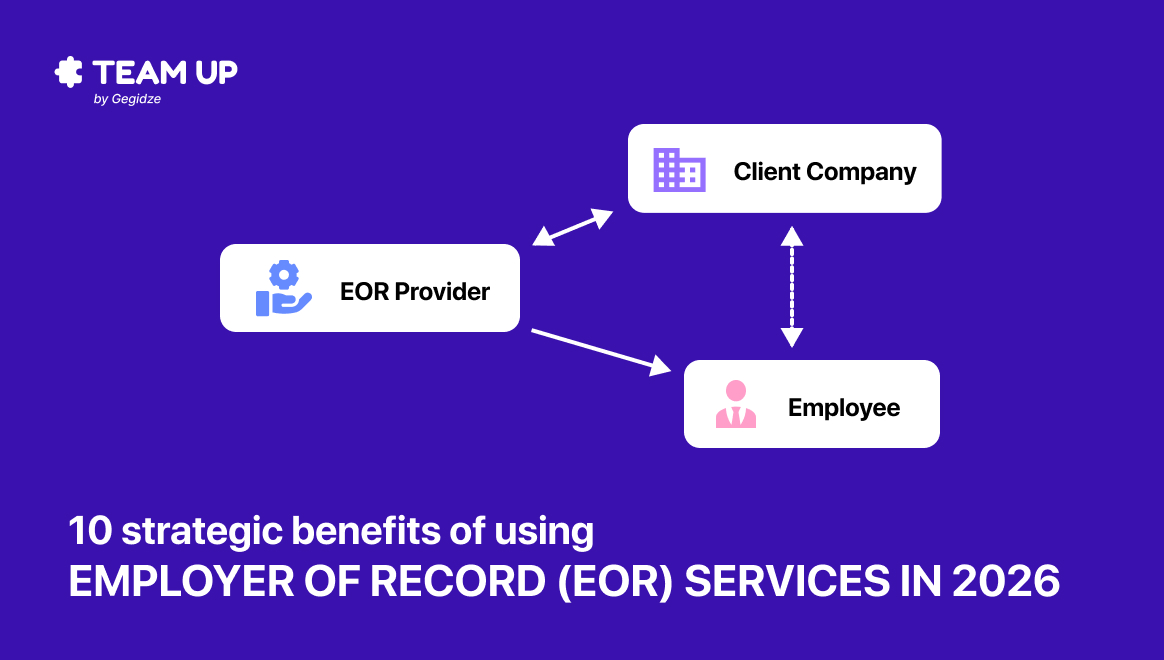
When you hire through an EOR, the employer of record — not your company — is the registered employer in the country. The employment relationship runs between the EOR and the employee. Your company has a services agreement with the EOR. That structure, done correctly, means your company does not have a legal employer presence in the country and is not the entity creating a taxable footprint.
Important nuance: PE risk is not zero when using an EOR. If employees have decision-making authority, conclude contracts on behalf of the parent company, or operate from a dedicated office space in the target country, PE exposure can still arise. A good EOR advises on how to structure roles and scope of work to minimize this risk — and in-country teams with local tax counsel are better positioned to do this than remote platforms relying on general guidance.
7. Manage Employee Benefits Without HR Infrastructure
Every country in this cluster has its own statutory benefit obligations. Annual leave minimums. Maternity and paternity leave entitlements. Social insurance contributions. Pension filing requirements. Health insurance mandates. Overtime rules.
Running those obligations correctly across five countries — without a local HR team in each one — is operationally intensive. Missing a statutory requirement is not just an administrative inconvenience. It is a legal violation that creates personal liability for the responsible entity and financial exposure for the company.
An EOR absorbs the entire benefits administration layer. Statutory obligations are tracked, calculated, and filed correctly. When new requirements come into force — like Armenia's mandatory health insurance contribution from January 2026, or Uzbekistan's restructured social insurance processing — the EOR updates its payroll and benefits systems before the deadline, not after the audit.
Beyond statutory compliance, a good EOR provides access to supplementary benefits — private health insurance above the state baseline, learning and development stipends, wellness programs — that would require separate vendor relationships and management overhead if sourced independently.
This matters for hiring competitiveness as much as compliance. In India's technology market, for example, group health policies covering employees and their families are close to expected in senior roles. A company that cannot offer this through its EOR will lose candidates to those that can. In the Caucasus, where international companies are competing for talent that has worked remotely for global firms, supplementary benefits signal the quality of the employment relationship.
8. Test New Markets With Flexibility
One of the most undervalued benefits of EOR is what happens at the end of an unsuccessful market entry.
The traditional model — set up an entity, hire, learn whether the market works — creates a serious problem when the market does not work. Entity wind-down in most countries takes six to twelve months, requires legal filings, regulatory approvals, and often significant legal fees. You are paying for an entity that is no longer generating value while you wait for permission to close it.
EOR flips this model. You test the market with two or three hires through an EOR. If the market validates, you scale. If it does not, you give the standard notice period, the EOR manages the compliant offboarding, and your exposure ends there. No six-month wind-down. No legal bills to close a subsidiary. No local director on the payroll while paperwork clears.
This flexibility changes the risk calculus for market testing entirely. A company can run three simultaneous pilots — one in Georgia, one in Kazakhstan, one in Turkey — with full employment compliance in each market, and exit any that do not perform without committing to entity infrastructure in any of them.
Real scenario: a US tech company identifies Yerevan as a potential engineering hub. They hire three backend engineers through an EOR in Armenia, operating for six months. The talent quality is strong, the time zone works, and the cost is competitive. They decide to expand to ten engineers. At that scale, they begin evaluating whether a local entity makes sense long-term. The EOR has given them six months of real operating data to make that decision — not speculation.
That is how the most sophisticated companies are now using EOR. Not as a bridge to entity setup. As a deliberate instrument for controlled market entry.
9. Access Global Talent Pools Faster

The global talent shortage is structural, not cyclical. A $8.5 trillion revenue impact from unmet talent demand is projected by 2030. The domestic talent pool in most Western markets cannot fill the gap. Companies that limit their hiring to local candidates leave a significant competitive disadvantage on the table.
The markets where EOR creates the most talent access leverage are exactly those where the compliance environment makes self-managed hiring most difficult.
India has 5.4 million technology professionals. Bengaluru, Hyderabad, and Pune are global centers for software engineering, AI, data, and product. The talent is world-class. The compliance environment, EPF, ESIC, Gratuity, TDS, multi-state minimum wage, Payment of Bonus Act, is one of the most complex in Asia. Companies without in-country compliance expertise consistently underestimate the administrative burden and end up with payroll errors, missed filings, and legal exposure. An EOR handles every element of India compliance as standard workflow, leaving the client to focus on identifying and managing the talent.
The Caucasus — Georgia, Armenia, Azerbaijan — is emerging as a high-value hub for technology and operations talent. Armenia's IT sector grew 24.5% in the first quarter of 2025 alone, driven by government tech incentives and a strong engineering education base. Georgia has become a preferred destination for relocated international professionals. Azerbaijan is opening to foreign investment with a growing technology workforce. The region is cost-competitive, time-zone-compatible with European companies, and culturally sophisticated. Accessing it without a compliance infrastructure — specifically without an EOR that knows the work permit rules in each country — is a practical barrier most companies have not cleared.
Kazakhstan and Uzbekistan are earlier in their opening but growing. Kazakhstan generates 60% of Central Asia's GDP. Uzbekistan has a 36 million population, a young workforce, and a government actively promoting foreign investment. Companies that establish compliant hiring infrastructure there now will have a meaningful talent advantage in three to five years.
An EOR that owns entities across these markets — and provides employer sponsorship for foreign nationals being relocated into them — is not just a compliance tool. It is a talent access mechanism.
10. Manage Multi-Country Hiring Through One Provider
This is the operational benefit that finance and HR leaders appreciate most — usually after their second multi-country expansion.
Without an EOR, managing international employment across five countries means: five different payroll systems, five sets of tax filing deadlines, five benefits providers, five employment law regimes to monitor, five sets of currency accounts, and five different contact points for compliance questions. The overhead is not linear. It compounds with each country added.
With an EOR — specifically one that covers multiple target markets under a single engagement — the overhead is consolidated. One invoice. One compliance reporting system. One relationship for employment questions across all markets. One point of accountability when something goes wrong.
For companies building teams across the Caucasus and Central Asia, this is particularly valuable. Georgia, Armenia, Azerbaijan, Turkey, Kazakhstan, and Uzbekistan each have distinct labor law regimes, different payroll cycles, different mandatory benefit structures, and different immigration frameworks. Managing those independently from a home-country HR team is not a realistic operating model at any meaningful scale.
An EOR with owned entities and in-country teams across all of those markets — like Team Up — delivers unified compliance management without the client company needing to develop expertise in each country independently. The HR team focuses on managing people. The EOR manages the jurisdictions.

Why EOR Benefits Are Stronger in Emerging Markets
Every benefit on this list applies to any EOR engagement. But they compound specifically in emerging markets — and that compounding effect is why EOR adoption in markets like the Caucasus, Central Asia, Turkey, India, and Egypt is growing faster than the global average.
In mature Western markets, some of these benefits are available through alternatives. You can often hire compliantly in Germany through a well-structured contractor arrangement with a German partner. You can find legal counsel to navigate the French entity setup quickly. The compliance landscape is documented, the professional services market is mature, and the mistakes are recoverable.
In emerging markets, the alternatives are thinner. The legal services market is less developed. English-language compliance guidance is often outdated or inapplicable to the current regulatory environment. Immigration rules change with less notice and less documentation. And the cost of a compliance mistake — in fines, operational disruption, and relationship damage with local authorities — is harder to absorb.
This is where an EOR with owned entities and in-country offices delivers its maximum value. Not just as a payroll processor, but as a local operating partner that has already made the regulatory mistakes so you do not have to.
Team Up operates owned legal entities across Georgia, Armenia, Azerbaijan, Turkey, India, Kazakhstan, Uzbekistan, and Egypt, with offices in Tbilisi, Yerevan, Istanbul, Almaty, and Tashkent. EOR services start at €199 per employee per month in Georgia. Every engagement includes full compliance coverage, direct immigration sponsorship, and in-country HR support — not a help desk or a partner network.
Frequently Asked Questions
What is the primary strategic advantage of employer of record services over entity setup?
Speed and capital efficiency, with compliance protection built in. Entity setup takes 3–9 months and costs $20,000–$250,000 upfront. An EOR can onboard your first hire in a new country within days, with no upfront capital commitment and no entity to wind down if the market does not perform. For companies with fewer than 15–20 employees in a single country, EOR is almost always more cost-effective when total costs are properly calculated.
How does an EOR help with employment sponsorship for foreign nationals?
When a hire requires an employer to provide work authorization — meaning "sponsorship for an immigration-related employment benefit" such as a work permit or visa — the employer must be a registered legal entity in that country. An EOR with an owned entity already meets this requirement and can act as the legal sponsor for immigration applications. This enables companies to hire or relocate foreign nationals into markets where they have no entity of their own. For country-specific sponsorship processes, see our guides on work permits and visa types by region.
Does using an EOR create permanent establishment risk?
For standard employment arrangements where the employee executes work on behalf of the EOR client but does not conclude contracts or make strategic decisions on the parent company's behalf, EOR alone does not generally create permanent establishment. However, PE risk depends on the scope of the employee's activities and the jurisdiction. A quality EOR advises on how to structure roles and work scope to minimize PE exposure, and in-country legal counsel is part of that service in markets where the risk is higher.
What is the benefit of using an EOR in India specifically?
India offers one of the deepest technology talent pools in the world, but its compliance environment — covering EPF, ESIC, Gratuity, TDS, Professional Tax, Payment of Bonus Act, and state-level minimum wage variations — is among the most complex in Asia. An EOR in India handles every statutory obligation correctly, handles payroll in INR, manages government filings, and allows the client to focus entirely on managing and building their team. Local India-specialist EOR providers typically charge $150–$250 per employee per month, significantly below global platforms while offering deeper country-specific expertise.
Can I exit a market quickly if EOR hiring does not work out?
Yes. This is one of the clearest operational advantages of EOR over entity setup. When you no longer need employees in a market, the EOR manages compliant offboarding under local notice and severance rules. Your obligation ends with the notice period and any statutory entitlements. No entity wind-down. No 6–12 month dissolution process. No ongoing legal and accounting fees while the closure clears regulatory approvals. For companies using EOR as a market-testing tool, this clean exit is a core part of the value.
Build Your Team in the Markets That Matter
The ten benefits in this article are not theoretical. They are the operational and financial reasons why 54% of companies now use or plan to use EOR as their primary international hiring model — and why the Caucasus, Central Asia, Turkey, India, and Egypt are attracting more EOR-enabled investment than at any point in the past decade.
Team Up provides employer of record services with owned entities, in-country offices, and direct compliance expertise across all eight markets in this cluster. From hiring your first engineer in Tbilisi to scaling a thirty-person team across Armenia and Kazakhstan, the infrastructure is already in place.
.svg)