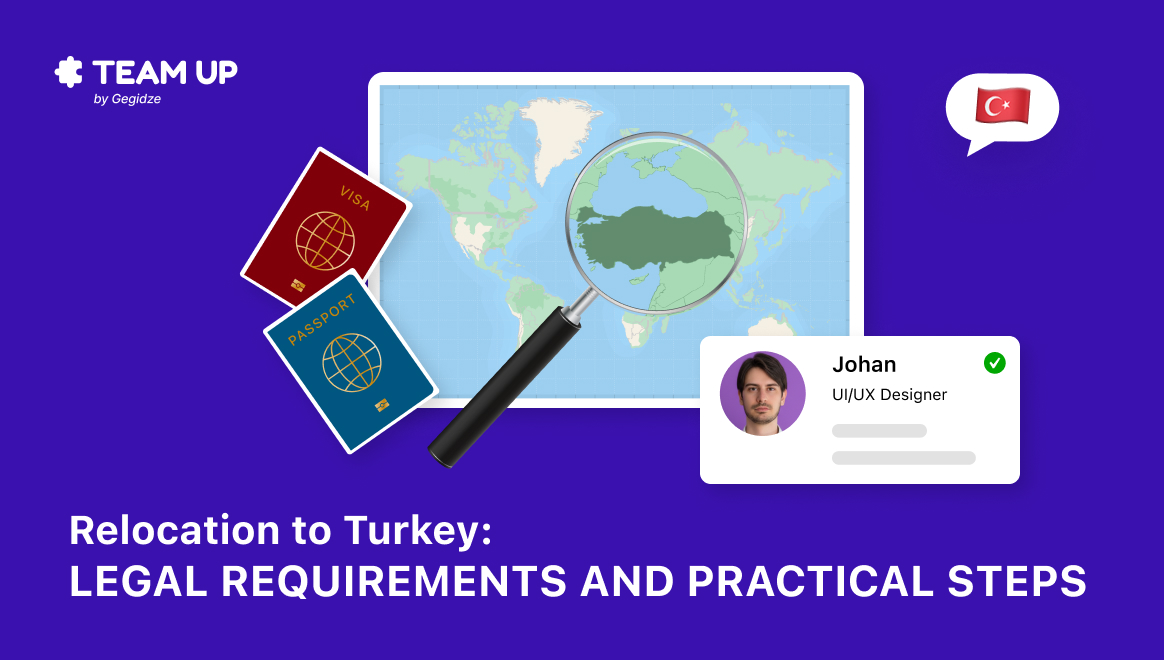
Relocation to Turkey: Legal Requirements and Practical Steps
Tl;DR
Navigating the transition into high-growth corridors like the Middle East and the Mediterranean requires more than just a passing familiarity with immigration law; it demands a nuanced understanding of how local bureaucracies breathe. For decision-makers scouting the next talent frontier, the concept of an employer of record in Turkey serves as a strategic gateway into a region that is as commercially rewarding as it is administratively dense. However, as the global hiring landscape shifts toward 2026, the real story for many founders is not just Istanbul, but the massive, often misunderstood market of Egypt. Relocating to these "emerging hubs" is a high-friction, high-reward move that feels, to many, like the British spread Marmite: you either love the chaotic energy and raw potential, or you hate the "war crime" levels of paperwork required to stay compliant.
Honesty is the only policy that survives the scrutiny of a founder uprooting their life. People can smell corporate "fluff" a mile away, and in markets like Egypt and Turkey, being transparent about the "hard parts", the 1:9 quotas, the mandatory HIV tests, and the "banking catch", is what establishes credibility. This report provides an exhaustive, expert-level examination of the legal requirements and practical steps for relocation, focusing on the structural reforms of 2025 and 2026. By weaving together the nuances of the employer of record Turkey framework with a deep, local dive into the Egyptian labor market, this analysis guides the reader through the procedural labyrinths of the Mediterranean's most significant economies.
Quick Navigation
- Tl;DR
- Legal Framework Governing Relocation to Turkey
- Corporate Vehicle Selection and Company Formation in Turkey
- Employer of Record (EOR) as a Market Entry Strategy
- The Regulatory Environment of the Turkish Labor Market
- Currency Regulations and Decree No. 32
- Practical Relocation: The Digital and Physical Infrastructure
- Technoparks and Strategic Investment Incentives in Turkey
- Compliance Architecture and Enforcement Risks
- Strategic Synthesis. Building a 2026-Ready Relocation Plan
- Frequently Asked Questions
Legal Framework Governing Relocation to Turkey

The primary gatekeeper for foreign nationals seeking professional integration into the Turkish economy is the Ministry of Labor and Social Security (MLSS). Under the framework of International Labor Law No. 6735, the concept of a "work permit" in Türkiye has been unified with the "residence permit," meaning that a valid work permit serves as a surrogate for legal residency, streamlining the administrative burden for those entering with employment intent. This consolidation reflects a policy intent to link residency rights directly to economic contribution, thereby ensuring that the foreign population remains productive and integrated into the formal social security system.
International Labor Law No. 6735 and Unified Work-Residence Permits
The Turkish work permit system is categorized by tenure and professional qualification, designed to manage the gradual integration of foreign labor into the domestic market.
The most common entry point is the Temporary Work Permit (Süreli Çalışma İzni). This permit is initially granted for a maximum duration of one year, strictly tied to a specific employer, a designated workplace, and a defined professional role. The limitation to a single employer during the first year is a deliberate mechanism to prevent labor market volatility and to ensure that the employer who sponsored the initial entry realizes the benefit of their recruitment investment.
Extensions of the temporary permit follow a prescribed legislative sequence. Upon the completion of the first year, an extension of up to two years may be granted, provided the employee continues to work for the same employer. A second extension can grant an additional three years of authorization. It is only after three years of continuous, legal employment with the same firm that a foreigner gains the legal mobility to apply for a work permit with a different employer, provided they remain within the same professional field. This sequence creates a six-year path toward professional stability before an individual can consider the Permanent Work Permit (Süresiz Çalışma İzni).
The Permanent Work Permit is reserved for those who have demonstrated a long-term commitment to the Turkish economy. Eligibility requires either eight continuous years of legal residency under a long-term residence permit or eight years of legal employment under a valid work permit. While this status grants the holder rights nearly identical to those of a Turkish citizen, including full social security benefits, certain sovereign exclusions apply. Holders of permanent permits are ineligible to vote, to stand for election, or to serve as civil servants. Furthermore, the privilege of tax-free vehicle importation, often granted to diplomats and certain specialists, does not extend to permanent work permit holders.
The Turquoise Card: A Sovereign Talent Attraction Strategy
In response to global competition for high-skilled talent, Türkiye introduced the Turquoise Card (Turkuaz Kart), a privileged status modeled after the European Blue Card but tailored to the specific needs of the Turkish innovation ecosystem. The Turquoise Card is granted to individuals categorized as "highly qualified" labor, including investors, scientists, researchers, and internationally recognized figures in culture or sports, who are deemed to provide a significant contribution to the country’s economy, technology, or international promotion.
The card utilizes a sophisticated points-based scoring system that evaluates the applicant's educational level, professional experience, wage level, and the scale of their investment or export contribution. A defining feature of the Turquoise Card is its initial three-year "transition period." During this timeframe, the Ministry assigns a specialist to monitor the holder’s activities and adherence to the commitments made during the application. If the specialist identifies deficiencies, the cardholder is given a three-month remediation period. Failure to correct these issues results in the cancellation of the card. Conversely, if the criteria are maintained throughout the transition period, the card becomes permanent, granting the right to reside and work indefinitely, while also extending automatic residency rights to the holder's spouse and dependent children.
Independent and Specialized Permits
For high-level professionals seeking to establish their own practices, the Independent Work Permit (Bağımsız Çalışma İzni) offers a pathway to self-employment. The evaluation of this permit is particularly rigorous, focusing on the applicant’s potential contribution to science and technology, the impact of their investment on the national economy, and their professional experience. Historically, this permit required five years of uninterrupted legal residency, though recent shifts in international labor policy have introduced more flexibility for innovators in the tech sector.
Concurrent with these permits are the specialized multipliers for salary requirements. To prevent the suppression of local wages and to ensure that foreign labor is truly high-value, the MLSS mandates that the gross monthly salary paid to a foreigner must be a specific multiple of the official minimum wage.
| Professional Category | Minimum Wage Multiplier | 2026 Estimated Gross Monthly (TRY) |
| Senior Managers and Pilots | 5.0 | 165,150.00 |
| Engineers and Architects | 4.0 | 132,120.00 |
| Middle Management and Specialized Expertise | 3.0 | 99,090.00 |
| Jobs Requiring Craftsmanship or Technical Skills | 2.0 | 66,060.00 |
| Household Services and Other Roles | 1.0 | 33,030.00 |
Data synthesized from.

The 5-to-1 Rule and its Revenue-Based Exemptions
Perhaps the most significant regulatory hurdle for foreign-owned entities in Türkiye is the "5-to-1 rule," which stipulates that a company must employ five Turkish citizens for every one foreign national. This rule is a cornerstone of Turkish labor policy, designed to ensure that foreign investment results in domestic job creation. However, recognizing the needs of multinational corporations and high-tech startups, the 2025 updates have introduced vital exemptions.
The 5-to-1 rule is waived for up to the first five foreign employees if the company’s net sales in the most recent fiscal year reached at least TRY 50,000,000. Furthermore, for foreigners who have resided in Türkiye for at least three of the last five years (excluding student permits), both the 5-to-1 rule and certain financial sufficiency criteria are waived for domestic applications, limited to three foreign employees per company. These exemptions indicate a nuanced understanding of the lifecycle of a foreign investment, allowing firms to initially staff with high-level expatriate leadership while they scale to meet domestic hiring quotas.

Corporate Vehicle Selection and Company Formation in Turkey
For entrepreneurs relocating to Türkiye, the choice of corporate structure is a foundational decision that impacts everything from capital requirements to long-term liability and share mobility. The Turkish Commercial Code (Law No. 6102) aligns closely with European standards, offering 100% foreign ownership and equal treatment for international and local investors.
Limited Liability Company (LLC) vs Joint Stock Company (JSC)
The Limited Liability Company (LLC or Limited Şirket) and the Joint Stock Company (JSC or Anonim Şirket) are the two primary vehicles for foreign investment. While both offer limited liability to their partners, their operational complexities and prestige levels differ significantly.
| Feature | Limited Liability Company (LLC) | Joint Stock Company (JSC) |
| Minimum Capital (2026) | TRY 50,000 | TRY 250,000 |
| Number of Partners | 1 to 50 | Minimum 1; no upper limit |
| Capital Blocking (2026) | Not required; 24 months to pay | 25% must be blocked before registration |
| Share Transfer Mobility | Requires a notary and registry registration | Easier; can be handled privately via share ledger |
| Regulatory Prestige | Suited for SMEs and small ventures | Higher prestige; suitable for large investments |
The LLC is the preferred model for over 90% of foreign-owned small and medium enterprises (SMEs) due to its simpler governance structure, no mandatory formal board meetings are required, and the fact that capital does not need to be blocked in a bank account before the company exists.
Conversely, the JSC is favored by larger firms seeking to eventually go public or those whose business model involves frequent share transfers, as JSC shares can be transferred without the constant need for notarization and trade registry filings.
Step-by-Step Incorporation Workflow
The process of company formation in Türkiye has been centralized through the Central Registry System (MERSIS), an online portal where all articles of association are drafted, and company names are reserved. For a foreign founder, the sequence begins with the notarized translation of their passport and the acquisition of a Turkish Tax ID number.
A critical operational challenge is the "Chicken and Egg" problem of bank accounts. To establish a JSC, 25% of the capital must be deposited into a Turkish bank account. However, opening a corporate bank account typically requires a tax ID, which in turn requires a company to be in the process of registration. To resolve this, the local tax office issues a "potential tax ID" for the company during the pre-incorporation phase.
The final registration occurs at the Trade Registry Office, where the notarized articles of association, proof of capital deposit (for JSCs), and the signature circular of the company directors are submitted. Once approved, the company is announced in the Turkish Trade Registry Gazette, gaining legal personality and the ability to sign contracts and hire employees.
Employer of Record (EOR) as a Market Entry Strategy
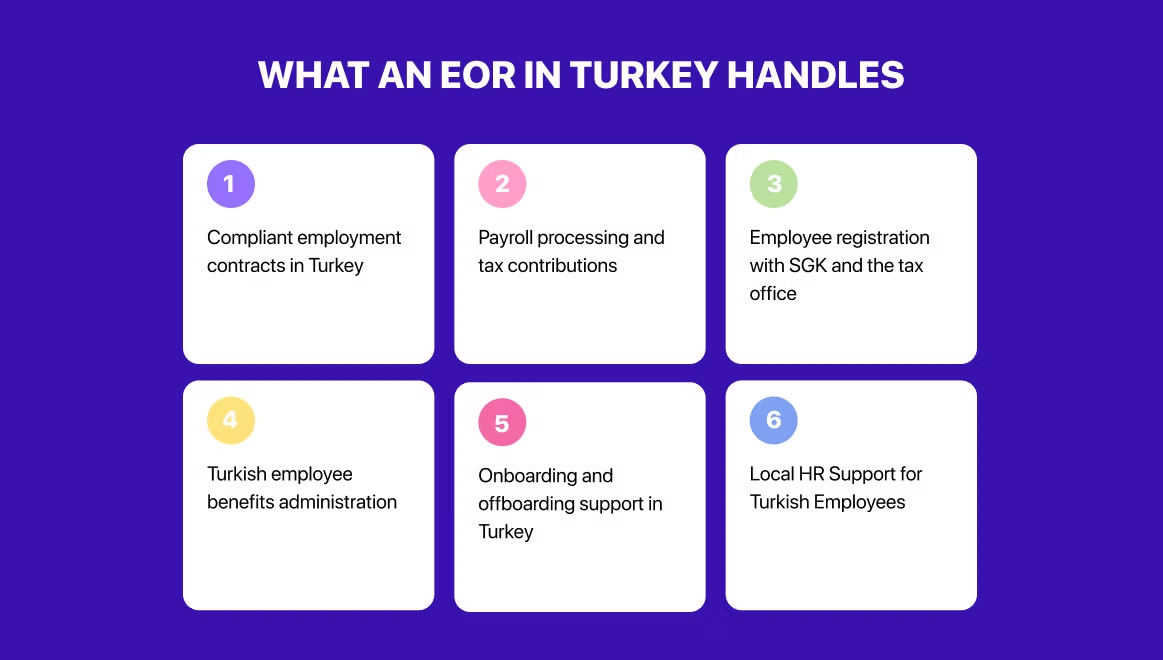
For many tech startups and remote-first organizations in 2026, the traditional path of entity incorporation is often bypassed in favor of the Employer of Record (EOR) model. An EOR in Turkey is a licensed Turkish entity that legally employs workers on behalf of a foreign company. This model allows a firm to onboard talent in 1 to 10 days, compared to the 6 to 8 weeks required for full incorporation.
The EOR partner takes on the full legal burden of employment, including social security (SGK) registration, payroll tax withholdings, and EOR compliance with the Turkish Labor Act. For a foreign company, this eliminates the need for a local physical office and a dedicated Turkish accountant, as the EOR provides a single monthly invoice covering gross salary, statutory costs (approx. 37.5% including employer and employee shares), and a service fee ranging from €199 to €599 per employee. This strategy is particularly effective for those testing the Turkish market or hiring a small initial team of developers or sales professionals.
The Regulatory Environment of the Turkish Labor Market
Navigating the Turkish labor market requires a deep understanding of the Labor Act (No. 4857) and the Social Security and General Health Insurance Law (No. 5510). These laws provide robust protections for workers, many of which are non-waivable even by mutual agreement.
Compensation Dynamics: Minimum Wage and Indexed Pay
The Turkish economy has experienced significant inflationary pressures, leading to a policy of frequent indexation for the minimum wage. For the 2026 calendar year, the official monthly gross minimum wage has been set at TRY 33,030. This figure serves as the baseline for all payroll calculations, including the minimum and maximum bases for social security premiums.
| Parameter | 2026 Monthly Amount (TRY) |
| Gross Minimum Wage | 33,030.00 |
| Net Minimum Wage | 28,075.50 |
| SGK Base Ceiling (Max Earnings) | 297,270.00 |
| Total Employer Cost (Standard) | 41,535.23 |
Data synthesized from.
The minimum wage for certain high-risk sectors, such as underground coal and lignite mining, is legally mandated to be at least twice the regular rate. This reflects a broader legislative trend toward using wage floors as a tool for social equity and occupational risk compensation.
The Severance Pay Ceiling (Kıdem Tazminatı)
One of the most critical financial liabilities for an employer in Türkiye is severance pay (Kıdem Tazminatı). Employees who have completed at least one year of service are entitled to severance pay upon termination by the employer (except for "just cause") or upon resignation for specific reasons like retirement or military service. The payment is calculated as one month's gross salary for every year of service.
To prevent excessive liability for high-earning employees, the government sets a "severance pay ceiling," updated every six months. If an employee's salary exceeds this ceiling, the severance calculation is capped at the ceiling amount.
| Period | Severance Ceiling (TRY) |
| Jan 1, 2025 – June 30, 2025 | 46,655.43 |
| July 1, 2025 – Dec 31, 2025 | 53,919.68 |
| Jan 1, 2026 – June 30, 2026 | 64,948.77 |
Severance pay up to this ceiling is exempt from income tax, though it is subject to a 0.759% stamp tax. For the employer, this biannual adjustment means that the cost of potential future terminations is constantly increasing, necessitating careful financial accruals.
Working Hours, Overtime, and Leave Entitlements
The standard working week in Türkiye is capped at 45 hours. Any work performed beyond this is considered overtime and must be compensated at a rate of 1.5 times the regular hourly wage, or 2 times the rate if performed on a weekend or public holiday. Total overtime is legally restricted to a maximum of 270 hours per year, and prior written consent from the employee is mandatory. Alternatively, an employee may choose to take "free time" instead of cash payment, calculated as 1.5 hours of rest for every hour of overtime, to be used within six months.
Turkish law also mandates generous leave entitlements, ensuring the long-term health and well-being of the workforce:
- Annual Paid Leave: At least 14 days after one year of service, 20 days after five years, and 26 days after fifteen years. Employees over 50 or under 18 must receive at least 20 days.
- Maternity Leave: 16 weeks of paid leave (8 before and 8 after birth), extendable in cases of multiple pregnancies.
- Paternity Leave: 5 days of paid leave for the father upon childbirth.
- Military Leave: Up to 90 days of paid leave per year for military exercises or statutory obligations.
- Marriage and Bereavement: 3 days of paid leave for each.
Currency Regulations and Decree No. 32
Relocating businesses must navigate the strictures of Decree No. 32 on the Protection of the Value of the Turkish Currency. This decree, substantially amended in 2018 during a period of currency volatility, prohibits Turkish residents—including foreign-owned subsidiaries—from determining contract prices or making payments in foreign currency (FX) for most domestic transactions.
FX Restrictions in Domestic Transactions
A landmark change occurred on March 6, 2025, with Communiqué No. 2025-32/72. This update significantly relaxed the FX ban for "movable asset sale contracts," excluding motor vehicles. This means that for the first time since 2018, Turkish businesses can both denominate and execute payments in USD or EUR for the sale of machinery, equipment, and commodities. This policy shift acknowledges the heavy reliance of Turkish industry on imported raw materials and high-value machinery, where pricing in TRY created unsustainable exchange rate risks for suppliers.
However, the "TRY is King" rule remains firmly in place for operational areas critical to the domestic economy:
- Real Estate: Sales and leases of residential or commercial property between residents must be in TRY.
- Labor and Service Contracts: Employee salaries and most service contracts (e.g., local consultancy, training) between residents remain strictly TRY-only.
- Public Sector: New restrictions imposed in 2025 prohibit public institutions and defense sector entities from accepting or making FX payments, even if the contracts are FX-indexed.
The 2026 Constitutional Court "Legal Reset"
Adding a layer of future uncertainty and potential liberalization is the 2026 Constitutional Court ruling. The court determined that the broad authority granted to the President to regulate currency via decree was unconstitutional, ruling that such restrictions must be based on specific parliamentary legislation. The transition period for this ruling ends on July 15, 2026, after which a new, parliament-enacted legislative framework is expected. This shift is anticipated to bring greater legal certainty and potentially more liberalized capital movement rules, provided the political climate remains business-friendly.
Practical Relocation: The Digital and Physical Infrastructure
The physical act of moving to Türkiye involves a series of interlocking steps where identity verification is the primary friction point.
The Identification Process: Tax ID to YKN
For the initial phases of relocation, such as signing a lease, setting up a bank account, or purchasing property, foreigners use a Turkish Tax ID Number (Vergi Kimlik Numarası). This is obtained immediately at tax offices or online using a passport.
Once the residency or work permit application is finalized, the individual receives a Foreign ID Number (Yabancı Kimlik Numarası or YKN), which always begins with "99". This number becomes the "digital fingerprint" for all official activities. It is linked to the e-Devlet system, which allows residents to manage their address registration (yerleşim yeri belgesi), criminal records, and mobile phone line registration. A critical step upon arrival is visiting the local Migration Administration office to register one's address, as failure to do so can jeopardize the validity of the residence permit.
Opening a Bank Account as a Foreigner in Turkey
Opening a bank account in Türkiye as a foreigner in 2026 remains a case-by-case process. While most banks officially require a residence permit and a YKN, some reputable institutions like Ziraat Bankası, İşbank, and Garanti BBVA may allow non-residents to open accounts with only a potential tax ID and a utility bill from their home country. Multi-currency accounts are standard, allowing residents to manage TRY, USD, and EUR easily through sophisticated mobile apps, which are often available in English.
Healthcare and Social Security Enrollment
Relocating individuals are typically required to have private health insurance for their initial residence permit. However, after one year of legal stay, they can apply to join the state SGK (GSS) system. This is particularly advantageous as it covers pre-existing conditions and provides free care at public hospitals. Furthermore, all residents can register at a local Family Health Center (ASM) to receive basic primary care and vaccinations free of charge. As of mid-2025, certain special-purpose health reports (e.g., for driver's licenses) are subject to a fixed fee, though mandatory public reports remain free.
Technoparks and Strategic Investment Incentives in Turkey
For technology founders and R&D-heavy companies, Türkiye offers one of the most competitive incentive regimes in emerging markets, largely centered on Technology Development Zones (Technoparks).
Technology Development Zones (Teknopark) Regime
Companies operating within an approved Technopark benefit from a 100% corporate tax exemption on profits derived from software development and R&D activities until December 31, 2028. Beyond corporate tax, there are significant payroll incentives for R&D personnel:
- Income Tax Exemption: Up to 95% of the salary of R&D personnel is exempt from income tax, based on their degree level.
- SGK Support: The government covers 50% of the employer's share of social security premiums for these employees.
- VAT and Customs Duty: Software sales within Technoparks are VAT-exempt, and imported machinery for R&D use is exempt from customs duties.
A unique 2025-2026 development is the flexibility for remote work. Under current Presidential decrees, up to 75% of the time spent by R&D personnel working outside the Technopark remains eligible for these tax exemptions, facilitating a hybrid work model that is essential for attracting global tech talent.
Regional Investment Incentives
Türkiye is divided into six investment regions, with Region 1 (Istanbul, Ankara) being the most developed and Region 6 (Eastern Anatolia) being the most incentivized.
| Incentive Type | Region 1 & 2 | Region 6 |
| Corporate Tax Reduction | 15% - 20% of investment | Up to 55% of the investment |
| SGK Employer Support | 2 - 3 years | Up to 12 years |
| Land Allocation | Limited availability | Priority allocation |
| Interest Rate Support | Not available | High support caps |
Data synthesized from.
The HIT-30 Program and the Project-Based Incentive Package offer tailor-made support for high-impact strategic projects, including cash grants for machinery, purchasing guarantees from the public sector, and energy subsidies.
Compliance Architecture and Enforcement Risks

Relocating to Türkiye involves a high level of ongoing compliance, as the Ministry of Labor and the Social Security Institution have intensified their audit activities in the 2025-2026 period.
Occupational Health and Safety (OHS)
Under Law No. 6331, which became fully effective for all workplaces on January 1, 2025, employers are responsible for the health and safety of their employees, regardless of the company's size. This includes appointing certified OHS specialists, performing regular medical checks, and providing safety training. Non-compliance is met with significant administrative fines, and workplace incidents can lead to criminal liability for directors.
Data Protection (KVKK)
Türkiye’s Personal Data Protection Law (KVKK) is closely aligned with the EU’s GDPR. Foreign companies must ensure that their HR systems and customer databases comply with local data processing agreements and registration requirements.
The 2026 Administrative Fine Landscape
Administrative fines under the Labor Act are revised annually based on the revaluation rate. For 2026, these fines have increased by 25.49%.
| Violation | 2025 Fine (TRY) | 2026 Estimated Fine (TRY) |
| Failure to notify the workplace establishment | 2,322 | 2,914 |
| Violation of the equal treatment principle | 2,017 | 2,531 |
| Failure to pay minimum wage (per worker/mo) | 2,179 | 2,734 |
| Collusive sub-contracting | 241,043 | 302,485 |
| Obstruction of labor inspectors | 192,838 | 241,992 |
Data synthesized from.
These fines underscore the government's commitment to enforcing labor protections. For relocating businesses, a proactive compliance audit every 12 months is essential to anticipate policy shifts and mitigate legal risks.
Strategic Synthesis. Building a 2026-Ready Relocation Plan
Successful relocation to Türkiye in 2026 is a multi-dimensional challenge that requires the synchronization of labor, corporate, and fiscal strategies. The "Turkey Century" initiative has created a landscape where high-tech innovation is heavily subsidized, yet traditional labor and currency protections remain rigid. The primary strategic recommendation for foreign founders is to leverage the Technopark ecosystem for R&D while utilizing an LLC structure for its simplicity. Concurrently, maintaining 100% compliance with SGK registration and Decree 32's currency restrictions is paramount, as the digitized enforcement systems of the Turkish state have become increasingly efficient at detecting and penalizing irregularities. As the 2026 "Legal Reset" approaches, businesses should prepare for a transition from presidential decrees toward a more stable, parliament-based legislative framework, potentially offering the most liberalized investment environment in the country's modern history.
Frequently Asked Questions
1. What is the new "500,000 TL Capital Rule"?
As of 2026, the minimum paid-in capital requirement for a company to sponsor a work permit has jumped from 100,000 TL to 500,000 TL. If you are a foreign shareholder seeking a permit for yourself or a manager, your company must meet this threshold.
Note: For existing companies, the Ministry now checks net sales (minimum 8 million TL) if the capital hasn't been increased.
2. Does the "5-to-1" Turkish employee ratio still apply?
Yes, and it is strictly enforced. For every one foreign employee you hire, you must employ at least five Turkish citizens who are registered with the Social Security Institution (SGK).
- Exception: If you are a foreign shareholder, you get a 6-month grace period from the date your company is founded before you must hire those five locals.
3. How have employer Social Security (SGK) costs changed in 2026?
2026 brought a cost increase for employers. The employer's share for "disability, old-age, and survivors' insurance" has increased from 11% to 12%. Additionally, the 5-point discount previously given to compliant employers has been reduced in some sectors, making the total "tax load" higher than in 2025.
4. Can I hire a foreigner who is already in Turkey on a Tourist Visa?
No. In 2026, you cannot apply for a work permit if the foreigner only holds a tourist residence permit. The candidate must either:
- Apply from abroad (via a Turkish Consulate).
- Have a valid Turkish residence permit with at least 6 months of remaining validity (non-touristic).
5. What are the mandatory "Salary Multipliers" for 2026?
You cannot pay a foreigner the minimum wage if they are in a specialized role. The Ministry mandates multiples of the 2026 minimum wage:
- Executives/Pilots: $6.5 \times$ minimum wage.
- Engineers/Unit Managers: $4 \times$ minimum wage.
- Teachers/Specialists: $3 \times$ minimum wage.
6. Does the Work Permit replace the Residence Permit?
Yes. In Turkey, a valid Work Permit Card officially serves as a Residence Permit. Your employees do not need to apply for a separate residence card from the Migration Office (Göç İdaresi) as long as their work permit is active.
7. What happens if I hire someone "off the books"?
The penalties in 2026 are severe. If caught during a labor inspection, the employer faces an administrative fine of approximately 35,000+ TL per worker. Furthermore, the company may be banned from sponsoring any foreign permits for a period of up to one year.
8. Are there any professions restricted to Turkish citizens?
Yes. Even with high capital and quotas, foreigners are legally prohibited from working as Attorneys, Dentists, Pharmacists, Notaries, or Private Security Guards in Turkey.
9. What is the "Turquoise Card," and should I use it for my team?
The Turquoise Card is a "super-permit" for highly qualified professionals (tech, science, or high-value investors). In 2026, it is the best option for long-term staff as it provides a permanent right to work and residency for the employee’s family, exempting the employer from some of the annual renewal bureaucracy.
10. Can I use an "Employer of Record" (EOR) to hire in Turkey?
Yes. Many international firms avoid the 500,000 TL capital requirement by using an EOR provider. The EOR already has the required Turkish staff and capital, effectively "leasing" the legal employment of your staff back to you while ensuring all 2026 tax and social security updates are met.
.svg)