


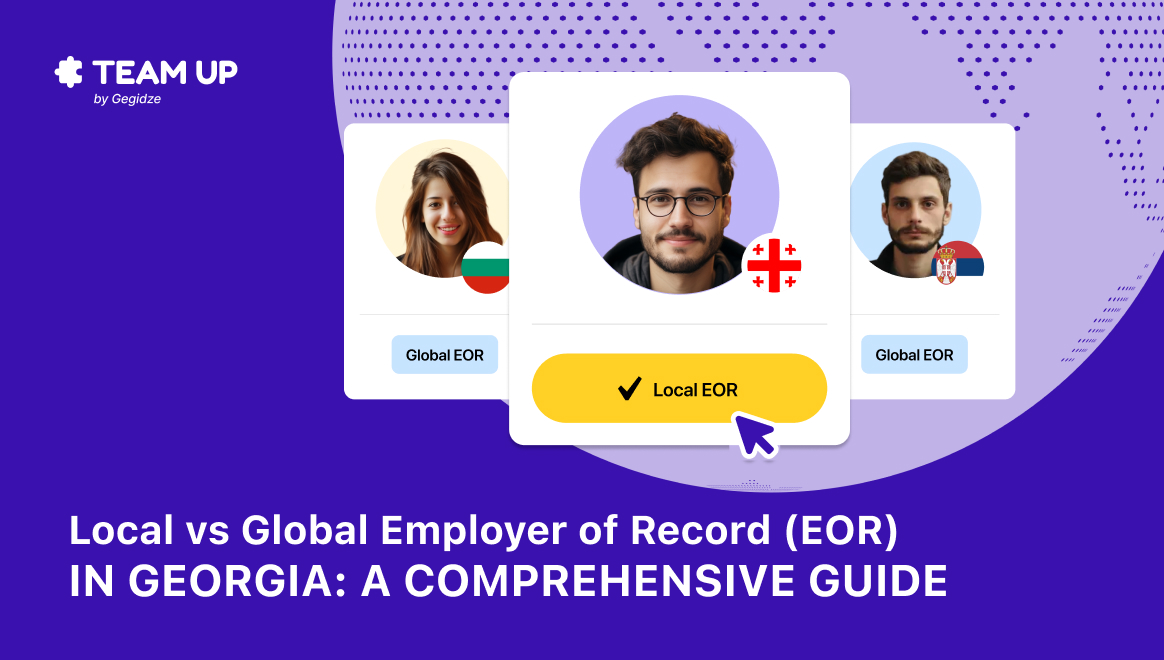
Local vs Global Employer of Record (EOR) in Georgia: A Comprehensive Guide
TL;DR
In the world of international expansion, "Global" is often sold as a synonym for "Easy." But if we are being Marmite-honest here: "Global" is usually just a very expensive interface for a very messy reality. When you see a platform claiming they can hire in 180 countries, they are not actually in 180 countries. They are essentially a travel agent booking your employees into "hotels" in Tbilisi or Batumi that they do not own and have never visited.
If you choose the wrong one, you are not just dealing with a bad UI; you are inviting hidden markups, compliance "hallucinations," and a fractured employee experience that can kill your culture before it even takes root. This is not an operational choice; it is a strategic decision about who holds your legal liability in Georgia when things get messy.
Let us look under the hood of the two models dominating the Georgian market in 2026.
Quick Navigation
- TL;DR
- Employer of Record (EOR) meaning
- Employer of Record Georgia: What it really means
- Local vs Global Employer of Record (EOR) in Georgia. Where theory meets reality
- Costs and pricing breakdown: The hidden costs of EOR services
- Decision matrix: Which one should you sign?
- Ready to choose the right EOR model in Georgia? Don’t guess. Decide with data.
- Frequently asked questions
Employer of Record (EOR) meaning
At its core, an Employer of Record exists to solve one problem: How do you hire someone in Georgia without becoming a legal expert in the Georgian Labor Code overnight?
But not all EORs deliver that solution in the same way. In 2026, many companies still misunderstand what they are actually buying. An EOR is not just “global payroll.” It is a legal operating model where a provider acts as the official employer for your Georgian team, while you maintain the day-to-day management of their work.
Here is what a proper EOR service should cover in Georgia, and where the differences between providers start to matter.
1. Legal employment, done locally and defensibly
The most important service an EOR provides is also the least visible. The EOR becomes the legal employer of your team member in Georgia. This means:
- The employment contract is issued under Georgian labor law.
- The employee is registered with the Revenue Service (RS.ge).
- The role is classified correctly under local regulations to avoid misclassification.
- Employment is enforceable in Georgian courts.
This is not paperwork for the sake of paperwork. It determines who owns the work product, whether a termination is valid, and whether you pass due diligence during a future fundraising round or acquisition. A strong EOR does not rely on generic templates; contracts must be locally compliant, often bilingual (Georgian/English), and aligned with how the law is enforced in Tbilisi.
2. Payroll processing and statutory tax filings
Payroll is where theory meets reality. A real EOR handles end-to-end payroll in Georgia, including:
- Gross-to-net salary calculations.
- Income tax withholding (the standard 20% flat rate).
- Statutory pension scheme management (the 2+2+2 rule).
- Payslips that meet local legal requirements.
- Monthly filings with the Revenue Service.
This is the heartbeat of employer of record payroll services. However, payroll is not just a calculation engine; it is a compliance process that requires an understanding of Georgian banking cycles and tax deadlines.
3. Mandatory benefits administration
Every country has benefits that are not optional. A compliant EOR in Georgia manages:
- Paid leave entitlements (the statutory 24 business days).
- Public holidays and sick leave rules.
- Parental leave, where applicable.
- Statutory pension contributions.
The difference between a good and bad EOR is simple: a good one knows what employees in the Georgian market expect, such as private health insurance tiers, while a weak one applies a global default and hopes it is enough to keep their talent from being poached.
4. Terminations, notice periods, and offboarding
This is the service no one wants to think about until they have to. A compliant EOR handles legally valid notice periods, termination documentation, and final settlements.
This is where global “one-size-fits-all” approaches tend to break. Terminations in Georgia are highly local. Get them wrong, and the risk is not theoretical; it is fines, claims, and reputational damage that sticks to your brand.

Employer of Record Georgia: What it really means

If you are looking at Georgia, you have already figured out that the "Silicon Valley of the Caucasus" is more than just a headline. With a 0% retained profit tax for IT companies and a workforce that is tech-fluent and hungry, Tbilisi is no longer a secret. But while the business environment is welcoming, the legal framework is precise.
An Employer of Record exists to bridge the gap between your ambition and the Georgian Labor Code. It is how you hire a lead developer in Batumi without spending months setting up a local LLC or learning the intricacies of the RS.ge portal.
But do not be mistaken: in 2026, an EOR in Georgia is not just a payroll provider. It is your local legal shield. Here is what a proper Georgian EOR service actually does to help you hit the ground running.
- High-Stakes Legal Compliance. The most important service is the one that keeps you out of Georgian labor courts. An EOR becomes the official employer of record, meaning the employment contract is rooted in the Georgian Labor Code, not a generic global template. The employee is fully registered with the Georgian Revenue Service. Intellectual Property (IP) rights are strictly assigned to you under local jurisdiction. Employment terms are enforceable and defensible in Tbilisi.
This is what determines whether your Georgian team is a scalable asset or a future liability during your next due diligence round.
- Precision Payroll and Tax Management In Georgia, payroll is about more than just a bank transfer. A direct EOR manages the entire flow: Gross-to-net salary calculations that account for the 20% flat income tax. The "2+2+2" statutory pension scheme ensures contributions from the employee, the employer, and the state are handled correctly. Monthly filings that keep you in the good graces of the Revenue Service. Local currency management to ensure your team receives their Lari (GEL) on time, every time.
- Benefits that Actually Attract Talent. Georgia’s tech talent is in high demand. If you offer the bare legal minimum, you will lose the best people. A local EOR knows the market and manages: Statutory paid leave (the standard 24 business days). Public holidays and local sick leave regulations. Market-aligned private health insurance is the number one perk Georgian employees look for. Remote work allowances and local equipment procurement.
- Protecting Your Exit Strategy Termination is the highest risk point in global expansion. Georgia has specific rules regarding notice periods and severance. A compliant EOR manages the offboarding process legally, protecting your brand from claims and ensuring that final settlements are calculated to the Tetri.
Georgia is open for business, and the talent pool is ready. The only question is whether you want to be a tourist in the market or a permanent player.

Local vs Global Employer of Record (EOR) in Georgia. Where theory meets reality
On paper, the choice between a local and a global Employer of Record in Georgia looks simple. One promises coverage everywhere. The other promises depth in one place. In practice, the difference shows up only when something goes wrong.
And in Georgia, things don’t go wrong loudly. They go wrong quietly. Until they don’t.
This section is about how the two EOR models actually behave on the ground in Georgia. Not how they’re marketed.

Global Employer of Record (EOR) in Georgia
Global EOR platforms approach Georgia the same way they approach most markets in the Caucasus. As a checkbox country.
The promise is familiar:
- Hire in Georgia in days
- One master agreement
- One invoice
- One dashboard
For companies hiring one person in Georgia while also hiring in ten other countries, this can feel convenient. Especially early on.
But convenience comes with structural trade-offs.
Most global EORs do not operate in Georgia through a deeply integrated local entity. Instead, they rely on:
- Standardized contracts adapted to Georgian law
- Central payroll logic with local overrides
- Local partner entities executing employment behind the scenes
That setup works. Until it doesn’t.
When Georgian labor law questions arise, global platforms often need to “check with the local partner.” When payroll edge cases appear, fixes move through global queues. When termination scenarios get sensitive, responsibility starts to blur.
Georgia is forgiving of paperwork. It is not forgiving of accountability.
The local EOR model in Georgia. Direct execution, clear liability
A local Employer of Record in Georgia works inside the system. Not around it.
This model is built on a simple principle. The entity that employs your team also runs payroll, files taxes, drafts contracts, and answers to regulators.
That changes everything.
A local EOR in Georgia typically:
- Employs your team through a Georgian-owned entity
- Draft contracts specifically for Georgian enforcement practice
- Runs payroll and tax filings in-country, not via middleware
- Responds to inspectors, banks, and authorities directly
- Makes decisions without third-party approval chains
This is not about being “more compliant.” It’s about being predictably compliant.
When something changes. A tax rule. A reporting expectation. An enforcement pattern. A local EOR reacts immediately because the risk sits on their balance sheet, not a partner’s.
Why Georgia exposes weak EOR models faster than expected
Georgia is often described as “easy.” That’s true only if you respect its simplicity.
Here’s where global EORs usually struggle in Georgia:
- Termination handling. Georgian law is flexible, but documentation and process still matter.
- IP ownership clarity. Poorly drafted clauses cause problems during exits.
- Payroll timing. Delays are noticed quickly by employees and authorities.
- Tax reporting consistency. Small discrepancies raise questions fast.
None of these issues show up during onboarding. They appear months later. Often during growth.
Local EORs are built for that moment. Global EORs are built to get you started.
The owned-entity question. Why it matters specifically in Georgia
Experienced CFOs ask this early for a reason.
Does your EOR own the Georgian entity employing your team?
In Georgia, this matters more than in many markets.
If the entity is owned:
- Liability is clear
- Decisions are fast
- Enforcement risk stays contained
- There is no partner negotiation during disputes
If the entity is subcontracted:
- Responsibility fragments
- Timelines stretch
- Risk flows back to you during pressure events
Georgia’s small market size amplifies this. Everyone knows everyone. Inspectors, lawyers, banks. Fragmented responsibility is easy to spot.
Which model fits Georgia best?
There is no universally “right” answer. There is only alignment with how you plan to hire.
A global EOR can make sense in Georgia if:
- You are hiring one person only
- Georgia is not strategic yet
- Speed matters more than long-term depth
- Headcount will remain low
A local EOR is the stronger choice if:
- You are building a real team in Georgia
- You expect promotions, terminations, or role changes
- Payroll accuracy and IP protection matter
- You want predictable costs and clean diligence outcomes
Georgia rewards companies that commit properly. It quietly penalizes those who treat it as interchangeable with other markets.
In the next section, we’ll break down pricing behavior in Georgia, the real cost differences between local and global EORs, and why fees behave very differently once headcount starts to scale.
Costs and pricing breakdown: The hidden costs of EOR services
If you want to understand how different EOR models really behave, follow the money. Pricing is where the gap between local EOR providers and global EOR platforms becomes impossible to ignore. It is also where many companies realize, a bit too late, that they optimized for convenience instead of sustainability.
Let us break this down clearly for the Georgian market.
How local EOR pricing works in Georgia
Local EOR providers price based on actual in-country execution, not global averages. That usually means a flat monthly fee per employee with transparent pricing that reflects Georgian payroll complexity. You will not find a percentage-of-salary markup here.
For the Georgian market, local EOR pricing reflects the reality on the ground. What is included is the part finance teams care about:
- Legal employment under a Georgian entity
- Payroll processing and tax filings (RS.ge)
- Statutory benefits and pension administration (2+2+2)
- Ongoing compliance and Labor Inspection support
This structure makes forecasting easy. Your cost per hire stays predictable even as salaries in the Tbilisi tech sector increase. That predictability is exactly why CFOs prefer local models when headcount starts to scale.
How global EOR pricing works
Global EOR platforms price for reach, not depth. The most common models involve high flat monthly fees or a percentage of the gross salary, often layered on top of extra fees for benefits or local adjustments. It is not unusual to see $600+ per employee per month.
The challenge is structural. As salaries grow, percentage-based pricing means your employer of record service gets more expensive without delivering more value. Same payroll. Same compliance work. Higher fee. That is not a compliance premium. That is a platform tax.
Pricing example: The Georgia Reality
Here is a simple comparison for hiring a senior developer in Georgia.
| Market: Georgia | Local EOR (Team Up) | Global EOR Platform |
| Monthly Service Fee | €199 - €500 per employee | $600+ per employee |
| Pricing Model | Flat, transparent | Flat or % of salary |
| Cost Scaling | Predictable | Increases with salary |
| Local Handling | Direct, in-country | Standardized, often partner-based |
Over a year, that difference compounds fast. Multiply it by 5 hires, then 10, then 25. Suddenly, EOR fees are no longer background noise. They are a line itemthat your board starts questioning. This is why cost-conscious teams building hubs in Georgia look beyond logos and ask how the pricing model behaves at scale.
Decision matrix: Which one should you sign?
At this point, the choice between a local and a global EOR for your Georgian expansion should feel less abstract. This is the section where operators stop debating theory and start making a call.
Below is a decision matrix built for founders, HR leaders, and CFOs who need to move fast in the Caucasus without creating problems they will have to clean up later.
Local vs Global EOR. Decision matrix
| Decision Factor | Local EOR Provider (Team Up) | Global EOR Provider |
| Speed to hire | Fast. Onboarding in days once the scope is clear | Fast for single hires across many countries |
| Cost efficiency | High. Flat pricing aligned to the Georgian market | Lower. High global fees or % of salary markups |
| Compliance depth | High. Built around the Georgian Labor Code and RS.ge | Moderate. Standardized processes adapted per country |
| Support model | Direct access to in-country Georgian experts | Tiered support is often routed through global queues |
| Issue resolution | Faster for local legal and termination edge cases | Slower when local partner input is required |
| Scalability | Best for building a concentrated hub in Georgia | Best for 1-2 hires across 10+ countries |
| Risk profile | Lower. Direct liability under a local entity | Higher in partner-reliant aggregator models |
How to read this matrix like an operator
Do not treat this as a scorecard where one side wins. Instead, map it to how your company actually intends to grow.
Choose a local EOR if:
- You are building a real team in Georgia (3+ people).
- Payroll accuracy and local tax filings (2+2+2) matter more than a pretty dashboard.
- You expect local contract changes, promotions, or complex terminations.
- Your CFO wants predictable, explainable costs that do not tax your growth.
Choose a global EOR if:
- You are hiring only 1 person in Georgia and have no plans to expand there.
- Speed and broad coverage matter more than Georgian legal nuance.
- You want one vendor and one invoice for a team scattered across 20 countries.
- Headcount per country will always stay extremely low.
The biggest mistake companies make is choosing a global model for a local problem. If Georgia is a strategic part of your talent map, you need a partner who owns the entity, not a travel agent for your employment.

Ready to choose the right EOR model in Georgia? Don’t guess. Decide with data.
You now have the framework. The only thing left is applying it to your exact hiring map in Tbilisi. If we are being honest, choosing an employer of record service is not about finding the biggest brand; it is about finding the shortest distance between a problem and a solution.
In 2026, the most successful companies are not the ones with the most flags on their map. They are the ones with the deepest roots in the countries that matter. Georgia is a unique market where talent is high-value and the legal environment is specialized. You know that your team in Georgia deserves more than a generic contract and a bot-led support queue.
At Team Up, we do not hide behind a network of third-party partners. We are the boots on the ground in Georgia. We own the entities, we handle the employer of record payroll services ourselves, and we protect your Intellectual Property as if it were our own.
If your strategy is to test five countries at once with a single hire each, a global platform can help you move. But if your strategy is to grow a dedicated hub in Georgia and stay clean while doing it, local execution is the only way to reduce friction, cost creep, and compliance exposure.
That is not marketing fluff. It is pattern recognition from operators who have seen both models under pressure.
Ready to ditch the middleman markup and build a Georgian team that actually lasts?
- Tired of the Aggregator Trap? Let us audit your current EOR costs.
- Building a Strategic Hub? Get a compliance deep-dive for the Georgian market.
- Need Real Support? Talk to a human expert who actually lives where you are hiring.
Frequently asked questions
Which countries are best served by local EORs versus global EORs?
Local EORs work best in countries where labor law is nuanced, enforcement is active, and teams tend to scale quickly once hiring starts. Good examples include: Georgia. Specialized IT tax regimes, specific pension rules (2+2+2), and active labor inspections.
When should a company transition from EOR to a local entity in Georgia?
There is no fixed headcount number, but the decision is strategic. Most companies consider transitioning when headcount in Georgia reaches 15 to 30 employees, or when the country becomes a permanent operational hub. Until then, an EOR provides better speed and flexibility. The biggest risk is waiting too long and paying high aggregator fees long after they stopped making sense.
What are the key compliance risks with global EOR providers in Georgia?
The biggest risk is indirect accountability. Many global providers rely on partner entities in Tbilisi. This introduces slower response times during audits, limited flexibility during terminations, and contracts that might be compliant in theory but weak in practice. These risks usually show up during inspections, employee exits, or due diligence for an acquisition
How do benefits and compensation differ when using an EOR?
Local EORs tend to align benefits with what Georgian employees actually expect. This means statutory benefits are handled correctly and market-standard extras, like private health insurance, are prioritized. Global EORs tend to standardize benefits across regions, which can lead to overpaying for benefits that are not valued locally or underdelivering on the perks that actually help you win talent wars in Tbilisi.
Is a global EOR always more expensive than a local EOR?
In almost every case where you are hiring in Georgia, yes. Global EOR providers typically charge $600+ per employee per month, regardless of the country. Local EOR providers usually charge €199 to €500, priced according to local payroll costs. The gap widens as salaries increase because local specialists use flat fees while many global platforms use a percentage of the gross salary.
Why do CFOs care so much about whether the EOR owns the local Georgian entity?
Because liability follows the legal employer. If the EOR owns the entity, accountability is clear. Payroll, contracts, and taxes sit under one legal roof. If the EOR is an aggregator using third-party partners, responsibility becomes fragmented. During a Georgian labor audit or a termination dispute, that fragmentation creates delays and legal risk for your business.
.svg)


