


What is Employer Sponsorship in India And How Does It Work?

Employer sponsorship in India is a critical concept for companies looking to hire foreign talent in the country. It refers to the formal process where an Indian organisation sponsors a foreign national’s work visa, essentially vouching for that individual’s employment and legal compliance while in India.
For decision-makers planning to expand or hire in India, understanding how employer sponsorship works is key to a smooth and compliant hiring process. This guide breaks down what sponsorship means in the Indian context, the types of work visas, employer obligations, what it means when a candidate “requires sponsorship,” and how partnering with an Employer of Record (EOR) like Team Up can simplify everything. We’ll also cover actionable steps and best practices to ensure your hiring of foreign nationals in India is hassle-free and fully compliant.
In this article, we will cover:
- What is Employer Sponsorship in India?
- Types of Work Visas & Permits in India
- Employer Obligations & Required Documentation
- What Does “Require Sponsorship for Employment Visa Status” Mean?
- Direct Sponsorship vs Employer of Record in India
- How EOR Services Simplify Visa Sponsorship in India
- Conclusion
- FAQ
What is Employer Sponsorship in India?
In the Indian context, employer sponsorship means an Indian-registered company acts as the official sponsor for a foreign employee’s work visa. In practical terms, the company provides the job offer and supporting documentation to help the foreign national obtain an Employment Visa (the primary Indian work visa category). The Government of India requires that any foreigner hired for a job in India have a sponsoring employer – you cannot legally employ a foreign national in India without this arrangement. In fact, employers in India must serve as the formal sponsor on the Employment Visa application. This means the company essentially guarantees to the Indian authorities that:
- The foreign hire is coming to fill a role requiring skills or expertise not readily available in the local labor market.
- The individual will be employed in a legitimate position and paid a qualifying salary.
- The company will take responsibility for the employee’s conduct, visa compliance, and eventual departure if required.
Put simply, sponsorship for employment is the mechanism by which the Indian government holds a local entity accountable for a foreign worker’s presence and activities in India. The employer becomes the “host” for immigration purposes, bearing various responsibilities (which we’ll detail shortly) to ensure the foreign employee’s work and stay remain fully compliant with Indian laws.
It’s important to note that employer sponsorship is not a one-time checkbox, but an ongoing commitment. Once the employee is in India, the sponsoring company must continue to uphold immigration rules – for example, making sure the employee doesn’t overstay their visa, updating authorities if the job role or location changes, and facilitating visa renewals as needed. Failure to meet these sponsorship duties can lead to penalties or jeopardize the employee’s legal status.
In summary, employer sponsorship in India means backing a foreign worker’s legal right to work in India, with the company’s credibility and compliance efforts providing the foundation for that worker’s visa approval and continued lawful employment.
Types of Work Visas & Permits in India
India offers several visa categories for foreigners, but when it comes to working in India, there are a few specific visas and permits that employers and foreign hires should be aware of. Each has its own purpose, eligibility, and limitations. Below are the key types of employment-related visas in India:

1. Employment Visa (E Visa)
The Employment Visa is the primary work visa for foreign professionals employed by an Indian company.
It applies to foreign nationals hired for salaried roles.
Key Requirements
| Requirement | Details |
| Sponsor | Indian employer must sponsor the visa |
| Minimum salary | ₹1,625,000 per year (≈ $25,000) |
| Skill level | Typically, senior or highly skilled professionals |
| Validity | Usually 1 year or contract duration |
| Maximum extension | Up to 5 years total |
| Employer restriction | An employee can only work for the sponsoring company |
FRRO Registration Rule
If the employee stays longer than 180 days, they must register with the Foreigners Regional Registration Office (FRRO) within 14 days of arrival.
This registration grants the employee a residential permit.
Employment Visa Checklist
Before applying, confirm:
- Indian company sponsorship confirmed
- Salary meets minimum threshold
- Employment contract signed
- Role qualifies as skilled or senior-level
- FRRO registration planned if stay exceeds 180 days
Important Limitation
The visa is job-specific and employer-specific.
Employees cannot switch employers without applying for a new visa.
2. Business Visa (B Visa)
The Business Visa is often misunderstood.
It is not a work visa.
It allows short-term business activities but does not allow salaried employment in India.
Allowed Activities
| Allowed | Not Allowed |
| Attending meetings | Working for an Indian company |
| Conferences | Receiving salary from India |
| Market exploration | Being on the Indian payroll |
| Setting up a subsidiary | Long-term operational work |
Business Visa Overview
| Feature | Details |
| Purpose | Business visits and negotiations |
| Validity | Up to 5 years |
| Entries | Multiple entries allowed |
| Salary from India | Not permitted |
Compliance Warning
Using a Business Visa to perform regular work for an Indian company violates immigration rules.
Foreign staff can visit India on a Business Visa for planning or setup discussions, but cannot perform ongoing work for an Indian entity.
3. Project Visa
The Project Visa applies to foreign specialists working on specific industrial projects.
This visa is common in sectors such as:
- Power
- Steel
- Infrastructure
- Heavy engineering
Project Visa Overview
| Feature | Details |
| Sponsor | Indian company |
| Sector | Core industries |
| Purpose | Execution of a specific project |
| Validity | Duration of the project |
| Extensions | Limited to project duration |
Project Visa Checklist
Confirm the following before applying:
- The project is in an approved core sector
- Employee is a specialist or technician
- Detailed project documentation is submitted
- Sponsoring Indian company is confirmed
Key Restriction
The visa expires when the project ends.
The employee cannot work for other assignments or companies.
4. Intern Visa (I Visa)
The Intern Visa allows foreign nationals to complete internships or training programs in India.
It is commonly used by:
- Students
- Recent graduates
- Trainees in corporate or NGO programs
Intern Visa Overview
| Feature | Details |
| Purpose | Internship or training |
| Sponsor | Indian company, NGO, or educational institution |
| Validity | Up to 1 year |
| Compensation | Stipend allowed |
Intern Visa Checklist
Before sponsoring an intern, confirm:
- An internship offer is issued
- An internship agreement exists
- The role focuses on training and learning
- Position does not replace a full-time employee
Authorities review these visas carefully to prevent misuse as low-cost employment.
5. Dependent Visa (Entry “X” Visa)
The Entry (X) Visa is issued to dependents of foreign employees working in India.
Eligible dependents include:
- Spouses
- Children
Dependent Visa Overview
| Feature | Details |
| Purpose | Residence for family members |
| Validity | Matches the Employment Visa duration |
| Work rights | Not permitted |
Dependent Visa Checklist
Confirm the following:
- Primary employee holds a valid Employment Visa
- Family relationship documents are provided
- Dependent understands work restrictions
Important Rule
Dependents cannot work in India.
If a spouse wants employment, they must apply for their own Employment Visa.
Other Visa Categories
In certain situations, additional visas may apply.
Examples include:
- Research Visa. For academics and research collaborations
- Volunteer Visa. For NGO work or social programs
These categories apply to specific cases and are less common for standard hiring.
Most Common Visa for Hiring
For companies hiring foreign professionals in India, the Employment Visa remains the primary pathway.
It provides the legal framework for:
- Salaried employment
- Long-term work authorization
- Employer-sponsored residency
Understanding the correct visa category is essential before hiring foreign staff in India. Choosing the wrong visa can delay projects and create compliance risks.

Employer Obligations & Required Documentation in India
Sponsoring a foreign employee is not just about offering a job – it comes with a series of obligations and paperwork that the employer must handle. Indian immigration authorities want assurance that the sponsoring company is genuine, compliant, and prepared to take responsibility for the foreign national. Here’s what Indian employers need to do and provide when sponsoring an employment visa:
Provide official invitation and sponsorship letters
The Indian employer must issue a formal invitation or offer letter to the foreign candidate, and a sponsorship letter addressed to the Indian embassy/consulate. The sponsorship letter declares that the company takes responsibility for the employee’s activities in India and will ensure their departure if needed. Essentially, the company vouches for the individual’s purpose in India and promises to cover repatriation costs should anything go wrong.
Furnish a tax liability undertaking
Immigration authorities often require a letter confirming the employer’s obligation for the foreign worker’s income tax liabilities in India. This means the company pledges to withhold and pay all required Indian taxes on the employee’s salary. It’s a way of ensuring the foreigner will pay taxes just like any local hire, with the employer facilitating compliance.
Justify the hire
Employers should be prepared to explain why a foreign national is being hired over an Indian. Often this is done via a justification letter stating that no qualified local candidate was available for the role, and highlighting the foreign hire’s unique skills or experience that are valuable for the job. This ties back to the eligibility criteria – generally, employment visas are for specialised roles, not positions where there’s an abundant local talent pool. Detailing the recruitment efforts and the candidate’s qualifications helps satisfy this requirement.

Submit company and legal documents
The sponsoring company needs to provide proof of its own legitimacy. Common documents include the Certificate of Incorporation of the Indian entity, the company’s PAN (Permanent Account Number) card copy, and sometimes financial statements. Basically, the government wants to verify that the employer is an established business in India and not a shell. Additionally, a copy of the signed employment contract and appointment letter with the foreign employee is required to confirm the terms of employment (role, salary, duration).
Ensure regulatory compliance (labor and payroll)
By sponsoring, the employer commits to follow all Indian labor laws for this employee. This includes enrolling them in mandatory benefit schemes (Provident Fund, Employee State Insurance if applicable, gratuity, etc.), issuing payslips, and depositing taxes. The employer must “ensure payroll and income taxes are correctly deducted and paid” for the foreign employee, just as they would for any Indian employee. Non-compliance on this front can lead to legal trouble both with immigration and labor authorities.
Support FRRO registration
If the foreign employee will stay in India longer than 180 days, the company should assist them in registering with the FRRO (Foreigners Regional Registration Office) within 14 days of arrival. Practically, this means providing any needed documentation (like proof of address, employment verification, etc.) and guiding the employee through the registration process. FRRO registration is mandatory for long-term visas and is part of the employer’s sponsorship duties.
Monitor visa status and renewals
Sponsorship doesn’t end once the visa is issued. Employers are expected to help manage the visa throughout employment. That means tracking the visa expiry and, if the employment is continuing, initiating renewal applications on time (visas can typically be extended yearly up to 5 years). If the employee’s role changes or if they are transferred to a different location in India, updates may need to be communicated to authorities. Essentially, “sponsorship is ongoing” – the company must ensure the employee does not breach any visa conditions during their stay.
Facilitate exit formalities
When the foreign employee’s assignment or employment in India ends, the employer should ensure proper exit formalities. This could involve notifying the FRRO of the end of employment, cancelling the work permit if required, and, of course, ensuring the individual leaves India or transitions to a different valid status. The sponsorship responsibility includes making sure that once the employment ends, the individual isn’t continuing to reside or work in India unlawfully.
Meeting all these obligations might seem daunting, but they are essential for immigration compliance. Companies often develop an internal checklist or work with immigration experts to handle the paperwork. It’s all about demonstrating to the government that you, as an employer, have everything under control – from the legitimacy of the hire to the welfare and legal compliance of the foreign employee.
What does Require Sponsorship for Employment Visa Status Mean in India?
If you’ve ever come across the question “Will you now or in the future require sponsorship for employment visa status?” on a job application or heard a candidate mention “I require sponsorship for employment”, it essentially boils down to whether the person needs an employer to sponsor their work authorisation in order to work in a given country. In the context of hiring in India, this question is asking: Are you legally authorised to work in India on your own, or will you need a company to sponsor a work visa for you?
For Indian citizens (or foreigners who already have a long-term work authorisation like an Overseas Citizen of India status), the answer is “No, sponsorship is not required” because they can work without any special immigration process. But for most foreign nationals without existing work privileges in India, the answer is “Yes – they will require sponsorship for employment.” That means the employer must go through the process we described above: securing an Employment Visa on the individual’s behalf.
From an employer’s perspective, a candidate who “requires sponsorship” is someone who cannot legally work for you in India unless you’re willing and able to sponsor a visa for them. This typically includes:
- Foreign nationals abroad who you want to relocate to India for a role.
- Foreigners already in India on a non-work status (e.g., tourist or business visa holders, or dependents) who seek employment would need you to sponsor the switch to an Employment Visa.
- Expats currently working for another company in India – they have a visa tied to that employer, so if you hire them, you’ll have to sponsor a new visa under your company’s name (since Indian visas generally aren’t transferable between employers).
In practical terms, when a company asks a candidate, “Do you require sponsorship?” they are gauging the additional steps and costs that might be involved in hiring that person. Sponsoring a work visa involves time, administrative effort, and compliance steps (as we’ve outlined). Some employers, especially those without experience or resources in this area, might be hesitant to hire someone who needs sponsorship. On the other hand, companies that have a global outlook or partners like an EOR in place are often prepared to handle it.
For the candidate, answering “yes” to requiring sponsorship could mean they need to assure the employer that they are worth the extra effort, and perhaps that the timeline for their start date might be longer (to allow for visa processing).
It’s worth noting that in India, the sponsorship process typically requires the employer to have a legal entity in India. If a foreign company (without an Indian branch or subsidiary) is asking a candidate this question, a “yes” answer would mean they either need to establish an entity in India or use a third-party Employer of Record to handle the sponsorship. We’ll explore those options in the next sections.
In summary, “requires sponsorship for employment visa status” means the person can only work if you sponsor their visa. It flags that hiring this person will involve navigating India’s immigration procedures. For companies, especially those new to Indian hiring, this is an important consideration – but as we’ll see, it’s very manageable with the right approach or partners in place.
Direct Sponsorship vs Employer of Record in India
When hiring foreign employees in India, companies typically choose between two sponsorship routes.
You can sponsor the visa directly through your own entity, or use an Employer of Record (EOR).
Both methods lead to the same outcome. A valid work visa and compliant employment. The difference lies in who handles the process, compliance responsibilities, and operational effort.
Direct Employer Sponsorship (In-House)

Direct sponsorship means your company acts as both the sponsor and the legal employer in India.
To do this, you must operate a registered legal entity in India, such as:
- A private limited company
- A limited liability partnership (LLP)
- An Indian subsidiary of a foreign company
Your organisation then sponsors the employee’s Employment Visa and manages all related obligations.
Setup and Administration
Before sponsoring foreign hires, you must already have an operational entity in India.
Setting up a local entity usually involves:
- Company incorporation
- Tax registrations
- Opening corporate bank accounts
- Compliance registration with labour authorities
Once operational, your company must manage full employment administration.
Typical responsibilities include:
- Payroll processing
- Provident fund contributions
- Indian employment contracts
- Income tax withholding
- HR and legal compliance
You become the full legal employer for the foreign hire.
Immigration Process
Your internal HR team or immigration counsel handles the visa process.
Typical steps include:
- Preparing sponsorship documentation
- Drafting employment and invitation letters
- Collecting required employee documents
- Filing the visa application at the Indian embassy or consulate
- Tracking approval and responding to immigration queries
After arrival in India, you must also ensure the employee completes FRRO registration when required.
Compliance Burden
All regulatory responsibility remains with your company.
Ongoing obligations include:
- Visa renewals
- Labor law compliance
- Immigration reporting
- Government filings
- Updates to employment records
If any issue occurs, such as visa rejection or a labour inspection violation, your company is directly accountable.
Control Advantages
Direct sponsorship provides maximum control.
Your company manages:
- Visa documentation
- Employment terms
- Payroll and benefits
- Immigration communication
Large multinational companies often choose this model when they already operate established subsidiaries and global mobility programs.
Cost Considerations
Direct sponsorship avoids third-party service fees.
However, the real costs appear elsewhere:
| Cost Area | Description |
| Entity setup | Incorporation, registration, banking |
| HR staff | Payroll and employee administration |
| Legal advisors | Immigration and employment law |
| Compliance infrastructure | Ongoing reporting and filings |
For companies planning long-term expansion in India, these investments may be justified.
For companies hiring only a few employees, the overhead can be significant.
Using an Employer of Record (EOR)
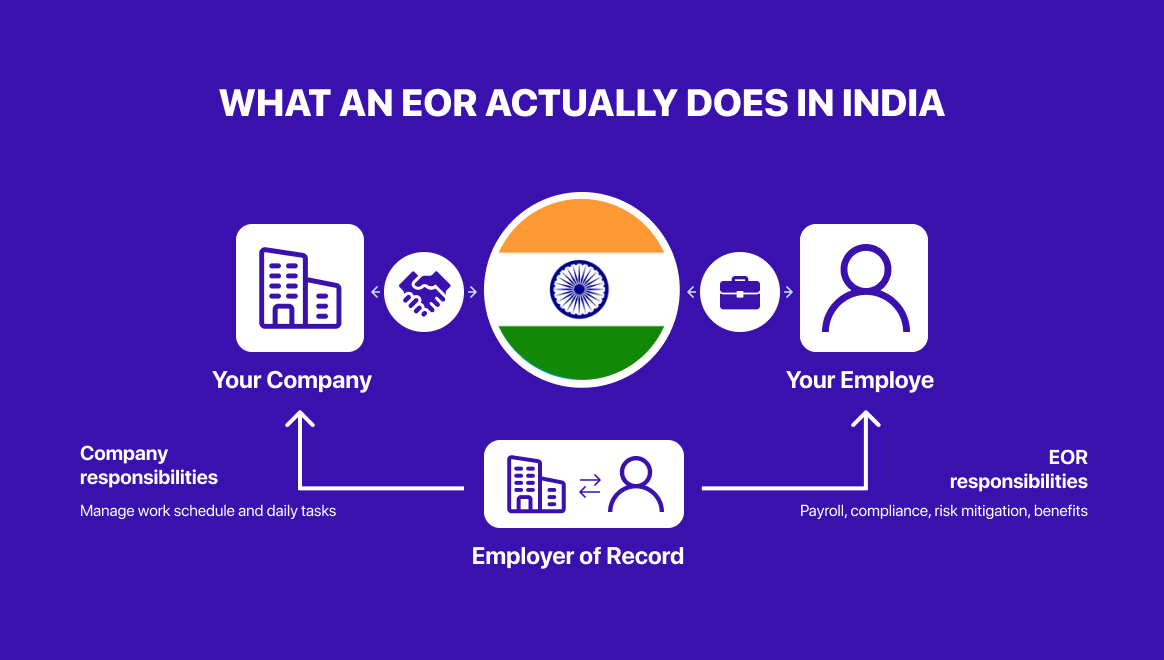
An Employer of Record provides an alternative structure.
The EOR becomes the legal employer in India, while your company manages the employee’s daily work.
In practice, the EOR’s Indian entity sponsors the visa and employs the worker on paper.
The employee works for your company operationally but is employed legally by the EOR.
No Local Entity Required
The biggest advantage of an EOR is that you do not need to establish a company in India.
The EOR already operates a compliant local entity.
This allows you to:
- Skip entity setup
- Avoid incorporation costs
- Hire within weeks instead of months
For companies testing the Indian market, this removes a major barrier.
Immigration Expertise
Most EOR providers maintain dedicated immigration teams.
They typically manage:
- Visa category selection
- Sponsorship documentation
- Invitation and cover letters
- Contract preparation
- Embassy coordination
Because they handle many visa applications, they understand procedural requirements and common issues.
This often leads to faster processing and fewer application errors.
Indian immigration policy allows third-party sponsorship for employment visas, meaning the sponsoring company does not have to be the company benefiting from the employee’s work.
In this model, the EOR acts as the host employer in India.
Compliance and Payroll Management
The EOR places the employee on its local payroll in India.
They handle:
- Salary payments in INR
- Income tax deductions (TDS)
- Provident fund contributions
- Social security filings
- Statutory benefits
- Employment contracts
They also assist with FRRO registration and immigration compliance.
Your company receives regular reports but avoids the operational complexity.
Flexibility for Scaling
An EOR model provides operational flexibility.
Examples include:
- Fast onboarding of new hires
- Compliant termination management
- Easy scaling of headcount
- No entity maintenance requirements
This makes EOR particularly useful for:
- Early-stage market entry
- Short-term projects
- Distributed global teams
Employees can often be onboarded within days rather than weeks.
Cost Structure
EOR service providers charge a service fee.
Pricing models typically include:
| Pricing Model | Description |
| Flat monthly fee | Fixed cost per employee |
| Percentage of payroll | Fee based on employee salary |
Although this introduces an additional expense, it replaces several internal costs:
- HR personnel
- Legal advisors
- Compliance management
- Entity maintenance
For smaller hiring operations, the EOR model can be cost-efficient overall.
Direct Sponsorship vs EOR: Quick Comparison
| Factor | Direct Sponsorship | Employer of Record |
| Local entity required | Yes | No |
| Visa sponsorship | Company handles | EOR handles |
| Payroll & tax compliance | Internal responsibility | Managed by EOR |
| Setup time | Months | Days or weeks |
| Operational control | Full | Operational control retained |
| Compliance burden | High | Low |
Which Option Is Better?
The right choice depends on your hiring strategy.
Direct sponsorship works best for companies that:
- Already operate an Indian subsidiary
- Have internal HR and immigration teams
- Plan to build a large workforce in India
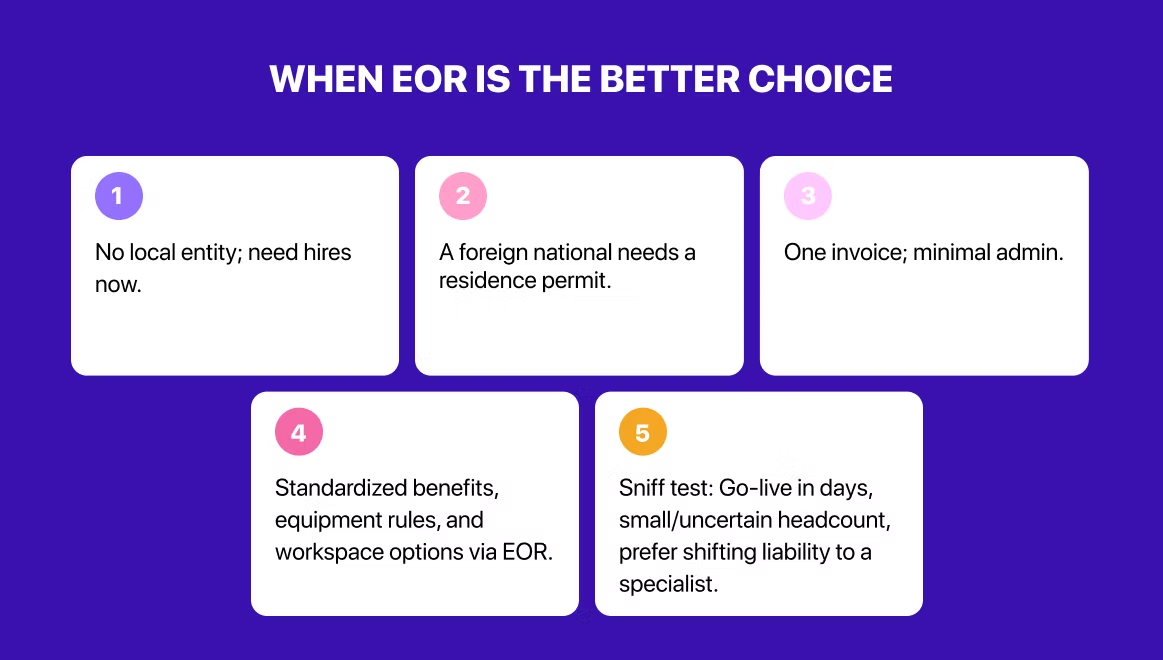
An EOR is usually better for companies that:
- Are hiring only a few employees
- Want faster market entry
- Prefer to avoid entity setup
- Need compliance handled externally
For most organizations entering India for the first time, the EOR model offers the fastest and lowest-risk path.
How EOR Services Simplify Visa Sponsorship in India
Using an Employer of Record (EOR) in India is often the easiest way to manage employer sponsorship. This is especially true if your company does not have a local entity or internal immigration expertise.
An EOR handles the legal, administrative, and compliance work behind hiring foreign employees. Your company focuses on selecting the talent and managing their daily work.
Below is a practical breakdown of how an EOR such as Team Up simplifies the process.
Streamlined Documentation and Visa Process
Visa sponsorship in India requires extensive documentation. Mistakes or incomplete filings can delay approvals or trigger rejections.
An experienced EOR removes this uncertainty.
What the EOR Handles
| Task | How the EOR Helps |
| Visa documentation | Prepares invitation letters, sponsorship declarations, and compliance guarantees |
| Application process | Submits and tracks visa applications |
| Document formatting | Uses templates aligned with embassy requirements |
| Communication | Coordinates with consulates and immigration authorities |
From the beginning, the EOR knows:
- Which documents do immigration officers expect
- How letters should be structured
- What compliance information must be included
Your team can focus on onboarding the employee while the EOR manages the visa application.
Faster Onboarding of Foreign Talent
An EOR already operates a registered entity in India. This removes the need to establish your own company before hiring.
Hiring Timeline Comparison
| Step | Direct Sponsorship | With EOR |
| Entity setup | 2–4 months | Not required |
| Immigration preparation | Internal process | Managed by EOR |
| Payroll registration | Internal setup | Already in place |
| Hiring timeline | Months | Often days to weeks |
Many EOR providers can onboard employees quickly once the service agreement is signed and the candidate is confirmed.
Some also assist with:
- Visa appointment scheduling
- Medical test coordination
- Immigration documentation review
This speed allows companies to place specialists in India much faster.
Local Compliance Assurance
Indian immigration and employment rules change frequently.
An EOR maintains constant oversight of these regulations.
Compliance Areas Managed by the EOR
| Compliance Area | EOR Responsibility |
| Salary eligibility | Ensures visa salary thresholds are met |
| Payroll tax deductions | Handles TDS withholding |
| Social contributions | Manages provident fund obligations |
| Immigration compliance | Monitors visa status and renewals |
| Employment contracts | Ensures contracts comply with Indian law |
If regulations change, the EOR updates processes immediately. This prevents compliance gaps that companies operating independently might overlook.
Guidance for Foreign Employees
Relocating to India involves several legal steps for the employee.
EOR providers support both the employer and the worker during relocation.
Support Provided to Employees
- Assistance completing visa forms
- Guidance on required medical checks
- Advice on police clearance certificates
- Support with FRRO registration after arrival
Some EOR teams also assist with family relocation questions, including dependent visas and documentation requirements.
This support helps ensure all formalities are completed correctly.
Reduced Immigration and Compliance Risk
Immigration errors can create serious problems. Visa refusals, delays, or compliance violations may disrupt projects or create legal exposure.
EOR providers reduce these risks through experience and process controls.
Risk Reduction Checklist
An EOR typically verifies:
- Job roles meet visa eligibility requirements
- Salary levels satisfy immigration rules
- Job descriptions do not conflict with local restrictions
- Visa renewals are initiated before expiration
They also maintain documentation records and reporting systems so companies can track visa status and compliance metrics.
Focus on Core Business Operations
Handling international hiring internally requires significant administrative work.
Using an EOR allows your HR team to concentrate on core responsibilities.
Tasks Your Company Still Handles
- Selecting candidates
- Managing daily work and performance
- Integrating employees into projects
- Setting company policies and goals
Tasks Managed by the EOR
| Area | Responsibility |
| Visa sponsorship | EOR |
| Payroll and tax filings | EOR |
| Employment contracts | EOR |
| Immigration compliance | EOR |
| HR administration | EOR |
This structure allows companies to scale international teams without building internal legal infrastructure.
Real Example: Hiring Without vs With an EOR
Imagine a UK technology company hiring a German software engineer for a project in India.
Without an EOR
The company must:
- Incorporate an Indian subsidiary
- Register for taxes and payroll
- Hire legal advisors
- Prepare immigration sponsorship
This process can take three to six months.
With an EOR
The company signs an agreement with the EOR. The EOR then:
- Hires the employee through its Indian entity
- Begins the visa sponsorship process
- Handles payroll, compliance, and tax filings
The employee could begin work in weeks instead of months.
Why Companies Choose EOR for Visa Sponsorship
An EOR provides a structured, compliant path for international hiring.
Key Advantages
- No need to establish a local entity
- Faster onboarding timelines
- Built-in immigration expertise
- Full payroll and tax compliance
- Reduced regulatory risk
In practical terms, the EOR acts like an on-the-ground HR and legal team managing employment and immigration requirements in India.
Conclusion
Hiring foreign talent in India is completely achievable, but it requires careful navigation of immigration rules, employment law, and compliance obligations. Choosing the correct visa category, preparing accurate documentation, and ensuring proper sponsorship are essential steps for any company bringing international employees into the country.
Companies with an established Indian entity can manage visa sponsorship directly, but this approach requires significant administrative infrastructure and ongoing compliance oversight. Payroll management, immigration filings, labor law adherence, and government reporting all fall under the company’s responsibility.
For organisations without a local presence or internal immigration expertise, an Employer of Record (EOR) provides a practical alternative. An EOR enables companies to sponsor visas, manage payroll, and maintain full compliance without setting up a legal entity. This approach significantly reduces operational complexity while accelerating hiring timelines.
With the right structure in place, businesses can focus on integrating global talent into their teams rather than managing regulatory processes. Whether through direct sponsorship or an EOR model, understanding India’s visa framework and compliance requirements is the key to building an international workforce confidently and legally.

FAQ
1. What is the definition of "Employer Sponsorship" in India?
Employer sponsorship is the legal process by which a registered Indian company petitions the government to hire a foreign national. The sponsor must issue a formal employment contract, provide a letter of support, and guarantee that the foreign hire possesses highly specialised skills not readily available in the local Indian labour market.
2. Is there a minimum salary requirement for sponsorship in 2026?
Yes. To be eligible for an Employment Visa (E-Visa), the foreign national must earn a minimum annual salary of USD 25,000 (approximately ₹21 Lakhs as of 2026).
- Exceptions: This threshold is waived for specific categories such as specialized chefs, language teachers (other than English), ethnic cooks, and volunteers for registered NGOs.
3. Can a foreign company sponsor an employee directly?
No. The sponsor must be a legally registered Indian entity. If a foreign company wants to send a worker to India but does not have a local subsidiary, they typically use an Employer of Record (EOR) or a local client’s office to act as the legal sponsor.
4. What is the difference between an Employment Visa and a Business Visa?
- Employment Visa: For long-term work (up to 5 years), receiving a salary in India, and requires a full sponsorship process.
- Business Visa: For short-term meetings, negotiations, or establishing a venture. You cannot be paid a salary by an Indian entity or engage in full-time employment on this visa.
5. What are the "Sponsor Duties" after the employee arrives?
The employer's responsibility doesn't end at the visa. Key duties include:
- Income Tax Compliance: Withholding and remitting Tax Deducted at Source (TDS).
- Reporting Changes: Notifying authorities of any change in job title, salary, or residential address within 14 days.
- Repatriation Guarantee: Signing an undertaking to bear the cost of the employee's repatriation if they violate immigration laws.
6. What is the 14-day FRRO/FRO registration rule?
Any foreign national arriving on an Employment Visa for a period exceeding 180 days must register with the Foreigners Regional Registration Office (FRRO) within 14 days of arrival. In 2026, this is done entirely through the e-FRRO portal, and the employer must provide a specific "Undertaking Letter" for this registration.
7. Does the employer need to prove a "Labor Market Test"?
While not always as rigid as in Europe, Indian consulates often require an Undertaking from the employer stating that they made a genuine effort to hire an Indian national but were unable to find a candidate with the required specialized expertise for the role.
8. How long does the sponsorship and visa process take?
- Sponsorship Paperwork: 1–2 weeks (Contract, CV vetting, NGO registration checks).
- Consular Processing: 2–6 weeks (depending on the country of application).
- Total: Employers should budget for 2 to 3 months from the job offer to the employee’s first day on-site.
9. Can I sponsor a "DACA" recipient or a stateless person?
DACA employer sponsorship is a U.S. legal concept. In India, sponsorship is strictly based on the applicant’s current nationality and passport validity. An applicant must have a valid passport (usually for at least 6–12 months) from their home country or a recognized Travel Document to be sponsored.
10. Can an employee switch sponsors while in India?
No. An Employment Visa is employer-specific. If an employee wants to change jobs, they must generally leave India, have the new employer file a new sponsorship petition, and obtain a new visa from their country of origin or domicile. "In-country" transfers are only allowed in extremely rare cases involving corporate mergers or acquisitions.
.svg)


