Eastern Europe Work Permits & Visas: Employer Guide to Types & Sponsorship
Introduction
Expanding into new markets is thrilling until you hit the wall of visas and bureaucracy.
For global employers eyeing expansion, navigating the employer of record work visa in Eastern Europe can feel like a bureaucratic obstacle course.
You’ve found the perfect engineer in Poland or designer in Romania, but now you’re staring at a maze of work permits, local laws, and government offices.
In Eastern Europe, hiring isn’t as simple as signing a contract; it means complying with each country’s immigration rules to the letter.
That’s where an Employer of Record (EOR) comes in.
An EOR is a global employer of record service that becomes your trusted partner, legally hiring your team on your behalf and sponsoring work visas so you don’t have to set up a company from scratch.
This guide cuts through the jargon (and the fluff) to give you a founder-level briefing on:
- Work permits
- Visa types
- Sponsorship steps
- Compliance across Eastern Europe
No corporate gobbledygook – just honest, actionable advice.
We’ll dive into real examples from Poland, Romania, Bulgaria, Ukraine, and Hungary, unpack the differences between using EOR services vs. establishing your own entity, and show how an EOR simplifies compliance with local immigration and labour laws.
By the end, you’ll know exactly what to expect, what mistakes to avoid, and how to leverage international employer of record services to hire fast and legally.
Eastern Europe Work Permits & Visas 101
Hiring in Eastern Europe comes with one non-negotiable: work authorisation.
If your new hire isn’t a citizen of the country (or an EU national in the case of EU member states), they’ll almost certainly need two things:
- A work permit
- A visa
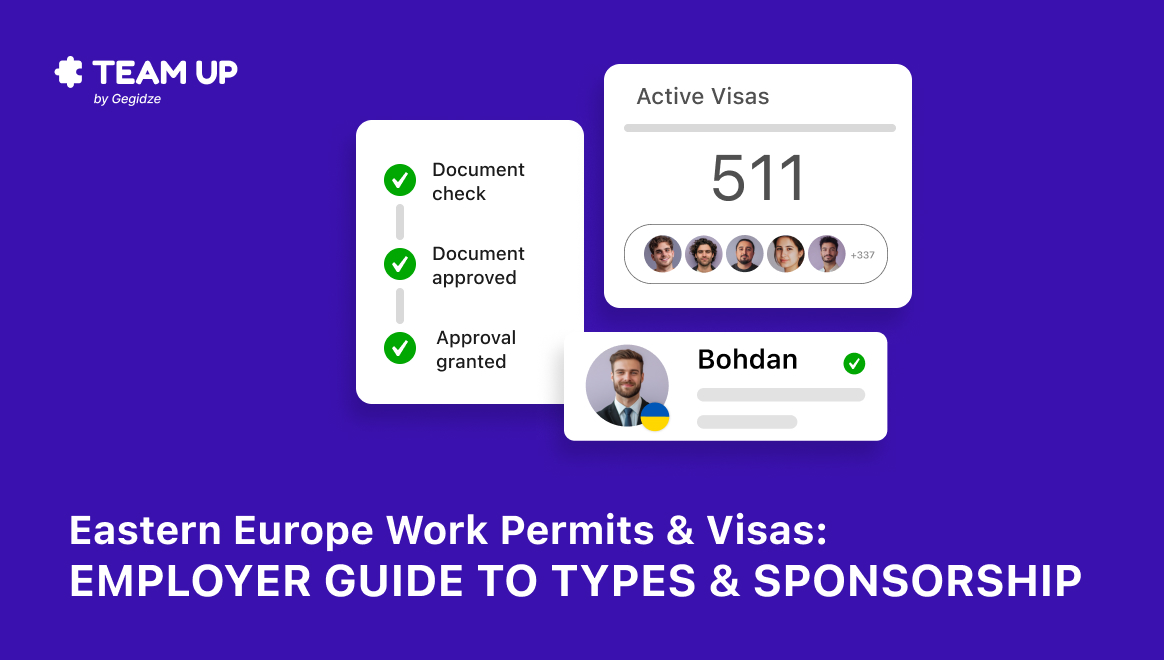
Think of the work permit as the government’s approval for a foreigner to work in-country, and the visa (often a Type D long-term visa) as the ticket to enter and reside there.
Here’s the catch: only a locally registered employer can sponsor a work permit.
That means you either:
- Establish a local company
- Use an EOR as the legal employer
For EU countries like Poland, Romania, Hungary, and Bulgaria:
- EU/EEA/Swiss citizens can work freely without permits
- Non-EU hires require permits
- Priority is always given to locals
Most Eastern European nations require a labour market test.
You must provethat no local or EU citizen is ready, willing, and able to fill the role before authorities approve a work permit.
Typical Work Permit Process in Eastern Europe
In broad strokes:
- The employer or EOR gathers required documents:
- Application forms
- Proof of qualifications
- Clean criminal record
- Job offer details
- Submit the application to the immigration or labor authority.Examples:
- Poland: Voivodeship Office
- Romania: General Inspectorate for Immigration (IGI)
- Bulgaria: Migration Directorate
- Wait for review. This can take weeks or months.
- Once approved, the employee applies for a long-term visa at a consulate.
- After arrival, the employee registers for a residence permit or local ID.
Only then can they legally start working and be paid.
Special Permit Types You Should Know
Eastern Europe is not one-size-fits-all.
EU Blue Card
A fast-track work permit for highly skilled and highly paid talent.
Example:
- Bulgaria offers a Blue Card for specialists earning 1.5× the average salary
- Processing can take 30 days instead of two months
- EU mobility is possible after 18 months
Other Permit Categories
- Intra-company transfer (ICT) permits
- Seasonal work visas
- Executive or specialist transfer permits
Now let’s break down country-specific rules.

Country-by-country Breakdown: Work Visas & Sponsorship Steps
Poland: Work Permits, Visa Types, and Timeline
Poland is often the first stop for international hiring in Eastern Europe.
If your new hire isn’t an EU/EEA/Swiss national, they’ll need a work permit.
Common Permit Type
- Type A – standard employment under Polish contract
Other types:
- Type B – board members
- Type C/E – intracompany transferees
Labor Market Test
Poland may require job advertising unless:
- The role is on a shortage occupation list
- The position qualifies for exemption
Processing Timeline
- Average: 3–10 weeks
- Visa processing: 2–4 additional weeks
- Total: approximately 2–3 months
Compliance Notes
- Permit specifies employer, role, and salary
- Role changes require a new permit
- Fines for illegal employment can reach 30,000 PLN
- Repeated violations can trigger criminal charges
How an EOR Helps in Poland
- Sponsors permit
- Drafts compliant contracts
- Handles Voivodeship filings
- Ensures Polish Labour Code compliance
Romania: Permits with Quotas and Long Timelines

Romania requires work permits for non-EU nationals.
Key Characteristics
- Annual quota system
- Labour market testingis required
- Strict documentation standards
Timeline
- Legal decision window: 30 days (+15 extension)
- Real-world processing: 3–8 months
- Visa: additional processing time
Compliance Risks
- Missing documents = rejection
- Strict language requirements (Romanian translations)
- Active inspections in foreign-heavy industries
Why EOR Matters in Romania
- Early quota monitoring
- Application tracking
- Local-language compliance management
Bulgaria: Single Permits and EU Blue Cards

Two Main Routes
- Single Permit (combined work + residence)
- EU Blue Card
Labor Market Test
Mandatory in most cases:
- 15 business days job advertisement
- Documented search process
Timeline
- Single Permit: up to 2 months
- Blue Card: ~30 days
Compliance Considerations
- Direct local employment required
- No informal secondment arrangements
- Fines for permit violations
EOR Role in Bulgaria
- Conduct labor test
- File applications
- Manage local payroll
- Ensure employer compliance
Ukraine: Fast-Track Work Permits

Ukraine stands out for speed.
Processing Time
- 7 calendar days for standard applications
Key Differences
- No labor market test in most cases
- No national quota system
- Minimum salary thresholds apply
Process
- Employer files with State Employment Service
- Work permit issued
- Type D visa obtained
- Temporary residence permit issued
Compliance Reminders
- Employment contract copy must be filed within 10 days
- Termination must be reported
- Violations can lead to deportation or fines
Why EOR Is Critical in Ukraine
- Fast but document-heavy process
- Ukrainian-language filings
- Ongoing regulatory changes
Hungary: Combined Work-residence Permits

Hungary issues joint work and residence permits.
Key Steps
- Labour market search (15 days)
- Combined permit application
- Entry visa
- Address registration
Timeline
- Up to 90 days by law
- Typical total: 3–4 months
Blue Card Option
- For highly qualified workers
- Higher salary threshold
- Up to 4-year validity
Compliance Considerations
- Hungarian translations required
- Occupation codes must match official classifications
- Strict documentation standards
EOR Value in Hungary
- Documentation review
- Translation coordination
- Payroll and social tax compliance
- Immigration tracking
Final Takeaway
Work permits and visas in Eastern Europe are manageable.
But only if you follow the rules precisely.
Each country has its own:
- Labor tests
- Permit categories
- Quotas
- Processing timelines
- Compliance risks
An Employer of Record removes the need to:
- Establish a local entity
- Navigate immigration filings alone
- Track changing regulations
- Risk fines or misclassification
Instead, you hire.
The EOR handles the rest.
EOR vs. Setting Up a Local Entity in Eastern Europe
Hiring in Eastern Europe boils down to two paths:
- Use an Employer of Record (EOR)
- Establish your own local company
It’s the classic speed vs. control trade-off. Let’s break it down with an entrepreneur’s lens – and a dose of brutal honesty.
Setting Up a Local Entity in Eastern Europe: Full Control, Full Responsibility
Setting up your own entity means total control.
You’re the legal employer.
You call the shots on employment contracts.
Your presence in-country is official.
But that freedom comes at a steep price in time and money.
Incorporating a subsidiary in each Eastern European country you want to hire in can be an epic bureaucratic quest.
You’ll need to:
- Navigate registration documents in Polish, Romanian, and Bulgarian
- Open local bank accounts
- Register for tax IDs
- Hire accountants and lawyers
- Maintain yearly compliance obligations
Cost of Entity Setup
Upfront costs can range from several thousand to tens of thousands of dollars per country.
One estimate pegs entity setup costs between $20,000 to $150,000 when factoring in:
- Legal fees
- Tax advisory
- Administrative expenses
Timeline for Setting Up a Company
Speed? Think in months.
- Best-case scenario: 4–6 weeks
- Typical range: 3–4+ months
During that time, your ideal hire may already have accepted another offer.
Using an Employer of Record in Eastern Europe: Speed and Simplicity
Now consider an Employer of Record.
An EOR already has the local entity in place.
With an EOR, you can hire in days or weeks, not months.
Instead of waiting for incorporation, your new hire is onboarded under the EOR’s payroll immediately.
EOR Costs in Eastern Europe
Instead of large upfront expenses, you typically pay:
- A flat monthly fee
- Or a percentage per employee
In Eastern Europe, the average EOR fee ranges between:
- $350–$600 per employee per month
Yes, that adds up over time. But here’s what’s included:
- Local tax handling
- Social contributions
- Mandatory benefits administration
- Payslip issuance
- Legal filings
- Ongoing HR compliance
It’s an all-inclusive model versus managing every component separately.
Compliance and Liability: Who Carries the Risk?
With your own entity:
- Every tax filing mistake is yours
- Every missed immigration notification is yours
- Every labour law error is yours
With a reputable EOR:
- They assume compliance responsibility
- They handle filings
- They often provide indemnification for compliance errors
That’s not just convenience. That’s risk mitigation.
When Does an Entity Make Sense?
If you plan to hire:
- 50+ employees in one country
- Build a long-term hub
- Maintain regional operations
Then an entity may become cost-effective over time.
Industry rule of thumb:
- Fewer than 10–15 employees in one country, EOR is usually more cost-effective
- Above that threshold, the entity may reduce long-term per-head costs
Multi-country Expansion: EOR Advantage
Running five entities across:
- Poland
- Romania
- Bulgaria
- Hungary
- Ukraine
Requires major administrative capacity.
An EOR can cover all five countries under one service agreement.
One contract. One point of contact. No multi-entity juggling.
Trade-offs of Using an EOR
Nothing is magic.
With an EOR:
- They are the legal employer
- You operate within their framework
- Custom benefits or equity must be coordinated
Some employees may initially question why another company name appears on their payslip.
Clear communication resolves that quickly.
EOR vs Local Entity
Choose an Employer of Record if you prioritise:
- Speed
- Lower upfront investment
- Reduced legal risk
Choose a local entity if you:
- Plan long-term scale
- Need complete structural control
- Have local HR and legal resources
Many companies use a hybrid strategy:
Start with an EOR. Transition to an entity once you reach scale.
Flexibility is a competitive advantage in Eastern Europe.
How an Employer of Record Simplifies Immigration & Labour Law Compliance
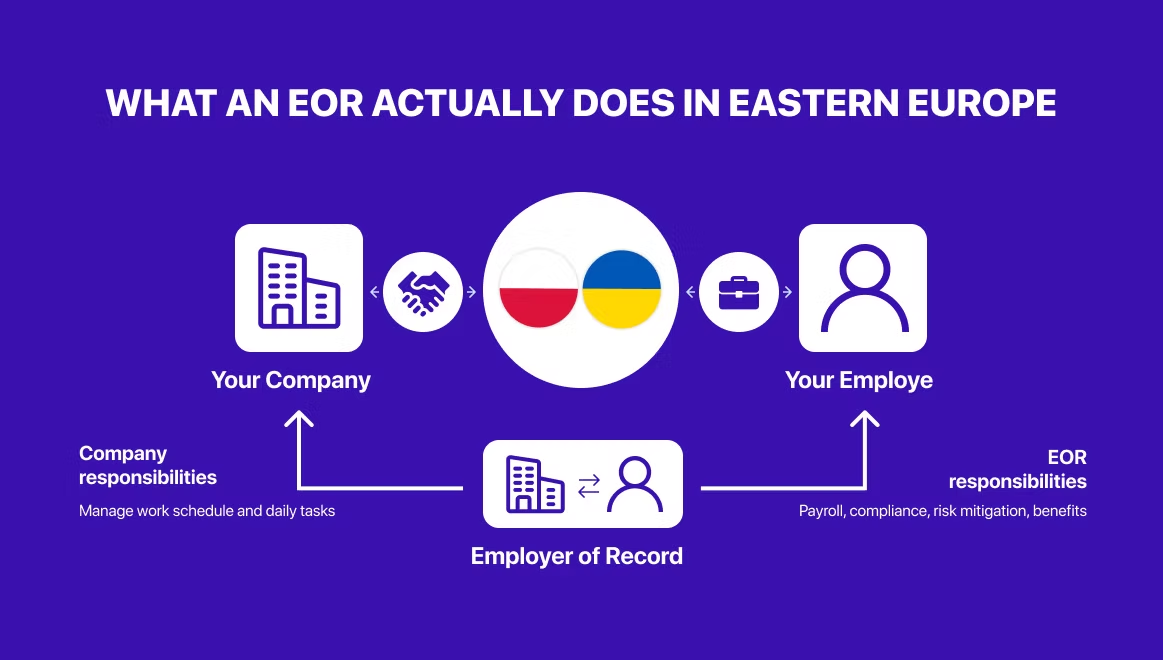
Hiring internationally means navigating foreign bureaucracy.
An Employer of Record exists to remove that complexity from your plate.
Here’s how.
1. Local Entity and In-country Expertise
An EOR already maintains registered legal entities across Eastern Europe.
These entities are:
- Properly licensed
- Familiar with local employment regulations
- Experienced with immigration authorities
When it’s time to sponsor a work visa, the EOR acts immediately as the legal employer.
You don’t waste weeks identifying:
- The correct authority
- Required forms
- Current immigration rules
For example:
- In Hungary, the EOR knows the exact work permit forms and address registration steps
- In Ukraine, they stay updated on the 2025 procedural changes
They function as your local HR department.
2. End-to-end Immigration Support
Strong EOR providers handle the full work permit process.
They:
- Recommend the correct visa category
- Collect documentation
- Coordinate translations and legalisations
- Submit applications
- Manage follow-ups
One of the biggest causes of visa delays is incomplete paperwork.
EORs use internal checklists and legal teams to prevent that.
In many cases, they will:
- Coordinate with local immigration offices
- Guide the employee through in-person steps
- Reduce risk of rejection
Result:
Faster approvals. Fewer surprises.
3. Legal Employment and Payroll Compliance
After onboarding, the EOR manages:
- Locally compliant employment contracts
- Social security registration
- Tax authority registration
- Monthly payroll
- Mandatory benefits enrollment
Examples:
- If Poland requires Polish-language contracts, the EOR provides them
- If Bulgaria requires employment registration within seven days, the EOR files it
- If Romania mandates specific safety training, the EOR ensures compliance
These are highly technical requirements that most foreign HR teams are not equipped to manage.
4. Staying Ahead of Regulatory Changes
Immigration and labour laws evolve.
Examples:
- Poland introduced new foreign worker reporting obligations in 2025
- Ukraine streamlined work permit processing timelines
- EU directives periodically reshape Blue Card rules
An EOR tracks these updates proactively.
They notify you when:
- Minimum salary thresholds change
- Reporting duties are introduced
- Documentation standards shift
Without an EOR, you would need:
- Continuous legal monitoring
- Country-specific legal advisors
- Additional compliance resources
5. Risk Mitigation and Compliance Shield
The biggest benefit of an Employer of Record is risk reduction.
EORs help you avoid:
- Illegal employment violations
- Immigration non-compliance
- Payroll tax penalties
- Government audits
If an error occurs due to EOR oversight, reputable providers often:
- Correct the issue
- Cover associated penalties
They act as a compliance buffer between your company and local authorities.
EOR Work Visa Sponsorship in Eastern Europe: How It Works Step-by-Step
To make things even more concrete, let’s walk through the step-by-step process of an Employer of Record sponsoring a work visa in an Eastern European country.
This process is generally similar across the region, with minor variations, so consider this an illustrative roadmap.
Step 1: Initiation & Requirement Gathering
You tell the EOR, “I want to hire Jane Doe in Country X.”
The EOR immediately kicks off an intake process.
They gather:
- Role details (title, duties, salary)
- Candidate details (nationality, CV, qualifications)
At this stage, the EOR determines:
- What type of work permit is required
- What visa category applies
Examples:
- Poland + Indian national → Type A work permit + National D visa
- Highly paid software engineer → EU Blue Card option
They also verify:
- Whether a labour market test is required
- Whetherthe salary meets local thresholds
This early diligence prevents costly delays later.
Step 2: Labour Market Test (If Required)
If the country requires a labour market search (e.g., Bulgaria, Poland, Hungary):
The EOR will:
- Advertise the role via official government channels
- Document that no suitable local candidate was found
- Obtain official confirmation from labour authorities
This step happens behind the scenes but is legally critical.
Skipping it results in automatic rejection.
Step 3: Document Preparation
This is where an Employer of Record proves its value.
The EOR compiles:
- Completed application forms
- Draft employment contract
- Labour office certification (if applicable)
- Passport copies
- Proof of qualifications
- Police clearance certificates
- Employer corporate documents
The EOR:
- Provides its own entity documentation
- Requests candidate documentation
- Coordinates notarization and apostille (if required)
- Manages sworn translations (Hungary and Poland commonly require this)
DIY mistakes often include:
- Missing translations
- Incorrect document formats
- Improper certification
An EOR prevents these errors.
Step 4: Submission of Work Permit Application
The EOR files the application with the appropriate immigration authority.
In most cases:
- The EOR submits as the official employer
- Power of attorney allows representation
- Government fees are handled
The EOR monitors:
- Processing status
- Requests for additional documentation
- Clarifications from authorities
If additional information is required, the EOR responds promptly.
Step 5: Work Permit Approval & Visa Application
Once approved, the EOR:
- Receives the official permit
- Shares approval documentation
- Guides the employee through the visa process
Typically, the employee must:
- Apply for a Type D visa
- Visit a consulate
- Submit insurance, financial proof, and required documents
The EOR provides:
- Visa checklists
- Application guidance
- Coordination with local immigration advisors if necessary
Mistakes at this stage can still derail timelines, so support is critical.
Step 6: Employee Arrival & In-Country Registration
Once the visa is issued:
The employee arrives in-country.
The EOR manages:
- Address registration
- Onboarding documentation
- Signing of local-language employment contracts
- Required medical exams (if applicable)
Many countries require:
- Residence registration within a fixed number of days
The EOR ensures compliance immediately.
Step 7: Post-arrival Compliance & Payroll Setup
After arrival, the EOR completes:
- Residence permit card processing (if applicable)
- Biometric appointments
- Social security registration
- Payroll setup
- Monthly payslip generation
- Tax contribution remittance
If authorities require:
- Periodic employment confirmations
- Role change notifications
The EOR handles these as well.
Ongoing Status Updates
Throughout the entire process, the EOR provides:
- Labor test confirmation
- Application submission notices
- Permit approval updates
- Visa issuance confirmation
- Arrival scheduling
They effectively project-manage the immigration journey.
Your involvement remains minimal.
Common Work Visa Mistakes & Penalties to Avoid
Hiring in Eastern Europe can go sideways without careful compliance.
Here is a practical checklist of common mistakes and consequences.
Starting Work Before Permit Approval
Never allow employment before official authorisation.
Consequences may include:
- Employer fines (e.g., Poland up to 30,000 PLN)
- Employee fines
- Deportation
- Entry bans
Always wait for formal approval.
Incomplete or Incorrect Documentation
Common errors:
- Missing notarization
- Incorrect photo specifications
- Untranslated documents
- Improper apostille
These cause delays and rejections.
Skipping the Labour Market Test
If legally required, skipping it results in immediate rejection.
Authorities strictly enforce this step.
Assuming EU Rules Are Identical
Each EU country has different:
- Forms
- Salary thresholds
- Processing timelines
- Blue Card requirements
Country-specific guidance is essential.
Choosing the Wrong Visa Category
Using:
- Business visas for employment
- Short-term visas for long-term work
Is illegal.
Incorrect category selection limits employee rights and duration.
Ignoring Post-Arrival Requirements
After entry, employees may need:
- Municipal registration
- Police registration
- Residence card pickup
- Medical checks
Failure to comply can invalidate permits.
Ignoring Quotas and Timing
Countries like Romania impose:
- Annual permit quotas
- Limited application windows
Government slowdowns during holidays also impact timelines.
Misalignment Between Permit and Employment Contract
Job title, salary, and location must match the permit.
Changing duties without updating the authorities can invalidate the permit.
Misclassifying Employees as Contractors
Using contractor agreements to bypass work permits creates:
- Immigration violations
- Tax liabilities
- Backdated penalties
A proper employment structure is required.
Choosing an EOR Without Immigration Support
Not all EORs handle visa sponsorship.
Always verify full immigration capabilities before engaging a provider.
Summary & Practical Tips for Employers Hiring in Eastern Europe
Hiring in Eastern Europe is manageable with the right structure.
Here are key takeaways for global employers.
Plan for Work Visas
Build realistic timelines.
Typical visa processing:
- 1–3 months in many countries
- Longer in Romania
Early planning prevents delays.
Use an Employer of Record for Speed & Compliance
An EOR allows you to:
- Hire without establishing an entity
- Avoid payroll and immigration pitfalls
- Onboard faster
It reduces legal exposure significantly.
Understand Local Labour Laws
Each country differs in:
- Notice periods
- Public holidays
- Termination rules
- Benefits requirements
Never assume uniformity across the region.
Budget for Compliance Costs
Compare:
- EOR monthly fees
- Entity setup costs
- Legal advisory retainers
- Potential fines
Evaluate over a 1–2 year horizon.
Maintain Thorough Documentation
Keep organised records of:
- Work permits
- Visas
- Employment contracts
- Tax filings
Proper documentation simplifies audits.
Stay Updated and Flexible
Eastern European labour and immigration rules evolve.
Monitor:
- EU policy updates
- Local salary thresholds
- Regulatory changes
Adapt hiring strategy accordingly.
PrioritiseCulture and Communication
Beyond legal compliance:
- Offer competitive benefits
- Communicate clearly about immigration timelines
- Maintain transparency during delays
Trust strengthens retention.
Final Thoughts on Hiring in Eastern Europe with an EOR
Eastern Europe offers exceptional talent.
With an Employer of Record handling:
- Work permit sponsorship
- Payroll compliance
- Immigration tracking
- Labour law adherence
Expansion becomes structured and predictable.
Avoid shortcuts.
Plan properly.
Leverage expert support.
Now you’re equipped to hire confidently and compliantly across Eastern Europe.
Good luck.
Frequently Asked Questions
1. What are the most common work permit types in the region?
Most countries in the region use a "Single Permit" system (combining work and residence):
- Poland (Type A): For direct employment by a Polish entity.
- Czech Republic (Employee Card): The standard long-term residence permit for employment.
- Romania (Permanent Worker Permit): For long-term roles under a local contract.
- EU Blue Card: Available across the region for highly qualified specialists with university degrees and high salaries (generally >1.5x the national average).
2. Is there a "Local Labour Market Test" requirement?
Yes. In almost every Eastern European country, you must first prove that no local or EU citizen is available for the role.
- The Process: You must advertise the vacancy with the local Labour Office (e.g., Urząd Pracy in Poland or the Inspectorate General for Immigration in Romania).
- The Duration: Usually, the vacancy must remain open for 15–21 days before the Labor Office issues a certificate allowing you to hire a foreigner.
3. What are the 2026 Work Permit Quotas?
Several countries set annual caps on the number of foreign workers allowed:
- Romania: The 2026 quota is set at 90,000 permits (a slight decrease from 2025).
- Hungary: Maintains a strict "Guest Worker" quota of 35,000 permits for 2026 to prioritise the local workforce.
- Lithuania/Latvia: Often set quotas as a percentage of their permanent population (roughly 1.4%).
4. How does the EU Blue Card differ in this region?
The Blue Card is the "fast track" for specialists.
- Validity: Often issued for up to 3 years (compared to 1–2 years for standard permits).
- Mobility: After 12 months of work in one country (e.g., Poland), the employee can move to another EU country (e.g., Czech Republic) for a new highly-skilled role with simplified procedures.
- Salary: In Hungary, for example, the 2026 Blue Card minimum salary is approximately 1,001,048 HUF per month.
5. What is Poland’s "Declaration" (Oświadczenie) system?
Poland offers a unique, simplified pathway for citizens of Ukraine, Belarus, Georgia, Armenia, and Moldova.
- Benefit: Employers can hire these nationals via a simple "Declaration of Entrusting Work" rather than a full work permit.
- Speed: Approval usually takes 7–10 days via a digital portal, allowing the employee to start work much faster than through standard channels.
6. What are the salary thresholds for 2026?
By law, a foreign worker must not earn less than a local citizen in the same role.
- General Rule: Salary must meet the national gross minimum wage (e.g., approx. 4,600 PLN in Poland or 4,050 RON in Romania).
- Expert Roles: For specialist permits, authorities often require the salary to be at least 100%–150% of the average regional salary to prevent "social dumping."
7. What is the employer’s liability if an employee quits?
In the 2026 regulatory environment, employers have new "Exit Responsibility" duties:
- Notification: You must notify the Ministry of Interior/Labor Office within 3 to 15 days (varies by country) if an employee's contract is terminated.
- Hungary Special Rule: Employers must ensure the foreign worker has a return ticket or funds to leave the country upon termination; otherwise, the employer may face significant fines.
8. How long does the sponsorship process take?
Timelines have improved due to digitalisation, but still require planning:
- Poland: 30–60 days for a Type A permit.
- Czech Republic: 60–90 days for an Employee Card.
- Romania: 30–45 days for the initial work authorisation from the IGI.
Total Timeline: Employers should account for 3 to 5 months from the initial job posting to the employee's physical arrival.
9. Can an employee change employers easily?
Not initially. Most permits are employer-specific.
- Standard Permits: If the employee leaves, the permit becomes void. The new employer must apply for a fresh work permit.
- EU Blue Card: In countries like Germany or Poland, after 12 months of employment, the worker may change employers with a simple notification rather than a full re-application.
10. What are the "Post-Arrival" registration steps?
Once the employee arrives:
- Address Registration: Mandatory in the Czech Republic and Hungary within 3 business days.
- Medical Insurance: The employer must prove the employee is registered with the national health system (e.g., NFZ in Poland or VZP in Czechia) to keep the permit valid.
- Biometrics: The employee must visit the local Foreigners’ Office to have fingerprints taken for their plastic residence card.
.svg)