Relocation to Kazakhstan: Legal Requirements and Practical Steps
TL;DR
Relocating a business or team to Kazakhstan is a bit like trying Marmite for the first time. If you expect something sweet and smooth, you will hate it. If you understand what you’re getting into, it becomes a strategic advantage.
Kazakhstan in 2026 is not a “seamless land of opportunity.” It is a complex, rapidly reforming jurisdiction rewriting its tax code, tightening labor quotas, and digitizing nearly every administrative process. The upside is real. So is the friction.
The three pillars you must understand before hiring a single person are:
- Digital identity. Without an IIN, you do not exist.
- The 2026 Tax Code. Progressive PIT and higher VAT will directly affect payroll costs.
- Your market entry model. National LLP, AIFC entity, or Employer of Record.
Get these right and momentum stays intact. Get them wrong, and compliance will quietly kill your expansion.
Quick Navigation
- TL;DR
- Step One. Digital Identity Is the Real Gatekeeper
- The 2026 Regulatory Landscape: A New Fiscal Reality
- Choosing Your Vehicle: AIFC Private Company vs. National LLP
- Hiring Without the Headache: The EOR Model
- The Immigration Labyrinth: Visas and the Labor Market Test
- Practical Steps: IINs, eGov, and Banking
- Labor Law and Performance: The Rules of the Road
- Strategic Takeaways for Decision-Makers
- Frequently Asked Questions
Step One. Digital Identity Is the Real Gatekeeper

Before tax optimization. Before entity formation. Before office leases.
Your relocation starts with the Individual Identification Number (IIN).
Without an IIN:
- You cannot open a bank account.
- You cannot receive a salary.
- You cannot sign employment contracts.
- You cannot register a lease.
- You are effectively invisible to the system.
The IIN Process in 2026
The process is now largely digital, but still requires physical presence or a trusted proxy. Long-term stay applicants must undergo fingerprinting. Once issued, the IIN unlocks access to eGov.kz and the eGov Mobile app.
Over 90% of public services are accessible online. Residency verification. Digital ID. Tax checks. Even the “Green Corridor” investor benefits.
If your team does not have IINs sorted before contracts are drafted, you are building on sand.

The 2026 Regulatory Landscape: A New Fiscal Reality
Kazakhstan is currently undergoing a massive structural transformation. The government is moving away from the "simplified" models of the past toward a sophisticated, progressive system designed to capture value from a growing professional class while closing loopholes that previously allowed businesses to fragmented themselves into smaller units. This transition is anchored by the new Tax Code, set to take effect on January 1, 2026.
The Shift to Progressive Individual Income Tax
For years, Kazakhstan was known for its flat 10% Individual Income Tax (PIT). That era is ending. Starting in 2026, the tax burden will shift based on income levels, measured by the Monthly Calculation Index (MCI), which is set at 4,325 KZT for the 2026 period. This shift means that high-earning expats and local specialists will see a different net-pay reality than they did in 2024.
| Taxpayer Category | Annual Income Threshold | 2026 PIT Rate |
| Resident Individuals | Up to 8,500 MCI | 10% |
| Resident Individuals | Above 8,500 MCI | 15% on the excess |
| Foreign Nationals | Up to 600,000 MCI | 10% |
| Foreign Nationals | Above 600,000 MCI | 17% on the excess |
The implications for a CFO are immediate. If you are hiring a Senior Software Engineer at a gross salary of 1,200,000 KZT per month, you are now operating in a world where tax withholdings must be precisely calculated to avoid mid-year corrections. The system is designed to be fairer, but for the unprepared employer, it is a source of administrative friction. This is why many companies are turning to employer of record payroll taxes in Kazakhstan to ensure that these progressive calculations are handled by local experts who live and breathe the new code.
Value-added Tax (VAT) and the End of Business Splitting
The standard VAT rate is also on the move, increasing from 12% to 16% in 2026. This is a significant jump for any business-to-consumer operation. More importantly, the threshold for mandatory VAT registration is being halved, from 20,000 MCI to 10,000 MCI (approximately 39.3 million KZT).
Historically, companies in Kazakhstan would "split" into multiple smaller LLPs to stay under the registration threshold. The 2026 Code effectively kills this practice. The government is signaling that if you want to play in the Kazakhstani market, you have to play as a transparent, grown-up organization. This transparency is enforced through the "horizontal monitoring" system, where large taxpayers provide the authorities with remote access to their accounting data in exchange for fewer traditional audits.
Choosing Your Vehicle: AIFC Private Company vs. National LLP
Founders and decision-makers face a critical fork in the road when entering Kazakhstan: do you register a standard Limited Liability Partnership (LLP) under national law, or do you opt for a Private Company in the Astana International Financial Centre (AIFC)?
The AIFC: The "Ocean View" for Startups
The AIFC is the crown jewel of Kazakhstan’s investment strategy. It is a separate jurisdiction within the city of Astana that operates on the principles of English Common Law. For an international founder, the AIFC is the "apartment with an ocean view" because it provides a legal framework that is recognizable to global investors.
- Judicial Independence: The AIFC has its own court and International Arbitration Centre (IAC), staffed by international judges. This bypasses the traditional civil law system, providing a level of legal certainty that is rare in the region.
- Venture Capital Readiness: Under a standard LLP, things like options pools, different share classes, and SAFE agreements are a legal nightmare. In the AIFC, these are standard tools.
- Tax Exemptions: AIFC participants can enjoy 0% Corporate Income Tax (CIT) and 0% PIT for foreign employees on certain licensed activities until 2066.
The Standard LLP: The Bread and Butter of Local Business
The national LLP (ТОО) is simpler and cheaper to set up—registration fees are roughly $300 compared to the $5,000+ often required for AIFC-regulated entities. However, you are bound by the national civil code, which can be rigid. For instance, changes to participants or the company name require a full state re-registration, whereas AIFC changes are often just a notification to the registrar.
| Feature | National LLP (ТОО) | AIFC Private Company (PC) |
| Legal System | Kazakhstan Civil Law | English Common Law Principles |
| Registration Cost | Low (~$300) | High ($5,000 - $10,000) |
| Tax on Salary | Standard Progressive PIT | 0% for foreign employees (conditions apply) |
| Operational Flexibility | Rigid (Notary required for many tasks) | High (Venture-friendly structures) |
Deciding which is better often comes down to your long-term exit strategy. If you plan to raise Western VC money, the AIFC is almost mandatory. If you are running a local service business, the LLP is usually sufficient. To dig deeper into this choice, founders should consult the guide on employer of record vs own entity in Kazakhstan.
Hiring Without the Headache: The EOR Model
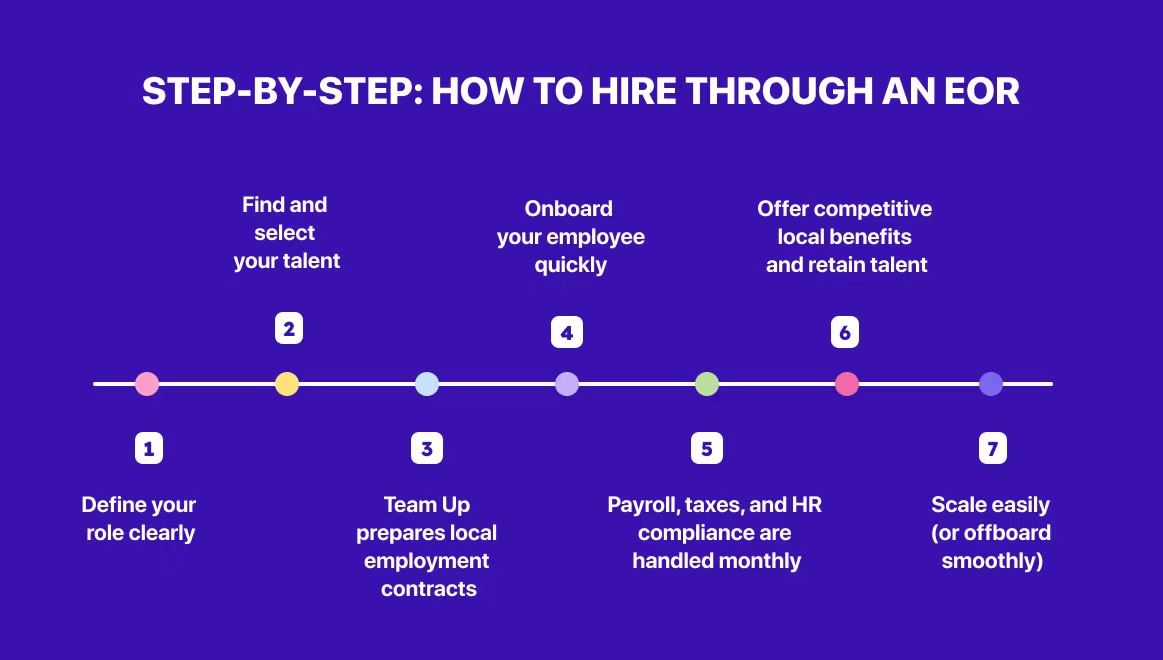
For many organizations, the decision to relocate to Kazakhstan is driven by a need for talent, not a desire to manage a local tax ID. This is where employer of record services in Kazakhstan become the ultimate bypass. An EOR allows you to hire a team in Almaty while your entity remains in Delaware, London, or Tbilisi.
Speed and Compliance
The primary value of an EOR in Kazakhstan is speed. While setting up an AIFC entity can take weeks and thousands of dollars, an EOR can onboard an employee in as little as 1–2 working days, provided the individual has their Individual Identification Number (IIN). This model shifts the compliance burden of the 2026 Labor Code updates onto the EOR partner.
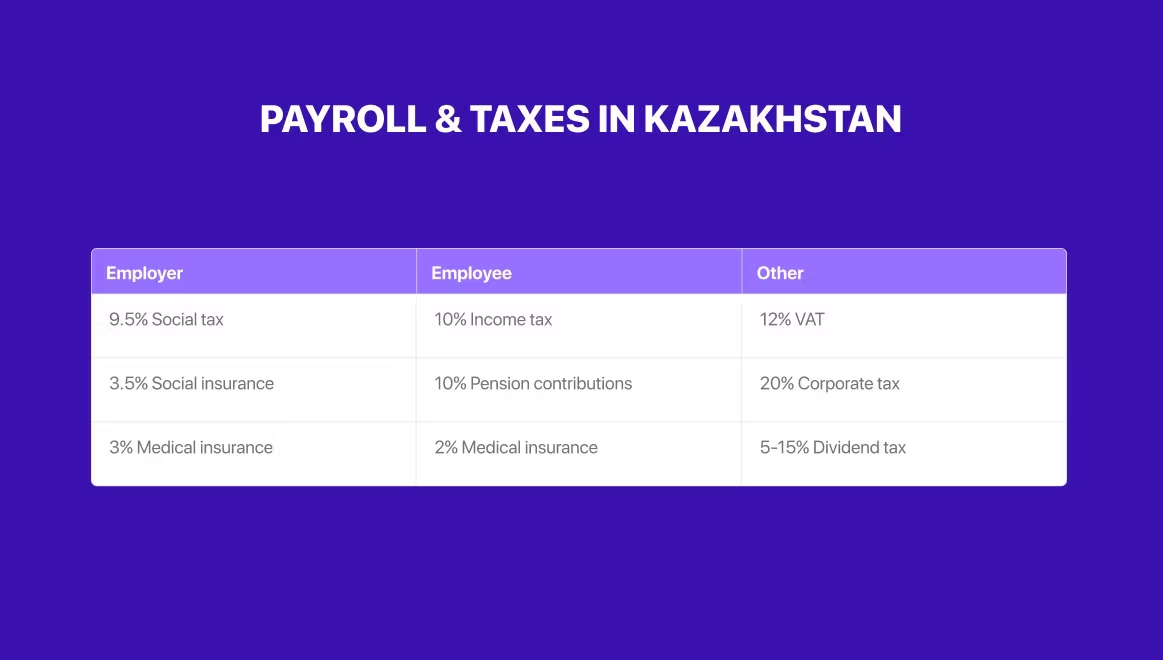
When hiring via an EOR, the "all-in" cost to company (CTC) includes the gross salary plus employer contributions, which in Kazakhstan range from 21.5% to 26.5%. These contributions cover:
- Social Tax: 6% (flat rate starting 2026).
- Social Insurance: 5%.
- Medical Insurance (Employer): 3%.
- Pension Contributions: 3.5% (increased from 2.5% in 2026).

Understanding these costs is critical for budgeting. Decision-makers often use a guide on employer of record cost in Kazakhstan to stress-test their hiring plans against other regional hubs.
The Immigration Labyrinth: Visas and the Labor Market Test
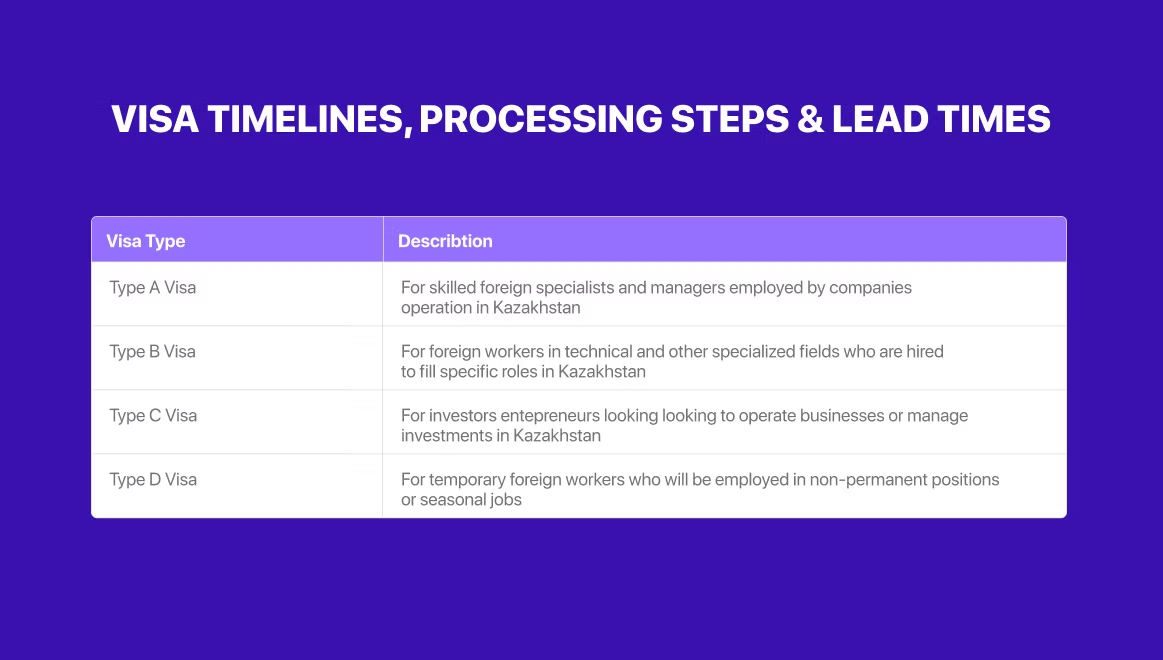
Kazakhstan's visa policy has traditionally been a point of friction, but recent amendments have introduced a "Neo Nomad" and "Digital Nomad" visa to attract global remote workers. However, if you are bringing in a team under a standard work permit (C3 visa), the rules have become significantly more stringent as of late 2025.
The 15-Day Labor Market Test
Effective September 1, 2025, any employer wishing to hire a foreign national under a work permit must first search for a local candidate. This is not a "check the box" exercise. You must post the vacancy on the Electronic Labor Exchange for 15 calendar days. Only if no suitable Kazakhstani citizen is found can you proceed with the foreign permit application.
For small businesses, the stakes have also risen. Previously, companies with fewer than 20 employees were exempt from local-to-foreign staffing quotas. That exemption is gone. You must now ensure that at least 70% of your management and 90% of your specialists are Kazakhstani nationals.
The 2026 Labor Quotas
The government sets an annual quota for the total number of foreign workers allowed into the country. For 2026, this is set at 0.25% of the total labor force.
| Worker Category | 2026 Permit Allotment |
| Category 1 (Senior Managers) | 726 |
| Category 2 (Heads of Divisions) | 3,402 |
| Category 3 (Specialists) | 5,893 |
| Category 4 (Skilled Workers) | 3,131 |
| Seasonal Workers | 4,994 |
Navigating these quotas requires a sophisticated understanding of employer of record work visas in Kazakhstan. In many cases, AIFC participants are exempt from these restrictive quotas, making the AIFC an even more attractive option for teams that are heavily expat-dependent.
Practical Steps: IINs, eGov, and Banking
If the Tax Code is the rules of the game, the Individual Identification Number (IIN) is your ticket to play. Without an IIN, you are legally invisible in Kazakhstan. You cannot open a bank account, you cannot receive a salary, and you cannot register a lease.
The Golden Key: Getting Your IIN
The IIN process was historically a manual, bureaucratic nightmare. Today, it is largely digital, though it still requires a physical presence or a trusted proxy. As of 2024, foreigners must also undergo fingerprinting if they intend to legalize their stay for the long term.
Once you have your IIN, the next step is registering on eGov.kz and downloading the eGov Mobile app. In 2025, over 90% of public services in Kazakhstan were available online. The app is remarkably robust; you can use it to verify your residency, access digital versions of your ID, and even receive "Green Corridor" priority if you are part of a recognized investment project.
Banking: The Kaspi Revolution
Relocating to Kazakhstan means entering one of the most advanced digital banking ecosystems in the world. Banks like Kaspi and Halyk have integrated everything from QR payments to government services into their apps.
However, currency control remains a major compliance hurdle for businesses. If your company needs to purchase more than $50,000 in foreign currency in a single day, you must provide the bank with your currency agreement and an invoice. If that currency isn't used for its intended purpose within 10 days, the bank is legally required to sell it back for KZT. This is a "Marmite" rule: it's intended to stabilize the Tenge, but it tastes like a massive headache for a finance team trying to manage international vendors.
Labor Law and Performance: The Rules of the Road
Kazakhstan's Labor Code is a protective document. It assumes a power imbalance between employer and employee and seeks to rectify it through mandatory written contracts and strict termination protocols.
Probation and Performance
Standard probation periods are 3 months, extendable to 6 months for executives and chief accountants. During this time, you can terminate with just 3 days' notice. Once an employee passes probation, they are "in the system," and letting them go becomes a procedural journey.
- Vacation: Every employee gets 24 calendar days. You cannot skip vacation for two consecutive years; if you do, the company faces fines up to 100 MCI.
- Termination for Cause: Requires documented evidence of performance failure or misconduct.
- Redundancy: Requires one month's notice and one month's average salary as severance.
For founders, the key is consistency. "People can smell BS," and employees can smell an unfair performance review process. Using an EOR service in Kazakhstan for probationary periods and performance management in Kazakhstan ensures that every "talk" is backed by the legal documentation required to make a termination stick if things go south.
The Language of Business
Kazakhstan is bilingual. While Russian is the language of Almaty’s cafes and business meetings, Kazakh is the "state language" of the law. All employment contracts must be in both languages. If there is a dispute, and your contract is only in English or Russian, you are in a weak position. The 2022 amendments to the Language Act have reinforced this, making Kazakh-only signboards and advertisements the new baseline, with other languages allowed as additions.
Strategic Takeaways for Decision-Makers
Relocation to Kazakhstan is a strategic move into the heart of Central Asia, but it is not a "set and forget" operation. The 2026 horizon demands a high degree of self-awareness and compliance-driven planning.
- Don't Fear the AIFC: If you are a tech company or an international investor, the AIFC is your best friend. The upfront cost is a small price to pay for the English Common Law protection and tax exemptions.
- Respect the IIN: Your relocation starts and ends with digital identity. Get your team’s IINs and eGov access sorted before you even think about signing an office lease.
- Audit Your 2026 Payroll: The progressive PIT and the 16% VAT will change your margins. If you aren't prepared for the higher tax thresholds, your "affordable" Kazakhstani team will suddenly look a lot more expensive.
- Use an EOR for Speed: If the "labor market test" and the quota system feel like too much, an EOR provides the legal shielding you need to hire the best talent while the government sorts out its new regulations.
- Be Honest about Local Content: Kazakhstan is prioritizing its own people. If you want to bring in a foreign team, you must be prepared to prove why a local specialist couldn't do the job.
Kazakhstan is a market that rewards those who do their homework. By understanding the, you can turn the "Marmite" of Central Asian bureaucracy into a high-yield component of your global growth strategy. For a complete overview of how to manage this transition, we recommend starting with the complete hiring guide for an employer of record in Kazakhstan and reviewing the top 5 reasons companies choose an employer of record in the region.
Frequently Asked Questions
1. What is the "70/90 Local Content" rule?
Kazakhstan enforces strict ratios to protect the local workforce. For most companies:
- Categories 1 & 2 (Executives and Managers): At least 70% of the staff must be Kazakh nationals.
- Categories 3 & 4 (Specialists and Skilled Workers): At least 90% of the staff must be Kazakh nationals.
Note: As of late 2025, even small enterprises (under 20 employees) that were previously exempt must now comply with these quotas if they hire even one foreigner.
2. How does the "Labor Market Test" work in 2026?
Before you can apply for a work permit, you must post the job vacancy on the Electronic Labor Exchange (Enbek.kz) for at least 15 calendar days. You can only proceed with a foreign hire if no suitable local candidate is found and registered during this period.
3. Are there exemptions for the CEO or Branch Manager?
Yes. Under the 2026 regulations, a company with 100% foreign ownership may employ the Chief Executive Officer (Director) and one Deputy CEO without a work permit. However, they still require an M1 (Work) Visa or a Temporary Residence Permit (TRP).
4. What is the "Annual Quota Request" deadline?
If you plan to hire foreigners in the following calendar year, you must submit a Quota Request to the local Akimat (regional government) by October 1st of the current year. If you miss this deadline, getting a permit mid-year is significantly more difficult and depends on whether the region has "reserve" slots available.
5. What are the 2026 Work Permit State Fees?
Fees are calculated based on the Monthly Calculation Index (MCI) and vary by category:
- Category 1 (Executives): Up to ~250 MCI (~$1,850+ USD).
- Category 3 (Specialists): Around 137 MCI (~$1,000 USD).
- Category 4 (Skilled Workers): Around 95 MCI. These permits are non-renewable and intended only for short-term knowledge transfer.
6. How does the Astana International Financial Centre (AIFC) differ?
The AIFC is a "legal oasis." Companies registered within the AIFC enjoy a much simpler labor regime, including exemptions from the standard work permit process and quotas for their foreign staff. They also benefit from an English-law-based jurisdiction.
7. What are the new 2026 tax rates for foreign employees?
Kazakhstan moved away from a flat tax for high earners in 2026:
- Individual Income Tax (PIT): 10% for standard salaries; 15% for salaries exceeding approximately 3 million KZT per month.
- Employer Social Tax: A new rate of 6% (simplified from the old 11% with deductions).
- Employer Pension Contribution: Increased to 3.5% in 2026 (up from 2.5%).
8. Is an "E-Contract" mandatory for all employees?
Yes. All employment contracts must be registered in the Unified System of Employment Contracts (HR-Enbek). Employers who fail to register a contract or update its status (termination, amendments) face administrative fines ranging from 60 to 150 MCI.
9. Can I hire citizens of EAEU countries without a permit?
Yes. Citizens of Russia, Belarus, Armenia, and Kyrgyzstan do not require a work permit or a visa to work in Kazakhstan. They only need to register their employment contract in the E-system and apply for a TRP for a period of up to one year (renewable).
10. Can I use an "Employer of Record" (EOR) to bypass quotas?
Yes. Many firms use an EOR in 2026 to manage the 70/90 ratio. Because the EOR is a large local company with hundreds of Kazakh employees, they can easily "absorb" your foreign hire into their quota, handling the permit, payroll, and 2026 tax compliance on your behalf.
.svg)