Relocation to Armenia: Legal Requirements and Practical Steps
TL;DR
Relocation to Armenia is on the rise, and for good reason. Employers worldwide are eyeing this Caucasus tech hub for its skilled talent, friendly business climate, and affordable growth opportunities. But before you move your star developer or new hire to Yerevan, you need to navigate Armenia’s legal requirements – from visas and work permits to compliance checkpoints. This comprehensive guide cuts through the bureaucracy (with zero fluff) and gives you clear, practical steps to relocate an employee to Armenia. We’ll cover why companies are making the move, what visas and permits you’ll need, how to stay compliant as an employer, and how solutions like an Employer of Record (EOR) can streamline the whole process. Let’s dive in.
Quick Navigation
- TL;DR
- Why Employers Are Relocating Workers to Armenia
- Visa and Work Permit Types for Foreign Employees in Armenia
- Step-by-Step Legal Process for Relocating an Employee to Armenia
- Compliance Requirements for Employers in Armenia
- Practical Tips for Relocating International Employees to Armenia
- How an EOR Helps with Relocation in Armenia
- Conclusion
- Frequently Asked Questions
Why Employers Are Relocating Workers to Armenia
It’s not just a trend – there are concrete reasons behind the surge in companies moving team members to Armenia. In recent years, Armenia has transformed into a magnet for tech talent and foreign businesses. Entire companies (especially in IT) have relocated here, attracted by a potent mix of opportunity and ease. Decision-makers are choosing Armenia to:
- Access a Deep Talent Pool: Armenia’s workforce is brimming with skilled engineers, developers, and multilingual professionals. Many have experience with international teams (from Berlin to Silicon Valley) and bring strong English fluency and a solid STEM education heritage. In short, you can tap top-notch talent without fighting off a dozen other recruiters.
- Optimize Costs Without Sacrificing Quality: Hiring in Armenia often costs a fraction of Western salaries for equivalent skill levels. Senior developers in Yerevan might earn half of what they would in major EU/US cities, yet deliver the same high-caliber work. Lower labor costs, combined with competitive productivity, make a compelling case for relocating roles here.
- Expand into a Growing Tech Hub: Global tech players like Intel and Microsoft have offices in Yerevan, and homegrown unicorns (think PicsArt) have put Armenia on the innovation map. For employers, relocating a team member here means plugging into a booming tech ecosystem. You’re placing staff in a dynamic environment with networking, partnerships, and new market prospects.
- Ensure Business Continuity & Stability: Regional developments have drawn companies (especially from Eastern Europe and Russia) to the relative stability of Armenia. The country welcomed a wave of relocations in 2022, and many who came “just to look” ended up staying. Employers saw that Armenia offered a predictable path to residence and work status, even during uncertain times. Keeping operations running smoothly is easier when the host country is cooperative.
- Leverage a Friendly Regulatory Environment: Armenian authorities have been notably welcoming to foreign companies and expats, acknowledging their boost to the economy. Fast business registration, minimal red tape, and government incentives (especially for IT startups) create an environment where relocating a worker isn’t a bureaucratic nightmare. In fact, registering a new legal entity can take as little as one day with minimal paperwork – a testament to how business-friendly the climate is.
In short, employers are moving people to Armenia because it checks all the boxes: talent, cost efficiency, growth, and a cooperative business setting. Now, let’s break down the visa and permit side of the equation, because none of those advantages matter if your employee can’t legally live and work there.

Visa and Work Permit Types for Foreign Employees in Armenia
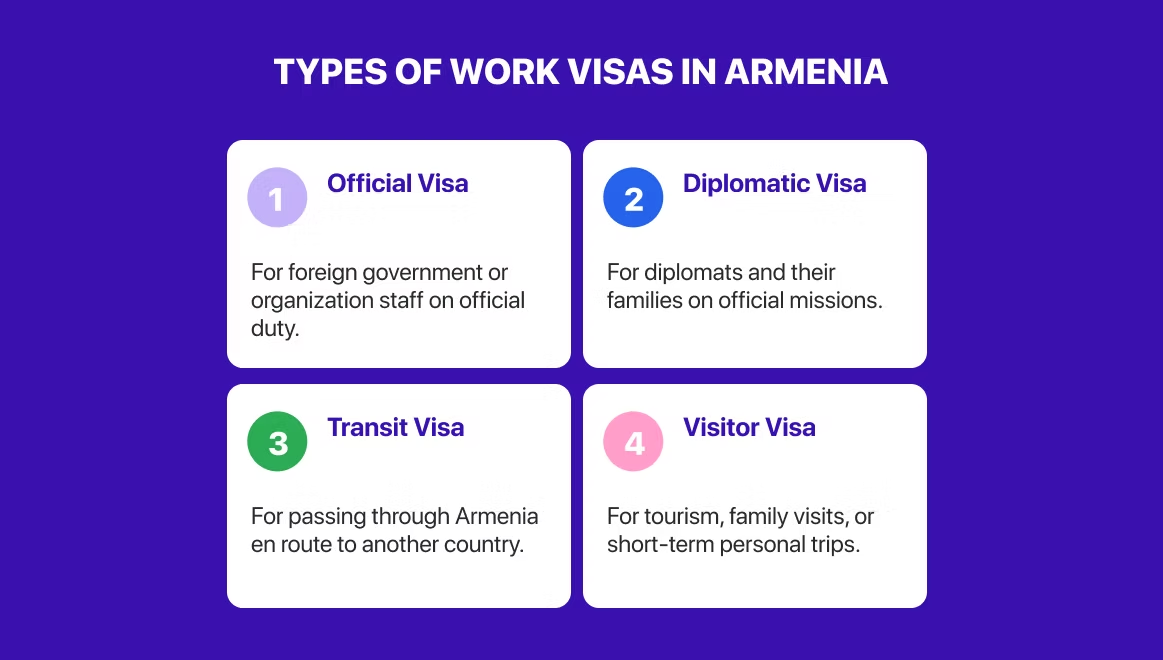
Let’s clear something up first.
Armenia is not a paperwork jungle. It’s not Egypt. It’s not Kazakhstan. It’s not a quota-heavy maze designed to make you suffer.
But that doesn’t mean you can wing it.
Relocating a foreign employee to Armenia usually comes down to two connected things:
- Work authorization
- Legal residence
They’re processed together. You don’t get one without the other. And once approved, your employee gets a residence card that lets them live and work legally.
Here’s how it actually works.
1. Work Visa (Type D Visa)

This is the long-term entry visa for employment.
Now here’s where Armenia is refreshingly practical.
Citizens of the US, EU, UK and many other countries can enter Armenia visa-free for up to 180 days per year. That’s generous. But generous does not mean work-authorized.
Visa-free entry lets someone stay. It does not let them legally work.
In practice:
- Many employees enter visa-free or on an e-visa
- Then transition to a work + residence permit in-country
- No border run required
The Type D visa becomes important when:
- The employee needs an entry visa
- You want clean immigration sequencing
- You prefer zero ambiguity on arrival
It’s typically valid up to one year and is multi-entry.
Think of it as the bridge to legal residency.
2. Temporary Residence Permit (1 Year)
This is the real prize.
Once the work permit is approved, your employee receives a Temporary Residence Card valid for one year.
This plastic card is what legally allows them to:
- Live in Armenia
- Work for the sponsoring employer
- Enter and exit freely
Key points:
- Valid for 1 year
- Renewable annually (usually up to 4 consecutive renewals)
- Tied to the specific employer
Most foreign employees in Armenia operate on rolling 1-year temporary residence permits. Simple. Predictable.
3. Permanent Residence Permit (5 Years)
If someone stays long enough, Armenia offers an upgrade.
After around five years of temporary residence, a foreign national can apply for permanent residence, valid for five years at a time.
Why this matters for employers:
- No annual renewal stress
- Greater employee stability
- Reduced immigration admin over time
And here’s something most countries won’t admit: Armenia has one of the more flexible long-term pathways in the region. Citizenship can even become possible after several years under certain conditions.
If you’re relocating someone for the long haul, this path is worth understanding early.
4. The Work Permit Itself
Technically, the work permit is an employer approval to hire a specific foreign individual.
In Armenia’s system:
- The employer applies online
- Once approved, the residence permit is issued
- The permit is role-specific and employer-specific
It is not transferable.
Change employer? New permit.
This isn’t hostile regulation. It’s standard labor control. But you need to plan for it.
5. Short Assignments and Grey Zones
Here’s where companies start convincing themselves they’re clever.
“Can we just bring them for three months on a business visa?”
Armenia does have business and short-stay visas. They are meant for:
- Meetings
- Conferences
- Exploratory visits
They are not designed for ongoing employment.
If someone is:
- On your payroll
- Performing regular work
- Reporting to your team
… then skipping the work permit process is gambling with compliance.
Armenia is relaxed compared to some markets. But relaxed does not mean blind.
6. Exemptions (Rare but Real)
Some categories don’t need a work permit:
- EAEU citizens (Russia, Belarus, Kazakhstan, Kyrgyzstan)
- Certain intracompany transferees or directors
Even then, residence registration is still required for longer stays.
If your hire isn’t from an EAEU country, assume the standard process applies.
Step-by-Step Legal Process for Relocating an Employee to Armenia
Let’s strip this down to operational reality.
Step 1: Confirm Entry Status
Ask:
- Is the employee visa-exempt?
- Do they need a Type D visa?
- How long can they legally stay upon arrival?
If visa-free, they can enter and begin the in-country permit process.
If not, you’ll secure a Type D visa with an employer support letter.
Timing matters. Make sure they have enough legal stay remaining to cover processing time.
Step 2: Employer Registration on workpermit.am
Armenia runs work permits through a digital system: workpermit.am.
The employer (or EOR) must:
- Register company details
- Create an authorized account
- Submit applications through the platform
If you’re using an Employer of Record, they handle this entirely.
No registration, no permit. Simple.

Step 3: Labor Market Test
Yes, Armenia protects its local workforce.
You must post the vacancy in the system.
This allows Armenian citizens to potentially apply.
In reality, for specialized or senior roles, this is usually procedural. But it’s mandatory.
Once authorities confirm no suitable local candidate is available, you move forward.
Skip this step and your application stalls.
Step 4: Submit the Work Permit Application
You’ll upload:
- Passport copy (notarized Armenian translation required)
- Proof of qualifications (if relevant)
- Passport photos
- Medical certificate (if required)
- Signed employment contract
- Government fee receipt (approx. AMD 105,000 / ~$270)
Translation errors and missing documents are the main delay triggers.
This is where experienced operators move faster.
Step 5: Approval and Residence Card Issuance
Processing usually takes up to 30 days.
Once approved:
- The employee receives notification
- They collect their Temporary Residence Card in Yerevan
- If abroad, the D visa is issued for entry
Once the card is in hand, they are legally resident and work-authorized.
That’s the moment you’re fully compliant.
Step 6: Start Employment Properly
Now the non-immigration compliance begins.
You must:
- Register the employee with tax authorities
- Begin payroll withholding
- Ensure proper employment contract documentation
Armenia expects you to act like a responsible employer from day one.
Step 7: Renewal Discipline
Don’t get lazy.
Start renewal 30–60 days before expiry.
The renewal process mirrors the initial one, but smoother.
Miss the deadline, and you create avoidable stress.
Compliance Requirements for Employers in Armenia
Let’s be honest.
Armenia is one of the smoother jurisdictions in the region. No extreme quotas. No arbitrary caps. No opaque “security black holes.”
But “easier” does not mean optional.
If you relocate someone and ignore compliance, the system will eventually remind you who’s in charge.
Here’s what actually matters.
1. You Need a Legal Employer in Armenia
This is non-negotiable.
To employ someone in Armenia, there must be:
- A locally registered Armenian entityor
- A licensed Employer of Record acting as the legal employer
If your company has no Armenian entity, you cannot simply wire money from abroad and call it employment.
You either:
- Incorporate locally
- Or use an EOR Armenia solution
There is no third hidden path.
Companies that try to “just pay them as a contractor” while managing employer of record teams like an employee usually discover the mistake during a tax inspection. Armenia’s digital reporting systems are improving fast. Shadow employment is not a clever strategy anymore.
2. Employment Contracts Must Follow Armenian Labor Law
Handshake deals do not survive audits.
Armenian law requires:
- A written employment contract
- Typically bilingual (Armenian + English or other language)
- Signed before work begins
Your contract must address:
- Salary (clearly defined, typically in AMD or equivalent stated)
- Working hours (40-hour week standard)
- Overtime terms
- Paid annual leave
- Termination and notice periods
- Any probation period
You cannot import a UK or US template and assume it works.
If a dispute arises, Armenian courts will rely on the Armenian-language version. If you don’t have one, you’ve created your own liability.
This is where local legal review or an EOR contract template saves you from future headaches.
3. Payroll, Tax & Social Contributions

Now here’s the part that surprises people.
Armenia does not impose heavy employer-side social taxes.
The main burden is on the employee:
- 20% flat income tax
- 5% pension contribution (up to threshold)
- 10% pension contribution above threshold
Your responsibility?
You act as a tax agent.
That means:
- Withhold taxes from salary
- Remit them by the 20th of the following month
- File payroll reports online
Miss the deadline and penalties apply.
It’s not complicated. But it is precise.
Also:
- Wages are typically paid in AMD
- Payroll reporting is digital
- Records must be clean and organized
If you dislike administrative precision, this is where payroll outsourcing or EOR services start looking very attractive.
4. Work Permit & Residence Maintenance
Issuing the permit is not the end.
It’s the beginning of an annual cycle.
You must:
- Renew permits before expiration
- Avoid employing someone past expiry
- Update authorities if employment ends
- Reapply if role changes materially
Work permits are:
- Employer-specific
- Role-specific
Promote someone? Change entity? Transfer departments?
Check whether a new filing is required before making the move.
Letting a permit lapse, even accidentally, exposes both employer and employee to fines.
Calendars exist for a reason. Use them.
5. General Labor Law Still Applies
Foreign employee ≠ special rules.
They are protected under Armenian Labor Code just like locals.
That includes:
- Maximum working hours
- Overtime compensation
- Paid annual leave
- Maternity and parental leave protections
- Minimum wage compliance
You cannot ask someone to waive statutory rights.
You cannot contract out of basic protections.
Armenia is business-friendly, but it is not deregulated.
6. Immigration Reporting & Record Keeping
Residence holders may need:
- Address registration
- Updates in case of status changes
- Proper documentation maintained on file
You should keep:
- Passport copies
- Residence card copy
- Work permit approval
- Employment contract
- Payroll filings
Not because paranoia is healthy.
Because inspections happen.
And when they do, organized employers look competent.
The Honest Truth About Armenian Compliance
Compared to many countries, Armenia is pragmatic.
But pragmatic systems reward disciplined operators.
They punish sloppy ones.
The employers who struggle are rarely those blocked by bureaucracy.
They’re the ones who assumed “it’s easy, we’ll figure it out later.”
Later is when fines happen.
Practical Tips for Relocating International Employees to Armenia
Now let’s shift gears.
Employer of Record Compliance keeps you safe.
Practical support keeps your employee productive.
Both matter.
1. Start Earlier Than You Think You Need To
Official timelines say “about a month.”
Reality says:
- Documents take time
- Translations take time
- Apostilles take time
Start 2–3 months before relocation.
That buffer protects your sanity.
2. Use the Visa-Free Window Strategically
If the employee can enter visa-free:
- Let them arrive
- Begin the permit process in-country
- Allow them to settle while the paperwork runs
Just remember:
They cannot legally perform local employment without permit approval.
Onboarding? Fine.
Internal meetings? Fine.
Official employment? Wait for the permit.
Sequencing matters.
3. Help With Housing Early
Yerevan’s housing market tightened significantly after 2022.
Do not let your employee scramble alone.
Support with:
- Temporary housing
- Broker introductions
- Neighborhood guidance
- Budget clarity
First impressions of relocation matter. If housing goes poorly, productivity drops.
4. Make Banking and Utilities Easy
Relocation friction often comes from small things:
- Opening a bank account
- Getting a SIM card
- Understanding how utilities work
Provide guidance or assign a local HR contact.
Small support creates disproportionate loyalty.
5. Prepare for Cultural Adjustment
Armenia is welcoming. Very welcoming.
But daily life runs in Armenian. Russian is widely spoken. English is common in tech.
Offer:
- Basic language resources
- Cultural briefings
- Public holiday calendar
- Workplace etiquette overview
It signals professionalism.
6. Think About Family Early
If dependents are relocating:
- Gather apostilled marriage and birth certificates early
- Research schools in advance
- Clarify the dependent residence process
A stressed family equals a distracted employee.
7. Build Flexibility Into Your Timeline
Relocation is one of life’s top stress events.
There will be:
- Delays
- Paperwork surprises
- Emotional adjustment
Employers who stay flexible earn loyalty.
Employers who demand precision from a person uprooting their life create friction.
8. Use Local Experts When Needed
You can DIY Armenia.
You absolutely can.
But if this is your first relocation, using:
- Immigration advisors
- Payroll specialists
- Or an Employer of Record
… often costs less than fixing a mistake later.
Experienced operators move faster not because the system is easier, but because they understand sequencing.
How an EOR Helps with Relocation in Armenia

Relocating talent to Armenia sounds simple.
Visa-free entry for many nationalities.
Affordable cost of living.
Fast-growing tech ecosystem in Yerevan.
But here’s the part founders underestimate.
Relocation is not just flights and an apartment. It’s:
- Work permits
- Residence cards
- Labor compliance
- Payroll registration
- Tax reporting
- Contract formalities
Miss one step, and your “smooth relocation” turns into immigration trouble.
Let’s break down how an Employer of Record (EOR) makes relocation to Armenia structured and predictable.
Step 1: Pre-relocation Planning
What Happens Before Your Hire Boards the Plane
When you decide to relocate someone to Armenia, the EOR starts immediately.
- Verifying nationality and visa status
- Confirming whether visa-free entry applies
- Preparing job description for workpermit.am
- Checking qualification alignment for labor test
- Reviewing salary structure for compliance
If the candidate needs an entry visa, the EOR provider in Armenia guides that process.
If they are visa-exempt, the EOR plans for in-country status conversion.
Founders often skip this planning phase. That’s where mistakes begin.
Step 2: Work Permit Sponsorship
Making the Relocation Legal
In Armenia, relocation requires:
- Work Permit
- Temporary Residence Permit
These are linked.
The EOR:
- Registers as sponsor on workpermit.am
- Posts the job and initiates labor market test
- Uploads passport copies, qualifications, photos
- Submits employment contract draft
- Monitors application progress
Armenia typically processes within 20–30 business days.
If authorities request clarification, the EOR handles it.
Without sponsorship, the employee cannot legally work, even if they entered visa-free.
Step 3: Temporary Residence Card
Once the work permit is approved:
- The employee applies for a temporary residence card
- The EOR coordinates documentation
- The government fee (~105,000 AMD) is paid
Processing usually takes around 30 days.
Once issued, the employee can:
- Stay beyond 180 days
- Open a local bank account
- Register utilities
- Sign leases
This is where relocation becomes “real.”
Step 4: Local Employment Contract Execution
Armenian law requires:
- A local employment contract
- Proper registration within 15 working days
- Issues Armenian-language contract
- Ensures labor code compliance
- Registers employment correctly
Founders often forget that foreign contracts don’t replace local ones.
No local contract means immigration risk.
Step 5: Payroll & Tax Registration
Relocation without payroll compliance is a ticking time bomb.
The EOR:
- Registers the employee with the Armenian tax authorities
- Sets up monthly payroll reporting
- Withholds income tax
- Manages pension contributions if applicable
Your relocated hire becomes fully compliant from month one.
No undeclared income. No back-tax surprises.
Step 6: Housing, Address & Local Registrations
Armenia requires foreign residents to:
- Register address
- Maintain valid residence documentation
The EOR guides:
- Address declaration
- Coordination with landlord
- Residence card pickup
- Bank account support
This avoids administrative friction during onboarding.
Step 7: Ongoing Compliance & Renewals
Relocation isn’t a one-time event.
Permits are typically valid for one year.
The EOR:
- Tracks expiration dates
- Starts renewal process 60–90 days early
- Monitors regulatory changes
- Ensures continuous legal status
If your employee stays long-term, the EOR supports:
- Annual renewals
- Potential transition to permanent residency after 5 years
Conclusion
Relocating employees to Armenia is both an exciting opportunity and a process that demands due diligence. We’ve covered the legal requirements – securing Employer of Record work visas (D visas) and residence permits, following a step-by-step process to get your people on the ground. We’ve emphasized compliance – from contracts and taxes to renewal rules – because doing it by the book isn’t optional. And we’ve shared practical tips to ensure your team member’s move is successful on a human level, not just a legal one.
Armenia offers a compelling package for employers: a rich talent pool, a booming tech scene, cost advantages, and a lifestyle that helps attract and retain the very people you’re relocating. It’s no wonder savvy companies are making moves to Yerevan. With a friendly business climate and government support for foreign investment, the country has opened its arms to international teams.
Of course, having the right partners makes all the difference. The Employer of Record model stands out as a strategic option to handle the nitty-gritty while you reap the benefits. Whether you engage an EOR to streamline the process or go it alone with your own entity, transparency and compliance should guide every step – that’s very much in line with Team Up’s own ethos of being confident, honest, human, and transparent in global hiring.
Now you’re equipped with the knowledge to proceed with relocating employees to Armenia. The legal path is clear, the practical tips are laid out, and the business case is strong. All that’s left is to take the next step. Armenia is ready to welcome your team, bon voyage (oops, we mean բարի ճանապարհ, “good journey”) on your relocation!
Frequently Asked Questions
1. Is the "Unified E-Contract Platform" now mandatory?
Yes. As of January 1, 2026, all new employment contracts in Armenia must be created, signed, and managed through the government’s unified electronic platform. Paper contracts are no longer legally sufficient for new hires. Employers and employees must both have a valid Armenian digital signature to finalize these documents.
2. Can I still hire a foreigner who entered on a tourist visa?
This is a critical change for 2026. While it was common in the past, a new law effective August 1, 2026, introduces a specific Work Visa. Foreigners must now generally enter on this work-specific visa to apply for a residence permit. Applying for work-based residency after entering as a tourist is now a common ground for rejection.
3. What happened to the 10-year "Special Residency" status?
The 10-year special residency (often used by investors and ethnic Armenians) has been abolished for new applicants as of August 1, 2026. It is being replaced by a 5-year Fast-Track Residency program. Existing 10-year permits remain valid until they expire, but new employees or investors will transition to the new 5-year renewable card.
4. Is there still a "Labor Market Test" required to hire foreigners?
The 2026 reforms have replaced the tedious case-by-case labor market test (proving no local could do the job) with a Government Quota System. The Armenian government now sets annual limits on foreign labor by sector. If your industry is within its quota, the hiring process is much faster and bypasses the local search requirement.
5. What are the mandatory employer-paid taxes in 2026?
Technically, the "tax" is withheld from the employee, but the employer is the responsible agent.
- Income Tax: A flat 20%.
- Social Security (Pension): Generally, 5% for the employee (withheld by you).
- Military Stamp Duty: A monthly fixed fee ranging from 1,500 to 15,000 AMD, depending on the salary tier.
6. How long does it take to get a Work/Residence Card?
The integrated system (where the Work Permit and Residence Card are one document) typically takes 45 to 60 days. However, with the full digitalization in 2026, straightforward cases through the workpermit.am portal can sometimes be processed in as little as 3 weeks.
7. Do EAEU citizens (Russia, Belarus, Kazakhstan, Kyrgyzstan) need permits?
No. Citizens of EAEU member states remain exempt from work permits. However, they must still register their employment contract on the electronic platform and obtain a Certificate of Legality of Stay if they plan to reside in Armenia long-term.
8. What are the penalties for "Informal Employment"?
Armenia has increased enforcement in 2026 to combat "shadow" salaries. Hiring an employee without an e-contract or failing to register them with the State Revenue Committee (SRC) before they start work can result in fines starting at 600,000 AMD (~$1,500 USD) per unregistered worker.
9. Can I use an Employer of Record (EOR) to avoid opening a local entity?
Yes. Many international companies use EOR services (like Team Up, Deel, Remote) to hire staff without registering a local LLC. The EOR handles the e-contracts, digital signatures, and tax withholdings, while the employee works directly for you.
10. Are there special tax incentives for IT companies in 2026?
Yes, though the "0% Income Tax" for startups has evolved. In 2026, certified tech companies still enjoy a reduced Personal Income Tax rate of 10% (instead of 20%) for their employees, provided they maintain certain growth and export criteria.
.svg)