Relocation to Azerbaijan: Legal Requirements and Practical Steps

TL;DR
The Republic of Azerbaijan has entered a transformative era in its legislative and digital landscape, specifically tailored to the global shift toward knowledge-based economies and specialized labor migration.
As of early 2026, the regulatory environment for foreign nationals and international corporations is characterized by a sophisticated interplay between the Migration Code, a modernized Labor Code, and a centralized digital infrastructure known as the ASAN ecosystem.
This report provides a comprehensive examination of the legal requirements and practical steps necessary for a successful relocation to Azerbaijan, specifically focusing on the 2026 amendments that have restructured the fiscal and labor obligations for both individuals and enterprises.
Quick Navigation
- TL;DR
- The Architecture of Migration and Residency
- The 2026 Labor Code Transformation
- Fiscal Obligations: The 2026 Tax and Social Insurance Regime
- The Highly Skilled Migrant Programme (HSMP)
- Operational Strategies: Entity Setup vs. Employer of Record
- The Digital Ecosystem: ASAN Imza and SİMA
- Practical Integration: Banking, Housing, and Cost of Living
- Compliance, Safety, and Strategic Risks
- Conclusion: Strategic Summary for 2026 Relocation
- Frequently Asked Questions
The Architecture of Migration and Residency
The statutory framework governing the entry and stay of foreigners in Azerbaijan is rooted in the Migration Code, administered by the State Migration Service (SMS), a central executive body with the status of a law enforcement agency established by presidential decree in 2007. The SMS operates the Unified Migration Information System, which serves as the primary mechanism for tracking the entry, stay, and residency of all foreigners within the territory of Azerbaijan.
Registration at the Place of Stay
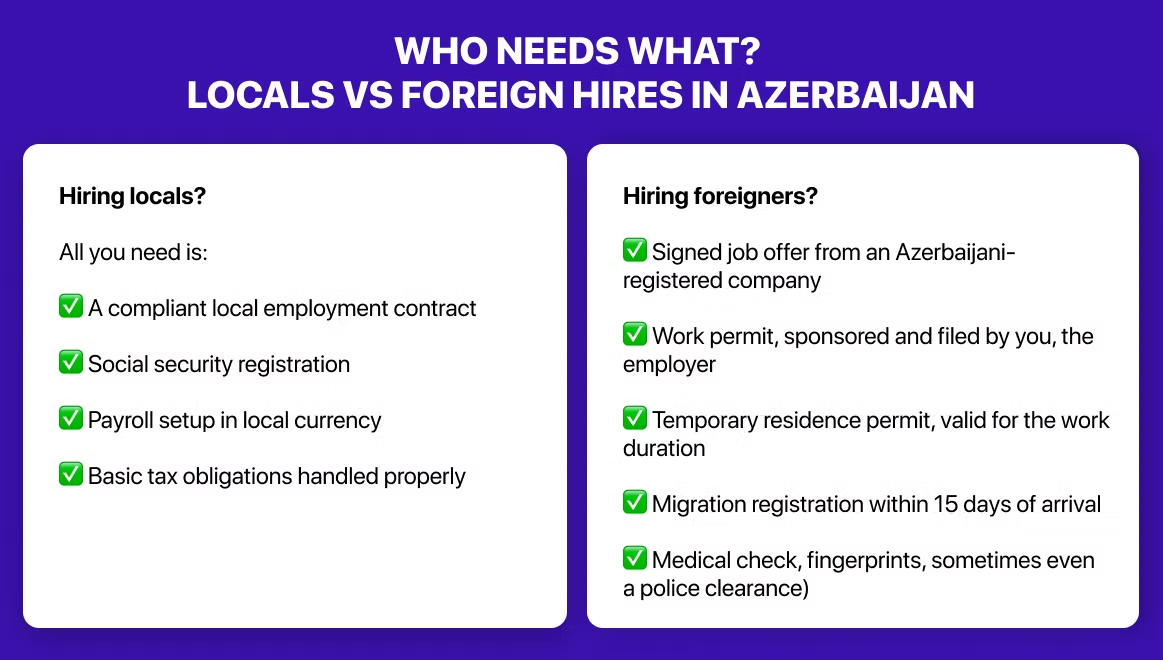
A fundamental requirement for any foreigner entering Azerbaijan is registration at the place of stay. For those intending to remain in the country for more than 15 days, registration must be completed within 15 days of arrival.
It is critical to note that for citizens of specific countries, such as Kazakhstan, this window is extended to 30 days. The mechanism for registration is decentralized through the "ASAN service" centers and the electronic portal of the State Migration Service. Failure to register within the stipulated timeframe is not merely a bureaucratic oversight but a basis for administrative liability, which can complicate subsequent applications for residence permits.
| Requirement for Registration | Specification | Procedural Note |
| Timeframe for Arrival | Within 15 days (30 for Kazakhstan) | Must be completed via e-mail or ASAN centers. |
| Mandatory Documents | Application form and a copy of the passport | Must include visa page and last entry stamp. |
| Change of Address | Within 5 working days | New registration is required for each change. |
| Service Fee | Free of charge | No state fee is required for this specific registration. |
The responsibility for this registration lies primarily with the "host party," which may be a hotel, a landlord, or an inviting organization. However, the foreigner bears the ultimate responsibility for ensuring that the registration has been finalized to avoid fines.
Temporary Residence Permit (TRP) Modalities
For stays extending beyond the limits of a standard visa, foreigners must obtain a Temporary Residence Permit (TRP). The 2026 regulatory environment recognizes several distinct grounds for the issuance of a TRP, each with its own threshold of evidence and capital.
Foreigners investing at least AZN 500,000 into the national economy are granted TRPs with significant flexibility. Alternatively, the ownership of real estate valued at no less than AZN 200,000 serves as a primary ground for residency.
For entrepreneurs, the creation of a legal entity (typically an LLC) remains a popular route, provided the company meets specific operational thresholds. Specifically, to qualify for a TRP under entrepreneurship, the entity must have an authorized capital of at least AZN 50,000 and must employ a minimum of five local Azerbaijani citizens if the work is full-time, or ten if part-time.
| Ground for Temporary Residence | Minimum Threshold / Requirement | Validity / Renewal |
| Economic Investment | AZN 500,000 | Up to 3 years. |
| Real Estate Ownership | AZN 200,000 | Renewed annually based on ownership. |
| Entrepreneurship | AZN 50,000 capital + 5 local employees | Linked to active business operation. |
| Family Reunification | Close relative of a citizen or resident | Valid as long as the family bond exists. |
| Highly Qualified Specialist | Invited by government or industry leaders | Streamlined under HSMP. |
The TRP application must be submitted at least 30 days prior to the expiration of the current stay period or visa. The issuance of a TRP provides the foreigner with a "permission card," which includes a unique 5 or 6-character Personal Identification Number (PIN code). This PIN code is recorded on the machine-readable optical character recognition part of the card and is essential for all interactions with the Azerbaijani digital government.

The 2026 Labor Code Transformation
The Azerbaijani Labor Code underwent significant amendments effective January 1, 2026, marking a shift toward greater employee protection and the formalization of modern work arrangements, such as remote and distant labor. These changes are critical for relocation professionals to understand, as they directly impact the structuring of employment contracts and the management of foreign staff.
Probationary Periods and Termination Grounds
One of the most profound changes in the 2026 Labor Code is the abolition of "failed probation" as a standalone ground for the immediate termination of an employment contract during the first three months. While the law still permits a probation period of up to 3 months, the employer can no longer terminate the contract during this period simply by claiming the employee failed to meet expectations. Instead, any termination must be justified with rigorous documentation and processed through the EMAS (Electronic Information System).
| Probation and Termination Nuances | Specification in 2026 | Legal Implication |
| Maximum Probation Duration | 3 Months | Must be explicitly stated in the contract. |
| Notice Period during Probation | 3 Days | Either party may terminate with 3 days' notice. |
| Failed Probation Ground | Abolished in 2026 | Terminations require more robust legal justification. |
| Contract Default | Deemed indefinite if no period is stated | No probation applies if not written. |
Furthermore, the 2026 amendments unified the terminology throughout the Code, replacing "cancellation of an employment contract" with the more comprehensive "termination of an employment contract". For foreign workers, this implies a more stable labor environment but also a more rigid administrative process for their employers.
Remote and Distant Work Regulations

The 2026 Code introduced Article 6 amendments to explicitly define and regulate remote work. This is defined as the performance of labor functions outside of the enterprise or the natural person employer's physical location, using electronic, telecommunication, and other relevant digital tools. This regulation is particularly relevant for the tech sector and for expatriates who may wish to work for foreign entities while residing in Azerbaijan.
The law now mandates that additional conditions for remote work must be explicitly detailed in the employment contract. This includes the provision of tools, the schedule of reporting, and the mechanisms for ensuring occupational safety in a non-traditional office setting. Interestingly, the Code now applies to foreigners performing labor functions in Azerbaijan even if their foreign employer has not established a formal branch or representative office in the country, provided the contract is registered in the national system.
Fiscal Obligations: The 2026 Tax and Social Insurance Regime
Relocating to Azerbaijan in 2026 involves navigating a new progressive tax structure. January 1, 2026, signaled the end of the seven-year income tax holiday for employees in the non-oil and non-government sectors, which had previously granted a 0% tax rate on salaries up to 8,000 AZN.
Progressive Personal Income Tax (PIT)
The new regime introduces a phased implementation of personal income tax for the private non-oil sector. This structure is intended to gradually transition the workforce into a fully taxed environment while maintaining the "White Salary" culture that the government has aggressively promoted to reduce shadow economy activities.
| Monthly Taxable Income (AZN) | 2026 Tax Rate | Formulaic Calculation |
| Up to 2,500 | 3% | $Income \times 0.03$ |
| 2,501 to 8,000 | 10% | $AZN 75 + 10\% \text of amount over 2,500$ |
| Above 8,000 | 14% | $AZN 625 + 14\% \text of amount over 8,000$ |
Note: The 3% rate for the lowest bracket is scheduled to increase to 5% in 2027 and 7% in 2028.
For those still operating within the oil and gas or government sectors, the tax rates are significantly higher, starting at 14% for income up to 2,500 AZN and rising to 25% for portions exceeding that amount.
Social and Medical Insurance Contributions
In addition to PIT, both employers and employees are responsible for mandatory social and health insurance contributions. The 2026 amendments have introduced reduced rates for high-income earners to prevent an excessive total tax burden on the non-oil sector.
The Mandatory Social Insurance (SSPF) for employees in the private sector follows a split model. For income up to 8,000 AZN, the employer pays 22%, and the employee pays 3% on the first 200 AZN plus 10% on the remainder. However, for the portion of monthly wages exceeding 8,000 AZN, the combined rate decreases to 21%, with the employee contributing 10% and the employer contributing 11%.
| Insurance Type | Employee Contribution | Employer Contribution | 2026 Nuance |
| Social Insurance (SSPF) | 3%–10% | 15%–22% | Reduced to 21% total over 8k AZN. |
| Health Insurance (MMI) | 2% (up to 2,500 AZN) | 2% (up to 2,500 AZN) | Reduced to 0.5% each over 2,500 AZN. |
| Unemployment Insurance | 0.5% | 0.5% | Remains unchanged at 1% total. |
Mandatory Medical Insurance (MMI) has also seen a reduction for higher earners. As of January 1, 2026, the total contribution rate for salaries above 2,500 AZN has been cut from 4% to 1%, split equally between the employer and employee.
The Highly Skilled Migrant Programme (HSMP)
Recognizing the need to attract global technical expertise, Azerbaijan launched the Highly Skilled Migrant Programme (HSMP). This initiative provides a streamlined path for residence and work authorization for qualified professionals in sectors such as Information Technology, Engineering, Oil and Gas, and Healthcare.
The HSMP utilizes a points-based assessment where applicants must typically score 70 out of 100 points based on their education, work experience, and specialized achievements (such as patents or leadership roles). One of the most significant advantages for HSMP winners is their exemption from the standard labor migration quota system. This allows Azerbaijani companies to hire these specialists without being constrained by the annual industry limits set by the Cabinet of Ministers.
Benefits for HSMP Winners and Families
HSMP status is awarded for up to five years, offering a level of stability that standard one-year renewable work permits do not provide.
- Residence Duration: Permits can be issued for up to 3 or 5 years initially.
- Freedom of Movement: Standard permits are often cancelled if the foreigner is outside Azerbaijan for more than 90 days in a 180-day period; this ground for cancellation does not apply to HSMP winners.
- Family Rights: Spouses and children under 23 receive residency and work permits in a preferential manner, without being subject to labor market testing or quotas.
- Permanent Residency: HSMP holders can apply for PRP after only two years of continuous residence and are not required to provide proof of sufficient funds to cover minimum needs during the PRP application.
For foreign professionals, this program represents the most robust and secure route for relocation, bypassing the "Work Permit Trap" often associated with standard administrative pathways.
Operational Strategies: Entity Setup vs. Employer of Record
For companies relocating to Azerbaijan, the decision to establish a local legal entity or use an Employer of Record (EOR) is a fundamental strategic choice. The EOR model has become increasingly popular in 2026 as a way to "bypass" the traditionally slow process of opening local bank accounts and physical offices.
The Employer of Record (EOR) Advantage

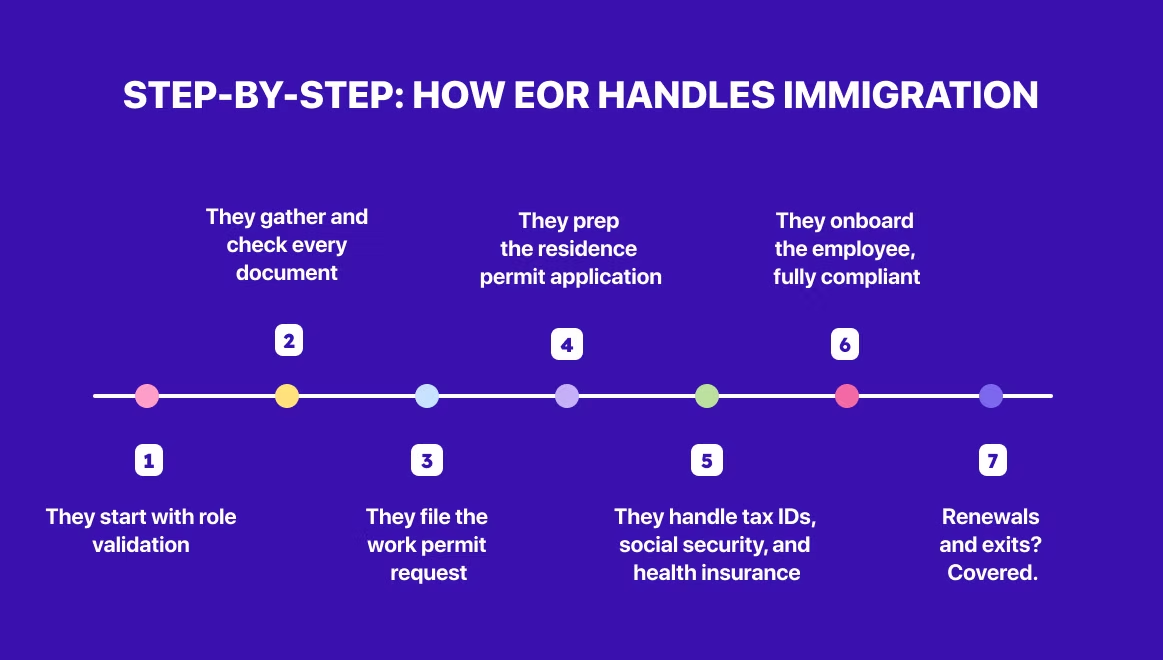
An EOR acts as the legal employer of the staff in Azerbaijan, assuming all liabilities for payroll, taxes, and Labor Code compliance, while the client company retains operational control over the employees' daily activities.
- Speed: Hiring through an EOR provider can take 1-2 days, whereas establishing a Limited Liability Company (LLC) typically takes 3-7 weeks.
- Cost: LLC setup involves initial costs of $300-$500 for registration plus $1,000-$3,000 for legal and accounting support. EOR services typically start at $199 per employee per month.
- Compliance: The EOR handles the mandatory registration of contracts in the EMAS system and the bi-monthly payroll filings, reducing the risk of administrative fines which can range from $411 to $882 for minor wage violations and up to AZN 35,000 for illegal work.
Establishing a Legal Entity (LLC)
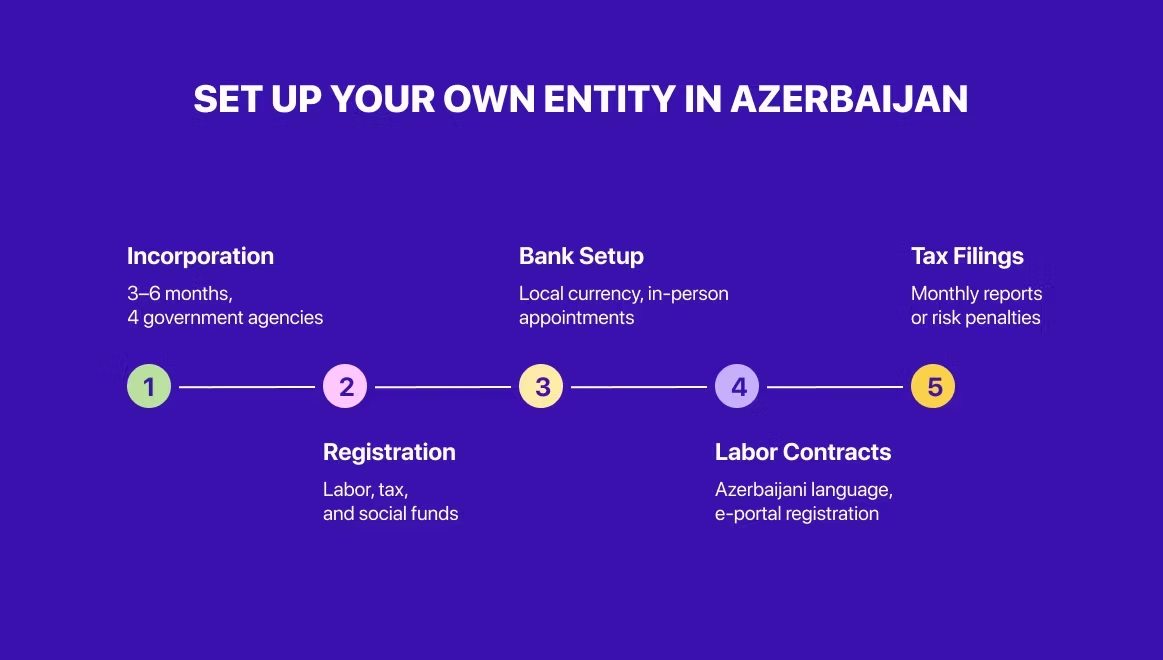
For long-term presence or larger teams (typically 50+ staff), establishing a Limited Liability Company (LLC) is the standard approach. Azerbaijan does not require a local partner or director; a foreigner can own 100% of the company and serve as its director. However, the director must obtain a work permit to engage in labor activity unless they are also the founder and qualify for specific exemptions.
| Operational Factor | EOR Model | LLC Establishment |
| Registration Time | 1-2 Days | 3-7 Weeks. |
| Upfront Investment | Minimal / Service Fee | $1,300 – $3,500. |
| Migration Sponsorship | EOR is the sponsor | LLC must sponsor. |
| Local Presence | Not required | Registered office required. |
| Bank Account | Not required (EOR's account used) | Mandatory (can take weeks). |
The Digital Ecosystem: ASAN Imza and SİMA
Relocation to Azerbaijan is deeply integrated with its digital identity infrastructure. The "ASAN service" centers provide a one-stop shop for almost all government services, from visa extensions to vehicle registration.
ASAN Imza (Mobile ID)
The "ASAN Imza" is a mobile electronic signature tied to a special SIM card provided by local mobile operators (Azercell, Bakcell, or Nar). It is the primary tool for authentication in the national digital systems, including the tax and labor portals.
- Cost: Connection fee of 80 AZN and a monthly fee of 2.5 AZN.
- Validity: Certificates are valid for three years.
- m-Residency: Non-resident entrepreneurs can apply for an ASAN Imza through Azerbaijani diplomatic missions abroad to set up and run a location-independent business in Azerbaijan.
SİMA Imza (Biometric Signature)
In 2022, Azerbaijan launched "SİMA Imza," a biometric digital signature app that uses facial recognition and public key infrastructure. Since 2023, the app has supported foreigners with TRPs or PRPs. Unlike ASAN Imza, which requires a physical SIM card, SİMA is a mobile app that allows residents to sign documents with banks, insurance companies, and government agencies entirely remotely.
Practical Integration: Banking, Housing, and Cost of Living
Successfully relocating to Baku, the center of Azerbaijan's economic and cultural life, requires an understanding of the local housing market and banking procedures.
Banking for Expats
Opening a bank account in Azerbaijan is a mandatory step for any foreigner receiving a salary or operating a business. PASHA Bank and ABB (International Bank of Azerbaijan) are the preferred choices for expats due to their English-speaking services and advanced digital apps.
Documentation for Individual Accounts:
- Valid Passport (with notarized Azerbaijani translation).
- Temporary Residence Permit (TRP) card.
- Proof of Address (sometimes required).
- Tax Identification Number (TIN/VÖEN) if receiving a salary.
While some digital-first options like Leobank exist, traditional banks are better suited for large transfers and corporate needs. It is important to note that Azerbaijani law prohibits paying salaries in foreign currencies like USD or EUR; all local employees must be paid in Azerbaijani Manat (AZN).
The Housing Market: Neighborhood Dynamics
Housing is likely the largest expense for an expat in Baku. The city is broadly divided into the "Old City" (Icheri Sheher) and the modern districts.
| Neighborhood | Profile | Rental Range (1-BR) | Characteristics |
| Sabail / Fountains Sq. | Historical center | $1,500 – $2,500 | Prestigious, walkable, noisy. |
| Nasimi (Modern Center) | Commercial hub | $1,000 – $1,800 | Central, heavy traffic, humidity. |
| White City (Ağ Şəhər) | New development | $750 – $1,200 | Clean, quiet architecture, rising star. |
| Yasamal / Elmler | Residential / Student | $500 – $900 | Affordability, quieter streets. |
Baku is known as the "City of Winds," and expats should prioritize "primary housing" (modern buildings) to ensure consistent water, gas, and electricity, which can be inconsistent in older Soviet-era "secondary housing".
Cost of Living Projections for 2026
The cost of living in Azerbaijan is relatively affordable compared to major European cities, but "Baku prices" are significantly higher than the rest of the country.
- Groceries: Sticking to local produce is inexpensive. A kg of chicken is ~4.50 AZN, and a liter of milk is ~1.25 AZN.
- Transport: Fuel is subsidized at ~1.17 AZN per liter. Public transport is exceptionally cheap (~0.50 AZN for a metro or bus ride).
- Education: International schools (British School, TISA) are the highest expense, ranging from $10,000 to $20,000 per year.
- Healthcare: Public healthcare is often seen as inefficient; most expats opt for private international medical insurance covering private clinics, costing ~$30-$60 per month.
Compliance, Safety, and Strategic Risks

Relocation professionals must account for the specific compliance environment in Azerbaijan. While the city is described as "super safe" for foreigners and solo women, and the crime rate is low, petty crime such as pickpocketing does occur in crowded tourist areas.
The "Work Permit Trap"
A critical warning for relocating employees: working on a tourist or business visa is strictly prohibited and heavily penalized. The State Migration Service conducts regular "raids" on offices. If caught, a foreigner faces immediate deportation and a permanent ban on re-entry, while the company faces a fine of up to AZN 35,000 (~$20,000 USD) per illegal employee.
Bureaucracy and Corruption
While the ASAN ecosystem has significantly reduced "petty corruption" in daily government interactions, "political corruption" and patronage remain a challenge, particularly in the oil industry. The judicial system carries a "very high risk" for corruption, and investment disputes involving well-connected local interests can be difficult to resolve through standard legal channels.
Conclusion: Strategic Summary for 2026 Relocation
Relocating to Azerbaijan in 2026 requires a high degree of digital literacy and an understanding of the phased fiscal reforms. The transition from tax-free salaries to a progressive PIT regime necessitates careful payroll budgeting, while the 2026 Labor Code changes demand more sophisticated HR management, particularly regarding termination and remote work.
The most successful relocation strategies will leverage the Highly Skilled Migrant Programme (HSMP) for technical talent and the Employer of Record (EOR) model for fast, compliant market entry. By utilizing the ASAN digital infrastructure, including ASAN Imza and the EMAS system, both individuals and companies can navigate the "Gatekept Garden" of Azerbaijan's economy with precision and long-term stability. The future of relocation in the Caucasus lies in this integration of strict statutory compliance with the efficiency of centralized digital services.
Frequently Asked Questions
1. What is the difference between a "Labor Visa" and a "Work Permit"?
They are distinct but connected. A Labor Visa is an entry document issued by the Ministry of Foreign Affairs (MFA) allowing a foreigner to enter Azerbaijan for work purposes. A Work Permit is the specific authorization issued by the State Migration Service (SMS) that allows them to legally hold a position in your company. You must secure the visa invitation first to get the employee into the country legally.
2. Is the "Labor Market Test" still required in 2026?
Yes. Before sponsoring a foreigner, employers must generally prove that there are no qualified Azerbaijani citizens to fill the role. This involves registering the vacancy with the State Employment Agency and waiting for a specified period (usually 15–30 days) to see if local candidates apply.
3. What are the penalties for hiring a foreigner on a Tourist or Business Visa?
The fines are significantly higher in 2026. If the State Migration Service discovers a foreigner working on a non-work status during an office inspection, the employer faces fines ranging from 30,000 to 35,000 AZN (~$17,600 – $20,500 USD). The employee is typically deported and banned from re-entry.
4. Do I need to register employment contracts electronically?
Absolutely. All employment relationships must be registered in the Unified Electronic Information System (MAS). An employment contract in Azerbaijan is not legally valid until the employer receives an electronic notification from the system confirming the registration.
5. Can I pay my foreign employees in USD or EUR?
No. Under Article 174 of the Labor Code, all salaries within the territory of Azerbaijan must be paid in the national currency, the Manat (AZN).
Practical Tip: Most employers peg the salary to a foreign currency in the contract (e.g., "the equivalent of $5,000 USD"), but the actual bank transfer must be in AZN based on the Central Bank rate of the day.
6. What is the total "Tax Load" for an employer in 2026?
Employers in Azerbaijan face a significant social security burden. Generally, you should budget for an additional 24% – 28% on top of the gross salary to cover:
- Social Protection Fund: ~22% (rates vary by sector and salary amount).
- Mandatory Health Insurance (ICHI): 2%.
- Unemployment Insurance: 0.5%.
7. Are there exemptions for the "General Manager" of a foreign branch?
Yes. Heads of branches or representative offices of foreign legal entities and their deputies are typically exempt from obtaining a work permit. However, they still require a Temporary Residence Permit (TRP) to live in the country legally.
8. What are the "Medical Check" requirements for foreign staff?
All foreign employees must undergo a mandatory medical examination at a certified clinic in Baku. This includes blood tests for HIV, Hepatitis B, and Hepatitis C. The resulting medical certificate is a required document for the Work Permit application.
9. How long is a Work Permit valid, and can it be extended?
Work permits are usually issued for one year. They can be extended annually, but the employer must apply at least 30 days before the current permit expires. In 2026, extensions are increasingly tied to proof that the company is meeting its local hiring quotas.
10. Can I use an Employer of Record (EOR) in Azerbaijan?
Yes, EOR services are highly popular in 2026 for companies that want to hire in Baku without setting up a local legal entity. The EOR becomes the legal employer, handles the MAS registration, pays the AZN salary, and manages all migration paperwork on your behalf.
.svg)