


PEO services for small businesses in Uzbekistan: What you should know
Introduction
Running a small business in Uzbekistan already feels like a full-time workout. You’re hiring. You’re onboarding. You’re figuring out payroll taxes, unified social payments, digital contract registration, sick leave rules — and that’s all before lunch. So it’s no surprise that PEO services for small businesses in Uzbekistan have become the thing founders start Googling when HR chaos finally outweighs optimism. A PEO promises structure. Predictability. Someone to make sure you don’t accidentally violate a labor regulation you didn’t even know existed.
But here’s the truth that matters: PEOs are not magic. They’re powerful tools when used correctly and compliance disasters when misunderstood. And Uzbekistan, with its increasingly digital and tightly monitored labor systems, is not the place where you want to learn those lessons the hard way.
Let’s break down what a PEO actually does here, how payroll works in Uzbekistan, when a PEO helps, when it absolutely doesn’t, and how to make sure your business stays compliant without drowning in administrative work.
What Is a PEO in Uzbekistan? (Real Definition, Not Marketing Speak)
A PEO, Professional Employer Organization, is a partner that handles your HR operations. Not your employer. Not your legal shield. Not a loophole to hire without a company.
A PEO is simply your outsourced HR team operating on top of your own legal entity.
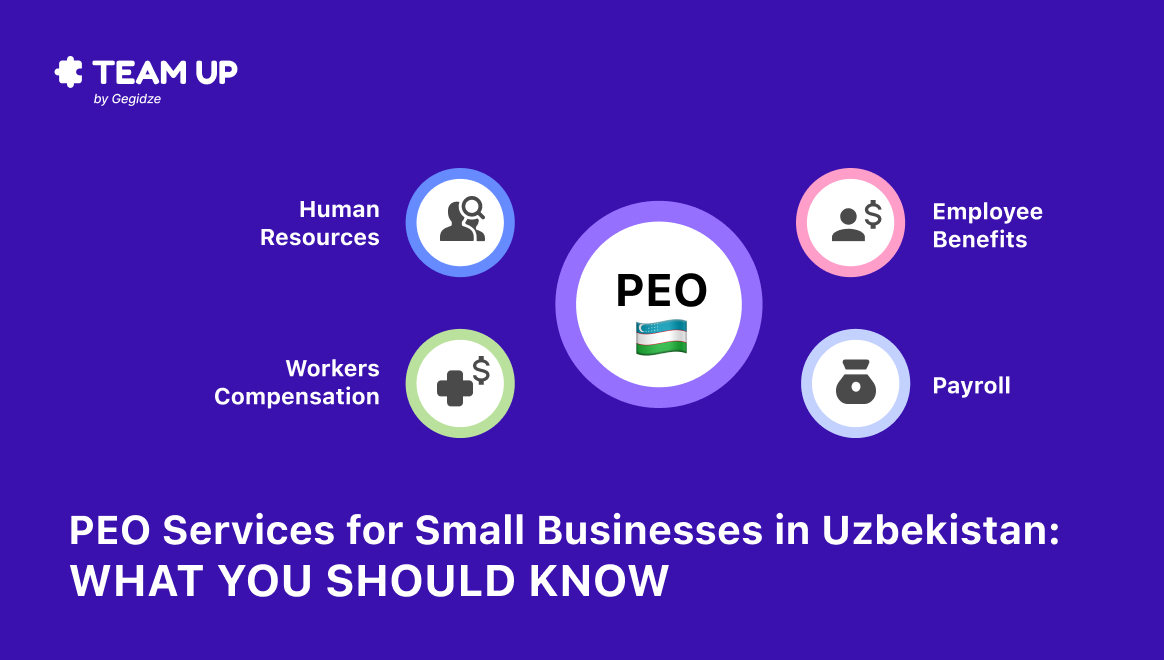
A Uzbekistan-ready PEO typically handles:
- Payroll calculations
- Unified Social Payment (USP) contributions
- Personal income tax withholding (12% flat rate)
- Digital reporting to the Tax Committee
- Employment contract drafting
- Contract registration through state systems
- Leave and sick pay management
- Benefits administration
- HR document retention
- Compliance guidance
Why this matters
Uzbekistan isn’t a market where you can casually “figure out HR later.”
Employment contracts must be registered digitally.
Payroll must be reported monthly.
USP contributions must be calculated exactly.
Audits aren’t hypothetical. They’re automated triggers.
If you're a founder, missing one filing can turn into days of cleanup. A PEO keeps that from happening.
What a PEO does not do
A PEO does not become the employer.
A PEO does not take legal responsibility.
A PEO does not allow you to hire without an Uzbek entity.
If you don’t have a local company registered in Uzbekistan, you need an Employer of Record (EOR), not a PEO.
(EOR explained later.)

How PEO Payroll Works in Uzbekistan (And Why It’s More Complex Than It Looks)
Payroll in Uzbekistan looks simple until you try doing it yourself. The rules are strict, the reporting is digital, and the penalties are real.
A solid PEO handles payroll end-to-end across these components:
Payroll Tax Withholding in Uzbekistan
Uzbekistan uses a flat 12% personal income tax.
The PEO ensures:
- correct withholding
- accurate salary calculations
- digital reporting via my.soliq.uz
- timely remittances
One miscalculation and the system flags you.
There are no “grace periods.”
Unified Social Payment (USP)
Here’s where many foreign businesses get confused.
For most private-sector employers:
- 12% employer contribution (USP)
- 0% employee contribution, unless working under specific tax regimes
The USP covers:
- pension
- social protection
- medical insurance component
- other state social functions
Companies inside IT Park or special economic programs have reduced rates — a PEO should explain these exemptions clearly.
Unemployment Insurance & Pension Elements
A PEO ensures compliance with:
- mandatory unemployment insurance
- pension fund elements embedded inside USP
- proper retirement contributions for each employee
Contract Registration Requirements
In Uzbekistan, employment contracts must be:
- written
- compliant with the Labor Code
- digitally registered with the Ministry of Employment’s system
If one contract is not registered correctly, you are effectively operating outside the law.
A PEO manages:
- drafting
- revisions
- digital registration
- termination documentation
Leave, Sick Pay, and Holidays
A PEO maintains correct tracking for:
- minimum 15 days paid annual leave
- additional leave for certain sectors
- sick leave using official medical certificates
- maternity leave entitlements
- Uzbekistan’s extensive list of public holidays
This alone saves founders hours — and protects you from disputes.
Digital Payroll Reporting (No Room for Guessing)
Uzbekistan requires digital filings through:
- my.soliq.uz (tax reporting)
- unified payroll reporting systems
- employee data portals
A PEO ensures nothing is missed, and everything is timestamped and compliant.
The One Universal Rule: A PEO Requires a Local Uzbek Entity
This is the part most founders misunderstand.
A PEO, in Uzbekistan or anywhere else, only works if:
- You already have a registered legal entity in Uzbekistan
- You are recognized as the legal employer
- You handle corporate tax obligations
- You accept employer liability
A PEO is not an employer.
It is an HR function, not an employment structure.
If you do not have an entity in Uzbekistan, you cannot legally hire employees using a PEO.
Full stop.
What you need instead
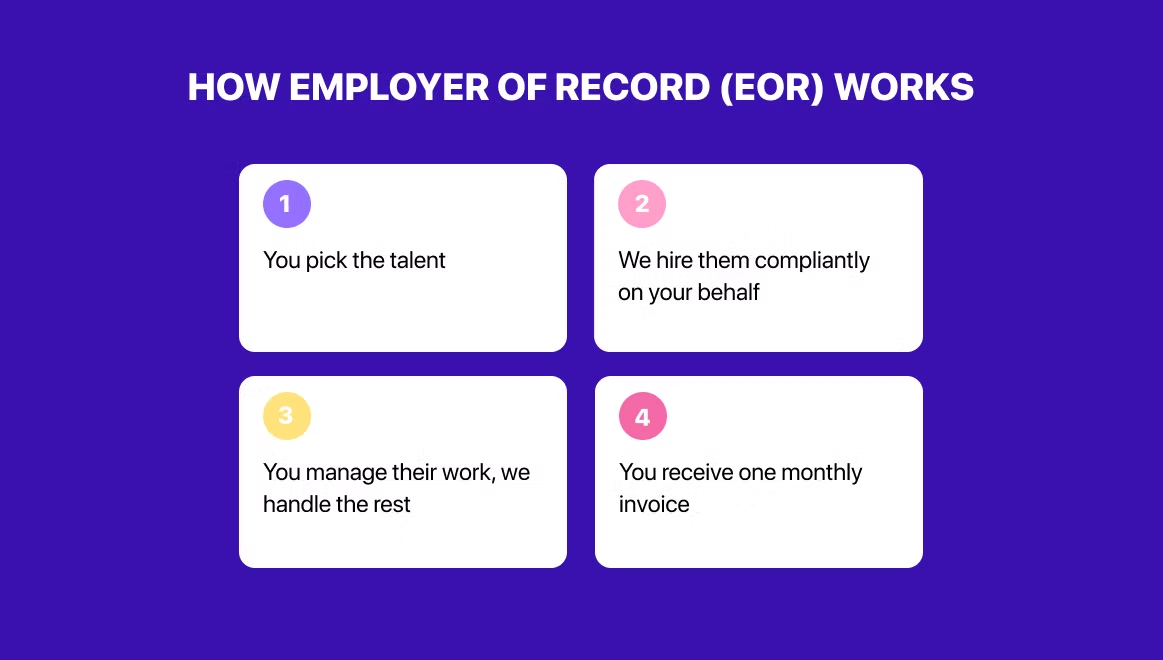
If you want to hire in Uzbekistan without opening a local company, the correct model is EOR (Employer of Record).
An EOR:
- becomes the legal employer
- issues Uzbek-compliant contracts
- handles payroll + taxes + USP
- manages digital reporting
- protects your IP
- shields you from employment liability
- lets you hire in days, not months
PEO vs EOR in Uzbekistan: Which Model Fits Small Businesses?
Let’s make this easy.
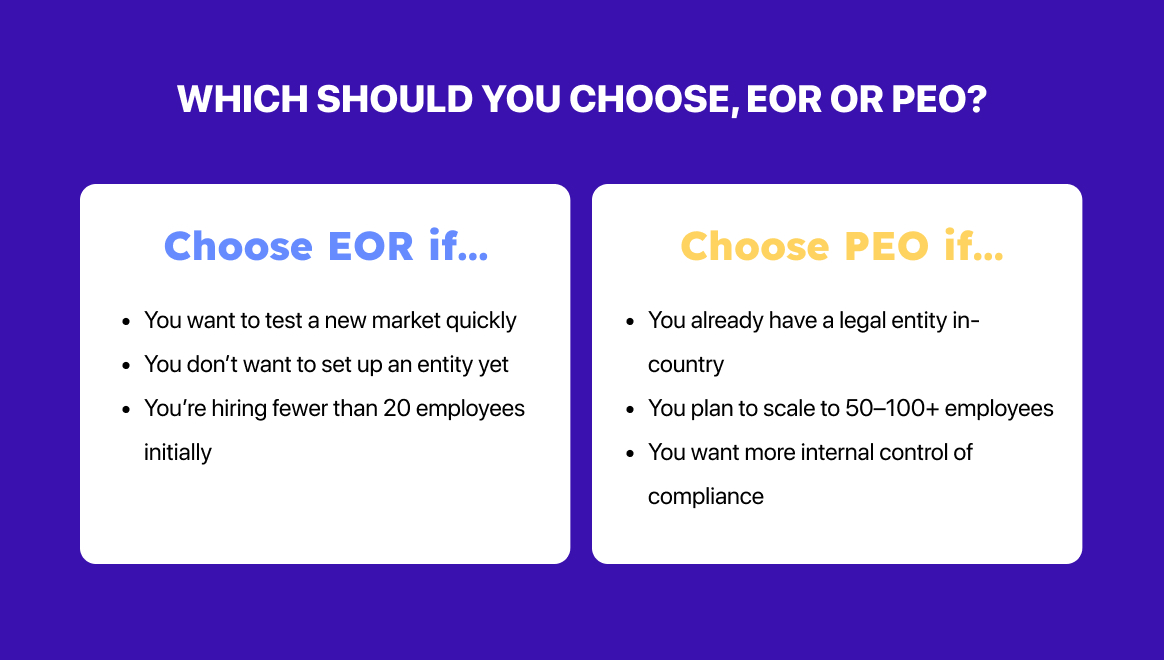
Use a PEO if:
- You already have a legal Uzbek entity
- You need structured HR, compliance, and payroll support
- You want to avoid hiring internal HR staff
- You want to offer better benefits
- You’re scaling a local presence
Use an EOR if:
- You don’t have an Uzbek legal entity
- You want to hire quickly
- You want zero compliance exposure
- You want predictable monthly costs
- You want locally enforceable contracts
- You’re testing Uzbekistan before committing
PEO helps run your local entity smoothly.
EOR helps you hire in Uzbekistan without creating one.
PEO Pricing in Uzbekistan (PEPM vs % of Payroll Explained)
Uzbekistan’s PEO pricing follows global models.
PEPM (Per Employee Per Month)
- Flat fee per employee
- Predictable
- Clean budgeting
- Best for teams with stable headcounts
Percentage of Payroll
- Commonly, 4–12% of gross salary
- Better for a flexible workforce
- Can get expensive for senior talent inthe IT Park or finance
Costs are influenced by:
- number of employees
- benefits required
- HR complexity
- payroll fluctuations
- local vs expat employees
- industry (tech, outsourcing, manufacturing)
PEOs can save money, or drain it, depending on how well you understand the fee structure.
Hidden PEO Costs in Uzbekistan That Small Businesses Rarely See Coming
PEO pricing always looks clean in the first slide. It is the contract where things get messy. If you are a small business in Uzbekistan, here is where money quietly disappears.
1. Onboarding and Setup Fees
A lot of PEOs charge extra to even get started.
You might see:
- per employee onboarding fees
- One-time implementation fees for connecting payroll and HR systems
- charges for migrating existing employee records into their platform
None of this is illegal. It is just rarely obvious.
Questions to ask:
- “Is there a setup fee per employee?”
- “Do you charge a separate implementation fee?”
- “What does onboarding include, and what is extra?”
If you do not get clear numbers, assume there are hidden costs.
2. Extra Charges for Off-Cycle Payroll
Real life does not always match payroll cut-off dates.
You might:
- forget a bonus
- Need to fix a salary error
- hire mid month
Some PEOs treat any off-cycle run as a billable event.
Ask them bluntly:
- “Do you charge for off-cycle payroll runs?”
- “If we make an error and need to correct it next month, is that included?”
You want a simple answer. Yes or no.
3. Markups on Benefits
Corporate health insurance and extra perks are slowly becoming more common in Uzbekistan, especially for tech and service roles. When PEOs source benefits, they may:
- Add a margin on top of the real premium
- bundle costs into “admin” lines
- avoid showing you the raw insurer price
You can avoid surprises by asking:
- “Can you show the base premium from the insurer?”
- “Is your fee separate from the premium?”
- “Are you adding a percentage on top?”
If they cannot separate these numbers. That is your warning.
4. Minimum Monthly Fees and Headcount Floors
Some PEO contracts are written with larger companies in mind. For small teams, this hurts.
Look for:
- minimum monthly invoice amounts
- minimum employee count
- base fees that apply even when staff numbers drop
If you are hiring in Uzbekistan with only 3 to 8 employees, those minimums matter a lot.
Ask:
- “Is there a minimum monthly fee regardless of headcount?”
- “What happens if we reduce to 3 employees?”
5. Charges for Documents and Reporting
You will need:
- employment certificates
- experience letters
- custom reports for investors or auditors
- breakdowns for due diligence
Some PEOs include all of this. Others quietly bill per document or per hour.
Ask:
- “Are employment confirmations included?”
- “Do you charge for custom reporting?”
6. Termination and Contract Amendment Fees
Uzbekistan has clear rules around termination, severance, and documentation. Some PEOs charge extra for:
- processing exits
- drafting termination documents
- updating and re registering contracts
Ask:
- “Are contract changes included in the monthly fee?”
- “Is there an extra fee when an employee leaves?”
If you do not ask now, you will learn later on the invoice.
When PEO Services Are a Smart Move for Small Businesses in Uzbekistan
Let us be fair. PEOs are not the enemy. When the conditions are right, they are extremely useful.
Here is when a PEO genuinely makes sense.
1. You Already Have a Legal Entity in Uzbekistan
This is the non-negotiable starting point.
If you have:
- a registered Uzbek company
- tax accounts set up
- Basic HR in place
Then a PEO can plug into your existing structure and clean things up.
2. Your Team Has Outgrown DIY HR
If you are at the stage where:
- Payroll happens every month with stress
- Someone always asks, “Are we sure these taxes are right?”
- leave balances live in random spreadsheets
- Contracts are copied and edited manually
You are in PEO territory.
Once you have roughly 8 to 15 employees, HR stops being part-time work. A PEO can replace the “we will figure it out later” approach with something that would actually survive an inspection.
3. You Do Not Want to Hire an Internal HR Team Yet
Hiring a full-time HR specialist in Uzbekistan comes with:
- salary
- taxes
- social contributions
- workspace
- tools and training
A PEO gives you:
- HR expertise on tap
- stable processes
- No extra headcount on your books
This is attractive if you are still in aggressive growth mode and want flexibility.
4. You Need Better Benefits to Compete for Talent
In Tashkent and tech-focused pockets of Uzbekistan, candidates are increasingly comparing:
- health coverage
- stability of payroll
- structure of employment contracts
- professionalism of HR
A PEO can help you roll out:
- health plans were available
- structured leave policies
- clear benefits and policies
That makes you look more serious than the average small employer.
5. You Want to Fix Compliance Before It Becomes a Problem
The biggest risk for small employers is not malicious non-compliance. It is an unintentional mistake.
Like:
- Miscalculating USP
- Mixing up tax periods
- Missing a filing
- Using weak or outdated contracts
A PEO gives you a safety net. It does not remove all risk, but it dramatically reduces “we had no idea” moments.
When PEO Services Become a Liability in Uzbekistan
Used in the wrong context, a PEO can create more problems than it solves.
Here is when it starts working against you.
1. You Do Not Have a Local Uzbek Entity
This is the big one.
If you do not have a registered Uzbek company, you cannot legally:
- Use co-employment
- Engage a PEO as your HR layer
- Treat a PEO as your “employer.”
Any provider telling you they can “act as your PEO” while you have no entity is not really selling PEO. At best, they are confusing terms. At worst, they are setting you up for compliance issues.
If you want to hire in Uzbekistan without a local entity, you need an Employer of Record (EOR) in Uzbekistan, not a PEO.
That is the model Team Up runs.
2. Your Headcount Is Very Small
If you only need:
- 1 engineer in Tashkent
- 2 support reps
- a single country manager
PEO economics usually do not work in your favor. You are paying for infrastructure sized for a bigger team.
For very small headcounts, EOR almost always:
- Costs less overall
- Moves faster
- Carries less admin
- Keeps your risk close to zero
3. You Want to Hire Quickly
PEO presumes your:
- Entity exists
- Tax registration is ready
- Bank account is live
- The legal structure is clear
If you are still setting those up, a PEO cannot speed you up. You will be stuck waiting for bureaucracy.
An EOR lets you:
- Hire in days
- Start working with local talent
- Test the market while your entity catches up, if you even decide to create one at all
4. You Want Zero Local Legal Exposure
Under a PEO model, you remain the legal employer. That means:
- Your company signs the employment contract
- Your company is liable for compliance failures
- Your company answers if the state questions filings
If your priority is to ring-fence risk, PEO is the wrong tool. You are asking it to do something it is not designed to do.
With an EOR, the provider is the legal employer. That is a very different risk profile.
5. You Plan to Hire Across Multiple Countries
If your hiring roadmap is:
- Uzbekistan now
- Kazakhstan next
- maybe Georgia or Armenia after
Then running separate PEOs under multiple entities becomes a coordination headache.
An EOR partner that can cover multiple countries gives you:
- One consistent model
- Similar processes
- Cleaner reporting
- Fewer moving parts
That is exactly where Team Up sits in the region.

How to Choose a PEO in Uzbekistan Without Regretting It Later
If you look at your situation and decide a PEO actually fits, do not pick one just because its website looks modern. Evaluate them as a CFO would.
1. Test Their Understanding of Uzbek Law and Practice
Ask questions that they cannot fake their way through.
For example:
- “How do you handle USP for employees under different tax regimes?”
- “What is your process for registering employment contracts digitally?”
- “What happens if the tax authority flags a discrepancy in payroll?”
If they answer in vague generalities instead of specifics, that is your answer.
2. Demand Clear, Boring Pricing
You want:
- A straight PEPM or percentage of payroll rate
- A list of what that rate covers
- An explicit description of what is extra
- Clear statements about minimums and contract length
If you need a lawyer and a microscope to decode the fee schedule, walk away.
3. Check Their Tools, Not Just Their Sales Deck
Ask for a look at:
- Payroll screens
- Payslip templates in the local language
- Employee self-service features
- Leave and absence tracking
- Reporting dashboards
If their tools look like they were built a decade ago, your team will feel it every month.
4. Interview Their Support Team With Real Questions
You are not buying software. You are buying a relationship.
Send actual scenarios:
- a miscalculated payroll case
- a tricky termination
- a contract update
Watch how they respond:
- Do they answer fast?
- Do they answer correctly?
- Do they show they actually understand Uzbekistan, or are they just guessing from another market?
5. Clarify Responsibility for Errors
This is a big one.
Ask:
- “If a payroll filing is wrong, who fixes it?”
- “If a fine is issued because of an error on your side, who pays it?”
- “Do you carry any liability insurance for your work?”
You do not want to discover the answer after something breaks.
6. Look at Who They Already Serve
Good signs:
- They already work with SMEs in Uzbekistan
- They support companies in your industry
- They can give anonymized examples of real cases
Bad sign:
- You are their “first test client” in the country
You do not want to be the experiment.
Final Guidance: PEO vs EOR in Uzbekistan, and Where Team Up Fits
Here is the clean summary, without the spin.
A PEO in Uzbekistan is a strong move if:
- You already have a local entity
- You are tired of juggling payroll, HR, and compliance yourself
- Your headcount is big enough that HR is no longer a side job
- You want more professional benefits and processes
- You accept staying the legal employer and carrying the final risk
A PEO is the wrong move if:
- You do not have a company registered in Uzbekistan
- You want to hire a small number of people quickly
- You want to keep legal risk off your books
- You plan to scale across multiple countries
- You want one simple model for global hiring
In those cases, you do not need a PEO. You need an Employer of Record provider in Uzbekistan.
That is where Team Up comes in.
Team Up acts as the legal employer for your team in Uzbekistan and across the wider region. We:
- Hire employees locally on your behalf
- Issue fully compliant, Uzbek law-friendly contracts
- Run payroll correctly with tax and USP handled end-to-end
- file reports on time
- Protect your IP and confidential work through enforceable agreements
- Give you one monthly invoice you can actually understand
You get the talent. You run the work. You stay out of legal trouble.
If you are serious about hiring in Uzbekistan without building an entire local structure first, PEO is not your tool. EOR is. And that is exactly what we do.

FAQ
1. What are PEO services for small businesses in Uzbekistan?
PEO services for small businesses in Uzbekistan provide outsourced HR, payroll, and compliance support through a co-employment model. The PEO manages payroll processing, unified social payments, tax filings, onboarding, and HR documentation while your business stays the legal employer.
2. How does a PEO work in Uzbekistan?
A PEO handles operational employer tasks such as payroll, employment contracts, leave tracking, digital reporting, and compliance checks. You keep full control over day-to-day management while the PEO ensures your HR processes meet Uzbekistan’s labor and tax laws.
3. Do I need a local legal entity in Uzbekistan to use PEO services?
Yes. A PEO requires your company to have a registered Uzbek entity. If you want to hire in Uzbekistan without opening a local company, you need an Employer of Record (EOR), not a PEO.
4. What is the difference between a PEO and an Employer of Record in Uzbekistan?
A PEO supports HR operations but does not become the legal employer. An Employer of Record becomes the official employer in Uzbekistan, handles contracts, payroll, and compliance, and lets foreign companies hire locally without forming an entity.
5. How does PEO payroll work in Uzbekistan?
PEO payroll covers income tax withholding (12% flat rate), Unified Social Payment calculations, unemployment insurance, digital payroll reporting, contract registration, and compliant payslips. The PEO ensures filings are accurate and submitted through Uzbekistan’s tax portals.
6. Is a PEO or EOR better for hiring remote employees in Uzbekistan?
If you have a local Uzbek entity, a PEO can support your HR needs. If you do not, an EOR is the only legal and compliant solution for hiring remote employees in Uzbekistan.
7. Are PEO services cost-effective for small companies in Uzbekistan?
They can be, especially for teams with 8–15 employees who already have a local entity and need structured payroll and HR processes. Very small teams or businesses without an entity usually save more with an EOR.
8. What hidden costs should businesses expect with PEO providers in Uzbekistan?
Potential hidden costs include onboarding fees, off-cycle payroll charges, benefits markups, minimum monthly fees, contract amendment fees, year-end reporting fees, and long-term lock-in contracts.
9. Can a PEO legally employ workers for a foreign company in Uzbekistan?
No. A PEO cannot legally hire employees on behalf of a company without a local entity. Only an EOR can act as the legal employer for foreign companies hiring in Uzbekistan.
10. How do I choose the best PEO service provider in Uzbekistan?
Look for strong knowledge of Uzbek labor and tax law, transparent pricing, modern HR and payroll technology, fast and reliable support, and experience handling digital contract registration and Unified Social Payment reporting.
.svg)


