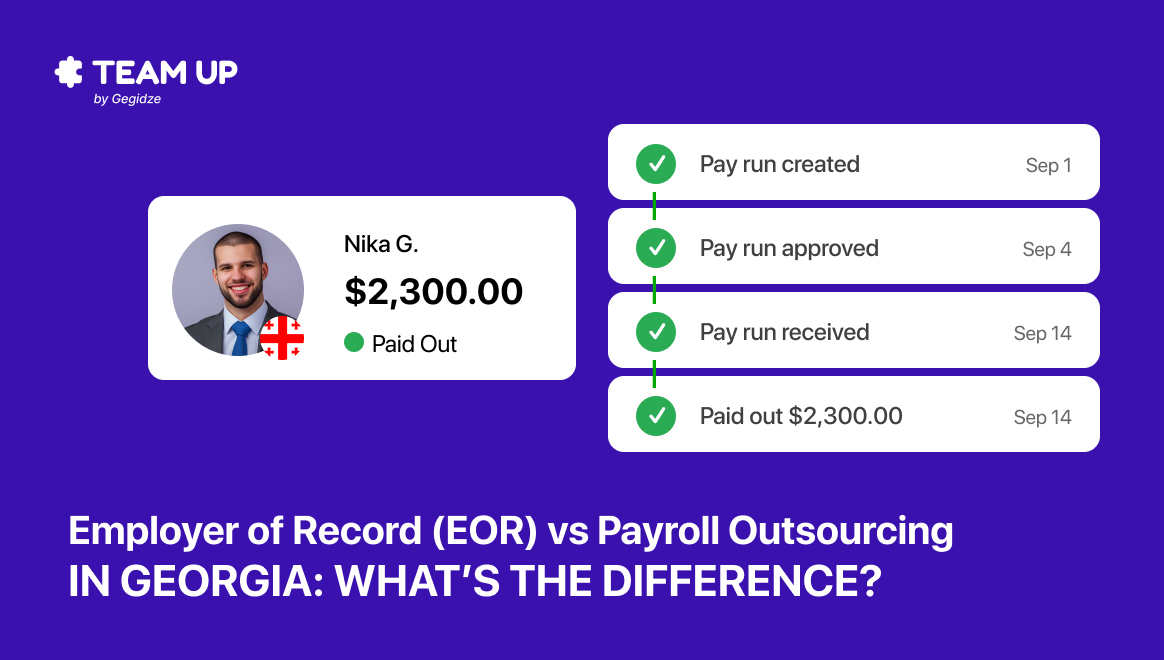
Employer of Record (EOR) vs payroll outsourcing in Georgia: What’s the difference?
Quick definitions you can act on
You need people in Georgia.
Do you need a legal employer or just someone to run payroll?
Pick wrong and you risk fines, stalled start dates, and unhappy hires.
What an EOR is in Georgia:
An Employer of Record in Georgia becomes the legal employer. You run the team. The EOR carries the legal load. What it covers:
- Compliant employment contracts and onboarding
- Monthly payroll, tax withholding, and pension filings
- Statutory benefits and policy compliance
- Leave, holidays, and record-keeping
- Terminations and offboarding
- Optional equipment, workspace, and insurance support
- Immigration support when needed
No local entity required. One provider. Lower risk. Faster start.
What payroll outsourcing is:
You are the legal employer. The provider only processes payroll for your Georgian entity. What they handle:
- Gross-to-net calculations
- Withholdings and monthly submissions
- Payslips and payroll reports
- Year-end payroll filings
Still deciding?
That’s why the article exists. See where money and mistakes hide.
Read the full EOR vs Payroll Outsourcing in Georgia comparison.
How does the legal responsibility differ between EOR and payroll outsourcing in Georgia?
Let’s cut to it. If your name is on the employment contract in Georgia, you carry the risk. If it isn’t, the EOR does. That’s the split that decides audits, fines, and who loses sleep.
With an EOR, they’re the legal employer, and you run the work
- The EOR is the legal employer in Georgia. They handle all the compliance checklist: sign contracts, hold personnel files, and shoulder the employment-side liability while you manage day-to-day tasks.
- Georgia’s Labor Code governs the employment relationship. The party listed as the employer is bound by those obligations, from contract terms to record-keeping.
What that means in practice:
- The EOR issues and maintains compliant employment agreements.
- The EOR processes payroll, withholds taxes, and handles statutory items like pensions for eligible hires. You focus on targets and deliverables.
With payroll outsourcing, you stay the employer, full stop
- Payroll outsourcing is a processing service. The provider runs calculations and filings, but you remain the legal employer with all related duties.
- To put people on payroll in Georgia as their employer, you need a lawful presence and the ability to meet employer obligations under Georgian law. The payroll vendor does not replace that status.
What still sits on your desk:
- Employment contracts, internal policies, and terminations.
- Liability for late filings or misapplied rules, even if a processor made the mistake. Outsourcing does not transfer responsibility.
Quick clarity: PEO vs EOR
- PEO uses co-employment and requires your own entity. You and the PEO share admin, but you are still an employer of your people.
- EOR is the legal employer for those hires. No local entity needed for you.
How do costs compare when choosing EOR versus payroll outsourcing for Georgia companies?
Money decides momentum. So let’s run the math you’ll actually use.
EOR at a glance
- Flat fee: €199 per employee per month.
- What’s inside: compliant contract, monthly payroll, tax and pension filings, payslips, record-keeping, basic HR admin, and support on terminations.
- Annualized: €2,388 per employee per year.
- No entity. No local accounting stack. Low lift.
When it shines
- One or two hires.
- You want to start this month, not next quarter.
- You prefer one line item and near-zero admin.
Entity + payroll outsourcing
- One-time setup for your entity and registrations: ~€700–€1,400.
- Ongoing payroll administration: ~€425 per month for your company, excluding salaries.
- You still handle employer obligations and any penalties if filings are late or wrong.
- Lead time to get fully live is longer than EOR.
Year 1
- €5,100 in admin fees plus €700–€1,400 setup.
- Total €5,800–€6,500 before you pay a single salary.
Year 2+
- €5,100 per year in admin, assuming the same service scope.
Straight-shooting comparisons
- 1 employee
- EOR: €2,388/yr
- Entity + payroll (Year 1): €5,800–€6,500
- Winner on pure cost and speed: EOR
- 2 employees
- EOR: €4,776/yr
- Entity + payroll (Year 1): €5,800–€6,500
- Still EOR
- 3 employees
- EOR: €7,164/yr
- Entity + payroll (Year 1): €5,800–€6,500
- Fees alone tilt to entity + payroll. You do carry the legal load.
Rule of thumb: break-even lands around three hires on fees alone. Below that, the cost to use an EOR in Georgia is cheaper and faster. Above that, entity + payroll can beat EOR on recurring fees, but only if you’re comfortable owning contracts, audits, and every compliance update.
What actually flows through payroll each month
Use this to forecast total cost and net pay.
- 20% Personal Income Tax withheld from salary
- 2% employer pension contribution on top of salary
- 2% employee pension contribution deducted from salary
Quick example for a €2,000 gross salary:
- PIT withheld: €400
- Employer pension on top: €40
- Employee pension deducted: €40
- Employer cost: €2,040
- Employee net: €1,560
Now layer your choice on top:
- With EOR, that entire flow and the filings sit with us.
- With entity + payroll, the processor runs calculations, but the legal responsibility stays with you.
What are the key legal risks of using payroll outsourcing instead of EOR in Georgia?
If you’re the employer on paper, you’re the one the inspector calls. Payroll outsourcing won’t change that. It just runs the numbers.
The misclassification trap
“Let’s start with contractors and switch later.” Sounds lean. Risks heavy.
- Role looks like employment? Expect scrutiny.
- Outcome if flagged: back taxes, pension contributions, late-payment interest, and potential fines.
- Who pays? You, not the payroll vendor.
Contracts, terminations, and disputes
Payroll processors don’t write or defend your contracts.
- Wrong clauses, missing notices, or shaky grounds for termination can trigger claims.
- You handle investigations, hearings, and settlements.
- The vendor keeps processing payslips while you deal with legal fallout.
Filings, deadlines, and penalties
A processor can submit payroll data. It cannot carry the can.
- Late or inaccurate returns lead to penalties.
- “The vendor messed up” doesn’t move the needle with authorities.
- You remain liable for corrections and any interest.
Immigration and right-to-work exposure
Hiring a non-citizen through your entity? You own the paperwork.
- If a permit or residence basis slips, employment becomes non-compliant.
- Payroll outsourcing won’t fix status; it only pays people.
Records, audits, and policy changes
- Authorities may ask for contracts, policies, time-off records, and payslips.
- If a rule changes mid-year, you must update policies and employee docs, not the vendor.
- During an audit, you show up first.
What EOR takes off your plate
An EOR is the legal employer. That shifts the blast radius.
- Compliant contracts issued by the EOR.
- Payroll, tax, and pension filings are done by the EOR under their employer status.
- Terminations run with EOR guidance and paperwork.
- Immigration is handled under the EOR’s sponsorship where applicable.
- Audit interface: the EOR stands in front, with you providing operational facts.
When payroll outsourcing can still work
- You already have a Georgian entity.
- You have solid contracts, policies, and a capable HR/legal function.
- You’re fine owning terminations, audits, and any penalties if filings go sideways.
Bottom line: payroll outsourcing moves tasks. EOR moves liability. Pick the one that matches your risk appetite, not just your headcount.
How quickly can a business establish or switch between EOR and payroll services in Georgia?
Speed is leverage. You want start dates, not waiting lines.
If you choose EOR
- Typical timeline. Days, not weeks.
- What happens.
- Kickoff and KYC
- Role details and salary confirmed
- Compliant offer and contract issued
- Payroll profile created and benefits set
- Start date locked
What you prepare
- IDs and basic employee data
- Compensation and allowances
- Preferred start date and probation terms
Where delays creep in
- Late document collection
- Complex allowances that need approval
- Last-minute contract changes
If you choose entity plus payroll outsourcing
- Typical timeline. About 2 to 4 weeks.
- What happens.
- Registrar paperwork and tax registration
- Bank account and signatories
- Payroll provider onboarding and testing
- Policy docs finalized and communicated
- First payroll run scheduled
What you prepare
- Company documents and local signers
- HR policies and templates
- Bank details and payroll calendar
Where delays creep in
- Banking approvals
- Missing HR policies
- Data migration for existing staff
Switching scenarios
Payroll to EOR
You want to move fast or lower risk.
- Notify staff and set a transfer date
- Terminate from your entity with the correct notice
- Rehire via EOR on a compliant contract
- Transfer benefits, leave balances, and equipment rules
- Align payroll cutoffs so no one misses a paycheck
What stays the same
- Day-to-day work
- Reporting lines
- Salary and perks, unless you choose to update them
EOR to payroll after you set up an entity
You built the entity and want ownership back.
- Open the entity payroll and confirm the bank signers
- Novate or reissue contracts to your entity
- Port HR files, leave balances, and benefits
- Switch payroll runs on a clean cutover date
- Assume all employer obligations going forward
What scenarios make EOR the better choice over traditional payroll services in Georgia
You need people on the ground. Red tape says “later.” EOR says “now.”
You don’t have a Georgian entity, and you need to hire now
- EOR gets a compliant contract out fast.
- Payroll, taxes, pensions, and records handled from day one.
- No banking setup. No registrations. No waiting in lines.
- Perfect for the first hire, a pilot team, or a market test.
You’re hiring a foreigner who needs residence-permit-backed employment
- EOR acts as the legal employer.
- Permits and registrations are prepared, filed, and tracked.
- The right to work stays clean. Your start date stays firm.
- Payroll outsourcing won’t fix immigration. It only pays people.
You want one invoice and minimal admin
- Single provider. Clear monthly fee.
- Contracts, payroll, filings, and offboarding are covered.
- Add what you need without building a local back office.
- Benefits, insurance, and workspace via EOR.
Bottom line: if speed, compliance, and headspace matter more than running a local entity, EOR is your easy button.
When payroll outsourcing is enough
You want clean payroll runs. You are fine carrying the employer badge. This is your lane.
You already have a Georgian entity
- You only need calculations, filings, and payslips.
- Your accounting and bank setup are live.
- You understand local payroll cutoffs and calendars.
You are comfortable owning the legal side
- You issue contracts and keep them current.
- You handle terminations, investigations, and disputes.
- You manage audits and policy updates when laws change.
- If a filing is late or wrong, you accept the penalty risk.
Your team size and permanence justify the overhead
- You plan a steady headcount in Georgia.
- You want in-house control of HR policies and culture.
- The yearly admin fee beats EOR once you pass a few hires.
- You are building for the long run, not a pilot.
What to have in place before you choose payroll outsourcing
- Solid employment templates and handbooks.
- A clear approvals flow for salary changes, bonuses, and allowances.
- A point person for audits and regulator queries.
- A tidy archive of contracts, leave, and timesheets.
When to rethink
- You need to start in days, not weeks.
- You are hiring a foreign national who needs a residence permit.
- You do not want to manage contracts or terminations.
Comparison table
| Employer of Record (EOR) | Payroll outsourcing | |
| Who is the legal employer | EOR provider | Your Georgian entity |
| Need a Georgian entity | No | Yes |
| Contracts | Bilingual, locally compliant, issued by EOR | You draft/issue and maintain compliance |
| Payroll filings & taxes | EOR calculates, withholds, and files | You or your accountant files monthly |
| Statutory benefits | EOR ensures leave, holidays, and pension | You track and provide all benefits |
| Immigration help | EOR bases residency on the employment contract | You handle residence permits yourself |
| Speed to hire | Days | Weeks (after entity, banking, tax setup) |
| Primary risk | Low, EOR bears employment compliance | The higher you bear compliance mistakes |
Conclusion
Hire in Georgia without drama. That’s the point.
Pick EOR when you don’t have an entity, need speed, or you’re hiring a foreign national who needs a residence permit. Liability sits with the EOR. Your team starts on time.
Pick payroll outsourcing when you already have a Georgian entity and you’re happy owning contracts, terminations, audits, and policy updates. It’s cheaper once your team is a few heads and stable.
Send us your headcount and start dates. We’ll map each role to the right path, EOR or payroll, show total cost, and lock a go-live date.
.svg)