


PEO services for small businesses in Eastern Europe: What you should know
Introduction
If you are looking at the PEO services for small businesses in Eastern Europe, you are probably not bored. You are just tired of the payroll and compliance across five or six different legal systems at once.
Poland uses a progressive income tax with double-digit social security on top. Romania runs a flat tax with heavy pension and health contributions. Czechia has thresholds where tax and social security jump. Hungary piles a 13% employer social tax on salaries, with 18.5% from employees.
On slides, this region looks like “one expansion block”. In real life, it is a mix of tax codes, labour offices and government portals that break at the worst possible time.
That is why founders and HR leaders start asking about PEO. Not because they want more vendors. Because they want to sleep.
This guide gives you a straight answer on where PEO actually fits in Eastern Europe, where it breaks, and why a strong Employer of Record partner often ends up doing the real heavy lifting.
Why PEO for small businesses matters in Eastern Europe
Let us be honest. Nobody wakes up excited about co-employment models. You start looking at PEO because of three very practical problems.
1. One region on the map. Ten different payroll realities
Take a simple case.
- A developer in Warsaw
- A finance lead in Bucharest
- A product manager in Prague
- A sales rep in Budapest
All of them are “Eastern Europe hires. None of them are on the same tax and social rules.
- Poland: Progressive tax. 12% up to PLN 120,000. 32% above that. Plus social security and health insurance contributions that can push the combined employer share above 20% of gross salary, and the employee side above 20% as well.
- Romania: Flat 10% income tax. Then 25% pension (CAS) and a 10% health (CASS) for employees on top.
- Czechia. 15% tax up to 36 times the average salary. 23% beyond that. Plus social security contributions with a capped assessment base each year.
- Hungary: Employer social tax at 13% of gross. Employee social security is at 18.5%.
Copy-paste does not work here. Your internal HR generalist will miss something. Not because they are lazy. Because this is a full-time job.
2. Social contributions that punish guesswork
Eastern Europe is a heavy contributor.
- pension
- health
- unemployment
- accident insurance
- sometimes separate labour or guarantee funds
The names, rates and caps change per country and sometimes per year. Get this wrong for a few years, then try to explain it to a labour inspector or tax officer. That conversation is not cheap.
3. Documentation culture
This region likes paper. Even when it is digital.
You need:
- Written employment contracts in the correct language
- internal rules or policies in some countries
- clean records of working time and overtime
- tracked leave and sick days
- Payslips that match filings
- Termination documentation that does not collapse in court
That is the world PEOs claim to help with.

What PEO services actually cover in Eastern Europe
Before you even think about pricing, you need a clean mental model.
Short version.
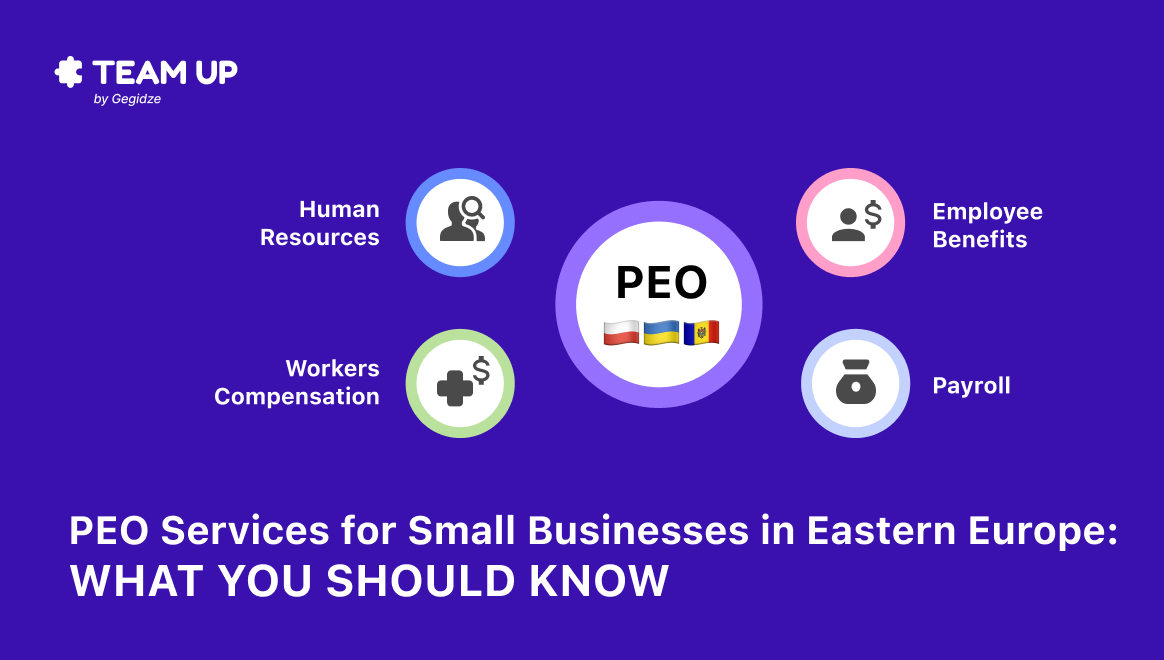
A PEO is a Professional Employer Organisation. It handles HR and payroll operations. It does not become the legal employer in Poland, Romania, Czechia or Hungary.
Your company still shows up on the contract. Your entity still sits in the crosshairs of the tax and labour authorities.
So, what does a PEO actually do in this region?
Payroll processing
A decent PEO will:
- Calculate gross to net based on each country’s tax rules
- Withhold income tax and social contributions.
- Generate payslips in the right language and format.
- Prepare monthly reports for finance.
- Keep up with minimum wage changes, tax threshold changes and social caps.
In Poland, that means tracking the split between pension, disability, sickness, accident insurance, labour fund and guarantee fund.
In Romania, that means applying the flat 10% tax but also keeping CAS and CASS contributions correct and respecting caps or thresholds.
In Czechia and Hungary, that means handling rate changes, caps and any new exemptions on benefits in kind.
You could keep all this in a spreadsheet. You could also balance a glass of water on the edge of your laptop and hope nobody bumps the desk.
HR administration
PEO services for small businesses in Eastern Europe usually include:
- Contract templates tailored to each country
- onboarding workflows and document collection
- tracking probation periods
- leave management
- Standard HR letters. Employment confirmations, salary letters, bank letters
- recording terminations and storing documentation
You still decide who to hire, promote or exit. The PEO turns those decisions into compliant paperwork.
Compliance support, not a legal shield
Good PEOs will:
- Tell you when you are offside on working hours or overtime
- Help you understand local public holiday rules
- Remind you about mandatory trainings or medical checks where they apply.
- Support you with data for inspections or audits.
They help you avoid mistakes. They do not stand between you and the regulator. That legal responsibility still belongs to your local entity.
How PEO payroll works in Eastern Europe
This is the part that vendors either oversimplify or bury in fine print.
Here, you set the big picture so a founder or CFO finally understands what they are buying.
Step 1. Local gross salary and structure
Everything starts with how you set compensation.
- Do you pay in local currency only?
- Do you offer bonuses or commissions?
- Do you provide meal vouchers or other country-specific benefits?
- Do you fund private medical cover in markets where that is common?
In Poland, for example, many companies use benefits like medical subscriptions and sports cards. In Romania, meal vouchers are common and have their own tax treatment. In Czechia, there are specific rules around non-cash benefits and annual limits.
A PEO helps structure this so that it is defensible under local rules and predictable for finance.
Step 2. Statutory payroll calculations
Each month, the PEO will:
- Compute gross to net for each employee
- apply correct tax brackets or flat rate
- apply the right contribution rates and caps
- generate employer cost per head
- prepare filings for tax and social authorities
Examples.
- Poland. Progressive tax, multiple contribution types, contributions shared between employer and employee. Total employer contributions are often in the high teens to low 20%. Total employee contributions are also around that band.
- Romania: 10% income tax. 25% pension, 10% health. The employee takes most of the contribution burden.
- Hungary: 13% employer social tax, 18.5% employee contribution. No ceiling on the base in many cases.
This is where PEO earns its fee if it knows the market. This is also where a weak PEO quietly pushes risk back on you.
Step 3. Payments and filings
Depending on your setup, the PEO may:
- calculate amounts and send you one consolidated payment file
- or initiate payments on your behalf under local permissions
Either way, the core responsibilities cover:
- paying employees correctly and on time
- remitting tax and social contributions to the right authority
- submitting payroll returns through local portals
Each country has its own deadlines and systems. Missed or wrong filings are a common way foreign employers get flagged.
Step 4. Reporting and audit trail
For small businesses, this is the part that often gets ignored.
A proper PEO in Eastern Europe should give you:
- monthly payroll summaries per country
- employer cost breakdowns
- year-to-date reports
- exportable data for your accounting system
- documents you can show during audits or due diligence
This matters when you:
- Raise a round, and investors run payroll checks
- sell the company, and buyers ask for clean records
- face a tax or labour inspection
If your current provider cannot produce this in a few clicks, they are not doing “professional” anything.
The legal truth. PEO needs your local entities
There is one fact you cannot negotiate away.
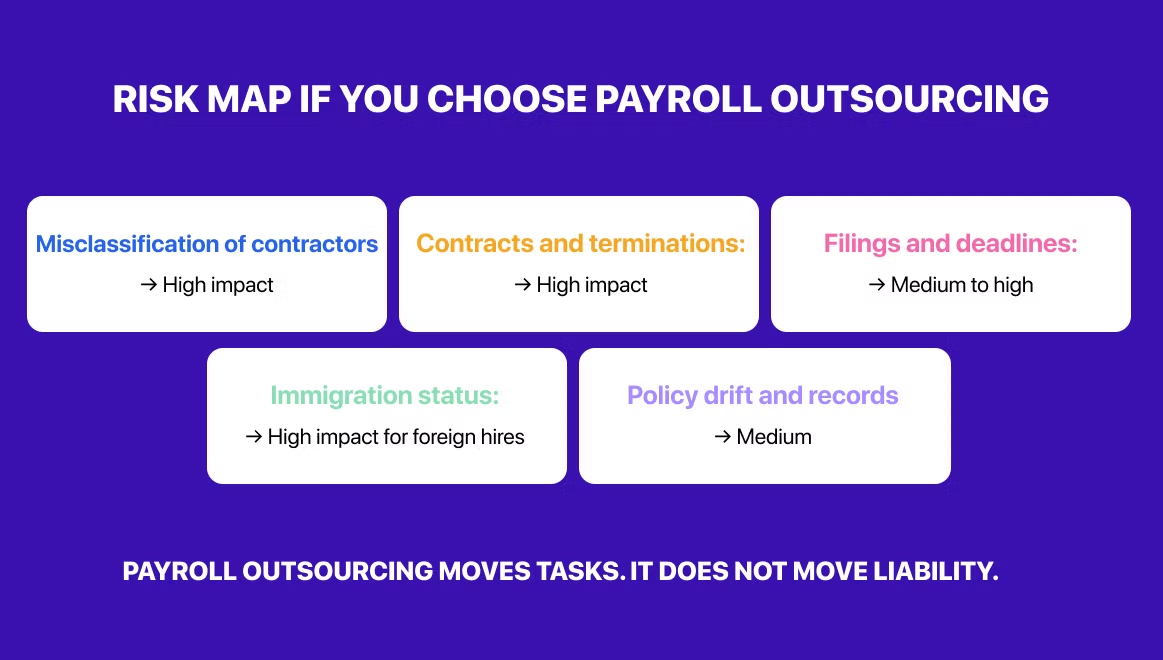
A PEO assumes you already have a legal entity in the country where employees sit.
- Polish employees must be on a Polish entity
- Romanian employees on a Romanian entity
- Czech employees on a Czech entity
- Hungarian employees on a Hungarian entity
PEO does not make that requirement disappear. It simply runs HR and payroll for the entity you already have.
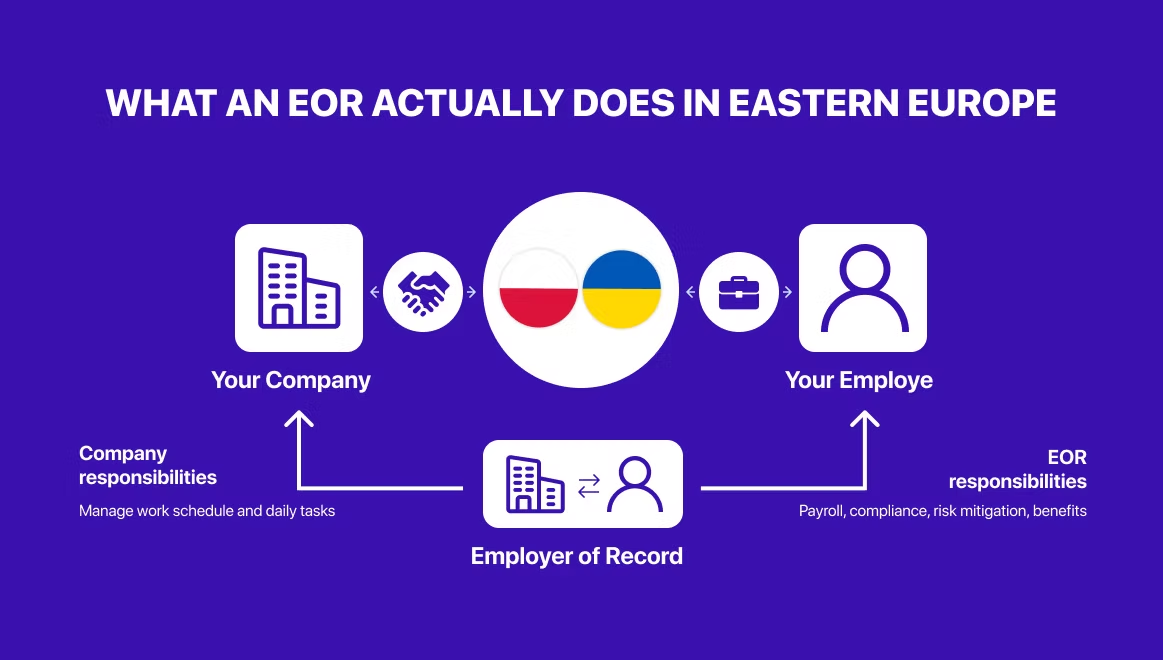
If you do not have a company registered in those countries, using PEO alone is not compliant. The only legal way to hire employees without a local entity is to use an Employer of Record.
That is exactly why EOR has become the default structure for foreign employers in Eastern Europe.
You will connect this point later to your legal and compliance checklist piece for EOR in Eastern Europe.
PEO vs EOR in Eastern Europe. Which model fits your plan
Simple rule.
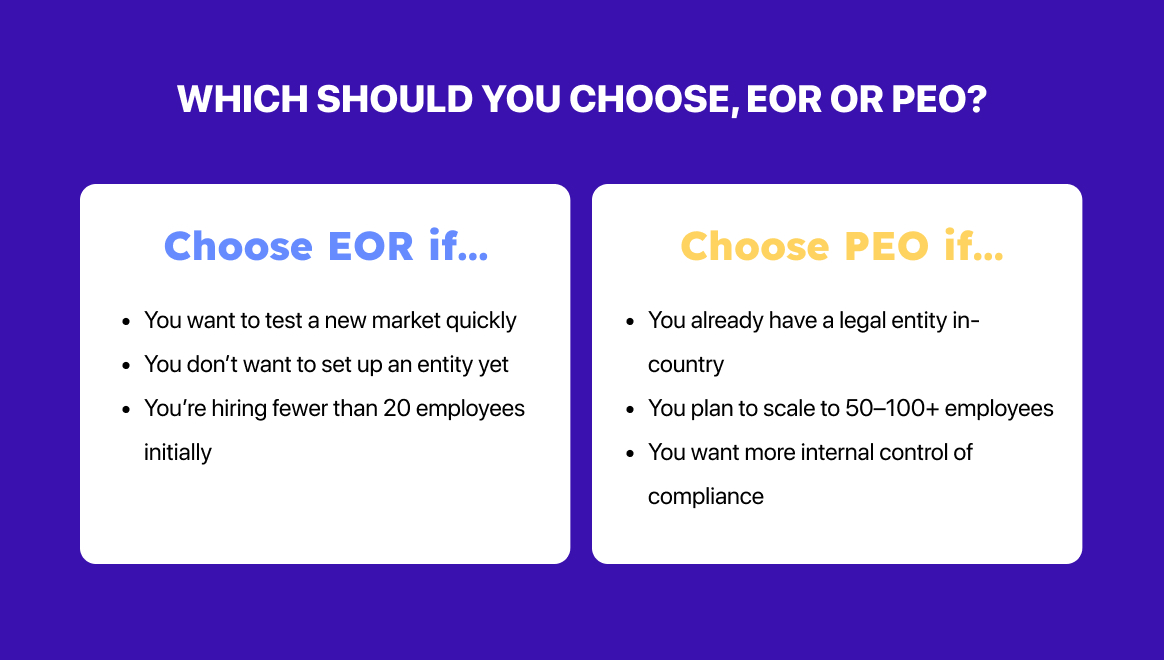
- PEO is for companies that already have entities in specific Eastern European countries and plan to stay.
- EOR is for companies that want to hire in Eastern Europe without setting up entities and want someone else to be the legal employer.
Under PEO:
- Your entity is on the contract
- You own the employer risk
- PEO runs the admin and calculations
Under EOR:
- The EOR entity is on the contract
- The EOR is the legal employer
- You control work and direction; the EOR carries employment compliance

Team Up sits on the EOR side of this line. The company built its reputation by handling hard labour and payroll reality in the Caucasus and now applies the same level of discipline across Eastern Europe.
You use EOR in Eastern Europe when you care more about clean compliance and speed than about owning a local entity from day one.
Hidden PEO costs in Eastern Europe
PEO pricing pages look clean. PEPM rate. Short bullet list of included services.
The real bill in Eastern Europe usually tells a different story.
If you are comparing PEO services for small businesses in Eastern Europe, this is where your finance brain needs to wake up.
1. Setup and implementation fees
Most PEOs charge you just to start working with them. That can mean
- A one-time implementation fee per country
- A “configuration” fee for each entity
- Extra billing to “clean up” your existing payroll data
On a three-country setup, you can easily burn four or five figures before a single payslip is processed.
Questions to ask
- “Is there any implementation fee per country?”
- “Do you charge separately for data migration from our current payroll?”
If they avoid numbers, assume it is expensive.
2. Minimum monthly fees and headcount floors
This is where small teams in Eastern Europe get trapped.
PEO marketing shouts “from 40 per employee per month”. Then the contract whispers
- Minimum monthly fee per entity
- Minimum headcount per country
- Separate minimum for each payroll currency
So you think you are paying 40 per head for four employees. In reality, you pay a 1,000 minimum just to keep the line open.
Questions to ask
- “What is the minimum invoice per country per month?”
- “If we only have two staff in Romania and three in Poland, what do we actually pay?”
You want that answer in plain language, not buried in an appendix.
3. Country surcharges for multi-market setups
Many PEOs love simple messaging, “global coverage”. The contract often says something else.
You may see
- a base rate for your “home” country
- uplift for each additional Eastern European country
- extra monthly fees for multi-country coordination
If you are hiring in Poland, Romania, Czechia and Hungary, these uplifts stack fast.
Questions to ask
- “Is the per-employee rate the same in all Eastern European countries?”
- “Do you add any coordination fee for multi-country setups?”
4. Off-cycle payroll and corrections
Real teams do not move in perfect monthly cycles. You will
- Hire mid-month
- Pay sign-on bonuses
- Backdate raises
- Fix mistakes
PEOs often treat this as extra work and bill
- Per off-cycle payroll run
- Per the reissued payslip
- Per amended tax or social filing
In Eastern Europe, where authorities care a lot about corrections, these events are guaranteed, not rare.
Questions to ask
- “How many payroll runs per month are included?”
- “Do you charge for amended filings and corrected payslips?”
5. Benefits margin and “admin” on top
Once you add things like
- private medical in Poland or Romania
- sports cards
- meal vouchers
- other local perks
The PEO may quote you “package pricing. That number often includes
- the insurer or provider price
- plus their own margin
- plus a flat “administration” fee
You are not paying for access. You are paying for the middle.
Questions to ask
- “What is the raw premium from the provider?”
- “How much is your fee on top of that?”
If they cannot show you a simple breakdown, assume the margin is healthy. For them.
6. Fees for letters and HR documentation
Eastern Europe runs on documents. Staff constantly request
- Salary confirmations for banks
- employment letters for visas
- income statements for mortgages
Some PEOs include these. Others quietly charge per letter or per request.
Multiply that by 20 people, several countries and a full year. It adds up.
Question to ask
- “Are standard HR letters included, or billed individually?”
7. Government interaction and audits
When tax or social authorities ask questions, someone has to respond.
Strong PEOs treat this as part of the job. Heavy involvement means extra work, not extra billing.
Weaker ones treat each letter as a “consulting engagement” with separate hourly rates.
Questions to ask
- “If an authority questions filings you submitted, who handles the response?”
- “Is this covered by our regular fee, or billed separately?”
8. Exit penalties and notice periods
You only see this cost when you want to leave.
Contracts can hide
- 12 or 24-month minimum terms
- early exit fees
- 3 to 6 months' notice periods per country
If your strategy changes, you keep paying long after you stop getting value.
Questions to ask
- “What is the minimum term?”
- “What happens if we end the relationship early?”
- “How much notice do you need per entity?”
Get these answers in writing. Future, you will be grateful.
When PEO is a smart move in Eastern Europe
PEO is not the villain. It is just the wrong tool in the wrong situation very often.
Here is where it actually fits.
1. You already have Eastern European entities, and you are staying
This is the first filter.
PEO makes sense if
- You already formed local companies in countries like Poland, Romania, Czechia or Hungary
- You plan to retain those entities
- You are committed to those markets long term
You do not need help being allowed to be employed. You need help running the heavy admin.
In that context, a PEO is a rational choice.
2. Your headcount and complexity justify dedicated operations
If you have
- 20 plus employees in one Eastern European country
- or 40 plus spread across several countries
Then payroll and HR are no longer “side tasks”.
You either hire an internal payroll and HR operations team in the region, or you give that work to a PEO.
For small and mid-sized companies, PEO usually costs less than recruiting senior in-country payroll talent in four different markets.
3. You need repeatable processes, not heroics
If your current state looks like
- Payroll is run by one person with a custom Excel file
- Nobody fully understands the logic if that person leaves
- Reporting to finance is manual and late
- Contracts and documentation differ per manager and per city
PEO can standardise that.
You get
- One process per country
- One way of structuring offers and contracts
- One source of truth for payroll and HR data
Not exciting. Very useful.
4. Your HR team should focus on people, not portals
If your HR people are spending hours every month
- wrestling with Polish ZUS portals
- updating Romanian and Czech payroll templates
- explaining payslips one by one
You are wasting them.
PEO lets HR
- Define policies
- Focus on recruitment and performance
- Leave the monthly calculations and filings to specialists
5. You have a clear risk posture and legal budget
PEO still leaves employer liability with your entity.
If you have
- In-house or external counsel you trust
- The budget to deal with complex cases directly
- a board that is comfortable with that risk
Then, PEO provides leverage without changing legal exposure.
When PEO becomes a liability in Eastern Europe
Now, the part most providers skip.
There are many cases where PEO services for small businesses in Eastern Europe are the wrong answer. Sometimes dangerously wrong.
1. You do not have entities in each country
If you
- want to hire in Poland and Romania
- but only have a UK or US entity
- and no local companies in those markets
PEO cannot legally solve this.
You might see creative structures offered. “We will support you” language. You will not see a regulator endorse that setup.
In this case, you need an Employer of Record. Not PEO.
2. You are still testing which Eastern European markets will work
If your plan is
- One senior engineer in Warsaw
- One designer in Prague
- A customer success hire in Bucharest
And you want to see which market sticks, then forming three entities plus three PEO setups is overkill.
You add
- registration costs
- annual compliance
- closure costs later
without knowing if those countries will ever scale.
An EOR provider lets you hire those people through a local entity you do not own. Fast. Clean. Reversible.
3. You have board board-level concern about legal exposure
If your investors have already asked
- “What happens if we get a labour claim in that country?”
- “What if we miscalculate contributions for years?”
Then, PEO might not be enough comfort.
With PEO
- Your name is on the contract
- Your entity is responsible
- The PEO is a vendor, not a shield
With EOR
- The provider is the employer
- The provider sits in front of the authorities
- Your exposure is limited to the commercial relationship
If legal risk in unfamiliar markets keeps resurfacing in board meetings, you want EOR, not just better admin.
4. You want one model across a large region
If Eastern Europe is just part of your map, together with the Caucasus, Central Asia or the Middle East, then
- Different entities
- Different PEOs
- Different contracts
turn into a full-time job.
EOR gives you
- One employer model
- One set of rules to understand
- One main partner to call
PEO cannot do that for markets where you have no entities.
5. You expect frequent market or team changes
If your hiring plan moves quickly
- Entering new Eastern European markets
- Closing down underperforming ones
- Shifting headcount between countries
PEO structures are slow and rigid. Each change can trigger new entity work, new registrations, and new minimums.
EOR is built for this kind of movement. Add a head. Remove a head. Add a country. You do not redo your entire corporate structure each time.
How to choose a PEO in Eastern Europe
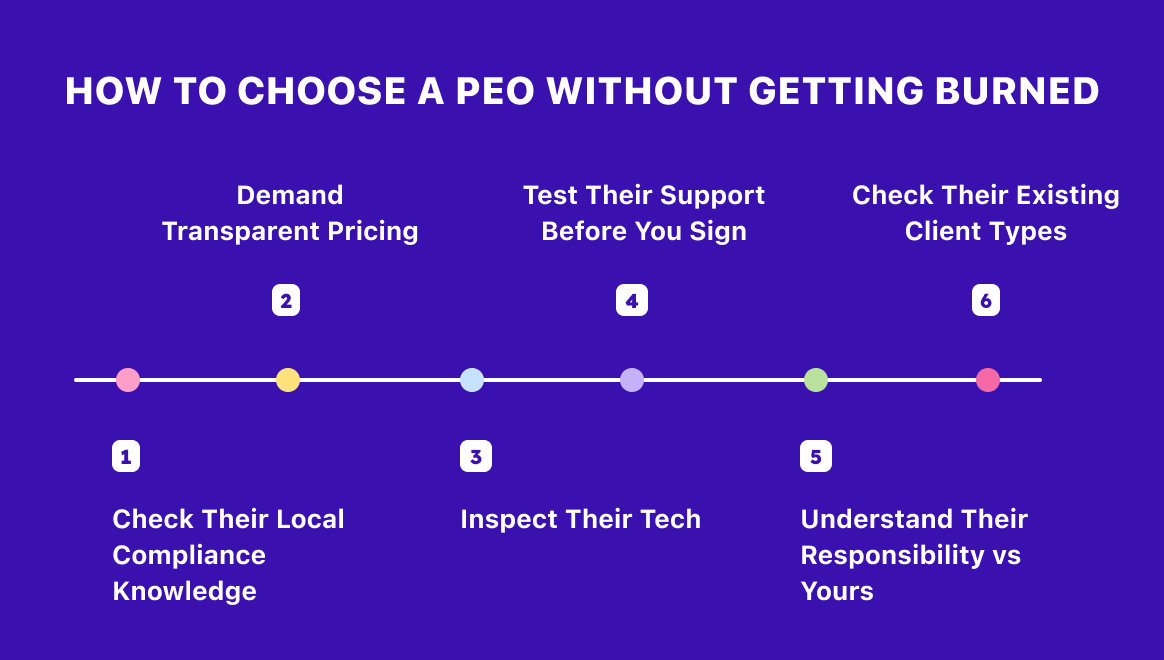
Let us say you have done the thinking, and PEO still makes sense for some of your entities. You now have a different problem.
Which one.
1. Ask for proof of country-level expertise
Do not ask, “Do you know Eastern Europe?” Everyone says yes.
Ask things like
- “How do you handle Polish employees who cross the 120,000 PLN tax threshold mid-year?”
- “How do you calculate Romanian CAS and CASS for high earners?”
- “What happens in the Czech payroll when someone works part of the month only?”
You are looking for concrete answers. Not vague phrases about “local compliance”.
2. Demand pricing that fits on one page
Ask for a written breakdown that includes
- Per employee rate per country
- Minimum monthly fee per country
- Implementation costs
- List of chargeable extras
- Contract term and notice period
If your CFO cannot explain the model out loud in five minutes, it is unclear by design.
3. Inspect the tech stack, not just the sales deck
Request
- A live demo of the employer portal
- Example payslips for Poland, Romania, Czechia and Hungary
- A sample monthly payroll report
- An example of how corrections are shown in reports
If the interface looks like accounting software from 2005, your HR and employees will hate it. That translates into more manual work on your side.
4. Test support before you sign
Send three real-world questions, such as
- “We want to promote a Romanian employee and increase their salary. What changes in total cost and contributions?”
- “We are terminating a Czech employee for poor performance. What steps must we document?”
- “We want to add private medical coverage for Polish staff. How does that impact payroll?”
Measure
- Response time
- Clarity of explanation
- Confidence and detail
- Whether they tailor answers to the law in that country
This is the support you will get under pressure.
5. Clarify who owns mistakes
Ask very directly
- “If a filing you handled leads to penalties, do you cover them?”
- “Do you correct your errors at your own cost?”
- “Do you have any insurance that covers your payroll work?”
Some PEOs accept some responsibility. Many push everything back under “employer responsibility”. You need to know which is which.
6. Check references in the region you actually care about
Ask for references
- With entities in the Eastern European countries, you plan to use
- witha similar headcount
- with a similar growth stage
Do not settle for a generic global case study when your actual plan is a 30-person distributed team across Warsaw, Bucharest and Prague.
Final guidance. PEO vs EOR in Eastern Europe, and where Team Up sits
So, after all that, how do you decide?
You use PEO when
- You already hold local entities in Eastern European countries
- You plan to keep those entities
- Your teams are large enough that internal payroll is no longer realistic
- You are comfortable with employer risk living on your balance sheet
In that world, PEO gives you structure and predictability around work you already have no choice but to do.
You use EOR when
- You want to hire in Eastern Europe without forming entities yet
- You are testing multiple markets
- You want to move quickly without improvising on compliance
- Your leadership and investors care deeply about limiting direct legal exposure
That is the world Team Up is built for.
Team Up started by handling the hard parts of global hiring in the Caucasus. Georgia. Armenia. Azerbaijan. That meant living with real labour codes, real inspections and real payroll audits. Not abstract “global HR” slides.
The same mindset now applies to Eastern Europe.
With Team Up as your EOR partner, you get
- Legal employment for your staff through local entities, you do not have to form
- Fully local contracts that match Polish, Romanian, Czech or Hungarian law
- Correct tax and social contributions from day one
- Clean payroll records that hold up to due diligence and audits
- One contract structure instead of a different one in every country
- One main point of contact for hiring across the region
You keep control of the team. Who you hire. What they build. How they serve customers.
Team Up carries the employer role and the risk that comes with it.
If your plan is to build lean product squads in Warsaw, support teams in Bucharest and commercial talent in Prague or Budapest, you do not need five new entities and three new PEOs.
You need one regional EOR partner that actually understands this part of the world.
That is what Team Up does.
FAQ
1. What do PEO services for small businesses in Eastern Europe include?
They cover payroll processing, tax and social contribution calculations, employment contracts, onboarding support, HR documentation, leave tracking and monthly statutory reporting across countries like Poland, Romania, Czechia and Hungary.
2. Do I need a local entity to use a PEO in Eastern Europe?
Yes. A PEO requires your company to have a registered entity in each country where employees sit. Without local entities, you cannot legally employ through PEO. You would need an Employer of Record instead.
3. How does PEO payroll work in Eastern Europe?
The PEO calculates monthly gross to net based on local tax rules, applies pension, health and social contributions, prepares filings, generates payslips and sends employer cost summaries. Each country has its own rules and calculation methods.
4. What is the difference between PEO and an Employer of Record in Eastern Europe?
A PEO handles HR and payroll while your company remains the legal employer. An Employer of Record becomes the legal employer, enabling you to hire without forming entities in Poland, Romania, Czechia, Hungary or other markets.
5. Are PEO services cost-effective for small teams in Eastern Europe?
Yes, when you already operate local entities and have ongoing payroll needs. If you have only one or two employees per country or you are testing the market, an Employer of Record is usually more efficient and less risky.
6. What hidden costs should I expect from PEO providers in Eastern Europe?
Common hidden charges include onboarding fees, minimum monthly billing, off-cycle payroll fees, correction fees, benefits markups, fees for employment letters, support charges during government audits and penalties for early termination of contracts.
7. Can a PEO help ensure labour law compliance in Eastern Europe?
A PEO can support compliance by setting up correct payroll, documenting employment, applying the right tax and social rules and flagging risk areas. But your entity still holds legal responsibility in case of audits or disputes.
8. When is a PEO the right solution for small businesses in Eastern Europe?
PEO is suitable when you already have entities in the specific countries, expect to grow long term, need structured payroll operations and want to remove manual HR admin from your internal team.
9. When does PEO become a liability in Eastern Europe?
PEO becomes a liability when you lack local entities, need to hire quickly across multiple countries, want to minimise legal exposure or expect frequent strategy changes. In those cases, an Employer of Record is safer.
10. How do I choose the best PEO provider for Eastern European hiring?
Look for providers with deep country level expertise, clear pricing with no hidden minimums, strong reporting tools, reliable support, documented processes, and proven experience handling payroll and HR operations across Eastern Europe.
.svg)


