


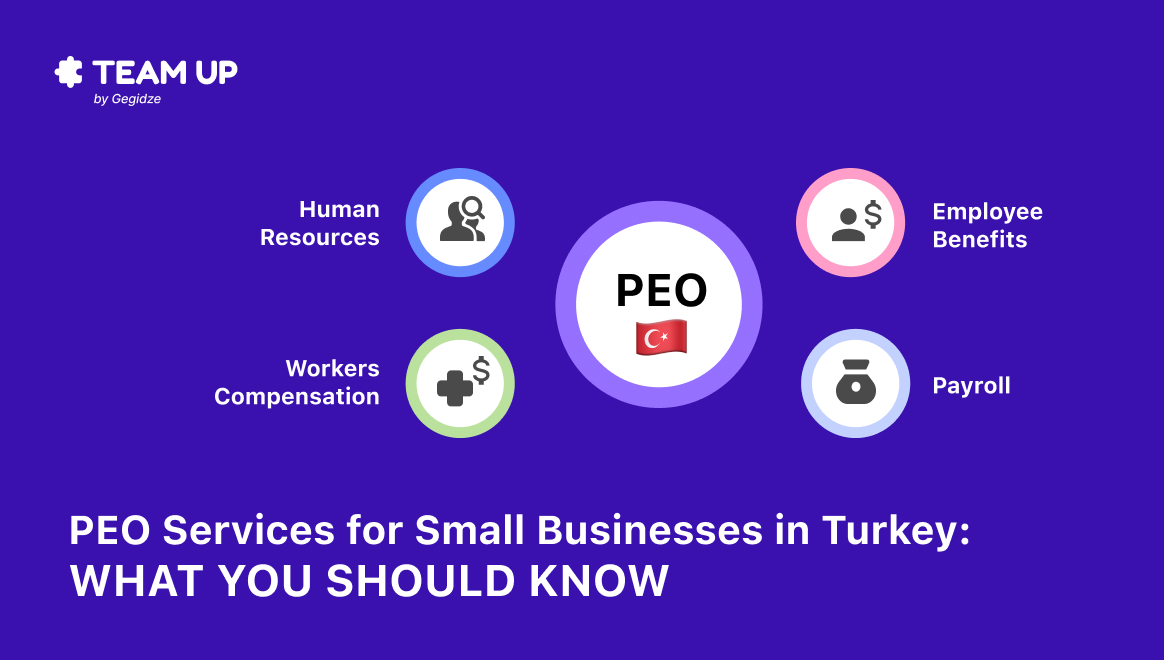
PEO services for small businesses in Turkey: What you should know
Introduction
Hiring in Turkey looks simple until you try to run payroll, calculate SGK contributions, keep up with ever-changing minimum wage rules, and submit everything through e-Bildirge without triggering an audit. It’s usually around that moment that founders start searching for PEO services for small businesses in Turkey, not because they love HR outsourcing but because they’re tired of wondering whether their compliance risk is one late filing away from becoming a real problem.
A PEO promises structure. Order. Someone who actually knows how to calculate income tax brackets without reaching for a headache pill. But here’s the part most small businesses don’t learn until too late. A PEO is powerful only if you use it correctly. And Turkey isn’t a market where you can improvise compliance and hope nobody notices.
So let’s walk through what a PEO really does in Turkey, why HR admin in this country overwhelms even experienced founders, how payroll works under Turkish law, and the one rule that decides whether you can even use a PEO in the first place.

What is a PEO for Small Businesses
Most business owners don’t wake up one morning thinking, “I’d love to outsource payroll today.” They start looking for a PEO because Turkey’s employment landscape is a lot more demanding than it looks from the outside.
Here’s what usually pushes them to that Google search.
Payroll Complexity No One Warns You About
Turkey uses:
- Progressive income tax brackets
- SGK (Social Security Institution) contributions are split between the employer and the employee
- unemployment insurance contributions
- stamp tax
- Monthly minimum wage adjustments that impact payroll calculations overnight
One small error can propagate across every submission made through MUHSGK (the unified tax + SGK return).
Strict Labour Code Requirements
Turkey’s Labour Law requires:
- Written employment contracts
- detailed notice and severance rules
- precise overtime calculations
- maternity and paternity benefits
- annual leave based on tenure
- workplace safety obligations (even for small teams)
A PEO helps you avoid the “I didn’t know that” compliance trap.
Mandatory Digital Reporting
Compliance in Turkey is not optional. It is automated.
Employers must submit:
- Payroll and SGK filings via e-Bildirge
- MUHSGK returns through e-Declaration
- taxes through digital systems
- employee registrations and terminations through SGK portals
If anything doesn’t match the state's data, you hear about it fast.
HR Talent Is Expensive
Hiring an internal HR/payroll specialist costs more than most small Turkish businesses expect. And even experienced HR managers sometimes struggle with SGK updates and payroll calculations during minimum wage changes.
Employees Expect Professionalism
In Istanbul, Izmir, Ankara, Bursa, Antalya, and especially within tech and services, employees now want:
- structured contracts
- consistent payroll
- medical insurance, where possible
- clear leave policies
A PEO helps small businesses look like an employer that has its act together.

What a PEO Actually Does in Turkey (Minus the Marketing Language)
Let’s talk about what a PEO actually does for a small Turkish business.
A PEO is your operational HR and payroll engine. It does not replace your company. It does not take over employer liability. It does not magically make Turkish compliance disappear.
Here’s what it really covers:
Payroll Administration
A Turkey-focused PEO manages:
- salary calculations
- tax withholding across multiple brackets
- SGK employer + employee contributions
- unemployment insurance premiums
- stamp tax
- Filing MUHSGK returns on time
- Ensuring payroll matches Turkey’s digital reporting rules
This alone removes hours of risk and admin work every month.
HR Documentation & Contracts
A PEO ensures:
- Employment contracts meet Turkish Labour Law
- Onboarding is documented properly.
- Amendments and renewals follow legal requirements.
- Exit procedures, notices, and severance rules are followed correctly.
A poorly written contract in Turkey is a lawsuit waiting to happen.
Leave & Entitlement Management
Your PEO tracks:
- Annual leave (14–26+ days depending on tenure)
- sick leave
- maternity and paternity leave
- public holidays
- overtime rules
Turkish employees know their leave rights well. You should, too.
Compliance & Digital Filings
A PEO handles:
- e-Bildirge submissions
- SGK notifications
- MUHSGK filings
- employee registration and deregistration
- documentation for inspections
With Turkey’s audit environment, clean digital trails matter more than charm.
How PEO Payroll Works in Turkey: A Deep Compliance Breakdown
Most founders underestimate how complex Turkish payroll actually is. Here’s the version nobody tells you, the one that explains why you eventually need help.
1. Income Tax Brackets
Turkey uses a progressive system. Employees move into higher tax brackets during the year, especially when bonuses or overtime push income up.
A PEO ensures:
- correct withholding
- updated bracket tracking
- Real-time recalculations when salaries change
- accurate digital filings
2. SGK Social Security Contributions
This is where payroll becomes serious business.
Employer SGK: ~20.5% (varies based on incentives)
Employee SGK: 14%
A PEO handles:
- Calculating each portion
- identifying applicable incentives
- adhering to SGK’s monthly reporting deadlines
One incorrect SGK payment can block future filings.
3. Unemployment Insurance
Employer: 2%
Employee: 1%
These are mandatory for every employee.
4. Stamp Tax
A compulsory deduction from salaries. Small amount, big consequences if wrong.
5. MUHSGK Unified Submission
Turkey combines tax and SGK filings into a single digital declaration.
A PEO ensures:
- Correct MUHSGK submission
- reconciliation between payroll and tax data
- error-free digital records
6. Minimum Wage Updates
Turkey updates minimum wage frequently — and employers must adjust payroll immediately.
A PEO:
- Recalculates all affected salaries
- adjusts contribution bases
- ensures compliance with new wage floors
7. SGK Registrations & Deregistrations
Every employee must be registered with SGK at the right time, ideally before work begins.
Late registration penalties are real.
The One Rule No One Tells Founders: You Need a Turkish Legal Entity to Use a PEO
This is where most foreign founders get it wrong.
A PEO cannot hire employees on your behalf.
A PEO cannot become the legal employer.
A PEO requires your own Turkish entity to exist first.
Why?
Because PEO = co-employment.
Co-employment = your company must already be the employer.
If you do not have a Turkish company, you cannot legally use a PEO.
You need an Employer of Record (EOR) in Turkey.
EOR is the model Team Up provides.
It’s fast, compliant, and lets foreign companies hire in Turkey without navigating company formation, SGK registration, or payroll setup.
PEO vs EOR in Turkey: Which One Fits Your Hiring Strategy?

Let’s keep this simple.
When a PEO Makes Sense
Use a PEO if:
- You already have a Turkish legal entity
- You need help running HR and payroll.
- You want stable compliance without hiring internal HR.
- Your team size is growing beyond 8–10 employees.
- You want to offer better benefits and structure.
When an EOR Makes Sense
Use an EOR if:
- You do not have a Turkish legal entity
- You want to hire fast.
- You want zero employer liability.
- You don’t want to manage SGK, MUHSGK, or labour law requirements.
- You’re testing Turkey before committing to a company setup.
EOR = risk offload + speed.
PEO = HR support if you have already built the legal foundation.

PEO Pricing in Turkey: PEPM vs Percentage of Payroll
Pricing follows two global standards.
PEPM (Per Employee Per Month)
- predictable
- easier for budgeting
- ideal for stable teams
Percentage of Payroll (4–12%)
- flexible
- Cost increases with higher salaries
- more common with Turkish providers
Pricing drivers include:
- payroll complexity
- SGK documentation requirements
- benefits administration
- contract changes
- termination handling
- leave management
- employee count
Hidden PEO Costs in Turkey That No One Puts on the Landing Page
PEO pricing always sounds simple on the website. It is rarely that simple in the contract.
If you are a small business in Turkey, these are the places money usually leaks out.
1. Onboarding and Implementation Fees
Many PEOs charge you just to start working with them.
That can look like:
- A one-time implementation fee
- per employee onboarding fees
- extra charges to migrate your existing staff into their system
None of these is unusual. The problem is when they are buried in the small print.
Questions to ask:
- “Is there a setup or implementation fee in Turkey. How much?”
- “Do you charge per employee onboarding fees?”
- “Does your price include migrating current employees, or is that billed separately?”
If you do not get precise answers, assume the worst.
2. Extra Charges for Off-Cycle Payroll
Real life does not always respect payroll cut-off dates.
You might:
- Hire someone mid-month
- Correct a mistake
- Add a one-time bonus.
- Pay retroactive overtime
Some PEOs bill extra for any off-cycle run, or for making corrections after MUHSGK has already been filed.
Ask:
- “Are off-cycle payroll runs included in your standard fee?”
- “If we need to correct something next month, is that part of your service or an extra charge?”
You need simple, clear answers here.
3. Markups on Benefits and Insurance
As private health insurance, meal cards, transport allowances and fringe benefits become more common in Istanbul and other big cities, PEOs often bundle these for you. Which is useful. Until they quietly add a margin.
That can show up as:
- Inflated per-employee benefit costs
- “admin” lines that hide the real premium
- zero transparency between insurer pricing and PEO fees
Ask directly:
- “What is the base premium from the insurer?”
- “How much of this line is your fee or margin?”
- “Can we see a breakdown by cost component?”
If they hesitate, you are paying more than you should.
4. Minimum Monthly Fees and Headcount Floors
Many PEO contracts are designed around larger employers. For small teams, that creates friction fast.
Look for:
- A minimum monthly invoice, even if you have only a few employees
- required minimum headcount
- A base fee that applies even when your team shrinks
Ask:
- “What is the minimum monthly fee, no matter what?”
- “If our Turkish team drops to three or four people, what do we pay?”
If you are testing the Turkish market with a small footprint, these details matter.
5. Fees for HR Documents and Custom Reporting
You will need:
- employment certificates
- proof of income for banks
- detailed payroll reports for investors or due diligence
- letters and HR documents for visas or relocations
Some PEOs include all of that. Others charge per document or per hour.
Ask:
- “Are employment certificates, income letters and reference letters included in the monthly fee?”
- “Do you charge extra for custom payroll or tax reports?”
6. Termination and Legal Support Costs
Turkey has strict rules around:
- notice periods
- severance pay
- valid termination reasons
- documentation and delivery of notices
PEOs sometimes charge extra for:
- handling terminations
- preparing settlement documentation
- providing legal review or consultation
Ask:
- “Is termination handling included in your core fee?”
- “Do you charge by the hour for legal or labour law questions?”
If that part is vague, the bill will not be.
When PEO Services Are a Smart Move for Small Businesses in Turkey
Now for the good news. In the right situation, a PEO in Turkey can be a lifesaver.
Here is when it actually makes sense.
1. You Already Have a Turkish Legal Entity
This is the first filter.
A PEO model only works if:
- You have a registered company in Turkey
- You are already the legal employer.
- You hold a tax ID and SGK registrations.
If that is true and you are drowning in admin, a PEO can plug into your structure and stabilise things quickly.
2. You Have Moved Beyond Spreadsheet Payroll
If this sounds familiar, you are in PEO territory:
- Payroll lives in Excel, and one person knows how it works
- You hold your breath every time MUHSGK is filed.
- You are not fully sure your SGK calculations match the current rules.
- Leave balances and overtime sit in scattered files.
Once you hit eight to fifteen employees, this is not just messy. It is risky.
A PEO gives you:
- Clean recurring payroll
- Documented processes
- Consistent leave and entitlement tracking
- Reporting that would survive an inspection.
3. You Cannot Justify a Full HR Team Yet
A competent HR or payroll professional in Turkey costs real money, plus employer contributions.
With a PEO, you get:
- Access to HR and payroll expertise
- No extra headcount on your books
- No need to train internal staff on every new SGK update
For many small businesses, that tradeoff makes sense.
4. You Need to Look More Professional to Candidates
If you are hiring in Istanbul, Ankara or Izmir for competitive roles, candidates will pay attention to:
- How their contract is written
- How stable your payroll looks
- Whether you offer any medical or fringe benefits
- How structured your HR processes feel
A PEO helps you look like a well-run employer, not a group of people improvising HR in between other tasks.
5. You Want to Tighten Compliance Before Something Breaks
Most problems with Turkish authorities do not start as fraud. They start as small mistakes.
Examples:
- Misaligned MUHSGK filings
- Underpaid SGK contributions
- Inconsistent termination documentation
- Missed deadlines after payroll changes
A PEO does not remove all risk, but it dramatically improves the odds that your payroll and HR will hold up when someone looks closely.
When PEO Services Become a Liability in Turkey
Used in the wrong context, a PEO will not save you. It will add cost and complexity on top of a model that was wrong from the start.
Here is when PEO is the wrong tool.
1. You Do Not Have a Turkish Entity
This is the big one.
If you do not have a legal entity in Turkey, you cannot:
- Enter into a compliant co-employment arrangement
- Use a PEO as your “employer”
- Push legal risk onto them.
Any provider saying “we can be your PEO in Turkey without you having a company” is not talking about a real PEO model. At best, they are mixing terms. At worst, they are inviting you into non-compliant structures.
If you want to hire in Turkey without an entity, the correct structure is Employer of Record.
That is what Team Up does.
2. Your Team Is Very Small
If your plan is to hire:
- One country manager
- two engineers
- a small remote support team
Then, PEO economics often do not add up. You end up paying big company infrastructure pricing for a very small headcount.
With that profile, an EOR provider is usually:
- Cheaper in total cost
- faster to start
- easier to wind down if needed
- cleaner from a risk perspective
3. You Need to Hire Quickly
PEO assumes that you already have:
- A registered company
- a tax number
- SGK registration
- a bank account and local representation
If you are still working on incorporation or registrations, a PEO does not solve your timing problem. It just waits for you to finish.
An EOR lets you:
- Hire in weeks, often days
- Test the Turkish market with real employees.
- Postpone the decision to form an entity until you prove the business case.
4. You Want Zero Local Employment Liability
Under a PEO model, you remain the legal employer in Turkey.
That means:
- Your name is on the contracts
- Your entity is on the hook if something goes wrong.
- You respond if tax or labour authorities come with questions.
A PEO reduces operational mistakes but does not stand between you and legal risk.
If your priority is to ring-fence liability, you want:
- A structure where someone else is the employer of record
- Contracts that are enforceable locally but held by your partner
- clear allocation of risk and responsibility
That is EOR, not PEO.
5. You Are Hiring Across Multiple Countries
If Turkey is one of several markets you are entering, running a separate entity and separate PEO agreement in each country quickly becomes painful.
You end up with:
- Multiple sets of contracts
- different payroll timelines
- fragmented reporting
- different risk profiles per country
Working with a regional EOR partner gives you:
- one model
- One approach to compliance
- much simpler reporting for finance and leadership
Turkey fits neatly into that model.
How to Choose a PEO in Turkey Without Regretting It Six Months Later

If you read all this and still know PEO is the right model for your situation, then the next risk is picking the wrong provider.
Here is how to evaluate PEOs in Turkey like someone who has already lived through one bad choice.
1. Test Their Knowledge of Turkish Law and Practice
Ask questions that force them to be specific.
For example:
- “How do you handle payroll for an employee hitting a higher income tax bracket mid-year?”
- “Walk me through the contributions and filings for a new hire on the current minimum wage.”
- “What is your standard process when SGK disputes a filing or raises a query?”
If they stay vague or sound like they are quoting a generic handbook, they are not ready to run your payroll.
2. Demand Simple, Written Pricing
You need:
- A clear per employee or per cent of payroll fee
- a written list of inclusions
- explicit list of extra charges
- clarity on minimum monthly fees and contract length
If the pricing page feels like a puzzle, there are hidden costs somewhere.
3. Look at Their Tools, Not Just Their Slide Deck
Ask to see:
- Employee portal or self-service access
- How pay slips look
- How managers approve leave or changes
- What reports can you export for accounting or audits?
If the tools feel clunky, your team will resent them, and adoption will be low.
4. Test Their Support With Real Scenarios
Before signing anything, send them realistic questions.
For example:
- A complex termination case
- maternity leave handling
- retroactive salary increase with SGK impact
Watch for:
- response time
- level of detail
- Signs they actually understand Turkish practice, not just generic HR theory
5. Clarify Responsibility for Errors
You should ask:
- “If there is an error in filings that leads to a fine, who pays it?”
- “Will you correct historical filings at your cost if the mistake is on your side?”
- “Do you carry any professional liability insurance for your services?”
Get written answers, not just verbal reassurances.
6. Check Their Track Record in Turkey
Look for:
- Existing clients with a similar size or industry
- experience across major Turkish cities
- references or anonymised case examples
You do not want to be the client they learn from.
Final Guidance. PEO vs EOR in Turkey and Where Team Up Fits
Here is the honest version.
A PEO in Turkey is a good move if:
- You already have a local legal entity
- Your team is large enough that HR and payroll are no longer side tasks.
- You want someone to standardise contracts, payroll and compliance.
- You are comfortable remaining the legal employer and carrying the risk.
A PEO is the wrong move if:
- You do not have a Turkish company
- You want to hire a small team quickly.
- You want to keep employment liability off your balance sheet.
- You are expanding across multiple markets and want one simple hiring mode.l
In those scenarios, you do not need a PEO. You need an Employer of Record.
That is exactly what Team Up provides.
With Team Up as your EOR in Turkey, you get:
- Local compliant employment contracts held by us
- Payroll that actually matches Turkish rules on tax, SGK, unemployment and stamp tax
- timely digital filings using the correct state systems
- protection of your IP and confidential work through enforceable agreements
- One clean monthly invoice rather than a stack of line items you have to decode
You manage your team as if they were your own employees. We carry the legal, payroll and compliance load so you can scale in Turkey without building a full HR and legal machine on day one.
If you care more about hiring the right people than wrestling with MUHSGK, SGK and contract templates, PEO is not your starting point. EOR is. And that is exactly the part of the problem Team Up is built to own.
FAQ
1. What are PEO services for small businesses in Turkey?
PEO services for small businesses in Turkey provide outsourced HR, payroll, and compliance support using a co-employment model. The PEO handles SGK filings, payroll calculations, leave tracking, and HR documentation while your company remains the legal employer.
2. How does a PEO work in Turkey?
A PEO manages operational employer tasks such as payroll processing, MUHSGK submissions, SGK registrations, contract preparation, onboarding, and HR admin. You manage day-to-day work; the PEO ensures your employment practices comply with Turkish labour law.
3. Do I need a Turkish legal entity to use PEO services?
Yes. A PEO requires your company to have a registered legal entity in Turkey. Without a Turkish entity, a PEO cannot legally employ workers for you. In that case, the correct structure is an Employer of Record (EOR).
4. What is the difference between a PEO and an Employer of Record in Turkey?
A PEO supports payroll and HR processes but does not become the legal employer. An Employer of Record becomes the official employer in Turkey, issues compliant contracts, manages payroll, pays SGK contributions, and allows foreign companies to hire without forming a local entity.
5. How does PEO payroll work in Turkey?
PEO payroll includes income tax calculations, SGK employer and employee contributions, unemployment insurance, stamp tax, MUHSGK filings, SGK notifications, payslip generation, and digital reporting through official government portals.
6. Is PEO better than EOR for hiring remote employees in Turkey?
If you have a Turkish legal entity, a PEO can streamline HR and payroll. If you do not have an entity, EOR is the only compliant hiring model. A PEO cannot act as the legal employer in Turkey.
7. Are PEO services cost-effective for small Turkish companies?
PEO services are cost-effective when you have a growing team and need a reliable HR structure. For very small teams or companies without an entity, EOR is usually more affordable and operationally cleaner.
8. What hidden costs should businesses expect with PEO providers in Turkey?
Common hidden PEO costs include onboarding fees, off-cycle payroll charges, benefits markups, minimum monthly invoices, HR documentation fees, termination support fees, and additional billing for legal consultations.
9. Can a PEO legally employ workers on behalf of a foreign company in Turkey?
No. A PEO cannot legally employ workers for a company that does not have a Turkish entity. Only an Employer of Record can serve as the legal employer for foreign companies hiring staff in Turkey.
10. How do I choose the best PEO service provider in Turkey?
Look for a provider with strong knowledge of Turkish payroll law, transparent pricing, modern HR tools, fast and detailed support, a clear contract structure, and proven experience managing SGK, MUHSGK, and labour compliance.
.svg)


