


Guide to the top 5 trends in Employer of Record services in Uzbekistan for 2026
TL;DR
- Uzbekistan is becoming a high-opportunity hiring market thanks to a young workforce, rapid modernization, and competitive salaries.
- EOR services make expansion faster and safer by handling payroll, compliance, legal documentation, and onboarding.
- The top 5 trends shaping EOR in Uzbekistan for 2026 include:
- AI automation for onboarding, payroll, and compliance
- Deeper demand for local legal expertise
- Flat-rate pricing as the new standard
- EORs expanding into full “people ops” partners
- Stronger data security and predictive risk management
- Companies using EOR avoid misclassification, payroll errors, penalties, and bureaucratic delays.
- With Team Up, businesses can hire in Uzbekistan immediately and operate with full legal protection.
Introduction: Why EOR services in Uzbekistan are growing rapidly in 2026
Uzbekistan is rapidly emerging as Central Asia's next major talent hub. Driven by accelerating economic reforms (with GDP growth projected at 6.0% in 2026) and a massive government push towards digitalization, the country is attracting significant foreign direct investment (FDI).
This has created a dynamic, high-skill talent pool, particularly in the tech workforce, engineering, and services sectors.
But here’s the problem: the speed of opportunity clashes directly with the complexity of bureaucracy. Trying to enter Uzbekistan via the traditional route, setting up a local LLC, is a slow, costly commitment plagued by evolving tax codes, stringent labor documentation requirements, and local registration friction.
Who has months to spend fighting paperwork?
This bottleneck is why Employer of Record (EOR) services in Uzbekistan are growing so rapidly.
The EOR model eliminates this friction, providing fast hiring and instant compliance without ever forcing you to form a local legal entity. It’s the essential tool you need to capitalize on this growing market quickly and safely.
You must see the EOR as the strategic solution that removes the risk from this high-reward market.
What is an Employer of Record (EOR) and how it works in Uzbekistan
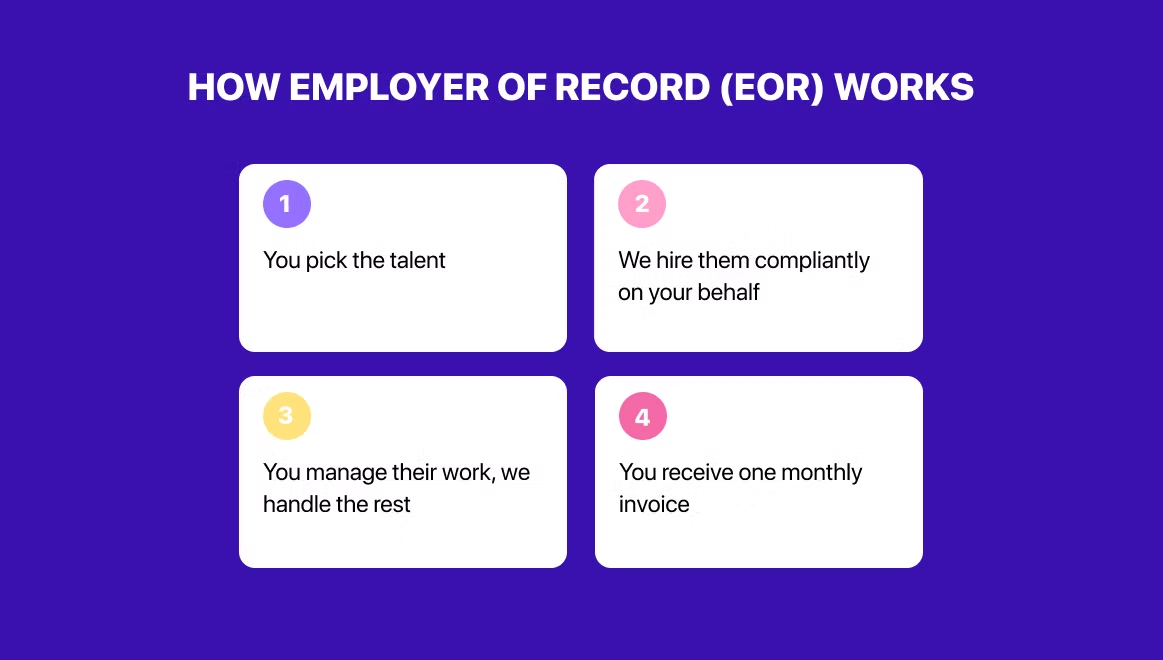
Let's cut through the jargon. If you want to expand into Uzbekistan, you need to understand the EOR's role completely: it’s not just outsourced payroll; it's a legal transfer of liability.
An Employer of Record (EOR) is the official, legally registered employer of your staff in Uzbekistan. The EOR's local entity executes the employment contract, taking on all legal and financial risks associated with local labor law compliance.
The crucial separation of control
For your business, the relationship is clear:
- You (The Client): You maintain functional control. You manage the employee's day-to-day duties, performance reviews, and strategic output.
- The EOR (The Legal Employer): The EOR manages legal control. They handle every statutory and administrative requirement, guaranteeing local compliance.
This is how you secure instant compliance without ever having to set up a local LLC or TOO, a process that exposes you to immediate bureaucratic and tax scrutiny.

EOR responsibilities: Navigating Uzbek labor specifics
| EOR Responsibility | Uzbek Labor Law Specifics | Legal Imperative |
| Labor Contracts | Drafting, executing, and registering mandatory Uzbek-language employment contracts (though bilingual is common practice). | Contracts must strictly adhere to the Labor Code of the Republic of Uzbekistan. Failure to use the correct format or language invalidates key protections. |
| Probation & Termination | Managing standard probation periods (typically up to three months) and strictly following statutory termination compliance. | The EOR must ensure terminations are based on legally valid grounds and that proper notice and severance pay calculations are met, minimizing wrongful dismissal risk. |
| Tax Withholding & Payroll | Calculating and remitting Personal Income Tax (PIT) (currently a flat 12%) and managing mandatory local deductions. | Requires accurate, timely filing with the State Tax Committee, which is crucial given the government's intense focus on digitalization and tax transparency. |
| Social Contributions | Managing and paying the mandatory social tax (which covers state pension, health, and social insurance) and other required contributions. | The EOR must handle the complex interplay of contributions and accurately report to state bodies like the Pension Fund and the Employment Assistance Fund. |
| Statutory Benefits | Administering mandatory annual leave (minimum 15 working days) and correctly calculating sick leave and vacation pay. | Ensuring all leave policies and pay rates comply with the Uzbek Labor Code requirements to avoid employee disputes. |
Uzbekistan’s labor environment, heavily influenced by its civil law tradition and rapid reform pace, demands specialized attention. The EOR's job is to master these specifics:The ultimate value here is the transfer of liability.
If an error occurs, say, an incorrect social tax contribution is filed, or a contract is deemed non-compliant, the EOR’s local entity is responsible for the fines and legal defense, not your company. This level of protection is non-negotiable for successful market entry.
Ensure your EOR partner covers every angle of the compliance checklist for EOR in Uzbekistan

Top 5 trends in employer of record services in Uzbekistan for 2026
Expanding into Uzbekistan used to feel like signing up for a mystery challenge where the rules were written in five different languages and the referee went home early. But 2026 is a different story. With a booming tech scene, government-led digital transformation, and a workforce that’s young, ambitious, and hungry for global opportunities, the demand for Employer of Record (EOR) services providers in Uzbekistan is climbing fast.
Why? Simple. Companies want to hire fast. Avoid legal drama. Skip entity setup purgatory. And keep compliance airtight while expanding into a new market. Uzbekistan ticks all the boxes, and EORs make the entire process smoother than most corporate onboarding manuals.
Below, we’ll dive into the top 5 trends shaping EOR services in Uzbekistan for 2026. These aren’t theories or buzzwords slapped on a slide deck. They’re the practical, high-impact shifts that global employers are leaning into as they build remote teams across Central Asia.
Trend 1. AI automation becomes the norm for onboarding, payroll, and compliance
Automation isn’t just a nice feature anymore. It’s the backbone of how EOR providers are operating in Uzbekistan in 2026.
Uzbekistan’s government has accelerated its digital transformation, rolling out new online systems for tax filings, identity verification, and employer reporting. EOR platforms have followed suit. The result is a hiring and compliance environment that’s faster, cleaner, and a lot harder to mess up.
Here’s what AI now handles effortlessly:
- Automated employment contracts in Uzbek, Russian, and English
- Identity and document verification synced with national systems
- Automated payroll calculations using the latest tax rates
- Compliance alerts when legislation shifts
- Onboarding workflows that remove manual delays
In a market where rules change fast and enforcement is increasingly automated, businesses can’t afford human error. AI gives companies the ability to scale in Uzbekistan without slowing down or tripping over administrative details.
Trend 2. Deep local expertise becomes the deciding factor for EOR buyers
Uzbekistan is modernizing, but its labor system still has quirks that are nearly impossible to navigate without someone on the ground who actually understands how things work.
There are strict rules around:
- Contract formats
- Probation periods
- Recording employment relationships with state bodies
- Social contributions
- Termination procedures
- Mandatory leave documentation
And many of these processes exist only in Uzbek or Russian, often without reliable English translations.
Businesses choosing EOR services in 2026 now prioritize providers that have:
- Dedicated local legal teams
- Specialists familiar with Uzbekistan’s labor code
- Experience handling inspections and audits
- The ability to draft compliant, locally accepted contracts
- Up-to-date knowledge of payroll and tax reforms
Uzbekistan’s digital enforcement system flags errors quickly. Local expertise protects you from misclassification, payroll mistakes, or documentation failures that could otherwise lead to fines or prolonged audits.
Trend 3. Flat-rate pricing becomes the standard for scaling teams
Percentage-based pricing may have worked in the early days of global employment, but companies scaling into Uzbekistan in 2026 want clarity, predictability, and no hidden costs.
Flat-rate pricing models are becoming the preferred option because they offer:
- One predictable monthly fee per employee
- No salary-based markups
- Clear service boundaries
- Easier financial modelling for long-term growth
- Better transparency for startups and fast-scaling teams
Uzbekistan is an emerging but cost-effective hiring market. Businesses don’t want pricing surprises, especially when growing distributed teams of developers, sales talent, or operations staff. Flat-rate models make expansion easier to justify and budget for.

Trend 4. EOR providers shift from “payroll processors” to “full people operations partners.”
Uzbekistan’s workforce is growing, maturing, and becoming more tech-forward each year. As global businesses scale their remote teams, they expect more than basic payroll from their EOR partners.
That demand is driving EOR providers to expand into full-service HR ecosystems that cover every part of the employee lifecycle.
What this looks like:
Expanded benefits and perks
- Private health insurance
- Supplementary allowances
- Hybrid or remote work support
- Well-being benefits
Local recruitment and talent sourcing
EORs now help companies find, screen, and onboard tech, engineering, customer support, and operational talent, especially in Tashkent, which is becoming a regional tech hub.
Workspace and equipment support
Coworking seats, laptops, onboarding equipment, office support, and compliance-aligned remote work setups.
Immigration and relocation services
- Work permits
- Residency support
- Family relocation
- Housing coordination
Companies want to grow in Uzbekistan without juggling multiple vendors. Modern EOR providers are building one-stop solutions that cover everything from recruitment to offboarding, helping foreign businesses launch and scale smoothly.
Trend 5. Data security and proactive risk management become mission-critical
Uzbekistan’s regulatory landscape is undergoing rapid digitalization. Tax filings, employment registrations, and compliance reports are increasingly processed through online systems that cross-check information instantly.
This means EORs can no longer be “service vendors.” They must be risk management partners.
What leading EORs now prioritize:
Enterprise-grade security
- End-to-end encryption
- Zero-trust security frameworks
- Controlled access to payroll and identity data
- Secure cloud-based document systems
GDPR-level data protection
Even though Uzbekistan isn’t bound by EU privacy rules, international employers expect the same standards, so EOR platforms are adopting them anyway.
Predictive compliance analytics
This includes tools that detect anomalies before authorities do:
- Inconsistent tax filings
- Outdated employee records
- Incorrect social contribution amounts
- Contract misalignment with new regulations
Cross-border payroll security
With more international companies hiring Uzbek talent, secure payroll routing is essential to avoid compliance breaches or blocked transactions.
Regulators in Uzbekistan are becoming more proactive, and digital systems catch mistakes instantly. Robust data security and risk forecasting prevent companies from being blindsided by penalties, failed audits, or compliance gaps.
How EOR services mitigate legal and compliance risks in Uzbekistan
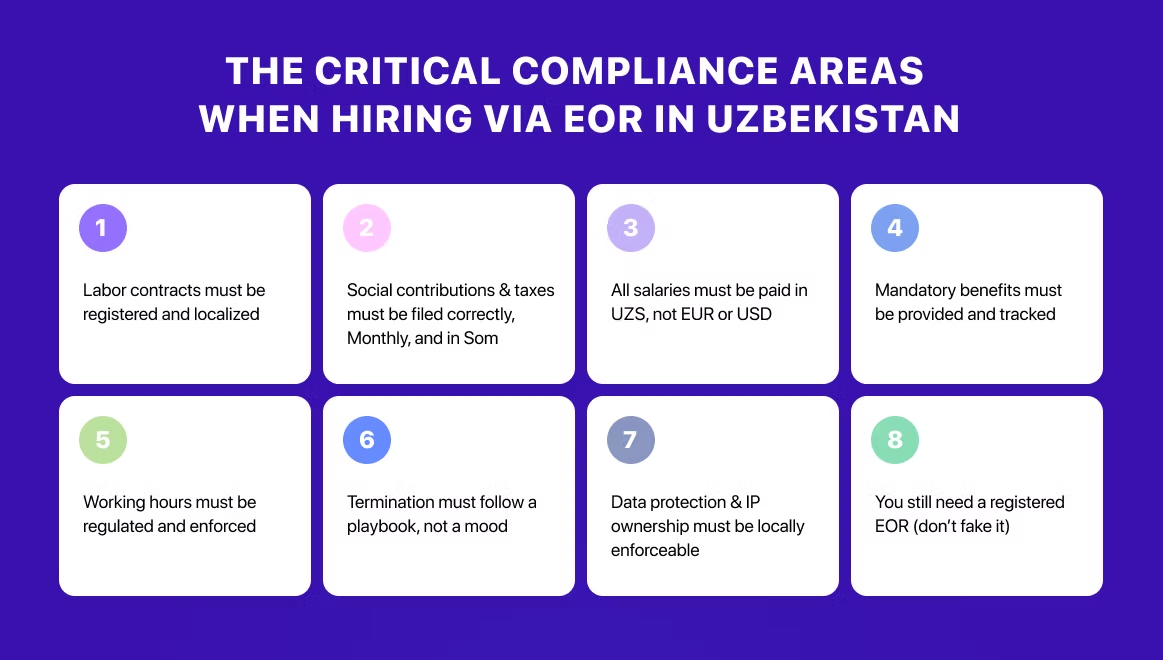
Hiring in Uzbekistan without local expertise is… ambitious. The country’s labor code is detailed, documentation requirements are strict, and government systems are becoming increasingly digitized, which means mistakes get flagged quickly. If you misclassify a worker, file payroll incorrectly, or miss a reporting step, you won’t find out months later. You’ll find out now, with penalties attached.
This is exactly why companies expanding into Uzbekistan lean on Employer of Record services. An EOR acts as both your legal buffer and your compliance engine, making sure every part of your employment process aligns with Uzbek law.
Here’s how an EOR protects you from the risks most foreign companies underestimate.
Clear worker classification (so you don’t accidentally create liabilities)
Misclassifying employees as contractors is one of the easiest ways for a foreign company to get in trouble. Uzbekistan has very clear criteria around employment relationships, and they rarely match Western assumptions.
An EOR ensures every relationship is set up correctly by:
- using locally compliant employment contracts
- defining job responsibilities according to Uzbek legal standards
- documenting the relationship with the appropriate authorities
No gray areas. No, “we thought this was a contractor.” Just clear, lawful employment.
Accurate payroll, taxes, and social contributions
Uzbekistan’s payroll calculations involve multiple moving parts:
- income tax
- mandatory pension contributions
- social contributions
- sick leave, vacation, maternity allowances
- industry-specific rules
If you get even one component wrong, the system catches it. And penalties add up fast.
An EOR handles all payroll with:
- accurate calculations aligned to current tax rates
- automated filings into government systems
- correct social contribution reporting
- compliant pay slips and documentation
You avoid penalties, audits, and forced corrections, which, in Uzbekistan, are not optional.
Legally compliant onboarding and terminations
Employment processes in Uzbekistan must follow specific steps to be recognized as valid. This includes:
- Recording the employee in local government databases
- Generating contracts in Uzbek or Russian
- Applying correct probation rules
- Following strict termination procedures
If one step is missed or done out of order, the company, not the employee, bears the liability.
An EOR ensures every action is:
- Documented
- Timestamped
- Stored properly
- Compliant with the labor code
You get a legally secure employment relationship from day one.
Benefits administration aligned with local requirements
Employees in Uzbekistan are entitled to:
- Annual paid leave
- Sick leave
- Maternity and paternity protections
- Pension and insurance contributions
Missing any of these can trigger legal disputes or financial penalties.
An EOR:
- Manages all statutory benefits
- Calculates leave accruals correctly
- Oversees medical certificates and approvals
- Ensures contributions are submitted on time
Your company stays compliant, and your employees stay protected.
Risk forecasting through proactive compliance monitoring
This is where EOR services in Uzbekistan move from “service provider” to “risk shield.”
Modern EORs use predictive tools that surface potential problems before they become formal violations, including:
- Outdated contracts
- Incorrect contribution percentages
- Inconsistent payroll records
- Missing documentation
- Sudden shifts in regulatory requirements
Instead of reacting to issues, companies expanding into Uzbekistan can prevent them and maintain a clean compliance profile as they scale.
Why this matters for global teams
Uzbekistan is a high-opportunity market, but it's also a high-structure market. Everything must be done correctly, legally, and on time. An EOR ensures:
- zero misclassification risk
- zero payroll errors
- zero document gaps
- minimized legal exposure
- faster hiring with full compliance
It’s the simplest way to expand safely, without building an in-house legal department just for one market.
What makes Uzbekistan a strong market for hiring in 2026?
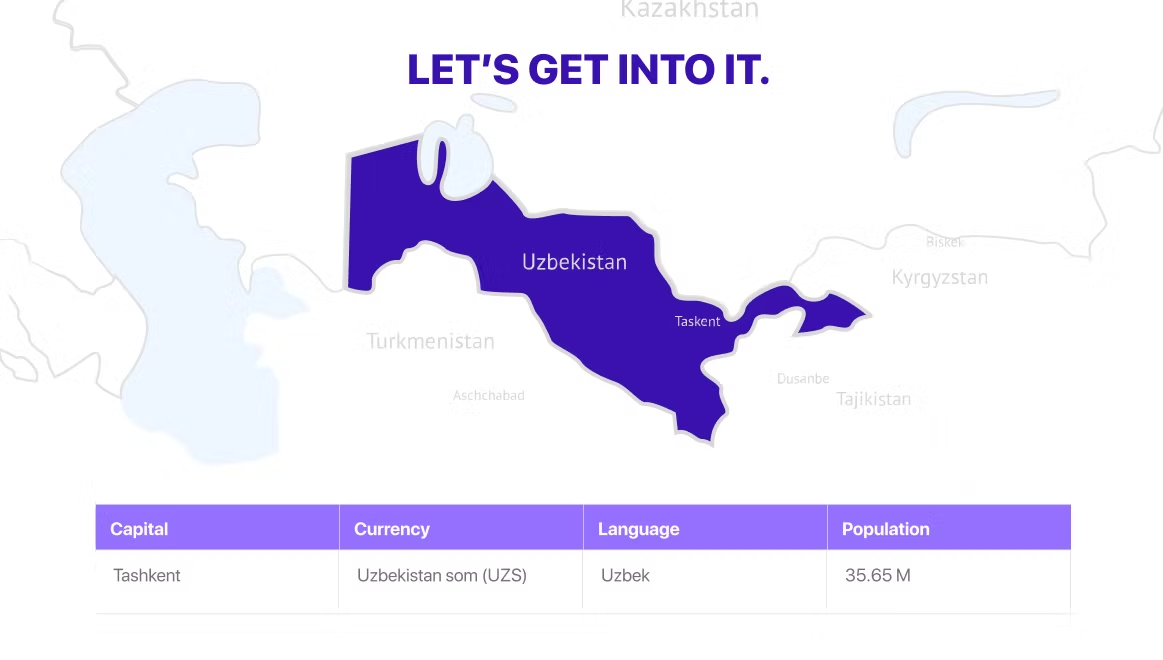
Alright, so there are a ton of reasons global companies are suddenly eyeing Uzbekistan like it’s the last untouched avocado at a California Whole Foods. And unlike that avocado, Uzbekistan isn’t secretly brown on the inside.
But if this market is so good, if it offers cost-effective talent, modernizing infrastructure, and a government that actually tries, then why isn’t every company already hiring here?
There are several reasons.
1. Uzbekistan takes growth seriously
And not the “we hired a guy to redesign our logo so now we’re innovating” kind of growth. I mean the real deal.
Uzbekistan is basically in its “just hit the gym, read three self-help books, and bought a whiteboard” era. The government has been pushing modernization like someone who finally understood what “digital transformation” is and took it personally.
New tax systems. New e-government portals. New startup incentives.
It’s like they woke up one day and said, “Let’s not be the underdog. Let’s be the plot twist.”
Meanwhile, neighboring markets are still arguing about whose turn it is to update a website last touched in 2009.
2. The workforce is young, ambitious, and allergic to stagnation
Here’s the thing: Uzbekistan has a young population, and not in the “still learning to tie their shoes” kind of way. More like “learning Python while doing freelance UI work between university classes” young.
You want hungry talent? You want flexibility? You want developers who actually read documentation?
Uzbekistan’s got you.
And unlike some oversaturated markets where everyone wants senior-engineer salaries after watching one YouTube tutorial, Uzbek talent tends to be grounded, committed, and motivated.
It’s refreshing. Honestly.
3. Costs that don’t make your finance team break out in hives
Let’s be honest: half the global companies expanding to new regions do it because they want great talent without needing a board meeting every time they add headcount.
Uzbekistan delivers on that.
Competitive salaries + strong skills = a hiring manager’s version of a cheat code.
The country hasn’t hit “San Francisco pricing” levels of delusion — and probably won’t anytime soon. That makes it easier for startups and scaling teams to build, experiment, and grow without waking up to a payroll that looks like a military budget.
4. A market that’s actually opening doors, not closing them
Some countries say they’re “open for business,” then hand you a stack of forms that look like they were written by 12 different committees in four different decades.
Uzbekistan… surprisingly isn’t one of those countries.
They’re cutting red tape.
Digitizing forms.
Supporting investors.
Encouraging startups.
It’s progress you can actually see, not just in speeches, but in systems that now work.
It’s almost suspicious how functional some of it is, but hey, we’ll take it.
5. The EOR advantage makes the entire market easier to enter
Here’s where things get spicy.
Setting up your own entity in Uzbekistan is possible.
But so is building IKEA furniture with your bare hands, and nobody recommends that.
With EOR services, companies get:
- Instant hiring
- No entity setup
- No tax registration nightmare
- No “surprise, you violated a subsection you didn’t know existed” moments
It turns Uzbekistan from a “maybe later” into a “why not now?”
So why Uzbekistan in 2026?
Because it’s the rare combination of affordable, talented, reform-focused, and not yet overcrowded.
It’s the hiring equivalent of discovering a band before they blow up, except this time, you actually get to benefit from being early.
Conclusion: The future of EOR services in Uzbekistan
Uzbekistan is changing fast, and companies that move early benefit the most. It’s one of the few markets where you still get a rare combination: strong technical talent, competitive labor costs, and a government actively modernizing its systems instead of slowing businesses down.
But speed means nothing without compliance. That’s where Employer of Record services become the smarter, safer path.
An EOR lets you:
- Hire immediately
- Skip entity setup
- Stay fully compliant with Uzbek labor law
- Eliminate misclassification risks
- Streamline payroll and taxes
- Protect your company from bureaucratic headaches
In 2026, EOR isn’t a workaround. It’s the most efficient way to enter Uzbekistan without exposing your company to legal or financial risk.
If you want to expand into Uzbekistan confidently, with a partner who understands the region, the law, and the realities of building remote teams, Team Up is built for exactly this moment.
Ready to hire talent in Uzbekistan without the complexity?
Let’s make it simple, compliant, and fast.
Book a call with Team Up and build your team in Uzbekistan with zero friction.
Frequently asked questions (FAQ)
What is an Employer of Record (EOR) in Uzbekistan?
An EOR is a third-party company that becomes the legal employer of your team in Uzbekistan. You manage the work. The EOR handles contracts, payroll, taxes, benefits, and compliance with Uzbekistan’s labor laws.
Why should companies use an EOR when expanding into Uzbekistan?
Because hiring without local expertise is risky. An EOR ensures correct classification, compliant payroll, accurate tax submissions, and proper documentation — all of which protect you from penalties and legal exposure.
What makes Uzbekistan a strong market for hiring in 2026?
A young, rapidly growing workforce, strong technical talent, improving business reforms, competitive costs, and increasing global interest make Uzbekistan one of the region’s most promising talent markets.
What compliance risks do businesses face when hiring in Uzbekistan?
Common risks include misclassification, incorrect payroll and tax filings, invalid contract formats, termination errors, and unrecorded social contributions — all of which can lead to fines or audits.
How does an EOR help with payroll in Uzbekistan?
An EOR calculates wages, deducts taxes, manages social contributions and pension payments, issues compliant payslips, and submits everything through the correct government portals.
Is it better to use an EOR or set up a local entity in Uzbekistan?
For most companies, especially startups and early-stage expansions, an EOR is faster, cheaper, and significantly lower risk. Entity setup takes time, money, and exposes you to administrative obligations from day one.
Do EORs in Uzbekistan offer employee benefits?
Yes. EORs handle statutory benefits and can also provide enhanced packages like private health insurance, allowances, wellness benefits, and workspace support depending on your needs.
Can an EOR help relocate international employees to Uzbekistan?
Modern EOR providers offer immigration support, work permits, and relocation services — making it easier to move global talent into the country legally and smoothly.
How are EOR costs structured in Uzbekistan?
In 2026, most providers use flat-rate monthly pricing per employee. This gives companies predictable costs with no percentage markups tied to salary.
Is data security a major concern when hiring in Uzbekistan?
Yes, and it’s one reason Trend 5 matters. With Uzbekistan’s increasing digital enforcement, EORs now invest heavily in encryption, GDPR-aligned practices, secure payroll systems, and predictive compliance tools.
.svg)


