


5 Things to Know About EOR-Sponsored Visas in Azerbaijan: Enterprise Guide
TL;DR
Azerbaijan is having a moment, and enterprise hiring teams are starting to pay attention. Between a rapidly digitizing economy, a government that just hosted COP29, and a tech ecosystem that grew its startup valuation by over 40% in two years, Baku is no longer the afterthought in regional expansion conversations. It's a destination.
But here's the thing no one tells you upfront: the moment you want to bring a foreign specialist into this market, you're stepping into one of the most structured immigration frameworks in the Caucasus region. EOR-sponsored visas in Azerbaijan are not optional, not theoretical, and not something you can figure out as you go. They're the legal foundation on which every compliant foreign hire is built.
This guide is for decision-makers who need real clarity, not a recycled checklist. We'll take you through what employer sponsorship actually means under Azerbaijani law, how the process has changed in 2025, what exemptions are genuinely available (and which ones don't mean what you think), and why the gap between a good EOR and a mediocre one gets very expensive, very quickly.
Why Hire in Azerbaijan: The Business Case for Employer of Record Expansion
Let's ground this in what's actually happening.
Azerbaijan's ICT sector is the fastest-growing part of its economy, growing at 18% annually by income. That's not a rounding error. That's a structural shift. The government has made it explicit in its national policy: Azerbaijan 2030 sets a target of increasing non-oil contributions to GDP by 130% through digitalization, and the resources being deployed to get there are real. SABAH.city, a new innovation cluster launching in 2025, will house data centers, research labs, and enterprise co-working spaces. The Azerbaijan AI Strategy 2025–2028 is already live. Technion (Israel's most prestigious tech university) has opened an academic program in Baku. EPAM, one of the world's largest IT service firms, set up Baku operations in 2025.
Microsoft, Samsung, and Xiaomi all have local presence. Startup Genome tracked Baku's ecosystem value growing over 40% between 2022 and 2024. More than 190 startups were in active incubation programs in 2023 alone.
What this means for an enterprise expansion decision:
- Bilingual tech professionals (Azerbaijani + English or Russian) at salary levels well below Western European benchmarks
- A timezone (UTC+4) with strong overlap into both Europe and the Middle East
- Tax efficiency: a flat 14% personal income tax for most employees, with social insurance contributions capped
- Geopolitical positioning: Azerbaijan sits at the intersection of the Middle Corridor, connecting China and Europe, giving logistics and trade-focused businesses a genuine regional hub advantage
- State investment incentives for tech park residents and ICT companies, including work permit fee waivers for qualifying entities
The demand for foreign expertise is real, too. Azerbaijan's own talent pipeline, while growing fast, can't yet supply the full range of specialized skills that scale-up tech teams require. Senior cloud architects, cybersecurity specialists with international certification, fintech compliance leads, these are the hires that bring foreign talent into Azerbaijani operations, and these are exactly the hires that require a fully compliant sponsorship pathway.
That pathway runs through an EOR.
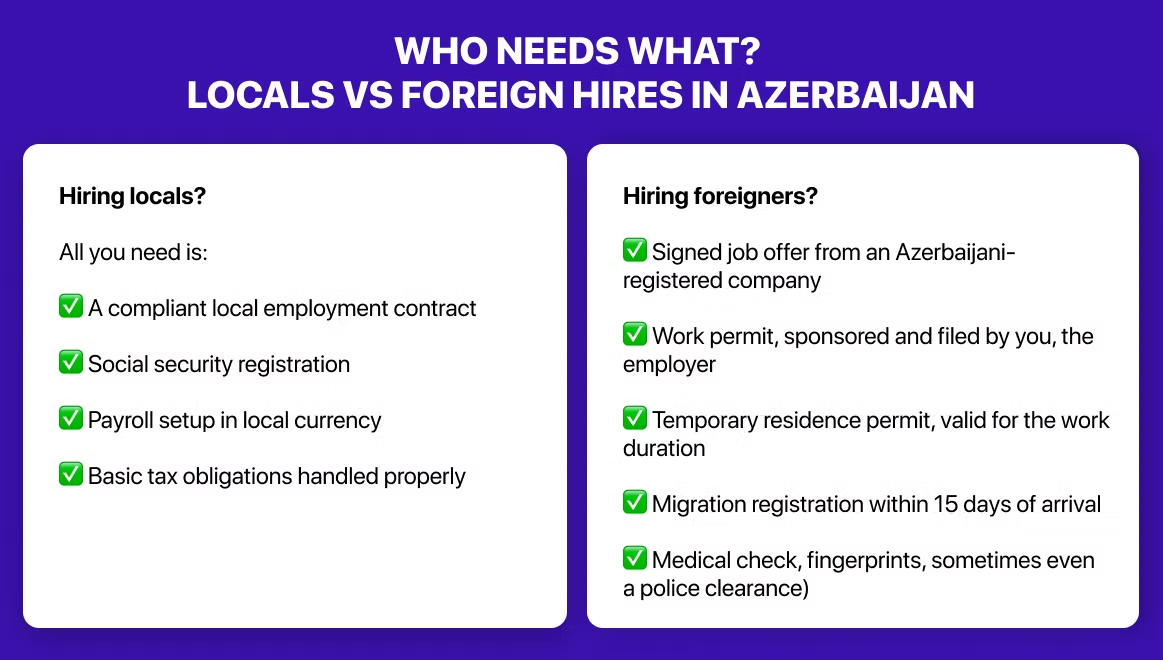
Thing 1: Work Permit Sponsorship in Azerbaijan: Why Only a Local Entity Can Act as Employer
This is the most important thing in this article. Everything else builds from it.
Under Azerbaijani law, specifically the Migration Code of the Republic of Azerbaijan, foreign nationals cannot self-sponsor their employment. A work permit cannot be applied for by the individual. It cannot be applied for by your foreign-registered company. It cannot be submitted by a contractor, an agent, or a third-party service provider without a legal entity in Azerbaijan.
The permit application must be submitted by a registered legal entity in Azerbaijan: a local company, a branch of a foreign legal entity registered with Azerbaijani authorities, or a representation office with valid registration. The State Migration Service (SMS) will only accept applications from entities that hold a valid tax identification number (VÖEN) and are in good standing with Azerbaijani regulatory bodies.
Here's where this becomes the operative decision for every enterprise team without a local presence:
If you don't have an Azerbaijani entity, you need an Employer of Record.
The EOR steps in as the legal employer of record in Azerbaijan. It holds the local registration, it holds the tax ID, it is the recognized sponsor before the State Migration Service. You, the international company, direct the work, set the deliverables, and run the daily business relationship. The EOR handles the legal employment relationship: the contract, the payroll in Azerbaijani Manat (AZN), the mandatory deductions, and critically, the work permit sponsorship.
Why this matters in practice:
Imagine a fintech company based in London wants to bring in a senior blockchain developer from India to its growing Baku engineering hub. The London entity has no Azerbaijani registration. Under Azerbaijani law, it cannot sponsor that work permit. If it tries to engage the developer as a contractor while the "real" hiring happens later, it's exposing both the company and the worker to misclassification and immigration violations.
The correct path: engage an EOR with a registered Azerbaijani entity. The EOR becomes the employer of record, sponsors the work permit, runs payroll, and ensures the developer is legally employed in Azerbaijan from day one. The London company gets its engineer. No entity required. No shortcuts needed.
That's what visa sponsorship for employment through an EOR actually looks like in this market.

Thing 2: Work Permit vs Work Visa in Azerbaijan: Why Both Are Mandatory for Foreign Employees

Here's where even experienced global HR teams get tripped up.
In Azerbaijan, getting a foreign national legally working is a two-document process. The work permit and the work visa are distinct authorizations, issued by different authorities, serving different legal purposes. Having one does not substitute for the other. And both must be in place before your hire touches their first day of work.
Document 1: The Work The Azerbaijan Work Permit: Requirements and Employer Obligations
Issued by the State Migration Service of Azerbaijan (migration.gov.az), the work permit is the authorization for paid employment in the country. It is employer-specific, role-specific, and linked to the physical workplace location.
What the law requires:
- The employee must be at least 18 years old
- The sponsoring employer must demonstrate that no qualified Azerbaijani citizen is available to fill the position
- The role must correspond to a genuine vacancy. Azerbaijan prohibits signing a labor contract with a foreign worker without a valid work permit (Article 69 of the Migration Code)
Documents required for the application (employer-submitted):
- Completed application form (approved format per the State Migration Service)
- Passport copy of the foreign national (valid for at least 6 months beyond intended stay)
- Notarized copies of educational and professional qualifications (translated into Azerbaijani where applicable)
- Reference letter justifying the necessity of hiring the foreign specialist
- For legal entities: notarized copies of the company charter and state registration certificate
- Medical certificate confirming the applicant is free of HIV, Hepatitis B, and Hepatitis C (as per Cabinet of Ministers requirements)
- Proof of residence in Azerbaijan (notarized, including landlord's identity card)
Processing speed and fees: Azerbaijan's ASAN service centers (the government's one-stop citizen services platform) accept work permit applications on behalf of the State Migration Service. Processing is tiered by fee:
- Standard: 20 working days
- Accelerated: 15 working days
- Urgent: 10 working days
Validity:Work permits are issued for one year (or the duration of the labor contract if shorter). They can be extended for up to one year at a time, up to four consecutive renewals. The employer must apply for renewal at least 30 days before expiry. If the state fee is not paid within 30 days of approval, the permit is automatically cancelled.
The Azerbaijan Work Visa (Type D): Entry Requirements for Foreign Employees
This is the entry authorization, the document that allows the foreign national to enter Azerbaijan specifically for employment. It is not the same as a tourist visa or a business visa. The work visa (also called the Labour Visa) is only issued upon invitation from an employer with a registered Azerbaijani entity.
Critical distinction: A work visa grants the right to enter Azerbaijan for employment. The work permit grants the right to work in Azerbaijan. One without the other creates a legal gap. Both must be active before employment begins.
What this means for your hiring timeline:
The permit and the visa processes must be initiated in parallel and coordinated carefully. ASAN service centers and the SMS handle the permit; the visa is typically applied for at the Azerbaijani consulate in the employee's home country, requiring the approved permit as supporting documentation.
Build 6–8 weeks into your hiring plan. In complex cases, national security-sensitive industries, certain nationalities, or roles requiring additional credential checks, which can stretch to 10 weeks or more.
An EOR that runs both tracks simultaneously, preparing visa documentation while the permit is in processing, compresses that timeline meaningfully.
Thing 3: Azerbaijan Work Permit Process: How the Ministry of Labour Impacts Hiring and Approvals
This is the compliance story of 2025 in Azerbaijan, and most global HR teams haven't caught up to it yet.
Until recently, work permit applications in Azerbaijan were handled almost entirely by the State Migration Service (SMS). The SMS is still the issuing authority. But in 2025, the Ministry of Labour and Social Protection formally entered the approval process. According to Fragomen's analysis published in April 2025, citing information from Manager Zaur Gasimov at Fragomen Baku, this is a structural shift in how the Azerbaijani government regulates foreign labor.
What the Ministry of Labour’s Involvement Means for Work Permit Approval
A broader labour market test framework. Previously, the labor market test in Azerbaijan was formally required only in the oil and gas sector. The Ministry of Labour's involvement signals that this scrutiny is expanding. Employers can now expect greater scrutiny of their justification for hiring foreign nationals, specifically, whether a qualified Azerbaijani citizen could have filled the role.
Compliance checks on the employer. The Ministry is now assessing sponsoring employers for adherence to Azerbaijani labor law: fair contracts, proper working conditions, and correct classification of the employment relationship. This is not a box-ticking exercise. An employer with labor violations or payroll irregularities is now at a higher risk of having work permit applications delayed or denied.
Skills alignment review. The Ministry can now assess whether the foreign worker's skills align with Azerbaijan's stated economic priorities and documented labor shortages. Roles in ICT, AI, renewable energy, logistics, and financial technology, sectors, explicitly named in Azerbaijan's national development plans, carry stronger justification narratives than generic roles.
Potential quota enforcement. Industry quotas on foreign workers are a tool the Ministry can now implement more rigorously. If your sector hits a quota ceiling, new applications may face additional hurdles regardless of individual candidate qualifications.
Also in 2025: a new digital submission platform. Azerbaijan introduced an upgraded digital application system that streamlined submission but simultaneously imposed stricter documentation checks. Scanned documents with missing stamps, mismatched details between the passport and the application form, or low-quality uploads now result in rejection rather than a request for corrections. There is less tolerance for administrative error than there used to be.
What This Means for Enterprise Hiring Teams in Azerbaijan
You can no longer rely on a 2022-era playbook. The process is tighter, the scrutiny is higher, and the documentation requirements are more demanding. An EOR that hasn't updated its application methodology for the new Ministry of Labour layer is going to get your permits delayed. Bluntly: this is where the operational gap between a genuine regional EOR and a reseller-model provider becomes a real business problem.
An EOR with in-country legal expertise, one that is tracking Fragomen-level policy updates in real time, knows how to structure the justification narrative, prepare clean documentation from the first submission, and engage the Ministry of Labour framework proactively rather than reactively.
That's the difference between 20 working days and 60.
Thing 4: Highly Qualified Migrant Exemptions in Azerbaijan: Who Qualifies and Who Still Needs Sponsorship
There is genuinely exciting news in Azerbaijan's immigration reform landscape. And there is a trap hidden inside it.
The news: Azerbaijan recently expanded its Highly Qualified Migrant exemption. Under updated rules, foreign nationals classified as "highly qualified" can now work in Azerbaijan without a standard work permit, in any field related to their specialty. Previously, this exemption was limited to individuals working on specific government-approved projects or national interest initiatives. The expanded exemption also extends highly qualified status to five years (renewable), making Azerbaijan a meaningfully attractive destination for elite international professionals.
Processing to obtain this status: 20–30 business days through the Ministry of Labour and Social Protection (and eventually through a dedicated digital portal, currently in development).
The caveat: a residence permit is still required regardless of highly qualified status. The work permit exemption does not remove the immigration authorization requirement. Your hire still needs to legally reside in Azerbaijan, and that requires a separate application.
Who Is Exempt From Work Permit Requirements in Azerbaijan
According to the official State Migration Service (migration.gov.az), the following categories do not require a standard work permit:
- Foreign nationals holding a permanent residence permit in Azerbaijan
- Foreign nationals engaged in independent entrepreneurial activity in Azerbaijan (registered business owners)
- Diplomatic representatives and consulate staff
- International organization employees (accredited in Azerbaijan)
- Military personnel and experts invited to serve in Azerbaijan's Armed Forces
- Media personnel accredited in Azerbaijan
- Individuals on missions totaling no more than 90 days per year in fields defined by the Cabinet of Ministers
- Technology park residents (ICT specialists specifically) — including directors, deputies, and ICT specialists attracted by the tech park resident entity
- Workers operating in the Alat Free Economic Zone
- Highly skilled migrants (under the expanded exemption above)
Common Mistakes Enterprise Teams Make With Work Permit Exemptions
They hear "technology park exemption" and assume it applies broadly to any tech role. It doesn't. The exemption applies to ICT specialists working for entities that are registered residents of an Azerbaijani technology park, a specific legal status requiring park registration, not simply a company that does technology work.
Similarly, the 90-day mission exemption is narrowly scoped to specific fields determined by the Cabinet of Ministers. It is not a general short-term assignment exemption.
A real example:
A US-based data infrastructure company sends a senior cloud architect to its Baku operation for a "three-month project." The architect's passport is American; he has no prior Azerbaijani visa history. The company assumes the 90-day mission exemption applies. It doesn't, cloud infrastructure work is not in the Cabinet-approved field list. The architect works for six weeks, comes to the attention of a government audit, and the company faces fines and a restriction on future foreign hiring.
The correct approach: EOR-sponsored work permit from day one, with the justification narrative built around the architect's specialization in distributed systems architecture, a field with documented labor shortages in the Azerbaijani market.
When in doubt, assume a permit is required and verify before you hire a board a plane.
Thing 5: Azerbaijan Work Visa Rules: Why Tourist Visas Cannot Be Converted Into Employment Status
This one isn't a grey area. There is no exception, no workaround, and no sympathetic reading of Azerbaijani law that makes it okay.
Azerbaijan does not permit the conversion of a tourist or business visa to a work visa from within the country.
If your foreign hire enters Azerbaijan on a tourist e-visa (which is available for citizens of over 80 countries) and begins working, even informally, even unpaid, even "just to assess the role", they are in violation of Azerbaijani immigration law. When the work permit is eventually approved, they cannot simply extend their legal status from tourist to authorized worker within Azerbaijan's borders. They must exit the country, apply for the appropriate work visa at an Azerbaijani consulate in their home country, and re-enter.
That means your hire:
- Incurs additional travel costs
- Experiences a gap in their employment authorization
- Faces potential scrutiny from the State Migration Service on future applications
- May trigger an alert in Azerbaijan's immigration database, depending on the nature of the prior visa violation
Why Tourist Visa Misuse Still Happens in Azerbaijan Hiring
Several neighboring countries, including Georgia, have relatively permissive short-term work authorization arrangements. Experienced global mobility managers sometimes carry assumptions from other markets into Azerbaijan and don't realize the rules are materially different.
Azerbaijan is strict. The SMS and the Ministry of Labour now coordinate more closely on immigration compliance, and spot audits of foreign employees in Baku's tech and energy sectors are real. "We didn't know" is not a defense when the fine lands.
Correct Visa Sponsorship Sequence for Hiring Foreign Employees in Azerbaijan
- Engage your EOR before your hire is confirmed
- Work permit application submitted while the candidate is still in their home country
- Permit approved (typically 20 working days standard, 10 urgent)
- Work visa issued at the Azerbaijani embassy or consulate in the employee's home country
- Employee enters Azerbaijan on a work visa
- Employment begins, legally, cleanly, on day one
This is the only compliant sequence. An EOR that knows Azerbaijan manages this sequencing automatically.
How to Hire in Azerbaijan With an Employer of Record: End-to-End Visa Sponsorship Process
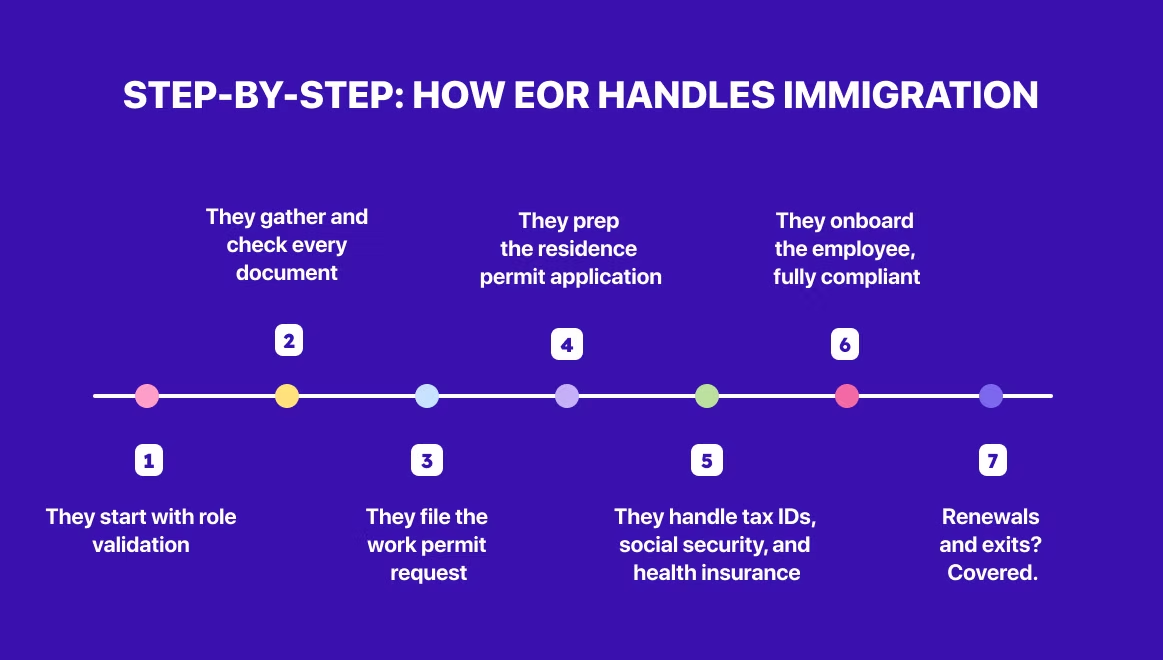
Here's the complete flow when a genuine international employer of record manages visa sponsorship in Azerbaijan on your behalf:
Week 0–1: Eligibility Check and Hiring Strategy for Azerbaijan
Your EOR's in-country legal team reviews the candidate's nationality, role, qualifications, and industry. Key decisions made at this stage:
- Does an exemption apply (highly qualified, technology park, other)?
- Which processing speed tier makes sense for your timeline?
- Is the role in a labor-sensitive industry (oil and gas, construction, protected sectors) requiring additional justification?
- Are there any credential translation or notarization requirements for this specific nationality?
Week 1–2: Document Preparation for Work Permit and Visa Application
The EOR gathers and prepares:
- Application form (State Migration Service approved format)
- Passport copy and visa status confirmation
- Notarized, Azerbaijani-translated qualification documents
- Medical certificate (HIV, Hepatitis B, and C)
- Reference letter justifying the hire (carefully drafted around the labor market justification framework)
- Employer entity documents (charter, state registration certificate, VÖEN)
- Proof of residence documents
Submitted to the SMS via ASAN service center or the State Migration Service directly, along with the applicable state fee for the chosen processing speed.
Week 2–4: Work Permit Review by Azerbaijan Authorities
The SMS reviews the application. For roles in oil and gas or other labor-tested industries, the labor market assessment happens in parallel. The Ministry of Labour may conduct additional compliance and skills reviews. Security checks run concurrently; applicants with no flags are typically cleared within the SMS processing window.
If documentation is incomplete or the justification narrative is insufficient, the SMS issues a written rejection within 5 business days of the decision. Reapplication is permitted after addressing the rejection reason, but this resets the clock entirely.
Parallel Process: Work Visa Application and Entry Coordination
While the permit is being processed, the EOR prepares the work visa invitation letter and supporting documentation. Upon permit approval, this is immediately dispatched to the candidate so they can apply at the Azerbaijani consulate in their home country. The consulate processes the work visa, typically 5–10 business days, and the candidate can travel.
Week 5–8: Temporary Residence Permit Issuance in Azerbaijan
Once in Azerbaijan on a work visa, the foreign national must apply for a Temporary Residence Card through the SMS. Work permit and residence permit documents are submitted together (as required by Azerbaijani regulations). The TRC is issued in alignment with the work permit validity period, one year initially, renewable.
Post-Approval: Payroll Setup and Full Compliance Onboarding
The EOR registers the employee with the State Tax Service of Azerbaijan, enrolls them in the mandatory social insurance system (DSMF, State Social Protection Fund), and begins payroll in AZN. Employment terms reflect the local Labor Code requirements: written contract, statutory leave entitlements, and termination notice periods.
Total timeline: 7–9 weeks for a standard international hire, from EOR engagement to a legally authorized, resident employee. Urgent-track processing can reduce the permit stage to 10 working days, compressing the overall timeline to approximately 5–6 weeks.
Compliance Risks in Azerbaijan: The Real Cost of Work Permit and Payroll Mistakes

Here's what you're actually risking if you skip the process or cut corners.
For the employee:
- Working without a valid work permit: fines and potential deportation under the Migration Code
- Violation of visa conditions (working on a tourist or business visa): mandatory exit from the country, potential re-entry ban
- If the work permit lapses and no grounds remain to stay, the employee has just 10 working days to leave Azerbaijan — there is no grace period
- Change of employer while on an existing work permit: legally prohibited. A new permit must be applied for by the new employer. Unauthorized employer changes expose the employee to status violations
For the sponsoring employer:
- Administrative fines and restrictions on future work permit applications
- Labor law violations (employing without a contract, payroll errors, classification mistakes) are now subject to review by the Ministry of Labour as part of the permit process
- Permanent establishment risk: if a foreign company operates in Azerbaijan through what the tax authorities deem a fixed place of business — even informally — it may trigger corporate tax obligations without a registered entity
- Reputational damage in a market where government relationships matter enormously, especially in tech, energy, and logistics
The contractor misclassification trap:
Some international companies try to bring in foreign talent as "independent contractors" to avoid the permit process. Azerbaijan's labor authorities are well aware of this tactic. If the working arrangement has the hallmarks of employment, consistent hours, direct supervision, company-provided equipment, exclusive or primary engagement, the relationship will be treated as employment regardless of what the contract says. The missing work permit obligation doesn't disappear because you changed the document title.

The Ministry of Labour's expanded role in 2025 means compliance checks are now more likely to surface these arrangements.
The bottom line: One compliance misstep in Azerbaijan creates a domino effect, a stranded employee, a frozen hiring process, and a legal remediation timeline that typically runs 6–10 weeks. The cost of doing it right from the start is a fraction of the cost of undoing it.
Employer of Record Azerbaijan: Why Team Up’s Local Infrastructure Matters
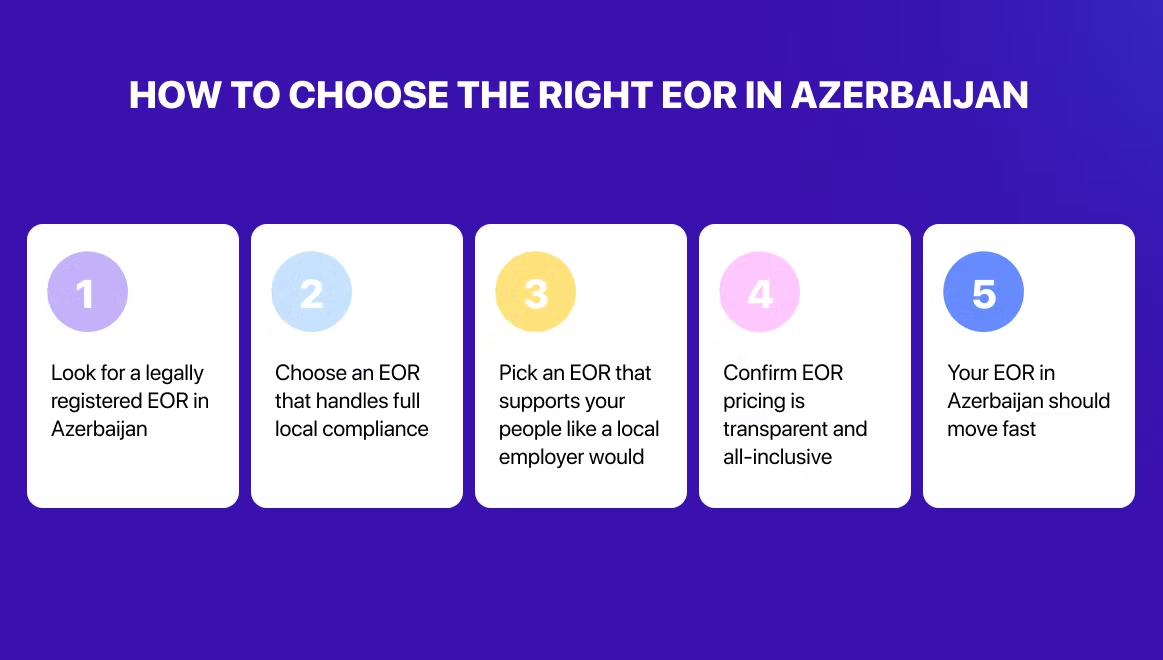
Not all EOR providers are the same. In emerging markets, the difference between a provider that owns its entity and one that subcontracts to local partners can mean the difference between a 20-day permit and a 60-day delay with no one accountable.
Team Up operates with directly owned entities across the Caucasus, Azerbaijan, Georgia, and Armenia, with expanded operations in Kazakhstan, Uzbekistan, Turkey, India, Egypt, and beyond. In Azerbaijan specifically, this means:
Direct SMS and ASAN engagement: Team Up's Baku-based legal and compliance team submits applications directly to the State Migration Service and ASAN service centers, not through local brokers or affiliate networks. Direct access means faster responses, real accountability, and the ability to proactively manage Ministry of Labour inquiries in real time.
Fluency in the Azerbaijani bureaucracy: Documents must not be notarized and translated into Azerbaijani. Applications must use State Migration Service-approved forms. Reference letters must meet a specific evidentiary standard under Azerbaijani law. Team Up's in-country team navigates all of this natively, because they work in this system every day.
Post-2025 compliance readiness: The Ministry of Labour's new role in work permit approvals, the 2025 digital platform upgrade, and the expanded highly qualified migrant exemption, Team Up's legal team tracked all of these changes in real time and updated its application methodology before clients were affected. That's what proactive compliance looks like.
Payroll precision in AZN: Azerbaijan's flat 14% income tax is simple in structure but demands a correct setup in the State Tax Service system. Social insurance contributions (DSMF), mandatory medical insurance, and proper employment contract terms under the Labor Code require local expertise to execute without errors. Team Up's payroll team runs this accurately from the first pay cycle.
Permit renewals and status management: Work permits must be renewed at least 30 days before expiry. TRCs follow the same timeline. If the state fee is missed within 30 days of approval, the permit is cancelled. Team Up tracks these deadlines automatically across every employee it manages, no manual follow-up required from your HR team.
For enterprise teams making their first or fiftieth hire in Azerbaijan, the right EOR partner is not just administrative convenience. It's the legal infrastructure that makes the hire possible in the first place.
Bottom Line
Azerbaijan is one of the most strategically interesting expansion markets in the Caucasus and Central Eurasia right now. The ICT sector is accelerating at 18% annually. The government is deploying real infrastructure, AI hubs, tech parks, startup accelerators, digital government platforms. And the talent pool is growing year over year, but still has meaningful gaps in specialist roles that create a legitimate, legally justifiable demand for international hires.
The immigration system is structured. It requires a registered local sponsor. It involves multiple documents that must be processed in the right sequence. And it just got a new layer, the Ministry of Labour, that demands higher-quality applications and tighter employer compliance.
EOR-sponsored visas in Azerbaijan are not a difficult path. They are the compliant path, and when run by an EOR with real in-country infrastructure, they're the fastest path too.
If you're planning to hire in Azerbaijan in 2026, start the process before you need the permits. Plan for 6–9 weeks. Document your justification carefully. Never count on the tourist visa as a bridge. And choose an EOR that employs a legal team in Baku, not one that subcontracts from a regional hub.
The market is worth building in. Build it right.
FAQ: EOR-Sponsored Visas in Azerbaijan
What is visa sponsorship for employment in Azerbaijan?
Visa sponsorship for employment means a legally registered Azerbaijani entity formally sponsors the work permit application for a foreign national and issues an employment visa invitation. Only registered legal entities can sponsor, individuals and foreign-registered companies cannot self-sponsor. If you don't have an Azerbaijani entity, an employer of record provides this sponsorship on your behalf.
What is the difference between a work visa and a work permit in Azerbaijan?
A work visa grants the right to enter Azerbaijan for employment purposes. A work permit grants the right to work. Both are mandatory and must be active before employment begins. The work permit is issued by the State Migration Service; the work visa is issued by Azerbaijani consulates abroad, based on the approved permit.
How long does an Azerbaijan work permit take?
Standard processing: 20 working days. Accelerated: 15 working days. Urgent: 10 working days. Additional time is needed for the work visa (5–10 business days at the consulate) and the temporary residence permit (typically concurrent with the work permit submission but requires follow-through upon arrival). Budget 6–9 weeks total.
Can I convert a tourist visa to a work visa inside Azerbaijan?
No. Azerbaijan does not permit in-country visa category conversions. The foreign national must exit and apply for a work visa at an Azerbaijani consulate in their home country after the work permit is approved.
Who is exempt from the Azerbaijan work permits?
Permanent residents, entrepreneurs, diplomatic staff, military personnel, accredited media professionals, technology park ICT specialists, Alat Free Economic Zone workers, individuals on Cabinet-approved missions under 90 days per year, and — under the newly expanded rules — highly qualified migrants in fields aligned with their specialty. Exemption categories are specific and legally defined; do not assume a role qualifies without verifying with an in-country legal expert.
What is the highly qualified migrant exemption in Azerbaijan?
Expanded in 2024–2025, this exemption allows foreign nationals who qualify as "highly qualified" (assessed via a points-based system by the Ministry of Labour) to work in Azerbaijan without a standard work permit in any field related to their specialty. The status is valid for five years and is renewable. A residence permit is still required regardless.
What happens if a foreign employee's work permit expires?
The employer must apply for renewal at least 30 days before expiry. If the state fee is not paid within 30 days of the renewal decision, the permit is automatically cancelled. Once cancelled, the employee has 10 working days to exit Azerbaijan unless they have another legal basis to remain.
Can a foreign employee on an Azerbaijan work permit change employers?
No. Work permits are employer-specific. A new employer must apply for a new permit. Working for a different employer than the one named in the permit is a violation of Azerbaijani immigration law.
What does an employer of record do in Azerbaijan?
An EOR in Azerbaijan is a locally registered company that employs foreign nationals on behalf of an international business. It sponsors the work permit, processes the work visa invitation, runs compliant local payroll in AZN, registers employees with the State Tax Service and DSMF, and manages all statutory obligations under Azerbaijan's Labor Code, while the international business directs the day-to-day work.
What are the compliance risks of hiring without proper work permit sponsorship in Azerbaijan?
Fines, permit cancellations, restrictions on future foreign hiring, mandatory exit of the employee within 10 working days, and potential reputational damage with Azerbaijani government authorities. For the employer, Ministry of Labour compliance checks now run in parallel with the SMS process, making it harder to hide labor violations behind technical permit compliance.
.svg)


