


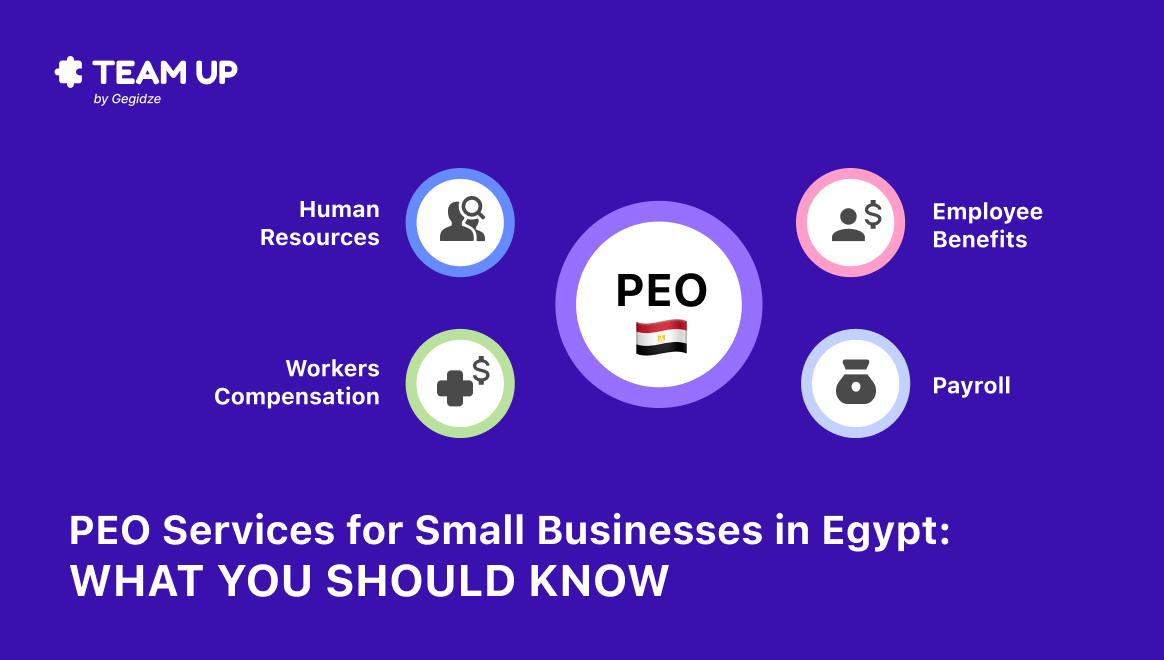
PEO services for small businesses in Egypt: What you should know
Introduction
If you run a small business in Egypt, you already know this. Payroll is never “just payroll.” It is a monthly obstacle course of changing tax brackets, shifting social insurance caps, Arabic government portals that reject submissions without explaining why, and labour rules that feel simple until you actually apply them.
That is exactly why founders and HR leaders start looking for PEO services for small businesses in Egypt. Not because they want to outsource HR for fun. Because running payroll in Egypt without help is a guaranteed way to lose sleep, lose time, and eventually, lose money.
This guide cuts the fluff and walks you through what PEOs really do in Egypt, how payroll actually works under Egyptian law, when a PEO is the right tool, and when you’re better off with an EOR like Team Up, the partner companies across the Caucasus and beyond rely on when they refuse to gamble with compliance.
Let’s get into it.

What is a PEO in Egypt
Egypt is a huge, talent-rich market. But the compliance environment? Brutal for small teams and foreign companies.
Most founders don’t seek PEO support because they want to scale HR. They do it because they’re tired of:
- miscalculating taxes
- updating spreadsheets every time the government publishes a new cap
- chasing signatures
- fighting with state portals
- learning labour laws the hard way
Egypt punishes HR guesswork. And nothing shows that faster than payroll.
Payroll is unforgiving; one wrong number, one penalty
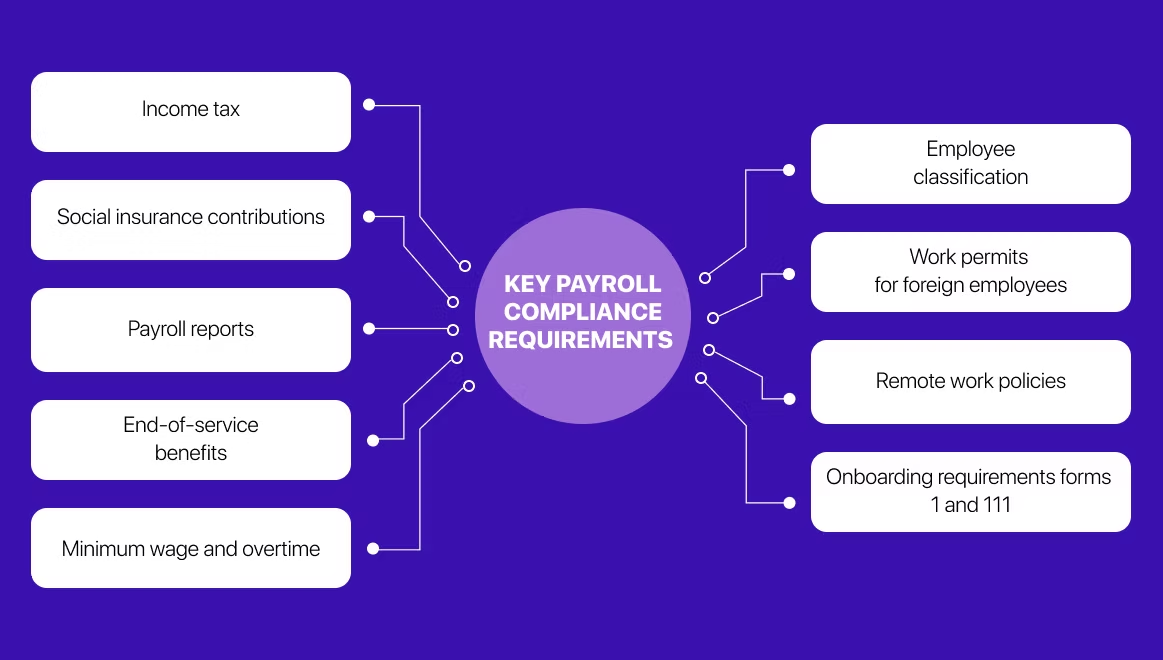
Egypt’s progressive income tax system has been revised repeatedly over the past few years. The latest brackets run from 0 percent up to 27.5 percent, with exemptions and credits that apply differently depending on salary. If you’re not recalculating yearly, you’re wrong.
Add the monthly withholding requirements and electronic reporting obligations, and the margin for error drops to near zero.
Social insurance is a moving target, and always mandatory
Every employee in Egypt must be registered for social insurance. And every company must pay into it.
As of 2025:
- Minimum insured salary: 2,300 EGP
- Maximum insured salary: 14,500 EGP
- Employer contribution: roughly 18.75 percent
- Employee contribution: roughly 11 percent
These ceilings change annually. Fail to update them and your payroll turns non-compliant instantly.
Labour law in Egypt is not “interpretation-friendly.”
Employment law here is document-driven. If it isn’t written, signed, and stored, it may as well not exist.
Critical rules include:
- A standard 48-hour workweek (even though many employers use 40)
- Mandatory written employment contracts
- 21–30 days of annual leave depending on tenure and age
- Sick leave that stretches up to 180 days
- Defined notice periods
- Defined severance structures
- Documentation requirements during termination
Miss one of these and you will feel it, usually in court.
Documentation is king, and Arabic systems do not forgive errors
You must maintain:
- bilingual contracts
- social insurance forms
- attendance registers
- payslips
- disciplinary letters
- termination notices
And you must file electronically through the Arabic government systems that expect absolute accuracy.
This is the point where companies finally say: “We need help.” And that’s where a PEO steps in.

What a PEO for small businesses actually does in Egypt
Let’s clear the marketing noise. A PEO in Egypt does not take over your company. It does not become your employer of record. It does not absorb legal liability.
A PEO handles the operational side of employment, so you stop drowning in admin, while you remain the legal employer.
Payroll execution without mistakes
A PEO takes over:
- salary and allowance calculations
- tax calculation using current brackets
- social insurance contributions using updated caps
- payslip generation
- monthly filings with the Tax Authority
- monthly filings with the Social Insurance Authority
They follow the law for you, because “hoping spreadsheets are correct” is not a compliance strategy.
HR admin that actually reflects Egyptian law
A good PEO handles:
- drafting bilingual contracts that actually hold up legally
- onboarding workflows
- leave management
- probation tracking
- attendance documentation
- HR letters (salary certificates, experience letters, bank letters)
This is not “nice to have.” This is what passes audits.
Compliance monitoring that stops small mistakes from becoming court cases
Egypt does not forgive:
- Incorrect termination procedures
- missing documentation
- outdated contract terms
A PEO:
- tracks labour law updates
- ensures contracts include the right clauses
- checks notice periods and entitlements
- prepares the required documents if an inspection happens
Do they replace a law firm? No. Do they reduce unnecessary legal exposure? Absolutely.
Benefits and allowances handled the right way
Egyptian compensation is structured. Allowances matter. Some affect tax. Some affect social insurance. Some don’t.
A PEO ensures:
- allowances are coded correctly
- Employer cost is predictable
- Compliance is maintained
This alone can save years of retroactive corrections.
How PEO payroll works in Egypt (Step-by-step)
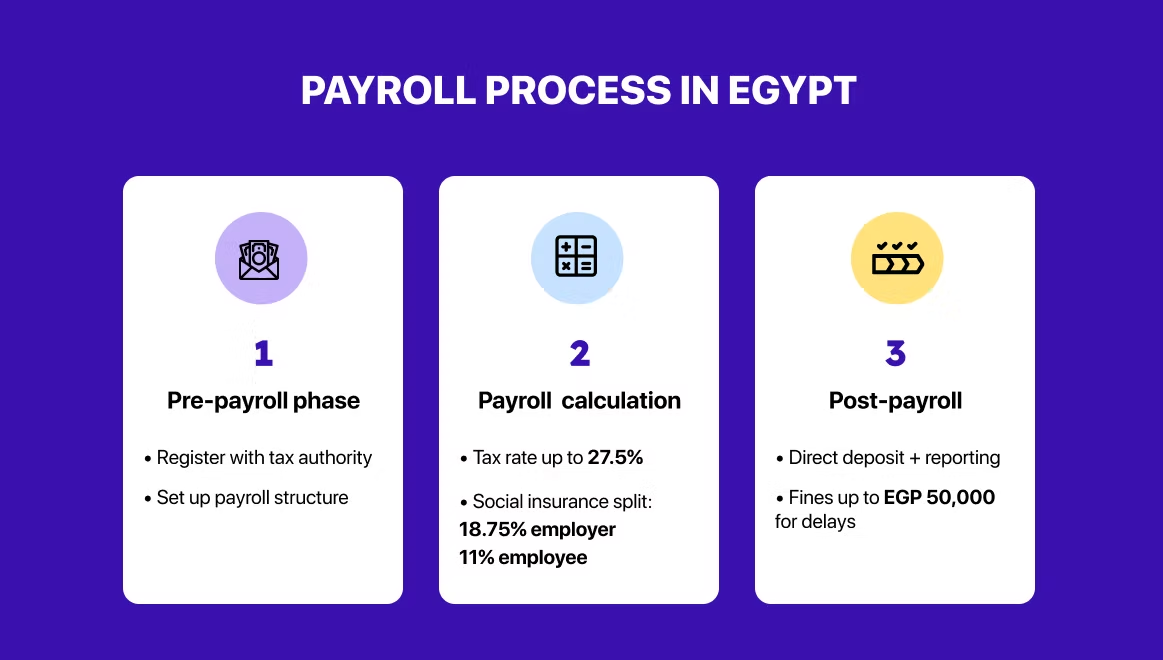
Egyptian payroll is not one calculation. It is a chain of decisions. A PEO handles each one.
Step 1: Build the gross salary
The PEO gathers:
- base salary
- fixed allowances
- variable pay items
This forms the employee’s gross income.
Step 2: Apply Egypt’s progressive income tax
Egypt uses tax brackets from 0 percent up to 27.5 percent, applied to annualised income, then adjusted monthly. Personal exemptions (around 20,000 EGP) also apply.
A PEO:
- annualizes
- applies correct brackets
- calculates credits
- derives monthly withholding
- adjusts when salary changes mid-year
This is where amateurs make mistakes. And Egypt does not tolerate mistakes.
Step 3: Calculate social insurance contributions
Using the updated caps, the PEO calculates:
- employer share
- employee share
- insured salary basis
And handles special categories like managers listed in the commercial registry, who follow different contribution rules.
Step 4: Apply additional employee or company deductions
Depending on the company, this may include:
- health funds
- solidarity contributions
- retirement schemes
- reimbursements or allowances with a taxable impact
Step 5: Generate bilingual payslips and employer reports
Employees expect clarity. Auditors expect detail. A PEO ensures both.
Step 6: File everything with the right authorities
This is where most internal teams fail. Egypt requires punctuality:
- income tax payments
- social insurance submissions
- accurate monthly reporting
A PEO stops penalties before they exist.
The one rule founders miss: You need an Egyptian entity to use a PEO
This is the mistake 90 per cent of foreign founders make.
A PEO is not a legal employer.
A PEO cannot hire employees on your behalf.
A PEO cannot register your employees with authorities in its own name.
To use a PEO in Egypt, you must already own a local Egyptian legal entity.
If you don’t have an entity?
You legally cannot hire through a PEO.
You need an Employer of Record (EOR) in Egypt instead, like Team Up.
- becomes the legal employer
- issues compliant contracts
- registers employees with tax and insurance authorities
- runs payroll end-to-end
- carries employer liability
- allows hiring with zero local entity
A PEO is for companies already in Egypt.
An EOR is for companies entering Egypt.
Simple as that.
PEO vs EOR in Egypt: Which model fits your plan
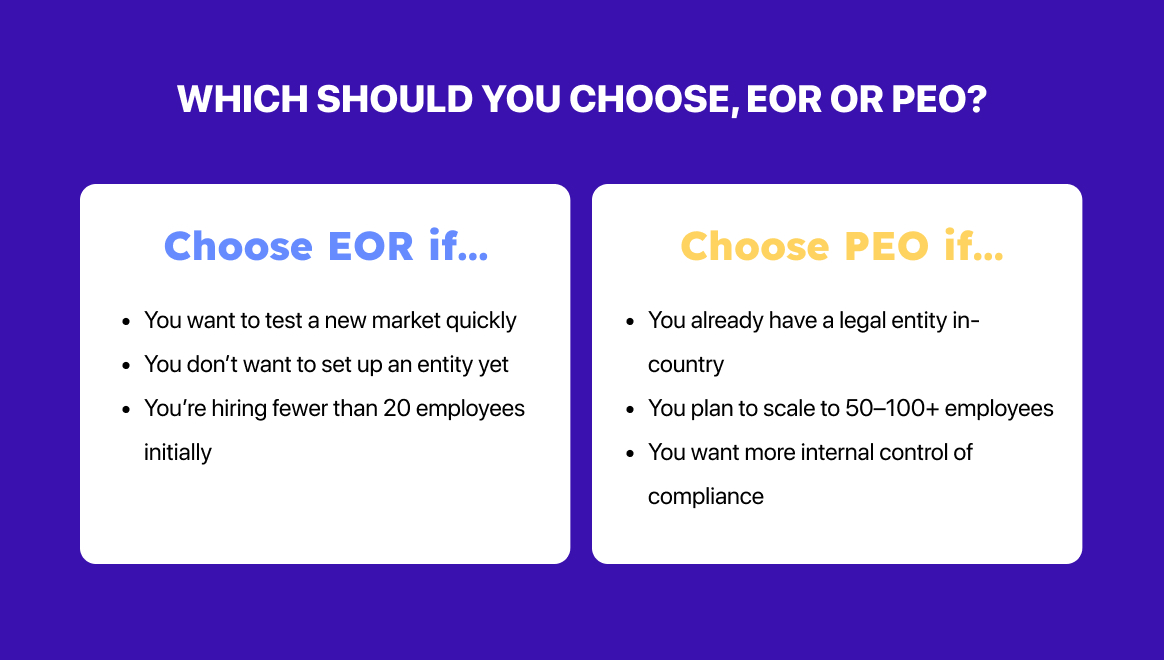
Let’s clear the confusion.
Use a PEO when:
- You already own an Egyptian entity
- You want to outsource payroll + HR admin
- You want more compliance structure without giving up employer control
- You are comfortable carrying employer liability
Use an EOR when:
- You do not have an Egyptian legal entity
- You need to hire fast
- You want to limit risk
- You want predictable monthly costs
- You want to test or scale Egypt without setup costs
This is why Team Up’s EOR services in Egypt are the default choice for global companies. It removes friction, removes liability, and replaces a mess of filings with a single clean invoice.
PEO pricing in Egypt: PEPM vs percentage of payroll
Egyptian PEOs typically use two pricing models:
1. PEPM (Per Employee Per Month)
Clear. Predictable. Harder to hide fees.
2. Percentage of payroll (usually 3–12%)
Feels affordable at first.
Then salaries rise.
Then your bill rises.
And most hidden margin lives here.
What drives the cost up:
- Number of employees
- Complexity of salary structures
- Multi-office support
- HR consulting levels
- Benefits administration
- Termination support
- Legal guidance
Hidden PEO costs in Egypt that never show up on the sales deck
PEO proposals always look clean. The invoices rarely do.
If you are serious about Egypt, you need to know where the real money hides.
1. Setup and onboarding fees
Most PEOs in Egypt charge you just to start working with them.
That can show up as:
- one-time implementation fees
- per employee onboarding fees
- extra charges to align your current payroll data with their system
What to ask:
- “Is there any one-time setup fee for Egypt?”
- “Do you charge per employee onboarding, or is that included?”
- “Is migrating existing employees into your system part of the base fee?”
If they dodge, they are charging.
2. Off-cycle payroll and correction fees
Real life in Egypt is messy. You will:
- Hire mid-month
- pay bonuses
- fix mistakes
- correct tax or insurance contributions
Some PEOs treat anything outside the normal run as an add-on.
That includes:
- off-cycle payroll runs
- re-issued payslips
- revised tax calculations
- corrections to social insurance submissions
What to ask:
- “Are off-cycle runs included?”
- “If we need to fix past months, do you bill extra?”
If every fix is a separate line item, your cost will drift up every quarter.
3. Handling notices from Egyptian authorities
The more you operate, the more likely you are to get a notice.
From tax.
From social insurance.
From labour authorities.
Strong PEOs stand in front of those with you. Weak ones call that “extra consulting”.
What to ask:
- “If the Tax Authority or Social Insurance sends a notice related to filings you handled, who answers it?”
- “Is that included in the fee or charged separately?”
If they will not own their own filings, that is a red flag.
4. Markups on benefits and allowances
Once you start offering health cover or other benefits, PEOs often:
- aggregate plans
- negotiate with providers
- pass on access to you
All useful. Until they stack a margin on top with no breakdown.
What to ask:
- “What is the base premium from the insurer?”
- “How much of what we pay is your admin fee?”
- “Can we see a simple cost breakdown?”
If they cannot answer, assume you are subsidising someone else’s pricing.
5. Minimum monthly fees and headcount floors
If you are small or still building your team, this one hurts the most.
Common patterns:
- minimum invoice amount, even with only a few employees
- required minimum headcount
- base fee that applies even if your team shrinks
What to ask:
- “What is the minimum monthly amount we will pay, even with one employee?”
- “Is there a required minimum number of employees?”
If you are testing Egypt with a small footprint, these floors matter more than the fancy per-employee rate.
6. Document and letter charges
In Egypt, employees constantly need:
- salary certificates for banks or visas
- experience letters
- confirmation letters for landlords or embassies
Some PEOs include these. Others charge per document.
What to ask:
- “Are salary and employment letters included in the monthly fee?”
- “Do you charge for standard HR letters?”
If every document triggers a charge, you will feel it over a year.
7. Termination and legal advisory fees
Termination is where Egyptian labour law gets serious.
You will need:
- correct notice
- proper documents
- settlement calculations
- clear communication
PEOs often charge extra for:
- complex terminations
- legal review or advice
- custom settlement agreements
What to ask:
- “Is support for normal terminations included?”
- “When do you start billing extra on labour law questions?”
You need clarity before you are under time pressure with a real case.
8. Contract lock-ins and exit fees
Some PEOs in Egypt love long lock-ins.
Common traps:
- one or two-year minimum terms
- penalties for early termination
- notice periods that are longer than your planning horizon
What to ask:
- “What is the minimum contract term?”
- “Is there a penalty if we exit earlier?”
- “How long is the notice period to stop services?”
You do not want to be locked into the wrong partner just because your business has changed.

When PEO is a smart move for Egyptian small businesses
Let’s be clear. PEO is not the villain. In the right conditions, it is exactly what a serious Egyptian employer should use.
Here is when it genuinely works.
1. You already have an Egyptian legal entity, and it is not going anywhere
This is the first filter.
PEO only makes sense if:
- You already have a registered company in Egypt
- You plan to keep that entity active
- You intend to employ people directly under this company
If you are committed to Egypt long term, PEO helps you build a disciplined HR engine behind that structure.
2. You have moved beyond “Excel payroll”
You are in PEO territory if any of this sounds familiar:
- Payroll lives in one fragile spreadsheet
- No one is certain if tax brackets or social insurance caps are current
- Payslips are manually created
- no clear audit trail for changes
At 10 to 50 employees, this is not lean. It is reckless.
A strong PEO gives you:
- standardised processes
- consistent gross to net logic
- documented payroll history
- audit-ready reports
You stop holding your breath every month.
3. You have mostly local staff and complex allowances
If your team is mostly in Egypt, with:
- multiple allowance types
- variable bonuses
- overtime
- shifts
Then a PEO simplifies a lot.
They keep your structure compliant even as you tweak comp packages to stay attractive.
4. You want internal HR focused on people, not paperwork
Your HR person should spend time on:
- hiring
- onboarding
- culture
- performance
Not wrestling with insurance caps and tax portals.
A PEO takes:
- raw inputs from HR
- turns them into clean payroll
- handles submissions
HR still owns people. PEO owns the process.
5. You want to clean up before things get serious
If you know:
- You might raise capital
- You might sell
- You might be inspected
Then, cleaning up now is cheaper than reacting later.
PEO standardises everything, so you are not rebuilding history for a due diligence data room.
When PEO becomes a liability in Egypt
There are also cases where PEO is the wrong tool. In these, forcing PEO into your strategy creates more risk, not less.
1. You do not have an Egyptian entity
This is non-negotiable.
No local entity means:
- No compliant co-employment
- No valid PEO model
- No way for a PEO to “host” your employees legally
If a provider claims they can “act as your PEO” in Egypt while you have no entity, they are either using the wrong term or inviting you into a grey area.
If you want to hire without an entity, you need EOR. That is the entire point of an Employer of Record.
2. You are still testing Egypt
If your plan is:
- One country manager in Cairo
- a small sales or support pod
- a handful of engineers
And you are not sure yet whether Egypt is a long-term bet, then:
- incorporating
- registering
- Then layering a PEO on top
It's overkill.
EOR lets you:
- hire quickly
- pay cleanly
- stay compliant
- Walk away if the market does not fit
No sunk cost. No shell entity to dismantle.
3. You want to ring-fence risk as much as possible
Under a PEO model:
- Your entity is the employer
- You are the name on the contract
- You face the authorities if things go wrong
PEO reduces operational mistakes.
It does not change who is responsible.
If you, your board, or your investors care deeply about limiting direct exposure, an EOR is a better choice.
The EOR becomes the employer of record.
You direct the work.
They carry the legal structure.
4. You are building a multi-country team
If Egypt is just one dot on your map, and you also hire in, say, Georgia, Armenia or other markets, running:
- separate entities
- separate PEOs
- separate systems
becomes a headache.
A regional EOR approach gives you:
- One framework
- One commercial model
- One partner is responsible for employment risk across markets
Egypt fits straight into that, instead of becoming a one-off exception with its own PEO stack.
How to choose a PEO in Egypt without regretting it six months later
If, after all of this, you are still sure PEO is right for your situation, the real risk now is picking the wrong provider.
Here is how to evaluate PEOs in Egypt like someone who has already survived one bad choice.
1. Test their Egypt knowledge with real scenarios
Skip the generic “we know compliance” talk.
Ask:
- “How do you handle the termination of a mid-level employee with two years of service?”
- “How do you calculate contributions when the social insurance cap changes mid-year?”
- “What happens if an employee works in Egypt but is paid partly in foreign currency?”
You want specific, local answers. Not vague theory.
2. Demand pricing that fits on one page
Ask for:
- a clear per employee or percent of payroll rate
- a list of inclusions
- a list of exclusions
- confirmation of the minimum monthly fee
- contract term and notice period
If you cannot explain their pricing to your CFO in ten minutes, it is too complicated.
3. Look at the tools your team will actually touch
Ask them to show:
- employee portal
- payslip format
- manager dashboard
- sample reports for finance
If it looks outdated or confusing, your staff will hate it. Adoption will drop. Support tickets will climb.
4. Test support before you sign
Before agreeing to anything, send them two or three realistic cases.
For example:
- “We are promoting an employee and raising salary. How does this affect tax and insurance.”
- “We need to end a contract for performance. What steps would you advise.”
- “We plan to add a health benefit. How will that appear in payroll.”
Watch for:
- response time
- clarity
- confidence
- local accuracy
You are not just buying software. You are buying brains.
5. Clarify who pays for errors
Ask directly:
- “If a filing you handle causes a penalty, who pays?”
- “Will you fix historic mistakes at your cost if they are your fault?”
- “Do you carry any professional liability coverage?”
If they will not commit to responsibility, consider that your answer.
6. Check their track record in Egypt
Look for:
- existing clients with a similar size and profile
- Experience with your sector if possible
- proof they have handled inspections or audits successfully
You do not want to be their first real Egypt experiment.
Final guidance. PEO vs EOR in Egypt and how Team Up fits into this
Here is the honest take.
A PEO in Egypt is a smart move if:
- You already have an Egyptian company
- You are committed to staying
- Your local headcount is growing
- HR and payroll are eating too much internal time
- You are comfortable staying with the legal employer
In that world, PEO is a clean way to professionalise operations.
A PEO becomes a liability if:
- You have no entity
- Your team is small or experimental
- You want to move fast
- You want to limit risk
- You are hiring in multiple countries and do not want a different setup per market
In that world, what you need is not PEO.
You need EOR.
That is exactly where Team Up comes in.
With Team Up as your Employer of Record provider in Egypt, you get:
- legally compliant employment without opening an Egyptian entity
- local contracts that respect Egyptian labour law
- payroll with correct income tax and social insurance every month
- full handling of local filings and registrations
- One invoice that covers everything
- One model you can reuse across Egypt, the Caucasus and other key markets
You keep control of the people, the work and the culture.
We carry the employment risk, the payroll burden and the compliance grind.
If your goal is to build a serious team in Egypt without turning into a full-time labour law specialist, PEO is not where you start.
You start with EOR.
You start with a partner that already knows this market inside out.
You start with Team Up.
FAQ
1. What are PEO services for small businesses in Egypt?
PEO services for small businesses in Egypt provide outsourced HR, payroll, and compliance support while the company remains the legal employer. A PEO calculates taxes, manages social insurance, drafts contracts, and ensures labour law compliance for Egyptian employees.
2. How does a PEO work in Egypt?
A PEO handles operational employer functions such as payroll processing, income tax withholding, social insurance contributions, leave tracking, onboarding, and monthly government filings. Your company still signs the employment contract and carries employer liability.
3. Do I need a local entity to use PEO services in Egypt?
Yes. A PEO requires your company to have a legally registered entity in Egypt. Without an Egyptian entity, you cannot hire through a PEO. In that case, the compliant alternative is an Employer of Record (EOR).
4. What is the difference between a PEO and an Employer of Record in Egypt?
A PEO supports HR and payroll functions but does not become the legal employer. An Employer of Record becomes the legal employer in Egypt, issues contracts, registers employees with authorities, and handles compliance for companies without a local entity.
5. How does PEO payroll work under Egyptian law?
PEO payroll in Egypt includes calculation of progressive income tax, social insurance contributions using annual salary caps, allowances, overtime, bonuses, and monthly remittances to the Egyptian Tax Authority and Social Insurance Authority. Payslips and reports are generated for employees and finance teams.
6. Are PEO services cost-effective for small businesses in Egypt?
PEO services are cost-effective for small businesses that already have a local entity and want consistent payroll, documented HR processes, and reduced administrative workload. For companies without an entity or those testing the Egyptian market, EOR is more cost-efficient.
7. What hidden costs should companies watch out for with PEO providers in Egypt?
Common hidden PEO costs include onboarding fees, off-cycle payroll charges, correction fees, benefits markups, minimum monthly billing, charges for HR letters, legal advisory fees, and termination support fees.
8. Can a PEO help with Egyptian labour law compliance?
Yes. A PEO helps with drafting compliant contracts, applying correct leave entitlements, maintaining employee records, ensuring proper notice periods, and preparing documentation for audits or inspections. But legal responsibility remains with your company.
9. When is PEO the right choice for hiring in Egypt?
PEO is the right choice when you already have an Egyptian company, expect long-term operations, need stronger HR processes, and want consistent payroll without building a full internal HR department.
10. When is an EOR better than a PEO for Egypt?
An EOR is better when you do not have an Egyptian entity, want to hire quickly, aim to reduce legal exposure, or plan to test the market. EOR allows compliant hiring in Egypt without incorporation, complex registration, or employer liability.
.svg)


