


Employee benefits, insurance & workspace: What EORs provide in Kazakhstan
Introduction
Let’s face it, hiring in Kazakhstan is easy on paper.
But once you go beyond the “Post job. Get candidate.” fairytale, things get messier.
You want great people. But they don’t know your brand, your culture, or your vision.
You want to retain them. But they’re remote, maybe in Almaty or Astana, maybe not.
You want them set up properly. But what does that even mean—do you ship a laptop from Berlin? Buy a WeWork pass in Tashkent? Pay their gym fee?
And when there’s no entity? No payroll system? No HR arm to manage perks, equipment, or even basic sick leave?
That’s when things start slipping through the cracks.
Not because you don’t care, but because you're building a business, not running a law firm. And building global HR from scratch in a new market? Not exactly lean startup material.
That’s where an Employer of Record (EOR) comes in.
Done right, an EOR is more than a payroll workaround. It’s how you hire fast, stay compliant, and offer a real employment experience without creating a miniature version of your HQ in Kazakhstan.
In this guide, we’ll break down:
- What benefits are legally required in Kazakhstan
- What top companies offer to stay competitive
- How equipment and workspace support actually work
- And how the right setup drives better retention
Let’s get into it.
What benefits are legally required in Kazakhstan?
Before you promise anything fancy, meal cards, wellness budgets, English lessons- you need to get the basics right.
Because Kazakhstan’s labor laws aren’t optional. And if you’re hiring without covering the mandatory stuff? That’s how you end up on the wrong side of the compliance line.
Here’s what your Employer of Record (EOR) in Kazakhstan will cover by default, because they legally have to.
Minimum wage compliance in Kazakhstan
The national minimum wage is KZT 85,000 per month (gross). Every employee, no matter the role, needs to earn at least this much. No exceptions.
Working hours & overtime in Kazakhstan
Kazakhstan operates on a 40-hour workweek spread across five days.
Overtime? Legal, but it needs to be compensated, usually at 1.5x base pay, and capped by labor code regulations.
Paid annual leave in Kazakhstan
Your team gets a minimum of 24 calendar days of paid annual leave per year.
Public holidays don’t count toward this number. And yes, those 12 public holidays? Fully paid.
Sick leave in Kazakhstan
Employees are entitled to paid sick leave, validated by a medical certificate.
Initially paid by the employer, then supported by Kazakhstan’s State Social Insurance Fund if the leave extends.
Maternity & paternity leave in Kazakhstan
Expectant mothers?
- 70 calendar days before birth
- 56 days after (extended to 70 for complicated or multiple births) All covered by state insurance.
Fathers?
They’re eligible for unpaid paternity leave, and parental leave options exist for both parents. An EOR ensures these entitlements are properly processed.
Pension & Social Contributions
- Employees contribute 10% of their gross salary to the Unified Accumulative Pension Fund (UAPF).
- Employers contribute 2.5% starting in 2025 (for those born after 1975); this rate increases yearly.
- On top of that: mandatory payments to the State Social Insurance Fund and Health Insurance Fund, covering everything from maternity to unemployment.
Labor protection & safety in Kazakhstan
Employers must provide a safe working environment, from PPE to compliance with safety protocols. It’s not just for factories; even remote setups need to meet legal standards.
Termination & Severance in Kazakhstan
Let someone go due to liquidation or restructuring?
You’ll owe at least 1 month’s average salary in severance, and you’ll need to pay out any unused leave.
Other paid leave in Kazakhstan
Life happens. So Kazakhstan’s law includes paid leave for events like:
- Marriage
- Funerals
- Hazardous work conditions
Your EOR provider in Kazakhstan should handle all of this, down to the last document.
Is private health insurance mandatory in Kazakhstan?
Short answer? No.
There’s no legal requirement to provide private health insurance in Kazakhstan. The only must-have is enrollment in the Mandatory Social Health Insurance (MSHI) system. It’s the national program every working resident is plugged into, whether they know it or not.
If you hire through an Employer of Record (EOR) in Kazakhstan, they’ll handle this for you:
- Employers contribute to MSHI on top of gross salary
- Employees contribute through payroll deductions
- And the state covers certain groups (children, pensioners, the unemployed)
So yes, your team gets public healthcare access. But does that mean you’re done? Not quite.
Why global employers offer private plans anyway
If you’re hiring senior developers, designers, managers, basically anyone with leverage, they’ll ask what private perks you offer. Because of relying only on the public system? It’s like telling your team their annual check-up will be covered… eventually… by someone’s cousin… maybe.
That’s why foreign companies in Kazakhstan often add private plans on top. To stay competitive.
Here’s what’s common:
- Basic supplemental coverage at private clinics
- Family-inclusive policies
- Direct-access packages (no waiting, no referral stress)
Is private health insurance required for Kazakh citizens or residents?
No.
Is it expected by talent? Increasingly, yes.
Offering private health insurance is one of the fastest ways to signal you’re a real employer, not just another outsourcing body with a Slack login and a spreadsheet.
If you're hiring through Team Up’s EOR service in Kazakhstan, we’ll help you bundle private health plans into your offer or decide when public coverage is enough.
What other perks do competitive employers offer?

If your entire benefits pitch in Kazakhstan ends with “...and we cover the basics,” you’ve already lost the talent you wanted.
Because here’s the truth: Statutory coverage is just the ticket in. What actually keeps high-performers around? Extras. Perks. Proof that you see them as more than a payroll number.
Let’s break down what top employers (local and global) are offering in Kazakhstan right now, and what your EOR setup needs to reflect if you want to stay competitive:
Perks that actually compete in Kazakhstan
1. Comprehensive Private Health Insurance
The state plan is fine on paper. But if you’re hiring engineers, finance leads, or anyone who’s ever seen a clinic with Wi-Fi, they’ll expect private coverage.
Think: fast access, private clinics, family-inclusive tiers, not just basic care.
2. Housing or Relocation Support
Kazakhstan’s workforce is mobile. So if you're hiring outside Almaty or Astana, relocation perks matter. This could be a housing stipend or temporary accommodation during onboarding.
3. Transport Allowances
In-office teams want help getting there. Company shuttles, fuel reimbursements, or public transport cards are still widely used in sectors like oil & gas and telecom.
4. Performance-Based Bonuses
Sure, they're not mandatory. But good luck competing with firms that offer quarterly bonuses tied to KPIs or retention. Cash talks. Especially in tech and finance.
5. Learning & Development Budgets
Certifications, online courses, language training, if you don’t offer it, someone else will. Especially in the IT and BPO sectors, employees expect a real upskilling path.
6. Flexible Work Models Remote-first is no longer novel. It’s the baseline. Offering hybrid setups, async hours, or 4-day weeks? That’s how you win loyalty, especially post-pandemic.
7. Wellness Perks
We’re talking gym memberships, wellness stipends, and mental health apps. Small budget, big impact.
And yes, Kazakh employees want this, especially younger talent.
8. Cool Workspaces The office vibe still matters. Think ergonomic chairs, break zones, good coffee, and strong Wi-Fi. It’s not a perk; it’s a productivity baseline.
9. Extra Pension Contributions
The legal pension rate is the minimum compliance. If you’re in a long-game industry (banking, energy), top employers top it up with supplementary schemes.
10. Employee Discounts
Retailers and hospitality groups often throw in staff discounts or perks across partner brands. Not flashy, but loved, especially in inflationary times.
Let’s be clear: you don’t need to tick every box. But if you’re hiring through an Employer of Record in Kazakhstan, make sure your offer reflects more than the minimum.
Team Up helps you structure local perks that feel global, and keep your hires from shopping around.
Workspace support for remote employees in Kazakhstan
Let’s be honest, no one wants to join a remote-first company and feel like they’ve been left to fend for themselves on a folding chair at the kitchen table.
In Kazakhstan, remote work isn’t a side hustle setup. It’s legally defined, with real employer responsibilities baked into the Labor Code. If you’re hiring through an Employer of Record (EOR), your remote employees won’t just expect a laptop; they’ll expect a fully supported working environment.
Here’s what that actually looks like.
1. Workspace setup is a legal responsibility
Kazakh law recognizes remote work as an official employment format. That means it’s not optional; you have to define the workspace terms in the employment contract.
This includes:
- Where the work takes place
- What tools are provided
- How employees are expected to communicate and check in
- What hours do they work (yes, even remotely)
2. You need to provide (or reimburse) equipment
Employees can’t be expected to work with a borrowed laptop and their phone’s hotspot.
The law requires employers to provide the gear and access needed for remote work, or reimburse employees who use their own setup. That includes:
- Laptop or desktop
- Internet connection
- Phone or VoIP software
- Accessories (keyboard, headset, monitor, etc.)
And no, “bring your own” isn’t an excuse to cheap out.
3. Safety rules still apply, even at home
You’re responsible for labor protection, full stop.
That means remote workers still need:
- Health and safety onboarding
- Instructions on ergonomic setup
- Safe and legally compliant working conditions It may sound extreme, but if your employee trips over a cable while on Zoom? That’s on you.
4. Cost compensation is negotiable and expected
Electricity, water, and internet bills, remote workers in Kazakhstan are often entitled to partial compensation.
EORs like Team Up handle these negotiations and outline them in the contract to stay compliant.
Coworking spaces = perk, not requirement
Some EOR setups include coworking memberships in Almaty, Astana, or regional cities. While not mandatory, it’s a killer perk, especially for engineers, marketers, or sales staff who want human contact without the full office return.
Who provides the equipment and tools in Kazakhstan?
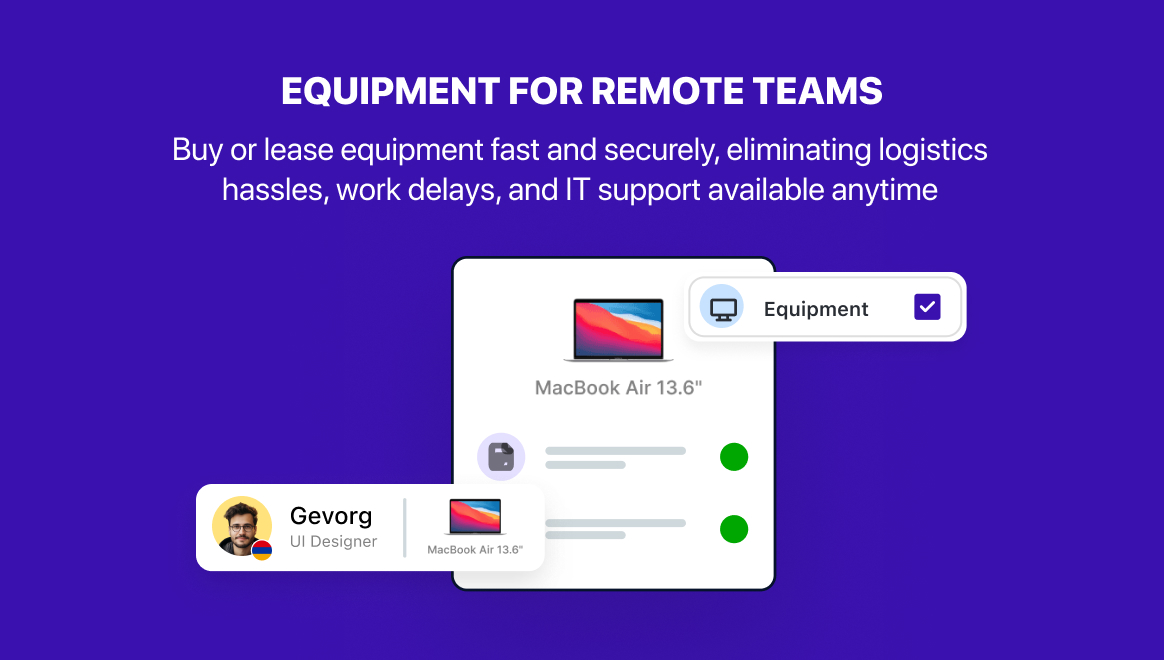
Hiring remote talent in Kazakhstan without sending over the tools they need? That’s like asking someone to code on a toaster.
Under Kazakh labor law, the employer, or your Employer of Record (EOR), is on the hook for more than just payroll. If you want that software engineer or marketing lead to actually, you know, do their job, here’s what needs to happen.
You provide the tools. Period.
The law doesn’t beat around the bush. Employers must supply:
- Laptops or desktops
- Stable internet access
- Phones or communication software
- Monitors, headphones, or keyboards (if relevant to the role)
And no, shipping your castoff MacBook from the London office won’t cut it.
Using their own gear? You still pay.
If your employee prefers their own device (or there’s a local shortage of decent monitors), that’s fine. But Kazakh law says you reimburse them. This is specified in Article 138 of Kazakhstan’s Labor Code, which regulates telecommuting (remote work)
This includes:
- Installation and maintenance
- Internet bills
- Any other work-related usage, even electricity or water, if it’s agreed upon
These terms must be written in a supplementary agreement to the employment contract. No handshake deals.
This goes in the contract
Remote work setups in Kazakhstan must be spelled out in black and white:
- What you’re providing
- What they’re using
- Who’s paying for what
- How and when is compensation processed?
Team Up handles this entire process for you, including contracts, compliance, and coordination.
Safety still matters
Even if your employee is working from a rented flat in Astana, you're responsible for ensuring:
- Ergonomic setup
- Occupational safety compliance
- A workspace that doesn’t destroy their spine
Again, we make sure this is legally covered and practically handled.
How Team Up handles it
We either:
- Procure and deliver equipment locally via trusted providers
- Coordinate reimbursement for employee-owned gear
- Ensure onboarding timelines match up with hardware delivery
No delays. No lost packages. No compliance risks.
Why this setup matters for retention
People don’t quit jobs.
They quit jobs that feel like afterthoughts.
Well, it does really sound like a LinkedIn post, but that’s exactly what your offer looks like if it doesn’t include proper tools, benefits, or a basic sense of “hey, we’re invested in you.”
Here’s the thing: When a developer in Almaty signs on and gets…
- No laptop
- No sick leave policy
- No idea who’s paying their taxes They start to wonder if they’ve actually been hired — or just added to some spreadsheet on autopilot.
And guess what?
Someone else will show up with a better offer.
One that comes with health insurance, a decent workspace, and a welcome email that doesn’t look like it was written by a bot.
Benefits aren’t extra, they’re proof
- Proof that your company values stability
- Proof that this isn’t just some temporary freelance gig
- Proof that someone is looking out for their career
Perks signal legitimacy.
Tools signal trust.
And structured onboarding makes it feel like this job is real.
Here’s what happens with Team Up
When you hire via our EOR model in Kazakhstan, you’re not just “compliant.”
You’re covered. And so are your employees.
We handle:
- Full statutory benefits + add-ons
- Equipment procurement or reimbursement
- Workspace support, onboarding, check-ins
- Payroll. Every month. On time.
The result?
Remote hires stay.
Because they feel like part of your team, not some outsourced ghost crew.
Final comparison: EOR vs building HR ops yourself
So, you’re staring down two options: Employer of Record vs setting up your own entity in Kazakhstan
Option 1: Plug into a ready-made legal structure with zero admin.
Option 2: Build everything from scratch in a country where you don’t speak the language and don’t know the laws.
Let’s break it down.
Using an EOR in Kazakhstan
This is the “done-for-you” model. You hire talent. The EOR becomes their legal employer. They handle:
- Payroll in tenge
- Labor law compliance
- Medical insurance, pensions, and reporting
- All that local HR stuff you don’t want to touch
The upside?
- No need for a local company
- Onboard in days, not months
- No legal headaches or paperwork hell
- Just one monthly invoice
- Leave anytime, no entity to shut down
The catch?
- You’ll pay a flat fee per employee, great for small teams, less ideal for long-term scale
- You don’t own every piece of the process
- Custom benefits? Kind of. But not like having your own HR team on the ground
Building HR in-house
This is the “we’re all in” model. You:
- Register a company
- Open a bank account
- Get licenses
- Hire accountants, lawyers, HR folks
- Handle payroll, tax filings, contracts, terminations, audits, and all the fun stuff
The upside?
- You control every detail
- Better unit economics if you’re hiring 30+ people
- You build brand presence locally
- You own the employer relationship
The catch?
- $10K to $50K setup costs
- Slow onboarding (months, not weeks)
- High legal risk if you mess up labor law
- Exiting the market is a legal slog
So, what’s right for you?
Go EOR if:
- You need speed
- You’re hiring <30 people
- You want compliance without the cost
- You’re testing the market or building a distributed team
Build in-house if:
- You’re committed to Kazakhstan long-term
- You’re scaling headcount fast
- You have legal and HR capacity
- You’re ready to invest in infrastructure
If you're somewhere in between?
Start with EOR. Scale when it makes sense.
Conclusion
If you're trying to win talent in Kazakhstan without getting buried under HR red tape, an Employer of Record isn’t just a nice-to-have; it’s your shortcut to staying competitive.
You’ll offer benefits that look legit.
You’ll pay people on time, in tenge, without legal panic attacks.
You’ll support remote workers with tools, perks, and compliance.
And you’ll do all of this without building an entire HR department from scratch.
That’s what Team Up does: it handles the paperwork, the compliance, the hiring infrastructure, so you can focus on actually working with your team, not managing their contracts.
Hiring in Kazakhstan?
Let’s make it easy.

.svg)


