


Complete EOR Compliance Checklist for Employers in Canada

Our compliance checklist for EOR services in Canada covers the broad legal obligations and risk categories. This article goes deeper into each checklist item. It breaks down the specific federal registrations, provincial filing layers, and ongoing reporting cycles an EOR must manage on your behalf. If you are evaluating providers, the granularity here will help you ask sharper questions. Every item maps to a concrete deadline, registration, or filing obligation that your EOR should handle without gaps.
Federal Compliance Requirements Every EOR Must Meet
CRA Registration and Payroll Accounts
Every EOR operating in Canada must hold an active Canada Revenue Agency (CRA) Business Number with linked payroll program accounts. The CRA assigns a separate payroll account identifier for each group of employees. A single EOR managing workers across multiple provinces may need multiple payroll accounts under one Business Number.
The EOR remits source deductions on each pay cycle. These deductions include federal income tax, Canada Pension Plan (CPP) contributions, and Employment Insurance (EI) premiums. Remittance frequency depends on the EOR's average monthly withholding amount. The CRA classifies remitters as regular, quarterly, or accelerated based on that threshold. Large EORs handling dozens of employees often fall into the accelerated category. That means remitting within three business days of each pay date.
Employment Insurance and CPP Structural Obligations
CPP applies to all employees aged 18 to 70 earning above the basic exemption. The employer matches the employee's contribution. EI premiums follow a similar matched structure, though Quebec uses a separate plan called the Quebec Parental Insurance Plan (QPIP) instead of the federal EI parental component.
An EOR serving clients in Quebec must register separately with Revenu Québec. Federal CRA registration alone does not cover Quebec-specific payroll taxes. A Toronto-based SaaS company hiring two developers through an employer of record in Canada discovered this gap when its first EOR failed to register for Quebec source deductions. The correction took six weeks and triggered penalties.
Record of Employment Filing
When any employee stops working, the EOR must issue a Record of Employment (ROE) within five calendar days of the last pay period. This applies to layoffs, resignations, leaves, and contract completions. Late ROE filings delay the employee's EI benefit claim and expose the EOR to CRA penalties.
Provincial Compliance Layers That Catch Companies Off Guard
Workers' Compensation Registration
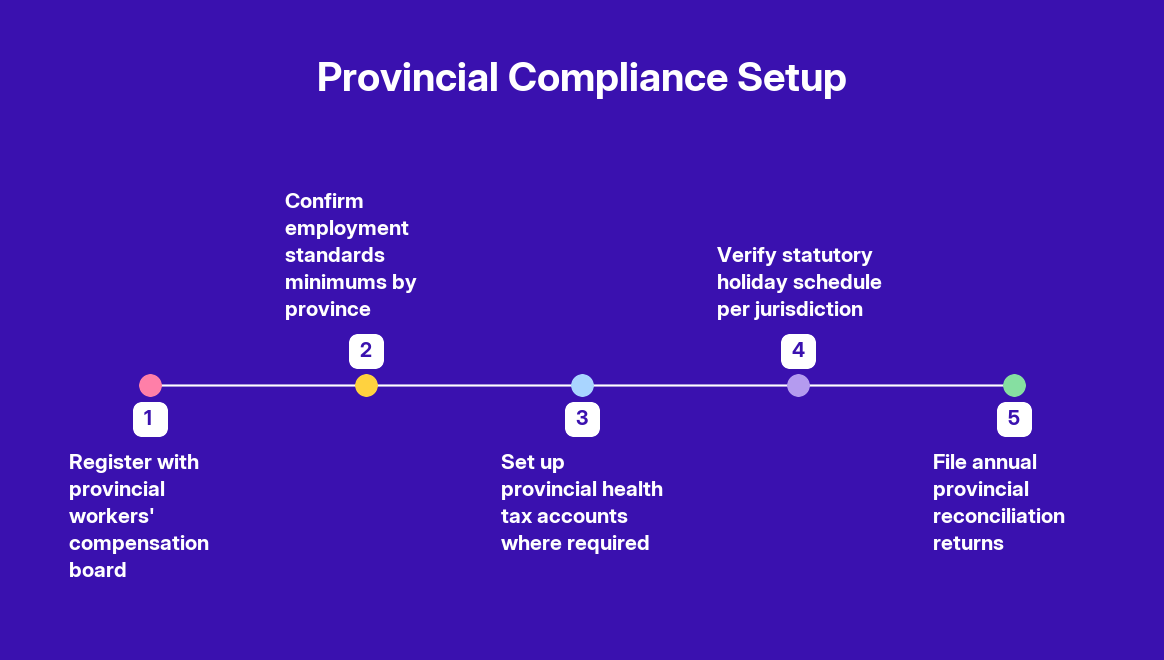
Each province operates its own workers' compensation board. The EOR must register and maintain active accounts in every province where employees perform work. Ontario uses the Workplace Safety and Insurance Board (WSIB). British Columbia uses WorkSafeBC. Alberta uses the Workers' Compensation Board of Alberta.
| Compliance Item | Federal | Provincial |
|---|---|---|
| Income tax withholding | CRA payroll account | Revenu Québec (QC only) |
| Pension contributions | CPP (all except QC) | QPP (Quebec only) |
| Workers' compensation | Not applicable | Mandatory per province |
| Employer health tax | Not applicable | ON, BC, MB, NL thresholds |
| Employment standards | Canada Labour Code (federal workers only) | Provincial ESA for most private-sector workers |
| Statutory holidays | Federal holidays for federal workers | Province-specific holiday calendars |
Employer Health Tax Obligations
Ontario, British Columbia, Manitoba, and Newfoundland and Labrador each levy an Employer Health Tax (EHT) on total payroll. The thresholds and rates differ by province. Ontario's EHT exemption threshold changes periodically. The EOR must track total payroll in each province and file accordingly.
Missing EHT registration is one of the most common gaps when choosing an EOR provider in Canada. Providers without owned payroll infrastructure sometimes overlook these provincial taxes for the first several months of a new engagement.
Employment Standards Act Variations
Minimum wage, overtime rules, vacation entitlements, and statutory holidays vary by province. British Columbia mandates different overtime thresholds than Alberta. Ontario requires vacation pay at a minimum percentage of gross wages, increasing after five years of service. The EOR must configure payroll for each employee based on the province of work, not the province of the client's headquarters.
Watch out: An employee working remotely from Nova Scotia for a client based in Ontario falls under Nova Scotia's employment standards. The EOR must apply Nova Scotia's vacation, overtime, and statutory holiday rules, not Ontario's.
Ongoing Compliance Monitoring and Reporting Cadence

Monthly and Quarterly Filing Rhythms
The EOR's compliance obligations do not end at onboarding. Monthly CRA remittances, quarterly workers' compensation premium reports, and annual T4 slip filings create a continuous reporting cycle. The T4 Summary is due by the last day of February each year. It reconciles all source deductions remitted during the prior calendar year.
Provincial workers' compensation boards typically require quarterly payroll reports. Some boards adjust premium rates annually based on industry classification and claims history. The EOR must track these rate changes and update payroll accordingly. A 90-day delay in reporting can trigger estimated assessments that overstate the actual premium owed.
Legislative Change Tracking
Federal and provincial governments amend employment standards frequently. Minimum wage increases, new leave entitlements, and changes to overtime rules can take effect with as little as 60 days' notice. An EOR serving clients across five provinces must monitor legislative changes in all five simultaneously.
Companies comparing EOR providers in Canada should ask how the provider tracks legislative changes. A provider with in-country compliance staff updates payroll configurations faster than one relying on external legal counsel for periodic reviews. The difference shows up in the gap between a law's effective date and the payroll system's actual update.

FAQs
What happens if an EOR misses a provincial workers' compensation registration?
The provincial board can assess retroactive premiums plus penalties and interest from the date the first employee started working in that province. In Ontario, WSIB penalties can include surcharges on unpaid premiums. The employee also loses coverage for workplace injuries during the unregistered period, creating direct liability for the client company if a claim arises.
Does an EOR need separate registration for the Quebec Pension Plan?
Yes. Quebec operates the Quebec Pension Plan (QPP) instead of CPP. The EOR must register with Revenu Québec, not the CRA, for QPP and QPIP contributions. Failing to register means employee deductions go unremitted. The EOR and the client can both face penalties. This is one of the most overlooked steps for companies hiring their first Quebec-based employee through an EOR.
Can an employee's province of compliance change if they relocate mid-contract?
It can. If an employee moves from Alberta to British Columbia, the applicable employment standards, workers' compensation board, and employer health tax obligations shift to British Columbia. The EOR must update the employee's payroll province, re-register with WorkSafeBC, and apply BC's employment standards within the first pay period after the move. Most EOR service agreements require the employee to notify the EOR before relocating.
What to Watch Next
Several provinces are reviewing employment standards amendments for the coming year. British Columbia and Ontario both have proposed changes to gig worker classification rules that could affect how EORs categorize certain contractors. Federal changes to the Canada Labour Code's right-to-disconnect provisions may also create new compliance obligations for federally regulated workers. Track your EOR's update cadence quarterly. If your provider cannot tell you which provincial amendments took effect in the last 90 days, that gap will eventually become your problem.
If you need a province-by-province compliance review for your Canadian team, TeamUp can walk through the specifics. Request a compliance consultation.
Written by TeamUp — helping companies hire compliantly across 20+ countries with owned local entities in core markets since 2020.
.svg)


