

EOR vs. Subsidiary in Canada: When to Set Up Your Own Legal Entity

Our guide to EOR providers in Canada compared major providers, pricing, and risks. It touched on the subsidiary question briefly. This article goes deeper into the specific financial, operational, and legal triggers that tell you when an EOR no longer makes sense. It also walks through what the transition from EOR to subsidiary actually looks like on the ground in Canada. The decision is rarely about cost alone. Headcount, intellectual property exposure, and long-term market commitment all play a role.
Cost Structures That Drive the Decision
The Per-Employee Math
EOR fees in Canada typically range from $400 to $700 per employee per month. For a five-person team, that means $24,000 to $42,000 annually in EOR management fees alone. Those fees cover payroll processing, tax withholding, benefits administration, and compliance.
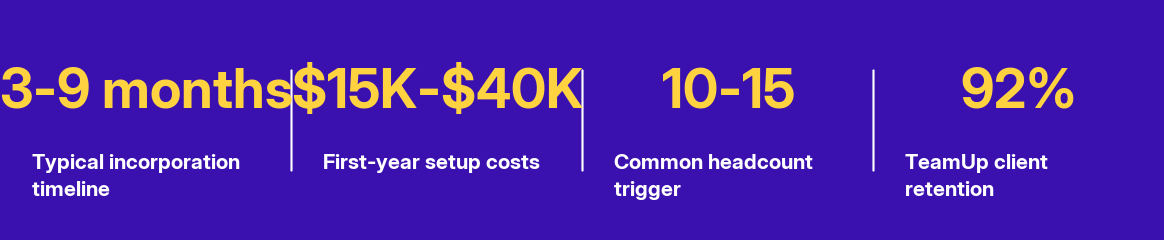
A Canadian subsidiary carries fixed costs that do not scale linearly with headcount. Incorporation, legal setup, and initial registrations with the Canada Revenue Agency cost roughly $15,000 to $40,000 in the first year. Annual maintenance adds accounting, corporate tax filings, and registered agent costs.
The crossover point depends on your growth trajectory. A 12-person team paying $600 per employee per month spends $86,400 annually on EOR fees. At that headcount, a subsidiary's fixed costs start to look cheaper per head. A detailed breakdown of EOR fee structures appears in our analysis of EOR costs in Canada.
Hidden Costs Most Companies Miss
The per-employee comparison tells only part of the story. Subsidiary operation requires a local payroll administrator or outsourced payroll provider. You need a Canadian accountant who understands GST/HST filing, T4 preparation, and provincial employer health tax obligations. Workers' compensation registration varies by province.
A Berlin-based SaaS company with 8 engineers in Toronto discovered their true subsidiary cost was 30% higher than the incorporation fees alone. Provincial obligations in Ontario, including Employer Health Tax and WSIB premiums, added overhead their finance team had not modeled. They stayed on an EOR for another 18 months.
| Factor | EOR Model | Subsidiary |
|---|---|---|
| Monthly cost per employee | $400–$700 | Decreases with headcount |
| Setup time | Days | 3–9 months |
| Compliance ownership | EOR provider | Your legal team |
| IP holding | EOR entity employs staff | Direct employment |
| Provincial registration | Handled by EOR | You register per province |
| Exit complexity | Contract termination | Dissolution process |
Operational Triggers for Switching to a Subsidiary
Headcount and Permanence
Cost is the loudest signal. It is not always the first one. Companies with 10 to 15 employees in Canada often find that management complexity under an EOR grows faster than fees. Custom benefits packages, equity compensation, and performance-based bonuses become harder to administer through a third-party employer.
If your Canadian headcount will reach 20 within two years, planning the subsidiary now saves a rushed transition later. Incorporation through Corporations Canada takes 1 to 4 weeks for federal registration. Provincial business registrations, CRA payroll accounts, and benefits setup add months.
Intellectual Property Exposure
Under an EOR arrangement, the EOR entity is the legal employer. Employment agreements assign IP rights to the EOR, which then assigns them to you. That chain of assignment creates a layer of legal risk.
For companies building core product in Canada, this matters. A fintech startup with 6 developers in Vancouver building proprietary trading algorithms decided the IP assignment chain through their EOR introduced unnecessary risk during a Series B due diligence process. They incorporated a Canadian subsidiary within four months.
Direct employment through a subsidiary eliminates the intermediary in IP ownership. Your subsidiary holds the employment contracts. Your developers' work product belongs directly to your corporate structure.
Regulatory and Client Requirements
Some Canadian government contracts require the vendor to be a Canadian-incorporated entity. Federal procurement rules under the Public Works framework can disqualify companies operating only through an EOR. Financial services clients sometimes require their vendors to hold direct Canadian employment relationships.
If your sales pipeline includes Canadian enterprise or government clients, a subsidiary removes a potential blocker. This trigger often appears suddenly during a procurement cycle. Companies hiring across multiple countries through an employer of record in Canada sometimes maintain EOR arrangements in smaller markets while incorporating only where client requirements demand it.
How the Transition Works in Practice
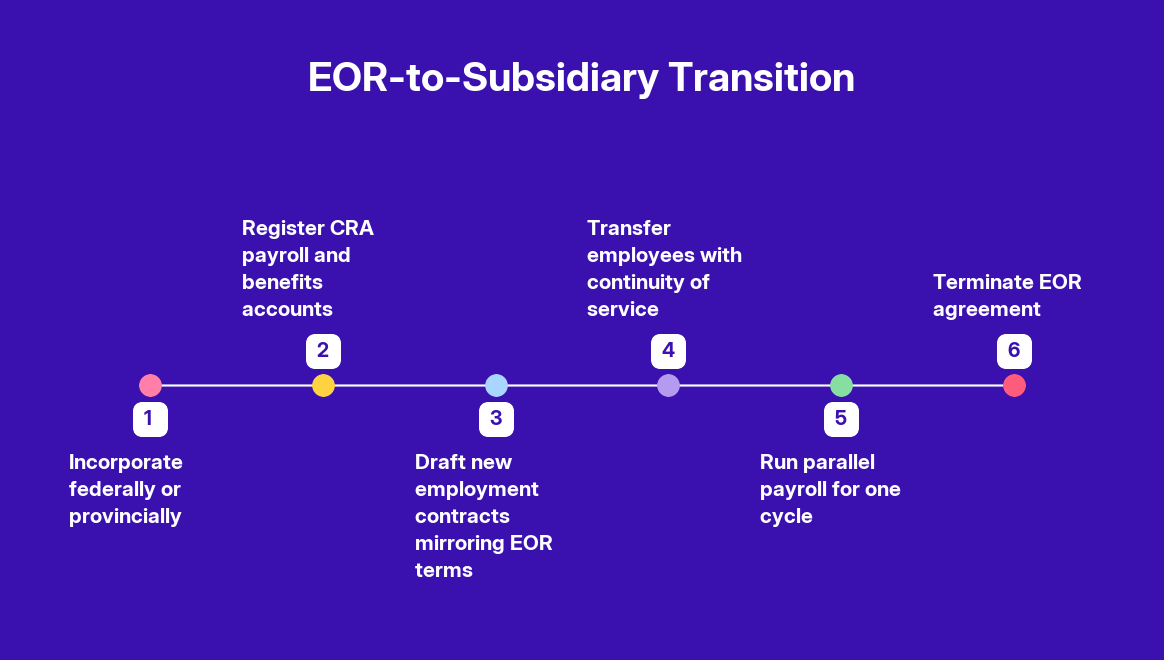
The transition is not a single event. It unfolds over 8 to 16 weeks when planned well. The most common mistake is treating employee transfers as new hires. Canadian employment law recognizes continuity of service. Employees moving from your EOR's payroll to your subsidiary retain their accrued entitlements.
Draft the new employment contracts before notifying employees. Match or exceed the terms in their current EOR-held agreements. Any reduction in benefits or compensation during the transfer creates constructive dismissal risk under Canadian common law.
Run at least one parallel payroll cycle where both your subsidiary's payroll system and the EOR process payments. This catches discrepancies in tax withholding, CPP contributions, and EI premiums before the EOR agreement ends. Your EOR provider should cooperate on transition logistics. Most reputable providers offer a structured wind-down period.
Watch out: If your EOR-held employees have been working in multiple provinces, your subsidiary must register as an employer in each province separately. A single federal incorporation does not cover provincial employer obligations like Ontario's Employer Health Tax or Quebec's QPIP.

FAQs
Can I use an EOR and a subsidiary simultaneously in Canada?
Yes. Many companies maintain both structures during a transition period or permanently. You might employ senior leadership through your subsidiary while keeping contractors or short-term project staff on an EOR. The CRA treats each entity's payroll obligations independently. Ensure your EOR agreement does not contain exclusivity clauses that prevent parallel direct employment.
What happens to employee benefits during the switch from EOR to subsidiary?
Group benefits plans under the EOR terminate when those employees leave the EOR's payroll. Your subsidiary needs its own group benefits plan active before the transfer date. Most Canadian insurers require a minimum of 2 to 3 employees to establish a group plan. Pre-existing condition exclusions can apply if there is a gap in coverage between plans.
Do I need a physical office in Canada to incorporate a subsidiary?
No. A Canadian subsidiary can operate with remote employees and a registered office address provided by a corporate services firm. You do need a registered office in the province of incorporation. Federal corporations must also maintain a registered office. Remote-first companies often use virtual office services that satisfy the legal requirement without leasing commercial space.
What to Plan For Next
The EOR-to-subsidiary decision will sharpen as your Canadian team grows. Start modeling the crossover point when you reach 8 to 10 employees. Build relationships with a Canadian employment lawyer and accountant before you need them urgently. Monitor provincial employer obligations in every province where your team members reside. The transition is manageable when planned 6 months ahead. It becomes expensive and risky when forced by a procurement deadline or investor demand.
If you are weighing the EOR-to-subsidiary switch for your Canadian team, TeamUp can walk through the cost comparison for your specific headcount and provinces. Book a consultation.
TeamUp Editorial Team | Updated 2025
.svg)


