Employer of Record (EOR) in South Korea 2026: The Complete Hiring Guide
TL;DR
- South Korea is one of Asia's strongest hiring markets for 2026 — deep technical talent, world-class semiconductor and software engineering pipelines, and a professional workforce that integrates seamlessly into international operations. The access cost is high and the compliance architecture is demanding.
- An EOR in South Korea is a registered Korean legal entity that acts as the sole employer of record for your hires — managing every obligation under the Labour Standards Act, the four-insurance system (NPS, NHIS, EI, WCI), the DC retirement plan, work permit sponsorship, and compliant termination — without requiring your company to form a Korean entity.
- The true employer cost in South Korea runs approximately 120% to 130% of gross salary when four-insurance contributions, DC retirement plan accruals, and EOR service fees are included. The EOR service fee alone is typically KRW 320,000 to KRW 600,000 per employee per month depending on headcount volume and service scope.
- Korean Labour Standards Act severance is mandatory for every employee who works more than one year — regardless of how employment ends, including voluntary resignation. Severance equals 30 days' average wages per year of service, payable within 14 days of termination.
- Dismissal without justifiable cause is prohibited. The 52-hour weekly working cap carries criminal penalties for management who knowingly exceed it. Year-end tax settlement (연말정산) is an annual employer obligation managed by the EOR each January.
- Foreign nationals require an E-7 Specially Designated Activities Visa or another work visa category. Employer sponsorship through a registered Korean employer — or an EOR acting as employer of record — is the prerequisite for all Korean work visas.
- The EOR inflexion point — where a local Korean entity becomes more cost-efficient — is typically 40 to 60 employees with confirmed long-term presence. Below that threshold, the EOR delivers better compliance outcomes and lower total infrastructure cost.
- Team Up operates as a REPSE-equivalent, globally compliant EOR with dedicated South Korea infrastructure — covering Labour Standards Act employment, four-insurance management, DC retirement, E-7 sponsorship, and compliant termination.
South Korea in 2026 is not a market you can approach casually. The semiconductor ecosystem in Hwaseong and Suwon, the software and AI talent concentration in Seoul's Gangnam and Pangyo tech districts, and the research infrastructure in Daejeon have produced a workforce that global companies are actively competing for — not just considering. If you have decided to hire in Korea, you are already behind some of your competitors. This guide does not waste your time on the "why Korea" question. It answers the "how" question completely.
An employer of record in South Korea is the structural mechanism that gives your company immediate legal access to Korean talent without the three-to-five-month entity formation timeline. This guide covers everything: how the EOR model works in Korea's specific legal environment, what the Labour Standards Act requires, how the four-insurance system operates, what the true employer cost looks like at different salary levels, how work permits and visa sponsorship work, how to build a competitive benefits package, and when the inflection point comes where a local entity makes more sense than an EOR.
South Korea in 2026: The Hiring Market You Are Entering

The Talent Fundamentals
South Korea produces more engineering graduates per capita than almost any developed economy. Its semiconductor industry — anchored by Samsung Semiconductor and SK Hynix but supported by a dense ecosystem of specialist suppliers, foundries, and IP firms — has created a technical workforce with depth and institutional knowledge that cannot be replicated quickly elsewhere. Its software and AI talent pool is growing: over 100,000 software engineering graduates enter the Korean workforce annually, and Seoul's startup ecosystem has matured to the point where experienced product engineers have often worked across Korean, Japanese, and US-funded companies before they turn 35.
Foreign direct investment into Korea accelerated from 2022 onward as US companies restructuring semiconductor supply chains found Korea to be both a strategic partner under CHIPS Act dynamics and a practical hiring market for the technical roles they needed to fill. By 2025, Korea had become one of the top five target markets in Asia for international company headcount growth in technology, financial services, and advanced manufacturing.
What Makes Korea a Complex Hiring Market
The same labour law framework that protects Korean workers is the framework that creates compliance risk for international companies entering the market without local expertise. The Labour Standards Act is actively enforced. The National Labour Relations Commission adjudicates wrongful dismissal claims with speed and consistency. The Ministry of Employment and Labour conducts routine workplace inspections. And the cultural and linguistic distance — regulatory correspondence from MOEL, NPS, NHIS, and COMWEL all arrive in Korean — means that compliance management from outside the country requires genuine Korean-language operational capability.
The EOR model addresses this directly. The EOR is the Korean-registered employer operating within Korea's legal system every day. It manages the compliance function in Korea. The client company directs the work in English, Japanese, or whatever language their global operations use. The legal employment relationship — and its compliance obligations — sits with the EOR.

What Is an EOR in South Korea and How Does It Work?
The Legal Structure
An employer of record in South Korea is a Korean-registered legal entity — a Jusik Hoesa (주식회사) or equivalent — that formally employs workers on behalf of an international client company. Every employment contract is between the EOR and the employee. The EOR holds the Korean business registration number, the four-insurance employer registrations with NPS, NHIS, MOEL, and COMWEL, and the NTS payroll infrastructure. The client company is the operational principal directing the day-to-day work. The EOR is the employer of record managing the legal employment relationship and all statutory obligations that attach to it.
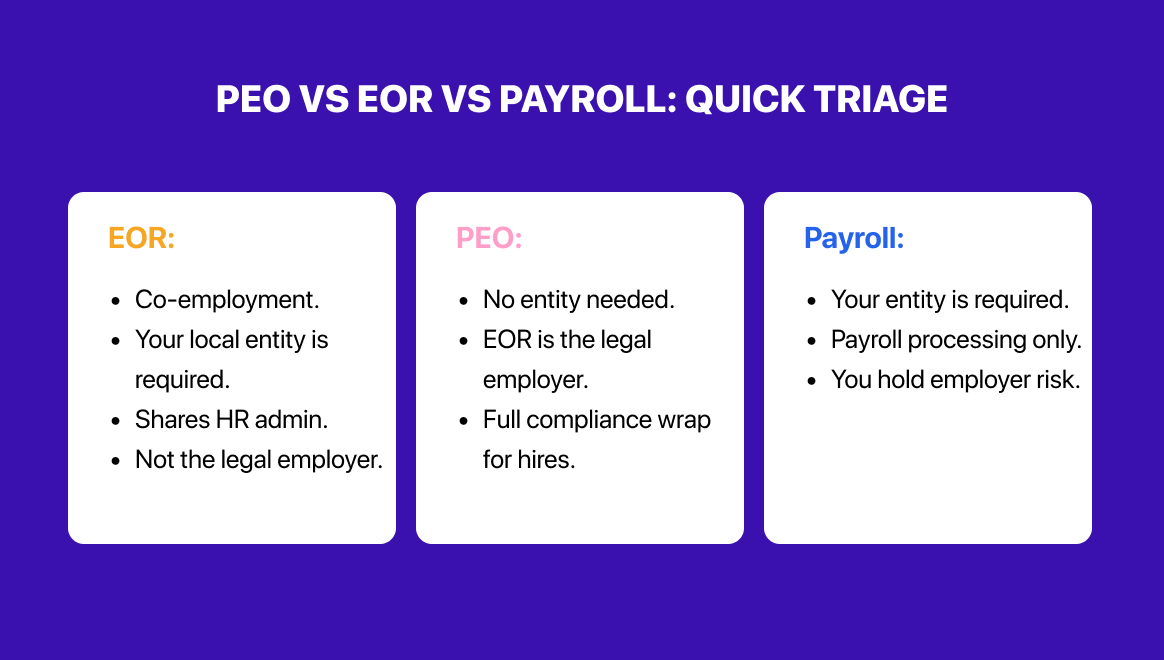
This structure is not a staffing agency arrangement and is not the same as the PEO (Professional Employer Organisation) co-employment model. The EOR is the sole legal employer. There is no co-employer. The client company does not carry direct Labour Standards Act liability for the employment relationship. NLRC wrongful dismissal claims are directed at the EOR. MOEL inspections examine the EOR's employment records. NPS audits review the EOR's contribution history. The liability sits with the party that has the operational infrastructure to manage it.
What the EOR Manages on Your Behalf
A full-service EOR in South Korea covers: employment contract drafting and execution under the Labour Standards Act; four-insurance registrations (NPS, NHIS, EI, WCI) completed before the employee's start date; monthly payroll processing with correct NTS income tax withholding; annual year-end tax settlement (연말정산) in January; DC retirement plan establishment and monthly 1/12-annual-wage contribution; standard monthly income (SMI) annual update in November; annual leave tracking and cash compensation target management for unused leave; maternity, paternity, and parental leave EI filing and benefit coordination; compliant termination management — LSA severance calculation, 14-day payment, four-insurance de-registration; and E-7 or other work visa sponsorship for foreign national hires.
The client company does not manage any of these directly. They instruct the EOR on hires, terminations, salary changes, bonus payments, and benefit additions. The EOR executes all of those instructions through the correct Korean legal and payroll infrastructure.
| A practical note on employee transparency: Korean employees hired through an EOR are told in their employment contract that the EOR is the legal employer and that the client company is the operational principal directing their work. This is both legally required and professionally standard in Korea's internationally integrated talent markets. Experienced Korean professionals who have worked with global companies are familiar with this structure. Attempting to obscure the EOR relationship — presenting the client as the employer in the contract when it is not the registered legal employer — is a Labour Standards Act violation and creates precisely the misclassification risk the EOR is designed to prevent. |
EOR vs Setting Up Your Own Entity in South Korea: The Core Trade-Offs
Entity Formation: What You Are Committing To
Forming a Korean Jusik Hoesa requires notarised articles of incorporation, registration with the district court, business registration with the National Tax Service (NTS), bank account opening with a Korean commercial bank (typically four to six weeks — the most common bottleneck), and four-insurance employer registrations across NPS, NHIS, MOEL, and COMWEL. The realistic timeline from initiation to first hire is three to five months. The upfront legal and administrative cost is KRW 8,000,000 to KRW 20,000,000. The ongoing entity maintenance cost — accounting, payroll administration, legal counsel, registered address — runs KRW 30,000,000 to KRW 80,000,000 per year.
Entity dissolution takes a minimum of six to twelve months. When market conditions change — and they do — the entity model does not allow rapid response. The EOR model winds down within the contractual notice period. That exit flexibility has real financial value that most entry-stage cost models do not capture.
The EOR Advantage at the Market Entry Stage
For most companies entering Korea in 2026 — testing the market, building an initial team of one to twenty employees, responding to an opportunity with a defined timeline — the EOR delivers faster access, lower infrastructure cost, clean compliance management, and real exit flexibility. The EOR service fee adds a per-employee monthly cost that the entity model does not carry. But the entity model carries KRW 30,000,000 to KRW 80,000,000 in annual maintenance overhead that the EOR fee must overcome before the entity becomes more cost-efficient. That crossover typically happens at 40 to 60 employees with confirmed long-term Korea operations.
| Factor | EOR | Korean Jusik Hoesa (Entity) |
| Time to first hire | 3–5 business days | 3–5 months |
| Formation cost | None | KRW 8,000,000–20,000,000 |
| Annual infrastructure cost | EOR fee only | KRW 30,000,000–80,000,000+ |
| LSA compliance management | EOR handles fully | Client entity's responsibility |
| NLRC wrongful dismissal exposure | EOR is the employer | Entity directly exposed |
| E-7 work permit sponsorship | EOR sponsors immediately | Entity sponsors (3–5 months post-registration) |
| Market exit timeline | Weeks — within notice period | 6–12 months dissolution process |
| Suitable headcount range | 1–50 employees | 50+ permanent operations |
The Labour Standards Act: The Compliance Foundation Every Korean Employer Operates Under
Employment Contract Requirements
Every employer in South Korea must provide employees with a written employment contract specifying wages, working hours, rest days, annual leave entitlement, and the place and nature of work. This is mandatory under Article 17 of the Labour Standards Act from the first day of employment — including during any probationary period. Failure to provide a written contract is a criminal offence subject to a fine of up to KRW 5,000,000 per violation. The EOR prepares the employment contract. The client company reviews and approves the commercial terms. The EOR executes the contract as the employer of record.
Probationary Periods Under the LSA
Probationary periods in Korea are legally permitted but must be used carefully. The maximum probationary period under standard Korean employment practice is three months (some EOR providers use up to six months for specific role categories). During probation, dismissal is permitted on broader grounds than during regular employment — but the employee still retains basic Labour Standards Act protections, including the right not to be dismissed without reason and the right to receive wages for work performed. A probationary employee who completes the probationary period and is not dismissed becomes a regular employee automatically. The EOR structures probationary contracts correctly and manages the regularisation event.
Prohibition on Dismissal Without Justifiable Cause
The most important protection in the LSA for employees — and the most significant compliance obligation for employers — is the prohibition on ordinary dismissal without justifiable cause under Article 23. Dismissal for economic reasons (redundancy, retrenchment) requires genuine business necessity, 30 days' advance written notice (or 30 days' pay in lieu), and MOEL notification. Dismissal for performance or conduct requires documented warnings, improvement plans, and evidence that meets the NLRC's evidentiary standard. The EOR assesses every proposed dismissal against the justifiable cause requirement and manages the dismissal procedure to the LSA standard.
Annual Leave Under the Labour Standards Act
Article 60 of the LSA mandates 15 days' paid annual leave after the first year of employment, accruing at one day per completed month in the first year. Entitlement increases by one day every two years of service up to a maximum of 25 days at 11 years. Unused leave must be compensated in cash (연차수당) where the employer has not actively encouraged its use. The EOR tracks leave accruals, monitors unused leave balances, and processes the annual compensation target calculation.
The Four-Insurance System: NPS, NHIS, EI, and WCI — Rates, Obligations, and EOR Management
Korea's four mandatory insurance schemes require separate employer registration, contributions calculated on different bases, and filings submitted to four different government bodies on different schedules. The EOR holds all four registrations and manages all four contribution cycles as a core operational function.
| Insurance | Governing Body | Employer Rate | Employee Rate | Basis | Filing Cadence |
| NPS (National Pension) | National Pension Service | 4.5% | 4.5% | Standard Monthly Income (SMI) | Monthly; SMI update November annually |
| NHIS (Health Insurance) | NHIS Corporation | 3.545% + LTCI ~0.46% of NHIS | 3.545% + LTCI | Monthly income | Monthly |
| EI (Employment Insurance) | MOEL | 0.9% (<150 employees) | 0.9% | Monthly wages | Monthly |
| WCI (Workers' Comp) | COMWEL | 0.7%–18.6% (industry risk) | 0% | Monthly wages | Annual declaration; monthly payment |
Three points that affect every Korea cost model. First, the NPS Standard Monthly Income (SMI) must be updated annually by November 30. Companies that fail to update SMI after salary increases are systematically underpaying NPS — and NPS identifies this through annual reconciliation. Retroactive contributions plus a 9% annual surcharge are the consequence. Second, the NHIS Long-Term Care Insurance surcharge (장기요양보험료) adds approximately KRW 8,000 to KRW 16,000 per month per employee on top of the NHIS premium. It is frequently omitted from reference tables. Include it. Third, WCI rates vary by industry risk classification. A Seoul office-based software company pays approximately 0.7% to 1.0%. A manufacturing operation can pay 2% to 5% or higher. Confirm the correct WCI classification for your Korea operation with the EOR before finalising the cost model.
| MOEL Employment Insurance dual obligation: the EI contribution that most employers know about (0.9% employer, 0.9% employee) is the unemployment benefit contribution. Employers with more than 150 employees also pay a separate EI skills development contribution (0.25% to 0.85% of wages, depending on employer size). Large Korea operations should model both components. An EOR with the current MOEL filing infrastructure applies the correct combined EI rate for your headcount size automatically. |
DC Retirement Plan: The Mandatory Pension Obligation That Changes Your Korea Cost Model

The Employee Retirement Benefit Security Act (근로자퇴직급여 보장법) requires every Korean employer to provide a retirement benefit plan for employees who have worked at least one year. The Defined Contribution (DC) plan — standard for foreign-invested companies — requires the employer to contribute at least 1/12 of the employee's annual total wages each month into the employee's individual retirement account (IRA). That is 8.33% of the annual salary per year, distributed monthly.
The DC contribution base is total annual wages — not just basic salary. Regular allowances (meal allowances, commuting allowances) and recurring bonus payments that form part of the employee's ordinary wage structure must be included. An EOR that only contributes to basic salary is under-contributing. The employee notices — they can see their IRP balance — and the shortfall creates a retroactive liability.
At termination, the DC account balance belongs to the employee. If the employment contract is correctly structured, the accumulated DC contributions satisfy the LSA severance obligation. Without correct structuring, both the DC balance and a separate LSA severance payment may be owed. The EOR structures the employment contract to specify the DC-to-severance relationship and calculates the correct payment at termination.
| Annual Gross Salary (KRW) | Monthly DC Contribution (1/12) | Annual DC Contribution | % of Gross Salary |
| 40,000,000 | 333,333 | 4,000,000 | 10.0% |
| 60,000,000 | 500,000 | 6,000,000 | 10.0% |
| 80,000,000 | 666,667 | 8,000,000 | 10.0% |
| 100,000,000 | 833,333 | 10,000,000 | 10.0% |
| 120,000,000 | 1,000,000 | 12,000,000 | 10.0% |
The DC contribution percentage is consistently 10% of gross salary across all income levels (using total annual wages as the base, which typically runs approximately 10% to 15% above basic annual salary when allowances are included). If your Korea cost model does not include this line item, it understates the true employer cost by approximately one month's salary per employee per year.

Severance, Termination, and the 14-Day Payment Rule in South Korea
LSA Severance: Non-Negotiable for Every Employee Over One Year
Labour Standards Act severance is mandatory for any employee who has worked more than one continuous year, regardless of how the employment ends. This includes voluntary resignations, mutual agreement separations, and dismissals for cause, not just redundancy or no-fault terminations. The entitlement is 30 days' average wages for each full year of continuous service. Average wages are calculated as the average daily wage over the three months immediately preceding the termination date, including all regular wages and allowances.
The payment deadline is 14 days from the termination date. Late payment carries an additional 20% per annum interest charge on the outstanding amount. For a mid-level engineer earning KRW 80,000,000 per year who resigns after four years, the mandatory severance is approximately KRW 26,700,000 — due within 14 days of their last working day. The EOR calculates the correct average wage, ensures the payment is made within 14 days, and issues the final CFDI-equivalent payroll documentation.
The Two-Notice Rule for Dismissals for Cause
Dismissal for employee misconduct or performance failure requires following the two-step procedural standard set by the NLRC. First, the employer must issue a written notice specifying the grounds for dismissal and giving the employee an opportunity to respond — minimum of 15 to 30 days depending on the nature of the issue. Second, after reviewing the response, the employer must issue a written notice of the final decision. Both notices must be in writing. Verbal dismissals and email-only dismissals without formal written documentation do not satisfy the procedural standard and convert a potentially justified dismissal into an illegal dismissal.
For redundancy dismissals, 30 days' advance written notice to the employee and simultaneous notification to the MOEL Regional Office is required. The business necessity must be genuine and must be supported by documentation showing the rationale for workforce reduction.
Wrongful Dismissal and NLRC Claims
A dismissed Korean employee can file a wrongful dismissal claim (부당해고 구제신청) with the National Labour Relations Commission within three months of the dismissal date. The NLRC process is relatively fast by international standards — a first-instance decision typically takes two to four months. Successful claims result in reinstatement orders (the employee returns to their original position) or back-pay awards from the dismissal date to the NLRC decision date, or both. Under the EOR model, the NLRC claim is directed at the EOR as the named employer. The EOR manages the response, any required mediation, and the eventual NLRC proceeding with Korean employment counsel.
Working Hours: The 52-Hour Cap and Its Criminal Enforcement in South Korea
The 2018 Working Hours Reform capped total weekly working hours — regular hours plus extended work — at 52 hours for companies with five or more employees (12 hours overtime above the 40-hour standard week). The cap is enforced by MOEL with criminal penalties: up to two years' imprisonment or a fine of up to KRW 20,000,000 for managers who knowingly require or allow violations. This is not a civil penalty. It is a criminal statute.
For international companies managing Korean employees across time zones — US West Coast companies in particular, where evening PST calls align with Korean early morning and late-night schedules — the 52-hour cap is a live operational compliance risk. The EOR structures employment contracts with explicit working hour provisions. Clients directing EOR-employed Korean employees must manage working hours within the 52-hour limit as part of their operational management responsibility. The EOR can advise on flexible working hour arrangement options, including the selective working hour system (선택적 근로시간제) that provides some flexibility for knowledge work roles under specific conditions.
| Selective Working Hour System (선택적 근로시간제): Korean law allows a flexible arrangement under which employees in designated knowledge work roles can spread their working hours across a settlement period (up to three months for research and development roles) rather than being bound to the daily 8-hour structure. The 52-hour weekly average must still be maintained across the settlement period. This arrangement must be specified in the employment contract and a written agreement with the employee must be in place. An EOR can structure employment contracts to include this provision where it is appropriate for the client's operational needs. |
True Employer Cost in South Korea: The Complete 2026 Model
Most Korean cost models start and end with gross salary. The true employer cost in Korea is approximately 120% to 130% of gross salary once all statutory obligations and the EOR service fee are included. The table below models the complete employer cost for a mid-level professional earning KRW 70,000,000 per year (KRW 5,833,333 per month gross).
| Cost Component | Monthly (KRW) | Annual (KRW) | % of Gross |
| Gross Monthly Salary | 5,833,333 | 70,000,000 | 100.0% |
| NPS Employer Contribution (4.5%) | 262,500 | 3,150,000 | 4.5% |
| NHIS Employer Contribution (3.545%) | 206,708 | 2,480,500 | 3.5% |
| NHIS LTCI Surcharge (~0.46% of NHIS) | 9,509 | 114,108 | 0.2% |
| Employment Insurance (0.9%) | 52,500 | 630,000 | 0.9% |
| Workers' Comp Insurance (1.0% mid-range) | 58,333 | 700,000 | 1.0% |
| DC Retirement Contribution (1/12 total wages) | 486,111 | 5,833,333 | 8.3% |
| EOR Service Fee (KRW 450,000 flat — mid-range) | 450,000 | 5,400,000 | 7.7% |
| TOTAL Employer Cost | 7,358,994 | 88,307,941 | 126.2% |
Two line items most cost models omit: the NHIS LTCI surcharge (small but real — approximately KRW 9,500 per month at this salary level) and the DC retirement contribution (large and consistently missed — KRW 486,111 per month, more than all four insurance contributions combined). Build both into every Korean headcount budget.
At senior levels (KRW 120,000,000 annual), the EOR service fee as a percentage of total cost falls to approximately 4.5% as the flat fee becomes proportionally smaller. At junior levels (KRW 40,000,000 annual), the same flat fee represents 13.5% of gross salary. If your Korea team has a wide salary distribution, the flat-fee pricing model favours senior hires and the percentage model favours junior ones. Negotiate accordingly.
Korean Employee Benefits: Statutory Floor and Competitive Supplemental Package
Statutory Benefits the EOR Administers Without Discretion
The statutory benefits layer is managed by the EOR as a compliance function. It includes: NHIS comprehensive healthcare coverage (employer contributes 3.545%/month); NPS pension accumulation (employer contributes 4.5% of SMI); EI unemployment and training benefits (employer contributes 0.9%); WCI workplace injury, occupational disease, and commuting accident coverage (employer pays full premium); DC retirement plan (1/12 of annual total wages per month); annual leave of 15 to 25 days scaling with tenure; 11 national public holidays; maternity leave of 90 days paid; paternity leave of 10 days paid; parental leave of up to 12 months per parent per child (EI-funded at partial replacement rate); and LSA severance at 30 days' average wages per year of service.
Supplemental Benefits the Korean Market Expects
A statutory-floor-only package loses candidates to Korean competitors. The Seoul professional market expects: a meal allowance (식대) of KRW 100,000 to KRW 200,000 per month (NTS-exempt up to KRW 200,000 when structured as a separate payroll component); a commuting allowance (교통비) of KRW 50,000 to KRW 150,000 per month (NTS-exempt up to KRW 200,000); annual performance bonuses equivalent to one to three months' salary (paid in alignment with Chuseok and Lunar New Year cycles, not a March review cycle); and supplemental group health insurance covering NHIS co-payment gaps, dental, and vision (KRW 30,000 to KRW 80,000 per employee per month, employer-paid).
Meal and commuting allowances are structured by the EOR as separate tax-exempt payroll components — not bundled into base salary, which would make them fully taxable. Bundling them into a base salary costs the employee KRW 50,000 to KRW 90,000 per month in additional income tax unnecessarily. The EOR prevents this structuring error automatically.
Work Permit and E-7 Visa Sponsorship Through an EOR in South Korea
The E-7 Specially Designated Activities Visa
Foreign nationals working in Korea in professional roles typically require an E-7 Specially Designated Activities Visa. The E-7 covers 85 designated activity categories — including IT systems analysis, electrical engineering, accounting, legal advisory, and research roles — with specific educational and salary requirements for each. The employer submits an invitation letter and employment contract to the Ministry of Justice (MoJ), and the employee applies at their local Korean embassy or consulate. The MoJ processes E-7 applications in approximately two to four weeks under normal conditions.
What is employer sponsorship for an E-7 in practice? The sponsoring Korean employer — or EOR acting as employer of record — formally attests to the MoJ that the employment is genuine, the role qualifies under the designated E-7 category, the employee meets the qualification requirements, and the employer accepts responsibility for the employee's work compliance during the employment period. If the employment ends before the visa expires, the employer must notify the MoJ. The EOR manages all of these obligations as part of the visa sponsorship lifecycle.
Other Work Visa Categories Relevant to EOR Hiring
Beyond the E-7, relevant visa categories for EOR-hired foreign nationals include: the D-8 Corporate Investment Visa for investors or senior executives of foreign-invested companies; the E-1 through E-6 categories for specific professional activities (E-4 for technology services, E-5 for professional occupations); and the F-2 Long-Term Residence Visa for qualifying foreign nationals with extended Korea ties. Each category has specific employer obligations. The EOR advises on the correct visa category for each foreign national hire before the sponsorship application is initiated.
The Korea EOR Hiring Timeline: From Decision to First Payroll
Local National Hire: 3–5 Business Days
For a Korean national hire with no work permit requirement, the EOR onboarding sequence is: employment contract prepared and executed (Day 1–2); four-insurance registrations completed — NPS, NHIS, EI, and WCI registrations submitted before start date (Day 2–3); payroll system setup and first-month payroll cycle initiated (Day 3–5); employee receives NHIS insurance card and NPS enrollment confirmation within two to three weeks of registration. First payroll run is processed on the agreed payroll date with correct NTS withholding, all four insurance contributions, and DC retirement plan contribution remitted.
Foreign National Hire Requiring E-7 Visa: 4–8 Weeks
For a foreign national hire requiring an E-7 visa, the timeline extends to account for MoJ processing. The sequence is: employment contract prepared and E-7 eligibility confirmed (Week 1); MoJ invitation letter and supporting documentation prepared by EOR (Week 1–2); employee applies at Korean embassy or consulate in their home country (Week 2–3); MoJ processing time — typically two to four weeks (Weeks 3–6); employee arrives in Korea on D-8 or E-7 visa, registers Alien Registration Card (ARC) within 90 days of arrival; employment commences and four-insurance registrations are completed immediately. First payroll runs on the agreed date with bilateral NPS agreement status verified.
| Hire Type | Key Steps | Timeline | EOR's Role |
| Korean national | Contract → four-insurance registration → payroll | 3–5 business days | Manages all steps |
| Foreign national (E-7) | Contract → MoJ application → visa approval → ARC → start | 4–8 weeks | Manages the application; the employee applies at the embassy |
| Foreign national (intracompany transfer — D-8) | Corporate investment documentation → D-8 application → start | 3–6 weeks | Prepares investment documentation; manages MoJ |
| Probationary hire (all nationalities) | Standard onboarding + probationary provisions in contract | Same as above + 3-month probation period | Structures probationary contract; manages regularisation event |
EOR vs Entity: When Does a Local Korean Subsidiary Beat the EOR?
The inflexion point is not a fixed number — it is a convergence of three separate thresholds.
The Financial Threshold: ~40–60 Employees
The EOR service fee for 50 employees at KRW 320,000 per month (volume pricing) is KRW 16,000,000 per month — KRW 192,000,000 per year. The entity maintenance infrastructure for a 50-person Korea operation — accounting, legal, payroll administration, registered office — typically runs KRW 60,000,000 to KRW 130,000,000 per year. At 50 employees, the entity becomes clearly more cost-efficient. At 30 employees, the comparison is close. Below 20 employees, the EOR almost always wins on cost when all infrastructure components are included.
The Certainty Threshold: Confidence in Permanent Korea Operations
The entity model is a permanent commitment — or at a minimum a commitment that takes six to twelve months to reverse. Companies that form an entity for 20 employees based on optimistic projections, and then see their Korea headcount stabilise at 20 rather than growing to 60, have committed to entity maintenance overhead without achieving the scale that justifies it. The EOR model is the right choice when confidence in the Korea headcount trajectory is less than high. Transition to the entity when the trajectory is confirmed, and the permanence of the operation is clear.
The Commercial Threshold: Korean Entity Required for Non-Employment Reasons
Some Korean operations require a registered Korean entity for commercial reasons independent of employment: government contracts that require a Korean registered supplier; industry licences in regulated sectors (financial services, healthcare, certain technology categories); or client relationships that contractually require a Korean legal entity counterparty. If the business model requires a Korean entity for these reasons, form the entity regardless of headcount. The EOR can serve as a transitional structure while the entity is being formed, ensuring you can hire immediately while the formation timeline runs.
How to Choose an EOR Provider for South Korea: Six Verification Points
Not all EOR providers claiming to operate in South Korea have genuine Korean employer infrastructure. Some are global payroll platforms that process Korea salaries without holding Korean employer registrations directly. Others are intermediaries that subcontract to local Korean providers without the client's knowledge. Before committing, verify the following six points.
- Korean business registration: The EOR must hold an active Korean business registration number (사업자등록번호) issued by the NTS. Request the business registration certificate — it is a public document and should be produced without hesitation.
- Four-insurance employer registrations: The EOR must hold active employer registration numbers with NPS, NHIS, MOEL (EI), and COMWEL (WCI). Request evidence of all four registrations for a recently onboarded employee or for the EOR's own operations.
- SMI update process: Ask specifically how the EOR manages the November NPS standard monthly income annual update. The answer should be specific and operational — a defined notification and update process tied to salary change events. Vague answers suggest manual, error-prone management.
- Year-end tax settlement (연말정산) process: Ask how the EOR manages the January yeommal jeongsan — specifically the employee communication, deduction receipt collection, and NTS reporting steps. This is the annual compliance event that most EOR platforms handle badly.
- DC retirement plan provider: Ask which Korean-licensed IRP provider the EOR uses, how contributions are calculated (total wages or basic salary only), and how the DC-to-severance relationship is structured in the employment contract. Under-contribution on basic salary only is a common error.
- E-7 sponsorship track record: If you anticipate foreign national hires, ask for a process description of an E-7 application the EOR has recently completed — MoJ documentation list, Labour Market Test approach (if applicable), and timeline. A provider that has not recently sponsored an E-7 in a relevant activity category for a professional services or technology employer may not have the operational experience required.
How Team Up Handles EOR Operations in South Korea
Team Up operates as a global employer of record with a dedicated South Korea employment infrastructure. For companies building their first Korea team or scaling an existing one, here is what working with Team Up delivers:
- Korean business registration and four-insurance management: Team Up holds an active Korean business registration, NPS employer number, NHIS employer number, MOEL Employment Insurance registration, and COMWEL Workers' Compensation registration. All four insurance contributions are remitted on schedule. SMI updates are managed in November as a scheduled compliance event tied to every salary change notification.
- Labour Standards Act employment contracts: Every contract is structured to LSA requirements — probationary period provisions, working hours under the 52-hour cap, mandatory benefit specifications, and DC-to-severance relationship correctly defined. Contracts are prepared by Team Up, reviewed by the client, and executed under Team Up's employer of record registration.
- Payroll and NTS compliance: Monthly salary payments processed with correct NTS income tax withholding. Annual year-end tax settlement (연말정산) managed in January — employee deduction receipt collection, withholding recalculation, and NTS reporting included in standard service scope.
- DC retirement plan: Korea-licensed IRP provider used for all employees. Monthly contributions calculated on total annual wages — not just basic salary. DC-to-severance relationship structured in the employment contract. Retirement benefit payment processed correctly at termination.
- Compliant termination management: LSA severance calculated on the correct average daily wage (three-month average). 14-day payment deadline met for every termination. Four insurance deregistrations were completed before the termination effective date. NLRC-ready documentation is maintained for every dismissal event.
- E-7 and other work visa sponsorship: Team Up manages the full MoJ work permit application — E-7 category eligibility verification, invitation letter preparation, and visa status maintenance throughout the employment period. ARC registration coordination included.
- Annual leave tracking and compensation target management: Leave accruals tracked per employee per anniversary cycle. Unused leave balances monitored. Cash compensation target (연차수당) calculated and processed at year-end, where legally required.
- Multi-market global EOR coverage: Team Up covers South Korea alongside Eastern Europe, the Caucasus, Turkey, Central Asia, India, and MENA — with a single contract structure, consistent reporting format, and one operational contact for clients managing Korea alongside other emerging market operations.
Final Thoughts
South Korea in 2026 rewards preparation and punishes improvisation. The talent is there. The opportunity is real. And the compliance architecture — the Labour Standards Act, the four-insurance system, the DC retirement obligation, the 52-hour cap, the NLRC wrongful dismissal framework — is not a background condition. It is an active operating environment with enforcement mechanisms that respond to violations quickly and with real financial consequences.
An EOR in South Korea is not a workaround. It is the structurally correct employment vehicle for companies at the market entry and early scaling stage — providing legal employment from day one, clean compliance management across all five government systems, and exit flexibility that a Korean entity cannot match. At the right scale and with confirmed long-term operations, a local entity is the right structure. Use the EOR to get there.
The most important things to get right from the start: build your headcount cost model on the real employer cost (126% of gross at mid-level, not 100%); verify that your EOR holds genuine Korean registrations — not just a platform claiming Korean coverage; ensure the DC retirement plan contribution is calculated on total wages; and structure the employment contract with the 52-hour cap, the DC-to-severance relationship, and the probationary period provisions correctly from the first day of employment. None of these are complicated once the framework is in place. The EOR's entire job is to have that framework in place before you need it.
Team Up is a global employer of record with dedicated South Korea infrastructure. Contact the Team Up team to receive a Korea employer cost breakdown for your specific headcount profile, a compliance readiness assessment, and a clear onboarding timeline for your first Korea hire.
Frequently Asked Questions
Can I hire Korean employees through an EOR and then transfer them to my own entity later?
Yes. The transition from EOR to a local entity is a structured process involving tripartite novation agreements between the EOR, the client's new Korean entity, and each employee. Seniority accruals continue without interruption — the employee's years of service for severance and leave entitlement purposes count from their original hire date, not from the transfer date. Four-insurance registrations are transferred from the EOR to the new entity through a baja-patronal equivalent process (EOR de-registers as employer; new entity registers as new employer) coordinated to avoid coverage gaps. The transition typically takes four to six weeks with careful management. Team Up coordinates this as a standard client service when clients reach the scale that justifies an entity.
Is Korean severance payable even if the employee resigns voluntarily?
Yes. Labour Standards Act severance applies to every employee who has worked more than one continuous year, regardless of how the employment ends. Voluntary resignation, mutual agreement separation, redundancy, and dismissal for cause all trigger the same statutory entitlement: 30 days' average wages per year of service. This surprises many international companies — they expect severance to be contingent on dismissal or redundancy, as it is in many other employment frameworks. In Korea, it is an accruing entitlement from the first year of employment. Include it in your Korea headcount cost model as a monthly accrual (approximately 8.3% of total annual wages), not as an off-balance-sheet contingency.
What happens if a Korean employee on a sponsored E-7 visa is dismissed?
Dismissal of an E-7-sponsored employee triggers two parallel processes: the employment termination under the Labour Standards Act (LSA severance calculation, 14-day payment deadline, final payroll, four-insurance de-registration); and the immigration notification obligation (the EOR must notify the Ministry of Justice of the employment end within 14 days). The employee's E-7 visa does not expire immediately — it remains valid for its original term — but the right to work is contingent on valid employment in the designated activity. The employee can transfer sponsorship to a new employer, apply for a different visa category, or depart Korea. The EOR coordinates the MoJ notification and advises the employee on their options within the visa validity period.
How does the year-end tax settlement (연말정산) affect employees' take-home pay?
Year-end tax settlement (yeommal jeongsan) is the reconciliation between the income tax withheld throughout the year and the employee's actual annual tax liability after deductions. Employees who submit substantial deduction receipts — medical expenses, education costs, charitable contributions, housing loan interest — typically receive a refund in their February payslip. Employees who received large variable payments late in the year and were insufficiently withheld may owe additional tax. The EOR communicates the settlement process to employees in January, collects deduction receipts, recalculates the withholding, and processes refunds or additional deductions in the February payroll. The NTS annual payment records are filed by the EOR before the March deadline.
Does South Korea have restrictions on using EOR services in specific industries?
South Korea's Dispatched Workers' Protection Act restricts the use of dispatched (agency) labour to 32 specifically designated job categories. Outside those categories, dispatch of workers is prohibited — and an EOR arrangement that functions as de facto labour dispatch (where the EOR formally employs workers but the client exercises all operational control in roles outside designated categories) can be reclassified as illegal dispatch by Korean courts. A properly structured EOR — where the EOR is the genuine legal employer with independent operational responsibilities, not a labour supply intermediary — is not subject to this restriction. The key is structural: the EOR must operate as a genuine employer, not as a staffing agency. Team Up's EOR structure is built to this standard.
Can foreign-owned companies hire Korean employees directly without using an EOR?
Yes — if they establish a registered Korean entity (Jusik Hoesa, branch office, or representative office). A registered Korean entity holds its own employer registration with NPS, NHIS, MOEL, and COMWEL and employs Korean employees directly under the Labour Standards Act. The EOR is the alternative for companies that have not yet formed an entity, are testing the market before committing to entity formation, or have assessed that the headcount and permanence of their Korea operations do not justify the entity maintenance overhead. A foreign company paying Korean workers without a Korean entity or an EOR is operating without a legal employment structure — the workers' statutory rights remain intact and the company's tax and social insurance liability accrues from the date the employment-in-nature relationship began.
What is the Korean 52-hour rule and how does an EOR help manage it?
The 52-hour weekly working cap limits total working hours — regular (40 hours) plus overtime (maximum 12 hours) — to 52 hours per week for companies with five or more employees. Violations carry criminal penalties for responsible management. The EOR structures employment contracts with explicit working hour provisions, including where appropriate the selective working hour system (선택적 근로시간제) for eligible knowledge work roles that provides flexibility in daily hour distribution while maintaining the 52-hour weekly average. The client company retains operational responsibility for managing actual working hours within the contracted limit. The EOR advises when operational patterns reported by the client appear to approach or exceed the statutory threshold.
.svg)