


Guide to the top 5 trends in Employer of Record services in India for 2026
Introduction
An Employer of Record is the legal firewall between you and an unexpected tax nightmare. It’s the entity that hires your team in India on your behalf, takes on the compliance burden, and keeps you out of the misclassification danger zone. That’s the job description. No mystique. No jargon.
And here’s the uncomfortable truth most founders learn too late.
Hiring in India without an EOR is an open invitation to the three headaches you absolutely do not have time for: tax mess, misclassification trouble, and fines that don’t politely cap themselves at your hiring budget.
India’s talent pool is incredible. The legal system, however, does not care how good your new engineer is if you classify them incorrectly or skip statutory payroll requirements. The moment a contractor starts working like a full-time employee, you’re exposed. Add India’s strict payroll tax rules, mandatory benefits, and labor law coverage, and suddenly “quick hire” becomes “regret sprint.”
That’s why Employer of Record services in India are evolving fast.
Global teams want the talent, not the legal liability. They want predictable payroll taxes, compliant employment contracts, and someone else to argue with the labor inspector if things ever go sideways. In other words, they want the hiring outcome, not the administrative punishment that comes with doing it alone.
This guide breaks down the top five trends shaping India’s EOR market in 2026. What’s changing, what’s getting riskier, and why every smart team is treating EOR as the default model rather than the experimental one.
Why India Is Becoming a Prime EOR Market in 2026

If you’ve talked to any founder or hiring lead lately, you’ve heard the same refrain: “We should hire in India.” And honestly, it’s not hype anymore. It’s just good business math. India gives global teams the three things they can never get enough of, talent, affordability, and predictability, without forcing them into an entity setup they absolutely do not want.
Below is the real breakdown, organized the way busy people actually read.
India’s Talent Supply Makes Employer of Record Hiring a No-Brainer
India isn’t “up and coming.” It’s already the world’s most reliable engine for tech and operations talent.
You get:
- Senior developers
- QA automation
- CX teams
- Finance and operations
- Data engineering
- Product talent
Not in theory. In practice. Every single year.
Hiring through an Employer of Record in India simply gives companies access to this pipeline without the administrative baggage.
Affordable Senior Tech Talent Accelerates EOR Adoption in India
India’s senior engineers have global-level experience, but the compensation structure hasn’t suffered the same inflation shock as the US or EU.
That means teams get:
- Senior-level output
- Sustainable payroll
- Predictable costs
This is also why more companies are choosing EOR services in India instead of opening an entity; they want cost advantages without compliance headaches.
English Proficiency Makes EOR in India the Default Remote Hiring Model
Cross-border collaboration lives or dies on communication. India’s huge English-speaking workforce is the reason remote hiring here feels frictionless.
This makes onboarding easier, performance management cleaner, and global workflows faster. EOR hiring in India amplifies that by delivering compliant contracts and faster start dates.
Companies Are Avoiding Entity Setup in India (And For Good Reason)
Opening an entity sounds glamorous until you see the real checklist: employment contracts, payroll taxes, statutory benefits, local compliance, ongoing filings, and labor law coverage.
Most teams look at that list and go: “No thanks.”
EOR in India solves that by absorbing the legal and administrative weight. You get the team. The EOR handles everything else.
Employer of Record Services Are Becoming India’s Remote Hiring Default
India has hit the perfect combination: huge talent pool + affordability + English + legal complexity.
That’s why global teams now treat Employer of Record India as the baseline, not the backup plan. They want fast hiring, clean compliance, and zero risk.

Trend #1: Companies Are Replacing Contractors with Full EOR Employment in India
Misclassification is no longer a theoretical risk
For a long time, global companies treated India as one big contractor playground. Slap a freelance contract on a full-time role, pay via an international platform, hope nobody looks too closely.
That window is closing.
If someone works fixed hours, uses your tools, sits in your Slack, and reports to your managers, Indian authorities increasingly treat them as an employee, not a contractor. That means back taxes, penalties, and scrutiny you do not want.
Labor inspectors are looking at gig setups with fresh eyes
Gig misclassification used to fly under the radar. In 2026, it is on the radar.
Inspectors and tax offices are a lot more interested in:
- full-time freelancers with a single client
- contractors on long-term commitments
- “consultants” working as part of product teams
If the paperwork says contractor but the reality says employment, you have a problem. An Employer of Record provider in India gives you a clean, defensible structure to avoid that gap.
Freelancers create IP and data exposure you cannot ignore
Giving a freelancer access to your codebase, product roadmap, and customer data is not just a trust exercise. It is a legal risk if your contracts are not enforceable locally.
Without proper Indian employment contracts you risk:
- unclear IP assignment
- disputes over ownership
- data protection arguments you do not want in front of a judge
EOR employment replaces vague templates with enforceable, local contracts that protect your IP and your product.
Predictable payroll is now a baseline expectation
Random contractor transfers might have been fine when headcount was low. At scale, they look messy.
Banks flag irregular international payments. Tax bodies wonder why one person is being paid the same amount every month as a “freelancer”. Investors ask questions during diligence.
EOR gives you:
- clean, recurring payroll runs
- proper payroll taxes handled
- documentation that actually lines up with reality
The story in your spreadsheet matches the story in your contracts.
Indian talent expects real employment, not fake flexibility
The best people in India are no longer impressed by “global contractor” arrangements.
They want:
- proper employment contracts
- statutory benefits
- stable income
- a clear legal employer
If you want senior engineers, managers, and specialists to stay, you need to treat them like employees. EOR lets you do that without opening your own entity.
Trend #2: EOR Is the Fastest Way to Hire Local + Foreign Talent in India
Residency and visa rules need structure, not guesswork
India is open to global talent, but not on a “figure it out later” basis.
Foreign hires need:
- the right visa category
- a valid employment basis
- proper documentation from an Indian employer
If you try to wing this with contractor agreements or improvised paperwork, you create delays and doubt. An Employer of Record in India gives foreign specialists a clear, legal employment anchor.
Direct hiring slows you down before day one
When you hire directly without an existing entity, you run into friction fast.
You still need:
- tax registrations
- local payroll infrastructure
- compliance processes
- contracts that match Indian labor law
That is a lot to build just to bring on a handful of people. EOR lets you bypass that build phase and go straight to hiring.
EOR employment contracts unlock faster onboarding
With an EOR, your candidate:
- signs a local, compliant contract
- receives clear role, salary, and benefits terms
- gets registered correctly for taxes and payroll
You do not spend weeks chasing signatures, reworking contract templates, or trying to merge home country standards with Indian law.
Relocating foreign specialists becomes straightforward
More companies are moving specialists into India for leadership roles, niche skills, or regional coverage. EOR makes that simpler because the provider:
- issues a valid Indian employment contract
- supports the documentation needed for visas
- keeps the legal responsibility on their shoulders
You still choose who you hire and what they do. The EOR carries the headache.
Paperwork bottlenecks move off your plate
Without an EOR, every new hire triggers a new round of admin. With an EOR, that admin lives with the provider.
They handle:
- filings
- registrations
- updates
- contract documents
You handle performance and delivery. The division of labor is exactly where it should be.
Trend #3: Companies Want Total Cost Transparency from EOR Providers in India
Percentage based fees are losing the argument
The old model looked simple. Pay an EOR a percentage of salary, let them handle the rest. Then senior hires came in, salaries rose, and EOR fees quietly ballooned.
In 2026, buyers want something different:
- stable, flat EOR fees
- no stealth price jumps every time someone gets a raise
Salary should reward your team, not your provider.
Monthly billing needs to be boring on purpose
You know what finance teams love. Boring, predictable invoices.
They want:
- one monthly bill
- no surprise surcharges
- no vague “service adjustments”
If your EOR invoice feels like a phone bill from 2003, that is a problem.
Every cost line needs to be visible and simple
Teams want to see, on one screen:
- gross salary
- payroll taxes
- statutory benefits
- EOR fee
No hidden lines, no things that only show up deep in a contract appendix, no “we will explain that on a call.”
Hidden charges are now an instant red flag
CFOs have seen enough global vendor billing to know when something does not smell right. If an EOR cannot show a clean breakdown, trust drops.
In India, where payroll taxes and benefits have clear rules, opacity is a choice, not a necessity.
India’s tax and compliance environment punishes vagueness
India has firm rules on payroll taxes, deductions, and statutory contributions. If your provider cannot map those clearly into the bill, you are the one who will be answering questions later.
Trend #4: EOR Is Becoming a Full People Operations Partner in India
Equipment is now part of the hiring promise
You cannot expect high performance from someone working on ten-year-old equipment at a kitchen table with unstable internet.
Modern EOR services in India:
- source and deliver laptops locally
- track assets
- support replacements when something breaks
You do not have to ship hardware across borders or deal with customs drama.
Workspace support goes beyond “you can work from home”
Remote is not a magic word. People still need workable conditions.
EOR can help with:
- coworking memberships
- hybrid office setups
- home office stipends where appropriate
That keeps your offer competitive without you learning the Indian flexible workspace market.
Health insurance and benefits matter more than slogans
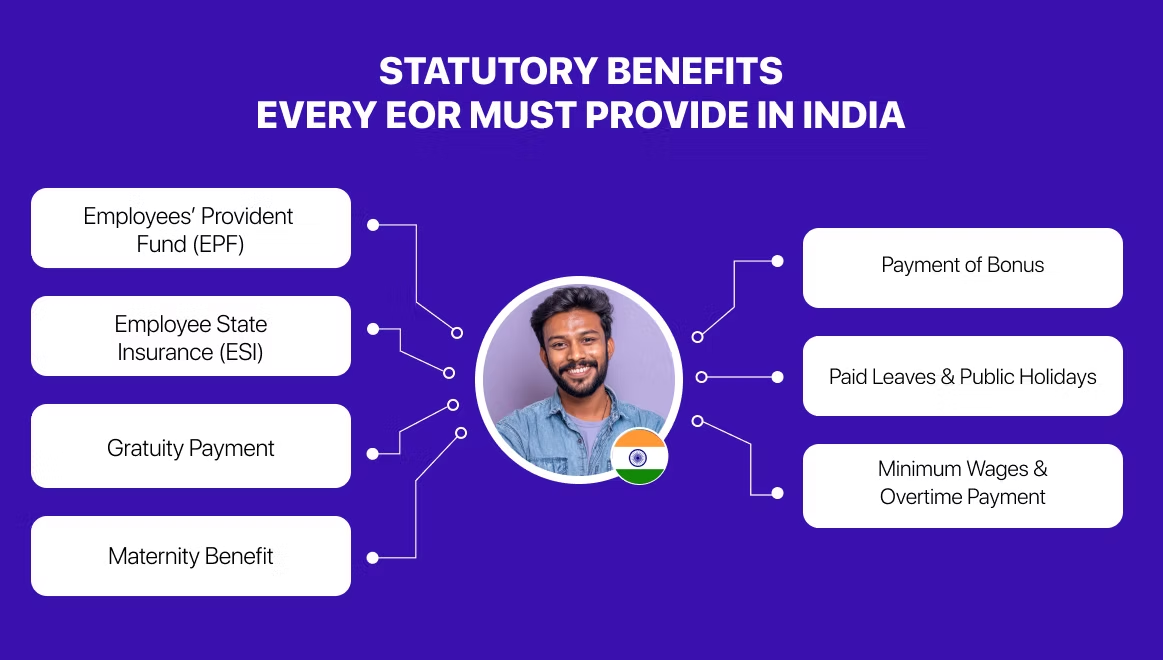
In India, smart candidates are not just asking “What is the salary?”. They are asking:
- What health coverage looks like
- What leave policies are
- What happens if something goes wrong
An EOR aligned with local norms can package benefits correctly instead of leaving you to guess.
Employee relations should not live in a founder’s inbox
Time-poor leaders do not want to be:
- interpreting local leave rules
- typing ad hoc policy clarifications
- playing part-time HR for another jurisdiction
EOR teams handle the local HR conversations so your managers can focus on performance and delivery.
Performance documentation protects you, not just the process
India’s labor rules care about how you document performance, warnings, and exits.
EOR-backed people ops give you:
- structured records
- compliant processes
- documentation that holds up if challenged
That reduces risk when you eventually need to make a hard decision.
Offboarding is handled like an adult process, not an improvised exit
Ending employment in India is not just “we are done here.”
You need:
- notice periods
- final payments
- documentation
- clean handover
EOR runs that playbook correctly, which keeps you out of the line of fire.
Onboarding is fast and consistent instead of invented each time
Every new hire should not trigger a new internal experiment.
EOR brings:
- standard onboarding flows
- clear day one expectations
- repeatable setup
Your internal team plugs into that instead of building a hiring process for India from scratch.
HR guidance is backed by real Indian labor law coverage
The EOR is not guessing. They are working off actual law and practice.
That matters when something gets messy, because you want the entity with the legal responsibility to also be the entity giving the HR advice.
Trend #5: EOR Adoption Is Now Driven by Regional Expansion Strategies Across Asia
India is becoming the operating base for regional teams
India sits in a sweet spot.
You get:
- overlap with Europe
- overlap with parts of Asia and the Middle East
- partial coverage with the United States
That makes it an obvious place to anchor engineering, operations, and support.
Multilingual teams make India more than a single market play
Beyond English, India can support:
- regional languages used across Asia
- language coverage for customer support and sales
- content and communication for multiple markets
An EOR structure lets you build that capability fast, without waiting on entity registrations in every country you want to touch.
Senior engineering pods can live entirely in India
You do not need a local company in every region to ship a global product.
You can:
- stand up entire product teams in India
- cover full stack, QA, DevOps, data, and support
- coordinate remotely with leadership elsewhere
EOR is the legal and payroll spine behind that setup.
India fills the gaps in global coverage
If you want reliable 24 hour coverage without burning out one team, India is the missing piece.
You can:
- run escalation coverage
- run support rotations
- run deployment windows that suit multiple timezones
EOR makes the “where” a solved problem so you can focus on the “who” and “what.”
EOR removes the multi entity headache
Without EOR, regional expansion means:
- One entity per market
- One accountant per country
- One stack of filings per jurisdiction
With EOR, you can leverage India as a core hub, then selectively add entities later only where it truly makes sense.
What Companies want most from Employer of Record services in India (2026)
Companies expanding into India don’t want surprises between “you’re hired” and “see you Monday.” They need a system where offers convert into start dates without delays caused by tax registrations, contract rewrites, or compliance bottlenecks. Predictability is a growth multiplier.
Compliance certainty backed by real Indian expertise
India’s labor laws are detailed, nuanced, and unforgiving when mishandled. Companies want an Employer of Record that understands:
- statutory benefits
- payroll tax rules
- employment terms
- notice periods
- documentation requirements
Not theoretically, but in a way that holds up during audits, disputes, and due diligence.
No legal surprises lurking in the background
Leaders don’t want to find out six months later that they misclassified a worker, skipped a statutory contribution, missed a payroll filing, or violated an employment rule. An EOR gives companies legal insulation so nothing pops up uninvited.
Transparent costs with no guesswork
Finance teams want to see every cost line clearly:
- gross salary
- payroll taxes
- benefits
- EOR fee
Nothing hidden. Nothing variable without explanation. India already has enough tax complexity — the EOR must remove complexity, not add to it.
HR support that doesn’t fall on internal teams
Teams want coverage for India-specific HR tasks:
- leave calculations
- policy compliance
- employee questions
- benefits setup
- documentation and support
When an EOR handles the local HR burden, your internal team stays focused on delivery instead of being dragged into unfamiliar legal territory.
Reduced risk exposure at every stage of employment
Companies want a hiring structure that minimizes:
- misclassification risk
- payroll risk
- IP risk
- contract risk
- termination risk
TeamUp is built precisely for this — absorbing the legal liability, managing payroll taxes, issuing compliant employment contracts, and ensuring companies stay protected.
Next: How to choose the right EOR in India.
How to Choose the Right Employer of Record Provider in India
Deep local compliance knowledge you can trust
If the provider can’t confidently explain Indian labor law in simple language, they’re not equipped to protect you. You need an EOR that understands the letter of the law and how it’s enforced on the ground.
Enforceable employment contracts adapted to India
India requires contracts that address:
- statutory requirements
- IP ownership
- confidentiality
- tax obligations
- termination rules
- leave policies
You need an EOR that drafts contracts in line with Indian law, not copy-pasted templates from another country.
Transparent pricing without percentage-based erosion
Flat fees > salary-based EOR pricing. Founders don’t want their provider’s revenue to grow every time an employee earns a raise. Predictability is the only sustainable model.
Benefits administration is handled like a real local employer
The EOR should seamlessly provide:
- health insurance
- statutory benefits
- leave management
- employee support
Because Indian employees expect real employment, not a patchwork of “optional extras.”
Immigration capability beyond handbook-level knowledge

If you’re hiring or relocating foreign specialists, your EOR must guide the process:
- correct visa category
- required documentation
- employment proof
- compliant timelines
Every missing piece slows onboarding or blocks relocation entirely.
A legitimate legal presence in India
This is essential. An EOR must have:
- a registered Indian entity
- the authority to employ locally
- the compliance infrastructure to file taxes and run payroll
If they can’t legally hire in India, they’re not an Employer of Record.
A mature platform for onboarding, payroll, and compliance
A good EOR removes friction. A great EOR removes friction and confusion with:
- clean onboarding flows
- real-time payroll visibility
- document storage
- compliance updates
Modern teams shouldn’t be tracking Indian employment documents in email chains.

Final takeaway: India’s EOR market Is entering its fastest growth phase
India isn’t just another expansion market, it’s becoming the global hiring engine for fast scaling companies. Engineering, operations, support, data, finance, the talent density is unmatched. Add English fluency, timezone advantages, and a massive workforce, and you get a market no serious company can ignore.
At the same time, compliance is tightening.
Regulators are enforcing labor rules more strictly. Payroll and tax filings are getting more scrutiny. The gap between “contractor” and “employee” is closing fast. Companies that try to cut corners get burned.
That’s why Employer of Record services are exploding in India. Teams want:
- speed without risk
- scale without complexity
- hiring without legal exposure
- clarity without bureaucracy
They want to hire confidently, not nervously.
Team Up delivers that confidence.
The compliance burden? We carry it.
The payroll taxes? Filed.
The employment contracts? Enforceable.
The risk? Off your plate.
TeamUp lets you hire in India without touching entity setup, tax compliance, payroll filings, or any of the administrative landmines that slow companies down.
One system. Zero stress.
If you’re hiring in India, this is the cleanest path forward.
FAQ
1. What is an Employer of Record (EOR) in India?
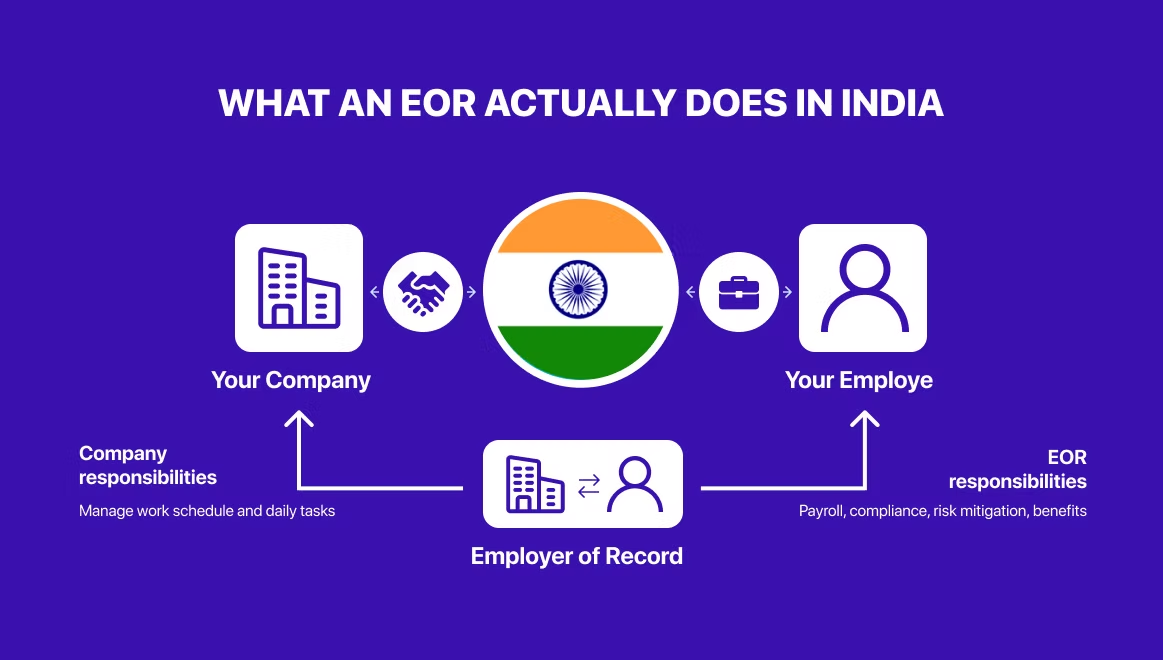
An Employer of Record in India is a licensed local entity that legally hires employees on your behalf. You manage the work, while the EOR handles labor law compliance, payroll taxes, statutory benefits, and employment contracts.
2. How do Employer of Record services work in India?
You choose the talent. The EOR becomes their legal employer with compliant Indian contracts, registers them for taxes, runs payroll, and manages HR obligations so you don’t need an Indian entity.
3. Is an Employer of Record legal and recognized in India?
Yes. EOR is a fully legal hiring model in India and one of the safest ways for foreign companies to employ staff without establishing a local entity.
4. What’s the difference between EOR and hiring contractors in India?
Contractors create misclassification risk, IP exposure, and tax problems. EOR employment removes those risks by providing legal employment, proper contracts, and full labor law coverage.
5. How does an EOR help with payroll in India?
The EOR calculates payroll taxes, withholds the correct amounts, pays statutory contributions, issues payslips, files returns, and keeps payroll aligned with Indian regulations.
6. What are the benefits of using EOR services in India?
EOR gives you:
- fast hiring timelines
- local compliance certainty
- No entity setup
- predictable payroll
- HR support
- reduced legal risk
7. Can I hire employees in India without opening a local entity?
Yes. An Employer of Record company in India handles all legal employment requirements so you can hire immediately without registering your own subsidiary.
8. Does an EOR in India support foreign employees or relocations?
A qualified EOR can assist with employment documentation, EOR visa support, and relocation-related requirements, making it easier to hire foreign specialists in India.
9. What does “EOR employee” mean in India?
It means the worker is legally employed by the EOR entity in India but operationally managed by your company. You control the work. The EOR carries the legal liability.
10. When should I choose an Employer of Record instead of setting up an entity in India?
Use an EOR if you want to hire quickly, avoid legal complexity, test the market, keep costs predictable, or avoid ongoing compliance, payroll, and HR administration.
.svg)


