PEO vs Employer of Record (EOR) in Armenia: Which is right for your organization?
Introduction
If you’re looking to hire in Armenia, you’ll quickly run into two models that sound similar but work very differently: PEO (Professional Employer Organization) and EOR (Employer of Record). On paper, both promise to make hiring easier.
In practice, the choice you make can determine how fast you enter the market, how much liability you carry, and how much it will all cost.
Armenia is attractive for its tech talent, competitive labor costs, and growing role in the Caucasus region.
But here’s the problem: do you go through the process of setting up a local entity and work with a PEO, or do you skip the entity altogether and let an EOR employ on your behalf?
This guide breaks down the key differences, pros and cons, and real-world use cases so you can decide which path makes sense for your organization’s expansion into Armenia.
What is a Professional Employer Organization (PEO) in Armenia?
Remote hiring in Armenia opens the door to a highly skilled workforce, especially in IT, finance, and customer services. But to tap into this talent, you need to understand the infrastructure behind employment. One option companies often explore is partnering with a Professional Employer Organization (PEO). Let’s break down what that means in the Armenian context.
1. The core definition
A Professional Employer Organization (PEO) is an HR partner that helps companies manage routine people operations. In Armenia, this typically includes:
- Running payroll in Armenian dram (AMD)
- Drafting and standardizing contracts in line with the Labor Code of Armenia
- Administering statutory benefits like pensions and social security contributions
- Managing leave policies, employee records, and basic HR compliance
On the surface, a PEO sounds a lot like an Employer of Record (EOR). But here’s the crucial difference: with a PEO, your company remains the legal employer of record.
The PEO co-manages HR functions, but the employment contract is still between you and the employee.
2. The entity requirement in Armenia
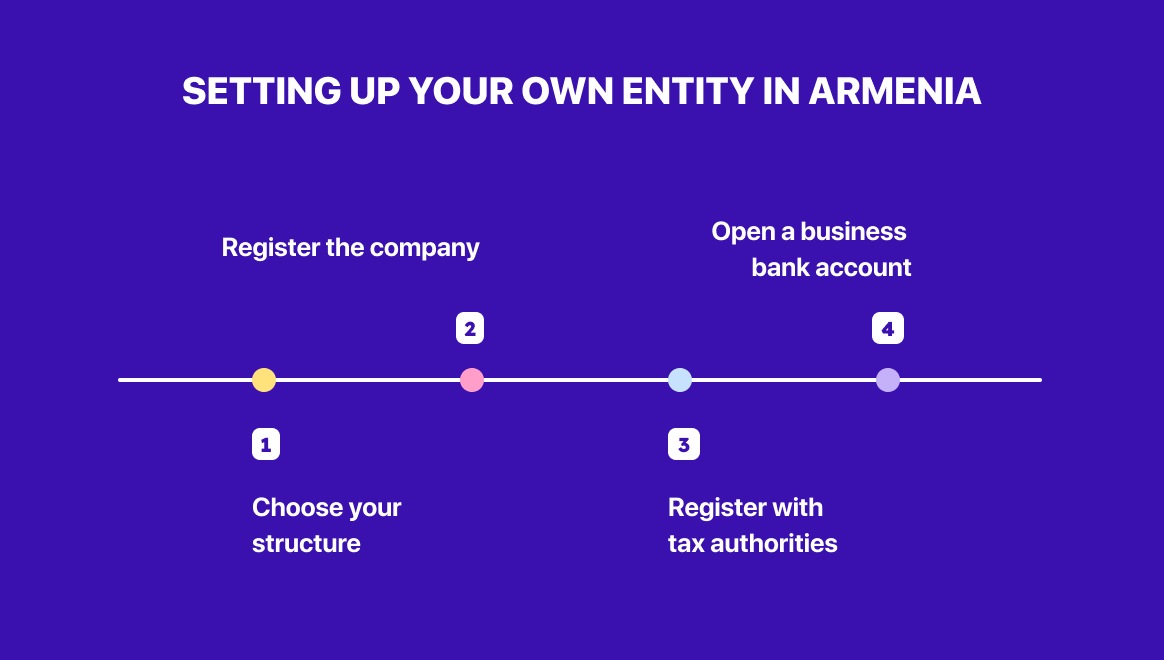
To use a PEO, you first need to establish a legal entity in Armenia, usually a Limited Liability Company (LLC).
This involves:
- Registering the company with Armenia’s State Register of Legal Entities
- Obtaining a tax identification number from the State Revenue Committee
- Setting up a local bank account to process salaries
- Ensuring compliance with mandatory contributions, such as pension and income tax withholding
Without these steps, a PEO cannot operate on your behalf.
This makes PEOs a poor choice for market entry but useful for companies that have already established a local footprint.
3. Compliance and liability
One of the biggest misconceptions about PEOs is that they “take care of compliance.” In Armenia, the reality is more nuanced:
- The PEO may prepare reports, payroll calculations, and HR records.
- But your entity remains legally responsible for compliance with Armenian labor and tax authorities.
- If there’s an error in payroll reporting or a dispute with an employee, liability falls on your company, not the PEO.
This model provides administrative efficiency but does not shield you from legal or financial exposure.
4. When a PEO makes sense in Armenia
A PEO is often a good fit if:
- You already have a registered Armenian entity and want to streamline HR.
- Your headcount is scaling rapidly, and you don’t want to expand your in-house HR team.
- You value local HR expertise to stay aligned with cultural and legal norms.
For example, a US-based IT company with an Armenian LLC might use a PEO to manage payroll and benefits while keeping strategic HR and compliance oversight in-house.
Key Insight
PEOs in Armenia are about efficiency, not entry. They’re ideal for businesses that have already committed to the Armenian market but want to outsource the complexity of day-to-day HR. If you’re still testing the waters or want to avoid entity setup altogether, a PEO will not solve that problem; that’s where an Employer of Record comes in.
What is an Employer of Record (EOR) in Armenia?
An Employer of Record (EOR) in Armenia is a partner that takes on the role of legal employer for your local hires. In practice, this means the EOR:
- Drafts and issues compliant employment contracts
- Runs payroll in Armenian dram (AMD)
- Withholds and pays taxes and social contributions
- Provides statutory benefits such as paid leave and pension contributions
- Ensures compliance with Armenia’s Labor Code and tax regulations
This arrangement lets you stay focused on business operations while the EOR manages the legal and administrative side of employment.
The advantage of no entity setup
Unlike a PEO, an EOR allows you to hire employees in Armenia without setting up a local entity.
You don’t need to register with Armenian authorities, open a local bank account, or take on compliance obligations yourself. Instead, you hire through the EOR’s existing legal entity.
For companies eager to move fast, this is a major advantage. You can build a team in Armenia in a matter of weeks rather than waiting months for entity incorporation and registrations.
Best fit for market entry
EOR providers in Armenia are especially useful for:
- Pilot teams: When you want to test the local market with a handful of employees.
- Quick entry: If you need to secure talent before competitors do.
- Low-risk expansion: When you want to avoid the cost and complexity of entity setup until you’re sure Armenia is a long-term play.
This is why many global companies use an EOR as a stepping stone. They start with a lean team under an EOR, and if headcount grows significantly, they later transition to their own entity or a PEO model.

Key differences between PEO vs EOR in Armenia

At first glance, both PEOs and EORs sound like they promise the same thing: outsourced HR and easier hiring.
But in Armenia, the two models operate under very different rules.
Those differences affect how quickly you can hire, who carries compliance risk, and how much it will all cost you in the long run. Let’s break it down step by step.
1. Entity requirement
- PEO: Requires you to already have a registered Armenian LLC. Without it, a PEO cannot engage employees for you.
- EOR: No entity needed. You can hire through the EOR’s local entity, making it far more practical for first-time market entry.
2. Legal employer
- PEO: You remain the legal employer of record. All contracts and filings are tied directly to your entity.
- EOR: The EOR is the legal employer, issuing contracts and ensuring compliance on your behalf.
This difference is the reason liability shifts with PEOs; the responsibility sticks to you; with EORs, it sits with the provider.
3. Compliance liability
- PEO: The PEO can advise, calculate payroll, and prepare reports, but legal liability stays with your entity. If there’s a labor inspection or tax audit, your name is on the paperwork.
- EOR: The EOR assumes responsibility for payroll taxes, labor law compliance, and filings, shielding your company from direct exposure.
4. Speed to hire
- PEO: Slow. You’ll need 2–3 months for entity registration, tax IDs, and bank setup before you can even engage a PEO.
- EOR: Fast. Employees can start in 10–14 days through the EOR’s existing entity.
For industries like IT and fintech, where talent moves quickly, this speed can make the difference between landing and losing top hires.
5. Costs
- PEO: Lower monthly service fees (often 2–5% of payroll), but you must absorb entity setup costs (legal, accounting, banking) and ongoing admin.
- EOR: Higher per-employee monthly fee (commonly $500–$700), but zero setup costs.
6. Scalability
- PEO: Works best for large operations (50–100+ employees) once you’ve already invested in your entity.
- EOR: Ideal for pilot teams, lean expansion, or testing the Armenian market before committing to incorporation.
7. Immigration support
- PEO: Visa and work permit support depends on your entity’s ability to sponsor foreign employees.
- EOR: Some EORs can sponsor visas under their entity, though support is limited and usually best for smaller expat hires.
Quick comparison table
| Category | Employer of Record (EOR) | Professional Employer Organization (PEO) |
| Entity requirement | No entity required — hire via EOR’s Armenian entity. | Entity setup required (LLC or branch). |
| Legal employer | EOR is the legal employer. | The client company is the legal employer. |
| Compliance liability | Managed fully by the EOR. | Remains with the client. |
| Speed to hire | 10–14 days. | 2–3 months (post-entity setup). |
| Costs | Higher per-employee fees, but no setup costs. | Lower monthly fees, but entity setup and admin are required. |
| Scalability | Best for pilot teams, lean entry, or market testing. | Best for large teams once the entity is in place. |
| Immigration support | Limited but possible through an EOR entity. | Depends on the client entity’s capacity. |
Key Insight: In Armenia, EORs are the clear entry tool, faster, safer, and less admin-heavy. PEOs only become valuable after you’ve already invested in a local entity and are ready to scale big.
Pros and cons of each model
Choosing between a PEO and an EOR in Armenia isn’t about which one is “better.” It’s about which one matches your stage of growth, your risk appetite, and how quickly you need to act. Both options have strengths and trade-offs. Here’s how they stack up.
Employer of Record (EOR)
Pros
- Fast setup: Hire employees in 10–14 days without waiting on entity registration.
- No local entity required: Avoid the cost, paperwork, and delays of setting up an Armenian LLC.
- Compliance shield: The EOR takes on payroll, tax, and labor law responsibilities, reducing your exposure to penalties.
Cons
- Higher monthly fees per employee: EOR providers charge bundled rates that cover compliance and admin. At scale, this can feel heavy.
- Not ideal for very large teams: Once you’re hiring 50–100+ people, the per-head cost may outweigh the convenience.
Professional Employer Organization (PEO)
Pros
- More control once your entity exists: You own the employer relationship and filings, while the PEO handles day-to-day HR.
- Cost efficiency at scale: Monthly admin fees are lower than EOR charges once you’ve already absorbed entity setup costs.
- Integration with in-house HR systems: A PEO can plug into your existing workflows for smoother administration.
Cons
- Entity setup required: You can’t use a PEO until you’ve registered an Armenian LLC and completed tax registrations.
- Compliance risk remains with you: If payroll or filings go wrong, liability falls on your company, not the PEO.
- Slower to first hire: Incorporation, banking, and tax IDs can delay hiring by months.
Which path should you choose, EOR or PEO in Armenia?
The decision between an EOR and a PEO in Armenia isn’t about which model looks better on paper, it’s about which one matches your stage of expansion.
If you’re entering the market for the first time, your needs will look very different from a multinational scaling an established subsidiary. Here’s a quick way to think about it.
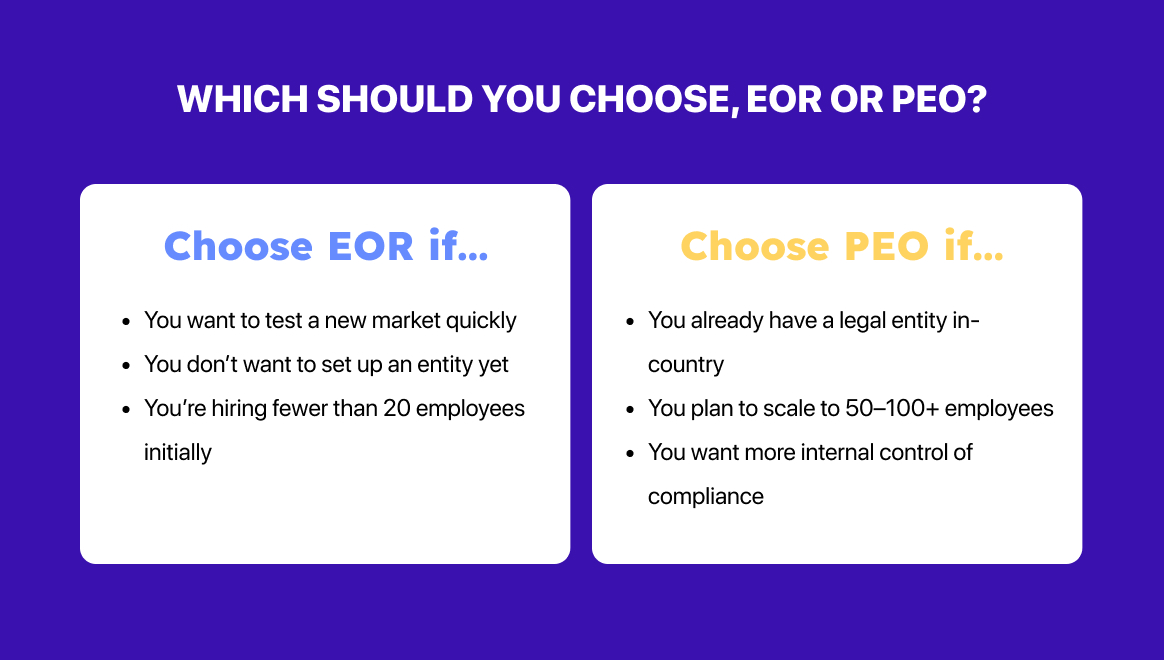
Choose EOR if…
- You want to test the Armenian market quickly. An EOR can have employees onboarded in 10–14 days.
- You want to avoid entity setup. No need to register an Armenian LLC, open a local bank account, or deal with tax registrations.
- You’re hiring fewer than 20 employees. For lean or pilot teams, an EOR is usually cheaper and far less risky than setting up a subsidiary.
Choose PEO if…
- You already have an Armenian entity. A PEO can only work if you’ve gone through incorporation.
- You plan to scale to 50–100+ employees. At larger headcounts, the lower per-employee cost of a PEO can make more sense than EOR fees.
- You want tighter control over compliance. With a PEO, you keep ultimate responsibility — and visibility — over payroll, tax, and HR filings.
Costs: PEO vs EOR in Armenia
When comparing PEO and EOR in Armenia, cost is often the deciding factor, but the numbers only make sense when you pair them with speed, risk, and long-term goals. Here’s how the models differ.
EOR Costs
An Employer of Record (EOR) in Armenia usually charges a bundled, per-employee monthly fee, which includes:
- Payroll administration and salary disbursement
- Withholding and payment of taxes and social contributions
- Compliance with Armenia’s labor code
- Statutory benefits like pensions and paid leave
Typical range:199 Euros per employee/month.
It may look higher on a per-head basis, but you save on entity registration, accounting, and compliance staff. For small teams or pilot projects, EOR is almost always the leaner option.
PEO costs
A Professional Employer Organization (PEO) typically charges lower monthly service fees (often a percentage of payroll), but there’s a catch:
- You must set up and maintain an Armenian LLC, which means upfront legal, banking, and tax registration costs.
- You’ll also cover ongoing overhead such as audits, statutory filings, and HR compliance.
For companies scaling past 50–100 employees, these lower monthly fees often outweigh the initial setup costs, making PEO the cost-efficient choice in the long run.
The trade-off
- EOR = higher monthly cost, zero setup hassle, faster to hire.
- PEO = lower monthly fees, but only after you’ve invested in an entity.
In other words, if you need speed and flexibility, EOR wins. If you’re scaling at volume and already have infrastructure in Armenia, a PEO can pay off.
Payroll outsourcing in Armenia: How it differs from PEO and EOR
Payroll outsourcing in Armenia often gets mentioned in the same breath as PEOs and EORs, but it’s not the same thing. Instead of acting as the employer of record or co-employer, a payroll outsourcing provider focuses strictly on calculating salaries, deducting taxes, and processing payments.
What Payroll Outsourcing Covers
- Monthly salary calculations in Armenian dram (AMD)
- Withholding and remitting income tax and social contributions
- Preparing payslips for employees
- Filing payroll-related reports with the Armenian State Revenue Committee
- Handling year-end tax documentation
It’s a compliance-heavy function, but it doesn’t extend to contracts, benefits administration, or immigration support.
How It Differs from PEO and EOR
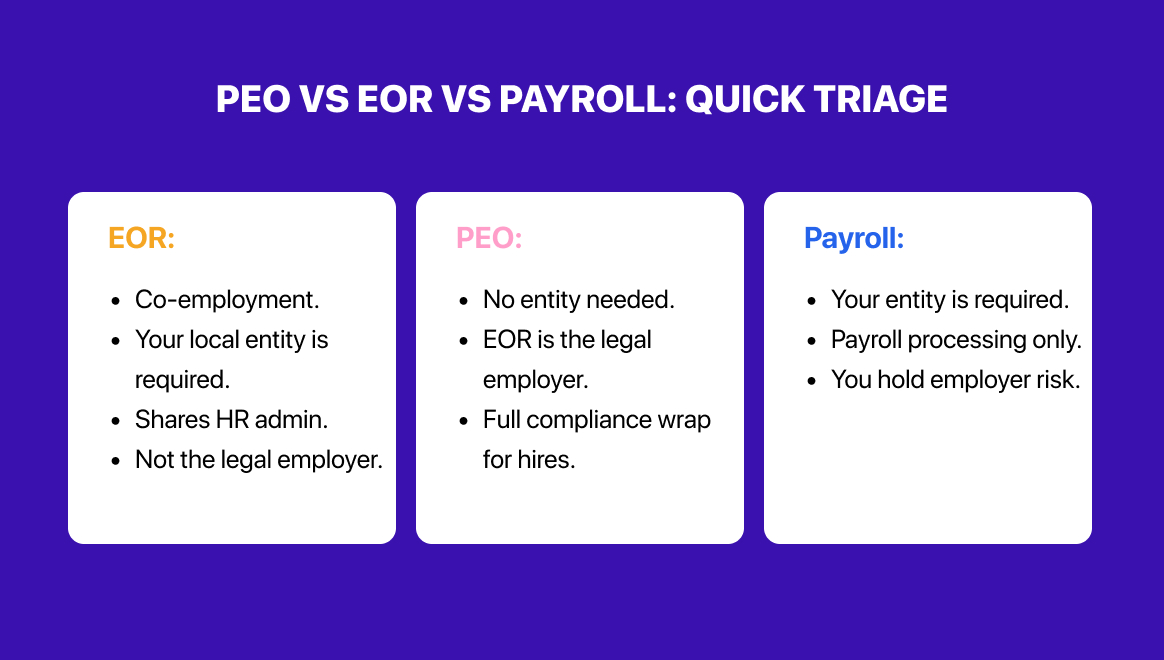
- Payroll Outsourcing: Limited to payroll and tax processing. You remain the legal employer.
- PEO: Adds HR administration (contracts, benefits, policies) but still requires your own Armenian entity.
- EOR: Covers payroll plus employment liability — the EOR becomes the legal employer, allowing you to hire without setting up an entity.
.
When Payroll outsourcing makes sense
- You already have a registered entity in Armenia.
- Your HR team is comfortable managing contracts and compliance but wants to outsource the mechanics of payroll.
- You’re looking for cost savings without transferring employer liability.
Conclusion
Choosing between a PEO and an EOR in Armenia isn’t about which model looks better in theory, it’s about which one aligns with your stage of growth and appetite for complexity.
- If you need speed, low risk, and market entry without bureaucracy, an EOR is the practical choice.
- If you’ve already invested in an Armenian entity and plan to scale headcount, a PEO can streamline HR while keeping costs lower over time.
Both models can support expansion, but they serve different needs. The key is to match the solution to your business strategy, not the other way around.
Team Up helps companies hire compliantly in Armenia and across the Caucasus, Eastern Europe, and beyond.
Talk to us to see whether an EOR or a PEO is right for your next market entry.
.svg)