

EOR Compliance Risks in Canada: What Employers Must Know in 2026

Our guide to Employer of Record (EOR) in Canada 2026 covered why companies use an EOR, how the model works, and what to look for in a provider. It touched on risks at a high level. This article goes deeper. Canada's compliance environment creates specific traps that generic EOR overviews skip. Provincial employment standards vary sharply. Contractor misclassification carries federal and provincial consequences. Permanent establishment risk can trigger corporate tax obligations you did not plan for. Each of these deserves a closer look.
Provincial Fragmentation and Employer Liability
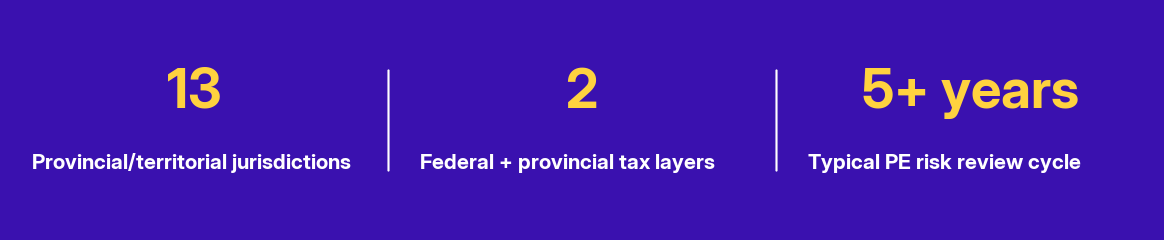
Canada does not have a single employment law. It has thirteen.
Why One Province Is Not Like Another
Each province and territory maintains its own Employment Standards Act. Ontario's Employment Standards Act, 2000 sets different minimum wage rates, overtime thresholds, and termination notice periods than British Columbia's Employment Standards Act or Quebec's Act Respecting Labour Standards. Federally regulated industries follow the Canada Labour Code, but most private-sector employees fall under provincial jurisdiction.
This creates a real operational risk. An EOR that operates compliantly in Ontario may apply Ontario-specific termination rules to an employee based in Alberta. That mistake exposes the client to wrongful dismissal claims.
Statutory Benefits and Leave Entitlements
Provincial variation extends beyond wages. Parental leave duration and eligibility differ across jurisdictions. Some provinces mandate specific paid sick leave days. Others do not. Workers' compensation premiums and registration requirements vary by province and by industry classification within each province.
| Compliance Area | What Varies | Risk If Misapplied |
|---|---|---|
| Termination notice | Minimum weeks by tenure differ per province | Wrongful dismissal liability |
| Overtime threshold | Weekly hour trigger differs (e.g., 44 hrs in Ontario, 40 hrs in BC) | Unpaid overtime claims |
| Statutory holidays | Number and specific holidays vary by province | Missed holiday pay obligations |
| Workers' compensation | Provincial boards, industry rate groups, registration rules | Uninsured workplace injury costs |
| Paid sick leave | Some provinces mandate paid days, others do not | Statutory benefit non-compliance |
A US fintech company hiring three customer support agents in Montreal, two developers in Toronto, and one product manager in Vancouver through an EOR needs that EOR to apply three separate provincial frameworks correctly. Applying a single "Canadian" standard is not compliant.
Vicarious Liability
Under Canadian common law, the legal employer bears vicarious liability for employee actions in the course of employment. Your EOR is the legal employer. If an EOR-employed worker causes harm, the EOR's liability insurance and corporate structure become relevant. Verify that your EOR carries adequate commercial general liability and errors-and-omissions coverage in every province where it employs workers on your behalf.
Misclassification, Permanent Establishment, and Tax Exposure

Contractor vs. Employee Classification
The Canada Revenue Agency applies multi-factor tests to determine worker status. Control, ownership of tools, chance of profit, and risk of loss all factor in. Provincial courts apply similar but not identical tests.
Misclassification penalties compound. The CRA can assess unpaid Canada Pension Plan contributions, Employment Insurance premiums, and income tax withholdings retroactively. Provincial authorities can add unpaid vacation pay, statutory holiday pay, and termination entitlements. The combined exposure for a single misclassified worker over two years can reach tens of thousands of dollars.
When comparing EOR and local entity structures in Canada, misclassification risk is one area where the EOR model should reduce exposure. The EOR formally employs the worker. But this protection holds only if the EOR actually structures the relationship as employment from day one.
Permanent Establishment Risk
This is the trap most overlooked. Under the Income Tax Act (Canada), a non-resident corporation that carries on business in Canada through a "fixed place of business" may trigger a permanent establishment (PE). A PE creates Canadian corporate tax obligations on income attributable to Canadian operations.
An EOR alone does not automatically create a PE. The EOR employs the worker under its own entity. But if your EOR-employed workers negotiate contracts on your behalf, or if they operate from a dedicated office that functions as your Canadian branch, CRA may look through the EOR arrangement.
The risk escalates when senior employees have authority to bind the company. A sales director in Toronto closing deals under your company name raises different PE questions than a software developer writing code remotely.
Watch out: Even without a physical office, CRA can deem a PE exists if an employee habitually exercises authority to conclude contracts on behalf of the non-resident company. This "dependent agent" PE rule applies regardless of the EOR structure.
Due Diligence Before Signing an EOR Agreement

Contract and Indemnity Structure
Your EOR agreement should allocate compliance risk clearly. Look for indemnification clauses that cover CRA reassessments, provincial employment standards claims, and workers' compensation penalties. If the EOR's contract is silent on which party bears the cost of a payroll audit, you have a gap.
Examine whether the agreement specifies which provincial standards apply to each employee. A well-structured EOR contract lists the jurisdiction for every worker and commits to updating entitlements when provincial legislation changes. Generic contracts referencing "Canadian law" without provincial specificity signal a provider that may not manage multi-province compliance at the level Canada demands.
Data Privacy and Provincial Requirements
Canada's Personal Information Protection and Electronic Documents Act (PIPEDA) governs private-sector data handling federally. But Quebec's Act Respecting the Protection of Personal Information in the Private Sector imposes stricter obligations. Alberta and British Columbia have their own substantially similar provincial privacy statutes.
Your EOR collects sensitive employee data. Payroll records, social insurance numbers, health benefit information. Confirm that your EOR's data handling practices comply with the applicable provincial privacy regime, not just PIPEDA.
Hiring compliantly without a local entity through an EOR shifts the employment law burden. It does not eliminate the duty to verify that the EOR meets that burden.

FAQs
Can a provincial employment standards complaint be filed against the client company instead of the EOR?
Generally, the EOR is the employer of record and the primary target. But provinces like Ontario have "related employer" and "joint employer" doctrines. If a tribunal finds that the client exercises sufficient control over working conditions, it may hold both the EOR and the client jointly liable. Review your day-to-day management practices to avoid triggering joint employer findings.
Does using an EOR in Canada affect eligibility for SR&ED tax credits?
The Scientific Research and Experimental Development program requires that the claimant be the employer performing or directing the R&D. If your EOR employs the researchers, the SR&ED claim becomes complicated. You may need to structure a cost-plus arrangement or establish your own entity to claim credits directly. Consult a Canadian tax advisor before assuming EOR-employed R&D staff qualify.
What happens if the EOR fails to remit payroll taxes to CRA?
CRA holds the legal employer responsible for remitting source deductions. If your EOR misses remittances, penalties start at 3% for amounts one to three days late and escalate from there. Repeated failures within a calendar year trigger higher penalty rates. As the client, you face operational disruption and potential PE scrutiny if CRA investigates the arrangement.
What to Watch Next
Canada's federal government and several provinces are reviewing employment standards legislation. Quebec's privacy framework continues to tighten. Ontario has introduced new rules around digital platform workers that could affect classification tests. Before renewing or entering an EOR agreement, audit your provider's provincial registrations and confirm their compliance infrastructure matches every jurisdiction where your team operates. Start with the provinces where your headcount is highest.
If you need a province-by-province compliance review for your Canadian EOR arrangement, TeamUp can walk you through it.
Written by TeamUp — a people-first EOR and nearshoring partner helping companies hire compliantly across 20+ countries, with owned entities in the Caucasus, Central Asia, Turkey, India, and Eastern Europe.
.svg)


