

EOR Costs and Pricing in Canada: What to Budget for Employer of Record Services

Our guide to EOR providers in Canada covered pricing ranges across the major platforms. This article goes deeper into what drives those numbers. EOR fees in Canada carry layers that a headline rate does not reveal. Provincial payroll taxes shift depending on where your employee sits. Statutory benefits add employer-side costs that vary by province and earnings level. Understanding each cost layer prevents budget surprises when your first invoice arrives.

How Canadian EOR Pricing Models Work
Flat Fee vs. Percentage of Salary
Canadian EOR providers use one of two pricing structures. The flat-fee model charges a fixed monthly amount per employee. The percentage model takes a cut of gross salary, usually expressed as a share of total compensation.
| Factor | Flat Fee | Percentage of Salary |
|---|---|---|
| Typical range | $400–$700/month per employee | 10–20% of gross salary |
| Cost predictability | High — fixed regardless of salary | Scales with compensation |
| Best suited for | Senior or high-salary roles | Junior or mid-level hires |
| Risk to budget | Overpaying for low-salary roles | Expensive for $120K+ roles |
| Transparency | Easy to forecast annually | Harder to benchmark across roles |
A $400/month flat fee on a $50,000 annual salary works out to roughly 9.6% of gross pay. That same flat fee on a $150,000 salary drops to 3.2%. The percentage model flips this math. A Toronto-based fintech hiring a senior DevOps engineer at CAD 140,000 would pay CAD 14,000–28,000 annually under a percentage model. The flat-fee equivalent would land around CAD 6,000–8,400.
What the Base Fee Covers
Most Canadian EOR base fees include payroll processing, employment contract drafting, and statutory filings. They also cover remittance of Canada Pension Plan contributions, Employment Insurance premiums, and income tax withholdings under the Income Tax Act. The EOR files T4 slips at year-end and handles Records of Employment when contracts end.
Base fees typically do not cover benefits administration, immigration support, or equipment provisioning. Those sit in separate line items.
The Hidden Cost Layers Most Quotes Leave Out
Provincial Payroll Taxes
Canada's employer health tax varies by province. Ontario charges it on total annual payroll above a threshold. British Columbia applies it above a separate threshold. Quebec layers in additional employer contributions to its provincial pension plan, the Quebec Pension Plan (QPP), which replaces CPP for Quebec-based employees.
These are employer-side costs the EOR passes through. They are not embedded in the EOR's service fee. A company hiring three employees in Quebec faces a different statutory cost profile than one hiring three in Alberta, which has no provincial health premium. Your EOR quote should itemize these separately.
Benefits and Insurance Markups
Canada has no federal mandate for private health insurance. Provincial healthcare covers basic medical services. Most Canadian employers offer supplemental benefits to stay competitive: dental, vision, extended health, life insurance, and disability coverage.
EOR providers either bundle a group plan or let clients choose. Bundled plans carry a markup ranging from 10% to 25% above the insurer's wholesale rate. That spread covers the EOR's administration and broker relationship.
Watch out: Some EOR providers quote a "fully loaded" monthly fee that buries the benefits markup inside the total. Ask for a line-item breakdown separating the EOR service fee, statutory employer costs, and benefits premiums before signing.
Immigration and Work Permit Fees
Hiring foreign nationals through an EOR in Canada triggers Labour Market Impact Assessment fees, work permit processing costs, and potential legal fees. These can add CAD 2,000–5,000 per hire depending on the permit stream. Most EOR providers treat immigration as a separate billable service. If you are weighing whether an EOR still makes sense at that cost level, our comparison of EOR vs. subsidiary setup in Canada covers the breakeven math.
Benchmarking EOR Costs Against Entity Setup
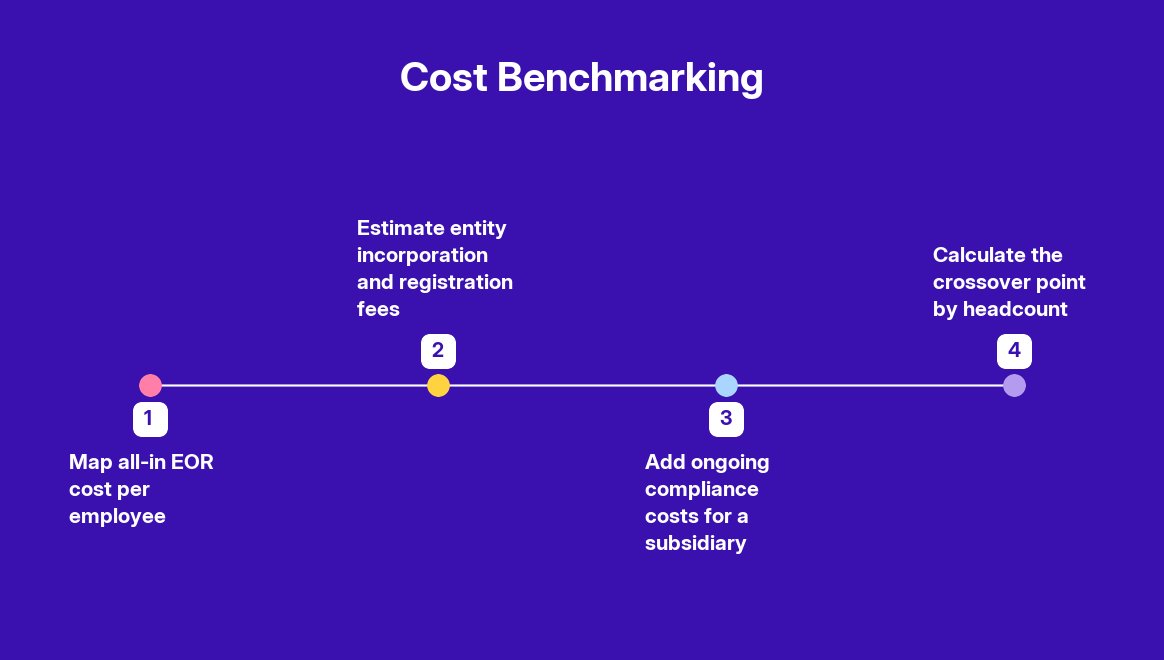
A Canadian federal incorporation costs roughly CAD 200 in government fees. Provincial registration adds more. But the real cost is ongoing. Annual corporate tax filings, provincial employer health tax registration, workers' compensation board premiums, and payroll compliance administration add up.
For a US SaaS company hiring two engineers in Vancouver, the EOR path at $600/month per employee totals roughly $14,400 per year. The entity path requires incorporation, a registered office, a Canadian payroll provider, an accountant for T2 corporate returns, and workers' compensation coverage. That overhead can exceed CAD 25,000–35,000 annually before you hire anyone.
The crossover point where entity costs per employee drop below EOR fees typically lands between 8 and 15 employees. Below that range, the EOR almost always costs less. Companies exploring employer of record options in Canada for small teams of under five rarely find the entity math compelling.
For companies already operating in markets like Turkey or India through a provider with owned local entities, adding Canada to the same EOR relationship simplifies multi-country payroll consolidation.

FAQs
Do Canadian EOR providers charge setup fees?
Some do. Setup fees range from zero to CAD 500 per employee. They cover employment agreement drafting, provincial registration verification, and payroll system onboarding. Providers waiving setup fees often build that cost into a higher monthly rate. Ask for the total first-year cost per employee to compare accurately.
Can the EOR fee change mid-contract?
Most EOR agreements allow annual price adjustments tied to statutory cost increases. If a province raises its employer health tax rate or CPP contribution ceilings increase, the EOR passes those through. Your contract should specify whether statutory pass-throughs require advance notice and whether the EOR's service fee itself is locked for the contract term.
Are severance and termination costs included in EOR pricing?
Rarely. Canadian employment law under the Canada Labour Code and provincial employment standards acts requires notice periods and, in some provinces, statutory severance pay based on years of service. These costs sit outside the monthly EOR fee. The EOR calculates and remits them, but you fund the actual severance amount. Budget a contingency reserve equal to one to three months of salary per employee for termination scenarios.
What to Watch Next
Canada's CPP contribution rates and ceilings are reviewed annually. Provincial employer health tax thresholds shift periodically. Both changes flow directly into your EOR invoices. Before locking in a multi-year EOR agreement, request a sensitivity analysis showing how a 5–10% increase in statutory costs would affect your per-employee spend. That analysis turns your EOR relationship from a cost line into a forecasting tool.
If you want a line-item cost estimate for hiring your first Canadian employees through an EOR, request a breakdown from TeamUp.
Written by TeamUp — a people-first EOR and nearshoring partner with owned entities across the Caucasus, Central Asia, Turkey, India, and Eastern Europe, supporting 200+ businesses across 20+ countries.
.svg)


