


Egypt Work Permits & Visas: Employer Guide to Types & Sponsorship
TL;DR
Hiring in Egypt is not for the faint of heart. If you are a decision-maker planning to tap into this talent-rich but red-tape-heavy hub, you need to understand that the employer of record work visa in Egypt is the literal gatekeeper to your operations.
You cannot "growth hack" your way around the Ministry of Labor. You cannot treat Cairo like a digital nomad sandbox. In Egypt, if you don't have a valid permit, you don't have a team; you have a liability waiting for a USD 2,000 fine per worker. Utilizing a global employer of record or specific employer of record services in Egypt is often the only way to navigate the 1:9 foreign worker ratio without your legal department having a collective nervous breakdown. This guide strips away the corporate fluff and gives you the raw, 2026-validated truth about sponsoring talent in the land of the Pharaohs.
Quick Navigation
- TL;DR
- Who Needs a Work Permit in Egypt?
- Types of Egypt Work Visas and Permits
- How the Egyptian Quota System works
- Taxonomy of Egyptian Visas and Permits for 2026
- The 2026 Regulatory Overhaul: Decrees You Can't Ignore
- Step-by-step guide on Egypt’s Work Permit Process
- The Egypt Work Permit Roadmap: Process & Timelines
- Payroll Compliance and the 2026 Social Insurance in Egypt
- The Integrated Inspection Regime: What Happens in 2026?
- Common Challenges & Compliance Risks in Egypt
- What Is Employer Sponsorship And How Does It Work in Egypt?
- How an Employer of Record Simplifies Egyptian Hiring
- Strategic Decision: EOR vs. Own Entity (Founder-Level Clarity)
- Conclusion
- Frequently Asked Questions
Who Needs a Work Permit in Egypt?

Let’s not sugarcoat this.
If someone is physically in Egypt and doing paid work, they need a work permit. Full stop.
It doesn’t matter if they’re an expat relocating to Cairo, a “remote employee” working from a Zamalek Airbnb, or a dual citizen who never bothered to renew Egyptian documents. If they are not recognized as an Egyptian national for employment purposes, they are treated as a foreign worker. And foreign workers require work permits under Egyptian law.
The Egyptian Ministry of Manpower is clear. Any foreign national engaging in paid activity inside Egypt must obtain proper work authorization. Even short stints. Even “temporary help.” Even remote work is performed on Egyptian soil.
There are narrow exceptions. Diplomats. Certain government consultants. Some investors are under specific regulatory programs. If your hire doesn’t fall into one of those tiny buckets, assume a permit is required.
Now, let’s clarify the grey areas people love to invent.
Egyptian citizens and permanent residents
Egyptian nationals are fine. A national ID is enough. No work permit required.
But dual citizenship only helps if the person actually holds valid Egyptian documentation. No Egyptian passport or national ID. Then for employment purposes, they are treated as foreigners. And foreigners need permits.
Remote foreign employees physically in Egypt
This is where founders get creative.
“They’re on a tourist visa.”
“They’re paid by our US entity.”
“They’re technically remote.”
Immigration authorities don’t care about your internal payroll structure. If the individual is physically performing work while in Egypt, that qualifies as employment activity. That triggers the need for work authorization.
There is no digital nomad visa in Egypt. There is no “remote but not really working here” loophole.
Working in Egypt equals Egyptian work authorization required.
Contractors and freelancers visiting Egypt
If a foreign contractor flies in to collaborate, train staff, or support a project, they are technically performing work on Egyptian soil. Egyptian law defines work broadly. Paid or unpaid does not change the core requirement.
Business meetings are fine on a business visa. Hands-on operational work is not.
Engaging in productive work while holding a tourist visa is explicitly illegal.
Business visas and short projects
Egypt issues business visas for conferences, meetings, and short non-operational visits. These visas are not employment authorization.
If someone with a business visa begins executing day-to-day responsibilities or contributing to production, that crosses the line into unauthorized work.
Bottom line. If they are not Egyptian and they are working in Egypt, get a work permit.
Skipping this step exposes both the employer and the individual to fines, penalties, and potential deportation issues. Egypt does enforce these rules.

Types of Egypt Work Visas and Permits
Egyptian immigration is not one single document. It’s a sequence.
Here’s what you’re actually dealing with.
Entry Visa
This is how the foreign employee initially enters Egypt.
For many nationalities, this can be a 30-day tourist visa on arrival. Others must apply at an Egyptian consulate before travel.
Important reality. An entry visa is not work authorization. It just gets the person into the country.
In most cases, the individual enters on an entry visa, and once the employer secures the work permit, their status is converted inside Egypt.
Work Permit
This is the core legal authorization.
The work permit is issued by the Ministry of Manpower. It is employer-sponsored and role-specific. That means:
- It is tied to a specific company.
- It is tied to a specific position.
- It cannot simply be transferred to a new employer.
Typically, work permits are issued for up to one year and are renewable annually. In practice, renewals can extend employment up to around three years before additional scrutiny or higher-level approvals are required.
Critically, the employer must justify hiring a foreigner. Authorities expect proof that no qualified Egyptian candidate is available for the role. Egypt enforces foreign-to-local workforce ratios in many sectors. This is not a box-ticking exercise.
No employer approval. No permit.
Work Visa (Employment Status Conversion)
In Egypt, there is no completely separate “work visa” application detached from the permit.
Once the work permit is approved, immigration authorities convert the individual’s visa status to reflect employment authorization. This is usually done inside Egypt if the person is already present legally.
The permit is the difficult part. The visa stamp reflects that approval.
Residence Permit
If the employee will stay beyond short-term entry periods, they also need a residence permit.
This residence permit is generally aligned with the validity of the work permit. Most foreign employees receive temporary residence valid for one year, renewable alongside the work permit.
There are longer residence categories in Egypt, but they are not typical for standard corporate hires.
The residence permit matters for everyday life. Leasing property. Opening a bank account. Signing contracts. Without it, basic logistics become complicated fast.
Business Visa
This is for meetings. Conferences. Exploratory visits.
It is not for executing projects. It is not for managing local teams. It is not for operational tasks.
Using a business visa as a substitute for a work permit is a compliance gamble. And it’s a losing one.
How the Egyptian Quota System works
The first thing any founder needs to swallow is the "10% Rule." Under Egyptian Law No. 12 of 2003, and reinforced by the 2025/2026 decrees, the number of foreign workers in any establishment cannot exceed 10% of the total Egyptian workforce. This is the "Marmite" of Egyptian labor law; you either plan your entire business model around it or you hate it when your work permit applications are summarily rejected.
The Quota Multiplier: Why One Expat Costs Ten Salaries
In Egypt, the 1:9 ratio is a functional constraint that demands a total redesign of project planning. You aren't just hiring an expat; you are committing to a "Local Support Multiplier". To legally sponsor one foreign specialist, you must have nine insured, registered Egyptian citizens on your payroll. For many tech startups, this is an immediate deal-breaker unless they use an international employer of record that can "absorb" the expat into a larger, compliant pool of local talent.
| Workforce Metric | Statutory Limit | Strategic Implication |
| Foreigner Cap | 10% of total staff | Requires a massive local scale for small teams. |
| Salary Cap | 20% of total payroll | Total expat wages cannot cannibalize the local wage bill. |
| Investment Law 72 | 20% cap (Exception) | Higher caps are available for companies under the Investment Law. |
| Free Zone Status | 25% cap (Exception) | Specific zones allow higher expat density for export-focused firms. |
If your project cannot sustain this tenfold cost, the operational model is essentially unviable under the 2026 mandate. This is where it becomes vital reading, as it compares the cost of carrying this ratio on your own entity versus using an EOR country partner to handle the quota balance for you.

Taxonomy of Egyptian Visas and Permits for 2026
The Egyptian government does not play games with "business trip" loopholes. Physical work activity, even short-term training or meetings, is subject to employment regulation. If they are working from a beachside Airbnb in Dahab, but they are on your payroll, they need a permit.
The Long-term Work Permit
This is the gold standard. It is issued by the Ministry of Manpower and Immigration and is the only authorization that allows lawful, long-term employment. It is role-specific and employer-sponsored; there is no "freelance visa" for employees.
- Validity: Typically one year, renewable annually.
- Processing Time: 8 to 10 months for the final "hard copy" permit, though you can work on the filing receipt.
- The "Receipt" Hack: The moment you file the application, you receive a submission receipt. In the eyes of the Egyptian authorities, this receipt allows the employee to start working legally while the security clearance drags on for months.
The Entry and Conversion Process
Most expats do not get their work permit while sitting in London or New York. They enter, then convert.
| Visa Type | Purpose | Duration/Nuance |
| Work Visa (Entry) | Entry for the purpose of work | 30 days, non-renewable, issued at embassies. |
| Tourist Visa | Standard entry | Often used as the initial entry point, then converted. |
| Temporary Residence | Interim stay | Issued for 6 months while the work permit is pending. |
| Permanent Work Visa | For highly skilled/tech | Linked to specific contracts and government approvals. |
The 2026 Regulatory Overhaul: Decrees You Can't Ignore

The transition from 2025 to 2026 saw a "thickening" of the bureaucracy. Ministerial Decree No. 279 of 2025 and Law No. 14 of 2025 have fundamentally changed the "at-will" nature of hiring and the transparency of the foreign labor register.
The 15-Day Absence Notification
One of the most aggressive new rules is the security-linked requirement to notify the Ministry of Labor if a foreign worker is absent for 15 consecutive business days without a valid reason. This is a "Security and Integrity" pillar designed to ensure that the expat isn't just a "ghost" on a permit but is actually performing the role for which the permit was granted.
Small Enterprise Facilitation (Decree 194)
There is a small glimmer of hope for "Small Enterprises" (restaurants, shops, sole proprietorships). Decree No. 194 of 2025 provided a temporary grace period for these entities to regularize foreign staff without the usual rigid experience certifications. However, for most tech founders, you are likely classified as a standard establishment, meaning the full weight of the law applies.
Step-by-step guide on Egypt’s Work Permit Process
Let’s be honest.
If you decide to handle Egyptian work permits without an Employer of Record or local immigration counsel, you are signing up for a bureaucratic endurance test. It is not impossible. It is just procedural, rigid, and unforgiving.
In Egypt, sequence matters as much as substance. Miss an order. Miss a stamp. Miss a translation. You start again.
Here’s what that actually looks like.
Step 1. The Labor Market Test and Justification
Before Egypt approves a foreign work permit, the employer must justify why this role cannot be filled by an Egyptian national.
This is not a vague explanation. It requires a formal Justification Letter addressed to the Ministry of Manpower. The letter must clearly outline:
- The specific skills required
- Why are those skills scarce locally?
- Why the foreign candidate is uniquely qualified
In 2026, scrutiny is increasing. Authorities are cross-referencing justifications with national workforce development data and skill classification systems. Generic wording does not work.
“We couldn’t find anyone suitable” is not an argument. It’s a rejection waiting to happen.
This stage is also where workforce ratio rules come into play. Many sectors operate under foreign-to-local caps, often around 10% foreign employees per establishment, unless exemptions apply. If your company exceeds the allowable ratio, your application can stall before it even begins.
This is the first filter. And it’s entirely employer-driven.
Step 2. Credential Legalization. The MFA Dance
Degrees are not globally portable in Egypt. They must be legalized through a strict chain.
If your candidate shows up with a framed diploma from London, New York, or Berlin, that piece of paper means nothing in Cairo until it completes the full authentication sequence.
The typical process looks like this:
- Authentication in the issuing country: The diploma must first be certified by the appropriate state or federal authority where it was issued.
- Legalization by the Egyptian Embassy: The authenticated document must then be legalized by the Egyptian embassy or consulate in that same country.
- Final legalization in Egypt: Once in Egypt, the document must receive the final stamp from the Egyptian Ministry of Foreign Affairs.
Skip a link in this chain, and the Ministry of Manpower will reject the application. Don't question it. Reject it.
This is where timelines stretch. If apostilles, translations, or embassy appointments are delayed, your entire hiring schedule moves with them.
Step 3. The Mandatory Medical Exam
Every foreign applicant must complete a medical examination in Egypt as part of the work permit and residency process.
The HIV/AIDS test must be conducted at the Central Laboratory of the Egyptian Ministry of Health or another officially designated government facility. Private overseas medical reports do not replace this requirement.
If your candidate walks in with a premium London clinic certificate, the authorities will still require the Egyptian government-issued test before residency approval.
This medical clearance is directly tied to residence issuance. No approved test. No residency card. No legal long-term stay.
There is no workaround here.
Step 4. Security Clearance. The Black Box
This is the least transparent stage of the process.
Once documents are submitted, Egyptian authorities conduct a security background check. This includes criminal record verification and broader national security screening.
There is no public timeline. It can take weeks. Sometimes longer.
There is no dashboard where you track progress. There is no explanation if the file is “under review.” There is no formal appeal path if delays occur beyond informal follow-ups.
This is why the official work permit submission receipt matters. It serves as evidence that the process is underway and helps bridge the gap while waiting for final clearance.
Founders often underestimate this stage. It is not about document quality at this point. It is about government vetting. You wait until clearance is granted.
The Egypt Work Permit Roadmap: Process & Timelines
The path from "candidate selected" to "legal on-set" is a rigorous sequence of approvals. While using an Employer of Record (EOR) streamlines the bureaucracy, you should still anticipate a 40-day window for full compliance.
Timeline Overview
| Phase | Focus | Estimated Duration |
| Phase 1 | Document Collection & Translation | Day 1–5 |
| Phase 2 | Ministry Submission & Security Clearance | Day 6–15 |
| Phase 3 | Work Permit Approval & Tax Registration | Day 16–30 |
| Phase 4 | Residency Finalization | Day 31–40 |
Phase 1: Preparation & Document Collection (Day 1–5)
The most critical stage is the pre-eligibility check. Before a single form is filed, ensure the candidate’s nationality and role align with Egyptian labor quotas.
- Documentation: Collect passport copies, photos, and police clearances.
- The "Arabic Requirement": All diplomas and reference letters must be translated and notarized.
- The Contract: Drafting the employment contract in Arabic is mandatory; an EOR provides the legally compliant template here to avoid immediate rejection.
Phase 2: Submission & State Security Screening (Day 6–15)
The sponsoring entity (your EOR partner or local entity) files the application with the Ministry of Manpower.
- The Waiting Game: This stage triggers the State Security background check.
- Risk Mitigation: While Egyptian security services review the candidate's profile, having an EOR ensures that paperwork is filed the first time correctly, preventing the "kick-back" loop that can add weeks to the timeline.
Phase 3: Approval & Statutory Registration (Day 16–30)
Once the Ministry approves the justification for hiring a foreign national, the initial work permit is issued (valid for one year).
- Onboarding: The employee is formally registered for Egyptian Social Insurance and assigned a Tax ID.
- Visa Synchronization: If the employee is abroad, the Egyptian Consulate is notified to issue the entry work visa. If already in-country, the transition from a tourist visa begins here.
Phase 4: Residency Finalization (Day 31–40)
A work permit allows you to work, but a Residence Permit allows you to stay.
- Ministry of Interior: Your team or EOR coordinates with the Immigration Authority for the physical residence ID card.
- The Finish Line: This stage may require the employee to visit a local immigration office for a registration stamp. Once the ID card is in hand, the employee is 100% compliant.
Payroll Compliance and the 2026 Social Insurance in Egypt
The cost of an employee in Egypt is a moving target. The National Organization for Social Insurance (NOSI) increases caps by 15% every January. If your EOR payroll system isn't updated by January 1st, you are out of compliance by January 2nd.
2026 Social Insurance Parameters
As of January 1, 2026, the contribution wages have been adjusted to reflect inflation and fiscal tightening.
| Category | 2025 Limit (EGP) | 2026 Limit (EGP) | Percentage |
| Min. Insurable Wage | 2,300 | 2,700 | N/A |
| Max. Insurable Wage | 14,500 | 16,700 | N/A |
| Employer Share | N/A | N/A | 18.75% |
| Employee Share | N/A | N/A | 11% |
For high-level managers or board members listed on the commercial register, the rate is a flat 21% of the maximum wage (EGP 16,700), totaling an employer contribution of EGP 3,131.25 per month. This is a critical detail for those moving to full management hiring.
Income Tax Brackets: The Progressive Pain
Egypt’s tax system is aggressive for high earners. Employers must withhold monthly and reconcile annually.
| Taxable Annual Income (EGP) | Rate | Context |
| Up to 40,000 | 0% | The "Personal Allowance" threshold. |
| 40,001 – 55,000 | 10% | Low-tier entry. |
| 70,001 – 200,000 | 20% | Most junior professionals. |
| 400,001 – 1,200,000 | 25% | Mid-to-senior management. |
| Above 1,200,000 | 27.5% | The "High Earner" ceiling. |
Founder Insight: In 2026, the Egyptian Tax Authority (ETA) uses "digital reconciliation" to flag any mismatches between tax filings and social insurance reports. Discrepancies trigger automatic audits. This makes eor payroll services more than a convenience, it's your insurance against a tax audit.
The Integrated Inspection Regime: What Happens in 2026?
The days of "hiding" foreign workers in a back office are over. The 2026 inspection regime is "integrated," meaning authorities no longer look at immigration and labor in isolation. They examine the coherence of the entire relationship.
- Workplace Alignment: Do workers appear at the worksites listed in their permit? If you permit them for a Cairo office, but they are found working in Alexandria, that is a violation.
- Job Description Truth: Does the actual task performed match the "Justification Letter"? If you hired a "Technical Consultant" but they are doing sales, immigration bodies will scrutinize the legal basis of their stay.
- Real-Time Ratio Checks: Inspectors can enter establishments at any time, day or night, without prior notice. They will count heads to ensure you haven't dropped below the 9:1 local-to-expat ratio.
If you are scaling quickly, check to understand how to onboard and manage these teams so you don't fail a snap inspection.
Common Challenges & Compliance Risks in Egypt

Let’s be blunt: navigating Egypt’s immigration and labor paperwork solo can be like assembling IKEA furniture blindfolded – you might figure it out eventually, but chances are something crucial will be backwards or broken. Here are some frequent red flags and mistakes that trip up employers (and how to avoid them):
1. Rejected Applications Due to Non-Arabic Contracts
So you submitted everything, but in English because, hey, everyone speaks English in business, right? Big mistake. Egyptian authorities require employment contracts in Arabic – even if you have a bilingual contract, the Arabic text must be the governing version.
If you skip this, your entire work permit application will hit a dead end, no matter how stellar your candidate is. We’ve seen companies fumble here by issuing an offer letter or contract only in English – the Ministry will not accept it. Always ensure the contract is translated by a certified translator and preferably reviewed by local counsel for compliance with Egyptian labor law.
An EOR will handle this for you and make sure the contract is formatted exactly as officials expect.
2. Delays from Missing or Incomplete Documents
Egypt’s process is document-heavy. Think of a checklist and then double it. Commonly overlooked items include: a local police clearance (or affidavit of no criminal record) for the employee, the full set of medical test results from an approved clinic, the detailed justification letter on why you need to hire a foreigner, and even proof of the two Egyptian assistants or understudies for the role.
Yes, that last one is a real requirement in some cases – showing you’re training locals alongside the expat hire. If any stamp, notarization, or supporting letter is missing, the application can languish or be sent back for fixes. Every omission means lost weeks.
The lesson: sweat the details, and use a checklist from someone who’s done it before. This is where an experienced local partner shines; they won’t let you forget the odd requirements.
3. Misclassification: Contractor vs Employee = Immigration Violation
This one’s the “sneaky” risk. You might think: I’ll bypass all this by hiring the person as an independent contractor. Be careful – if that individual is working full-time for you, taking direction like an employee, and especially if they’re a foreign national, Egyptian authorities can deem it illegal employment under the table.
We call this the contractor misclassification trap. The immediate consequences can include a work visa denial (if they try to convert later), fines for the company, or even a ban on future hires. Essentially, if it walks and talks like an employment relationship, Egypt will treat it as such – meaning you should have sponsored a work permit. Don’t risk it. (For context: a foreign contractor needs to have their own work authorization and tax registration in Egypt to be legit, which most don’t.) When in doubt, it’s safer to use an EOR to convert that contractor into a properly registered employee with a permit, rather than keeping them off the books.
4. Hiring Expats on Tourist Visas (Unregistered Work)
Perhaps you figure, “We’ll just have them work quietly on a tourist visa for a few months, nobody will know.” This is a ticking time bomb. If an expat is working without a permit, they are by definition unregistered – no tax ID, no social insurance, nothing.
All it takes is a routine audit or an employee trying to open a bank account (banks often ask for work permits or residence IDs) to flag the situation. The result? Surprise labor inspections, retroactive fines, and legal headaches for both you and the individual. The worker could get deported or barred, and your company could face penalties and be blacklisted from sponsoring future visas.
Egypt is increasingly cracking down on undeclared work as it tightens labor enforcement. The age of “just winging it” is over. If they’re physically working in Egypt, get them on the books properly. Period.
In short, compliance is not optional. We’ve outlined the traps so you can avoid them. Now, understanding all this, you might wonder: Is there a scenario where setting up my own company in Egypt is better than using an EOR? Let’s briefly compare the two approaches in context of work permits.
What Is Employer Sponsorship And How Does It Work in Egypt?
Let’s say it plainly.
In Egypt, a foreign employee cannot sponsor themselves. A recruiter cannot sponsor them. A “partner company” cannot casually sponsor them.
Only a legally registered Egyptian entity can.
Work permits here are employer-driven by design. That means if you hire a non-Egyptian, your company, or your Employer of Record, carries the full legal weight of that sponsorship.
Here’s what that really involves.
1. You Need a Legal Entity in Egypt
No entity. No work permit.
The Ministry of Manpower requires the sponsoring employer to be a locally registered Egyptian company or branch. A foreign company operating from abroad cannot directly sponsor a work permit.
So your options are:
- Set up your own Egyptian entity, which means incorporation, tax registration, local banking, local compliance, and ongoing reporting.
- Use an Employer of Record that already has a licensed Egyptian entity and can sponsor on your behalf.
This is why EOR exists in markets like Egypt. Not as a luxury. As a practical necessity when you don’t want to incorporate just to hire one person.
2. You Must Prove No Egyptian Can Do the Job
Egypt protects local employment aggressively.
As part of the application, you must submit a formal justification explaining why a foreign national is required. Authorities may request:
- Evidence of attempts to recruit locally
- Proof of the candidate’s specialized qualifications
- Clear business necessity
Under Labour Law No. 14 of 2025, enforcement tightened. This is not a box-ticking exercise anymore. The justification must align with national workforce priorities.
If your argument is weak, the application slows down or stops.
3. You Must Respect Foreign Worker Quotas
Egypt operates under strict foreign-to-local workforce ratios.
The general framework:
- Foreign workers cannot exceed 10 percent of total employees.
- Their combined salaries cannot exceed 20 percent of the total payroll.
- Often applied as a 1:9 ratio. One foreign employee for every nine Egyptians.
If you are hiring your first foreign executive, you cannot ignore this. You must build your local workforce alongside.
Exceptions exist in limited sectors. But they require additional approvals and sometimes special fees.
This is not just compliance. It’s a workforce planning strategy.
4. Documentation Is Extensive and non-negotiable.
The employer compiles and submits the entire application file. This includes:
- Commercial registration and tax ID
- Official sponsorship letter
- Arabic employment contract, or bilingual with Arabic controlling
- Authenticated diplomas and certifications
- Medical clearance, includingan HIV test
- Police clearance
- Work permit forms signed and stamped
And yes, the Arabic contract is mandatory. Submitting only an English contract is a guaranteed rejection.
There is also a knowledge transfer element. In some cases, employers must provide documentation showing Egyptian understudies are being trained alongside the foreign hire. This reflects the government’s expectation that foreign expertise will transfer to local talent over time.
Egyptian immigration is procedural. If the sequence or format is wrong, the file goes back to you.
5. Security and Medical Clearance
You do not control this timeline.
After submission, the Ministry coordinates with State Security for background vetting. This stage has limited visibility. It can take weeks. Sometimes longer.
Simultaneously, the employee must complete a government-approved medical examination inside Egypt. External private tests are not accepted for final residency issuance.
As sponsor, you coordinate:
- Biometric submissions
- Health lab appointments
- Police registration within days of arrival
You are accountable for making sure it all happens correctly.
6. Fees, Renewals, and Exit Management
Work permits carry government fees, generally a few hundred dollars annually. The employer pays these.
But the bigger obligation is renewal management. Work permits are typically valid for one year and must be renewed before expiration. Miss the deadline and your employee falls out of legal status.
If employment ends, you must:
- Cancel the work permit
- Notify authorities
- Update immigration records
The sponsorship relationship does not automatically dissolve. You must actively close it.
How an Employer of Record Simplifies Egyptian Hiring

1. Sponsorship Without Incorporation
An EOR already has a compliant Egyptian entity. They sponsor the work permit under their company name.
You do not:
- Incorporate
- Open a corporate bank account
- Register for tax
- Hire local payroll staff
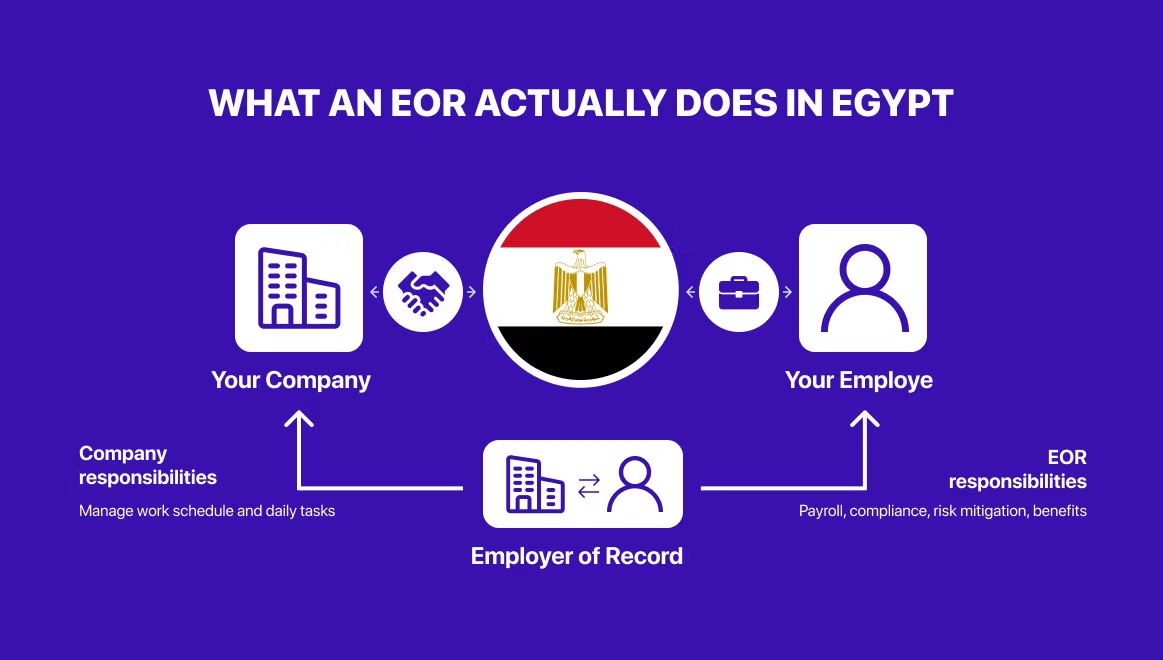
The EOR becomes the legal employer of record. You manage the employee’s work. They manage compliance.
2. Paperwork Management in Arabic
Egyptian immigration paperwork is Arabic-first.
A strong regional EOR drafts:
- Fully compliant Arabic employment contracts
- Properly formatted sponsorship letters
- Government application forms
They already have commercial registration and tax documents on file. They know which offices require originals versus copies. They know the order of submissions.
No trial and error. No guessing which stamp goes where.
3. Government Liaison and Process Navigation
Egyptian bureaucracy is structured. But it is also human.
A local EOR team understands:
- Which ministry office handles what
- How long does security clearance typically takes
- When to escalate
- When to wait
They interact with the Ministry of Manpower, the Ministry of Interior, and local labor offices regularly. That experience reduces friction and surprises.
4. Faster, Predictable Onboarding
Without local expertise, first-time employers in Egypt often take 2 to 3 months to navigate the process.
With an experienced EOR, timelines typically compress to 30 to 45 days in straightforward cases, assuming documentation is clean.
During processing, the employee can often begin onboarding under structured guidance while final approvals move forward.
You reduce idle time. You reduce risk. You reduce stress.
Strategic Decision: EOR vs. Own Entity (Founder-Level Clarity)
If you are planning to hire 1–10 people to test the Egyptian market, setting up an entity is a strategic error. The administrative burden of managing Arabic payslips, monthly Social Insurance reports, and the 1:9 quota will kill your momentum.
The Employer of Record (EOR) Advantage
- Speed: Go from "Job Offer" to "Onboarded" in 10 business days, rather than months of entity registration.
- Liability: The EOR carries the employer's liability. If there is a labor dispute (which is common in Egypt’s employee-friendly courts), the EOR handles the legal defense.
- Language: Everything in the Egyptian government is Arabic. A top eor in India or the USA won't help you here; you need local eor services in Egypt that speak the language of the Ministry of Manpower.
The Entity Setup Reality
To hire directly, you need a local bank account in EGP, a registered tax ID, and a local HR team to manage the physical files (which must be kept for 5 years after termination). This is only viable for companies with 50+ employees planning a decade-long stay. For a detailed cost-benefit analysis, refer to.
Conclusion
Egypt is a bureaucratic jungle, but it’s a jungle with some of the best engineering and tech talent in the eor services mena region. The average gross monthly salary of EGP 11,000–12,000 (roughly USD 225–245) provides a massive arbitrage opportunity for international firms, provided they can swallow the compliance costs.
The employer of record work visa in Egypt is the price of admission. You can't avoid it, but you can outsource the pain. By using an eor country partner, you offload the 1:9 ratio, the MFA stamps, and the 2026 integrated inspections to experts who have done it a thousand times before. You focus on the code and the customers; the EOR focuses on the Ministry of Manpower.
Team Up has built a reputation as a trusted regional EOR by doing exactly that – keeping companies compliant and worry-free. They earned their stripes navigating the complexities of Georgian labor law, and they bring that same rigor to Egypt and the broader MENA region. The result? You get to hire the people you need, where you need them, without jumping through hoops or risking legal violations. No entity setup fees, no bureaucratic nightmares, no hidden liabilities.
Ready to build your team in Egypt with confidence? With the right partner, you can focus on the exciting part – growing your business – while we (or your chosen EOR) handle the permits, visas, and fine print. Egypt’s talent pool is waiting, and now you know how to bring them on board the right way. Don’t let paperwork stand in the way of opportunity. Reach out and let’s make your Egypt expansion a compliant success story.
Frequently Asked Questions
1. What is the "10% Rule" (1:9 Ratio)?
By law, foreign employees must not exceed 10% of a company's total staff. This means for every one foreign worker you hire, you must employ at least nine Egyptian citizens.
Note: These foreign workers also cannot account for more than 20% of your total payroll.
2. Can I get an exemption from the 10% quota?
Exemptions are rare and typically reserved for specialized technical roles where no local talent is available. To hire beyond the 10% cap, employers must submit a request to a special committee at the Ministry of Labour, often paying significantly higher fees for these "extra-quota" permits.
3. What are the primary types of work authorizations?
- Short-Term Work Authorization: Recently extended to allow stays of up to 180 days for temporary assignments.
- Standard Work Permit: The most common permit, issued for one year (renewable).
- Work Visa (Entry Visa): A specific visa obtained from an Egyptian consulate abroad that allows the employee to enter the country for the purpose of finalizing their work permit.
4. What is the minimum salary for foreign workers in 2026?
While the general private-sector minimum wage is 7,000 EGP per month, foreign specialists are expected to earn significantly more to justify their sponsorship. Authorities often review the salary against the "10x rule"—calculating if the project can sustain the cost of one foreign expert plus the nine local staff members required to meet the quota.
5. Does an employee need a medical test?
Yes. A mandatory HIV/AIDS test is required for all foreigners applying for a work permit in Egypt. This test must be conducted at a government-approved central laboratory within Egypt; results from abroad are generally not accepted for the final permit.
6. Can a foreigner work on a Tourist Visa?
Strictly speaking, no. However, Egypt allows a "conversion" process where an employee enters on a tourist or business visa, and the employer then applies for a work permit. Once the Ministry issues a "Work Permit Submission Receipt," the employee can legally begin working while the final permit (which can take 6+ months) is processed.
7. What are the employer's "Bi-Annual Filing" obligations?
As of the 2025/2026 regulations, employers must submit workforce reports twice a year (January and July). These reports must list all Egyptian and foreign staff to prove the company is still maintaining the required 1:9 employment ratio.
8. What is the "15-Day Absence Rule"?
Under the current "Security and Integrity" themes, employers are required to notify the Ministry of Labour if a foreign employee is absent from their designated workplace for more than 15 consecutive days. This ensures that the permit holder is actually performing the role for which they were sponsored.
9. How long does the approval process take?
- Temporary Authorization: 2–4 weeks.
- Standard Work Permit (Interim Receipt): 1–3 months.
- Final Work Permit Card: 6–10 months.
Pro Tip: The "Interim Receipt" is the key document—it allows your employee to work legally even before the final plastic card is issued.
10. Are there restricted professions for foreigners?
Yes. Certain sectors are strictly reserved for Egyptian nationals. Foreigners are generally prohibited from working as tour guides, in customs clearance, or in most general export/import administrative roles.
.svg)


