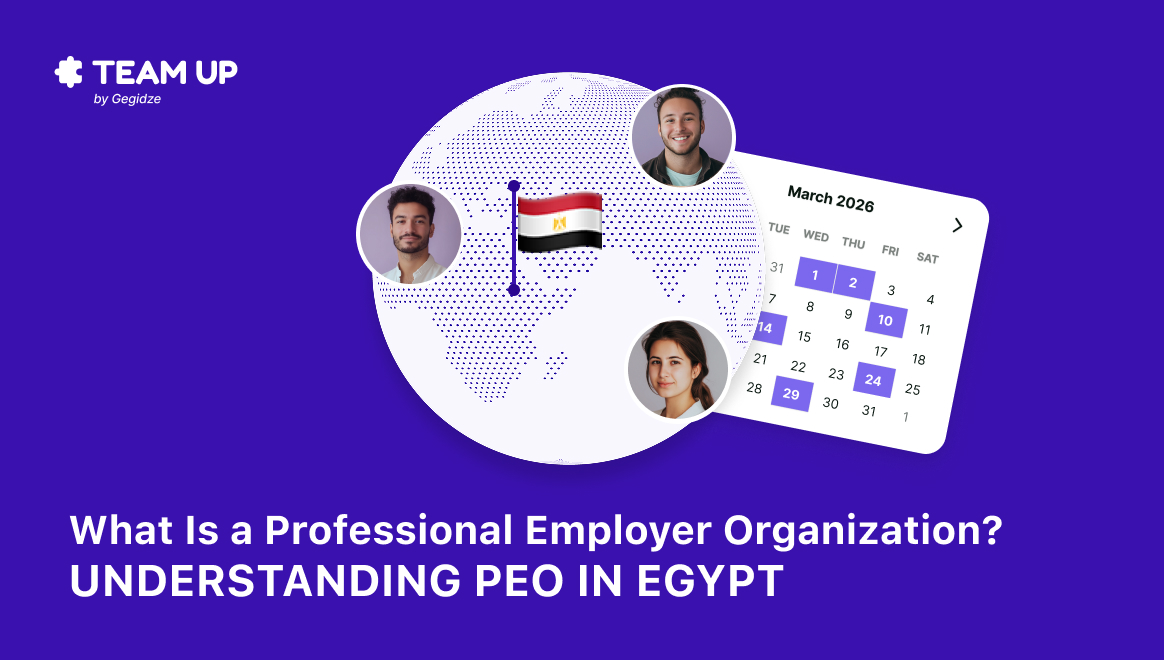
What Is a PEO? Understanding Professional Employer Organizations in Egypt
TL;DR
Expanding into Egypt is a bit like driving in Cairo: it looks like absolute chaos to an outsider, but there is a very specific, unspoken rhythm to it.
If you try to navigate it without knowing the local "rules of the road," you’re going to get stuck, or worse, end up in a costly legal pile-up.
If you are looking at the North African market, you’ve likely asked: What is a PEO in Egypt? and more importantly, do I actually need one?
We aren't going to tell you that entering Egypt is "seamless" or "effortless." It’s not. It’s a bureaucratic labyrinth of Arabic-only filings, shifting minimum wage decrees, and social insurance nuances that would make a seasoned CFO’s head spin.
A Professional Employer Organization (PEO) is essentially the local co-pilot who knows exactly when to honk the horn and which turns to take to keep your business moving.
This guide shows you which is which.
Table of contents
- TL;DR
- Why PEOs are misunderstood in Egypt
- What is a PEO in Egypt
- How PEOs actually work in the land of the Pharaohs
- PEO consulting services in Egypt step by step
- What a PEO services does not cover in Egypt
- PEO vs Employer of Record (EOR) in Egypt
- When using a PEO in Egypt actually makes sense
- When a PEO is the wrong choice in Egypt
- PEO vs staffing agency in Egypt
- Common compliance traps companies hit with PEOs in Egypt
- The honest takeaway
- Ready to hire in Egypt without guessing or gambling?
- Frequently Asked Questions

Why PEOs are misunderstood in Egypt
The confusion usually starts with one bad shortcut.
Someone hears “PEO” and assumes it means “they hire employees for me.”That is not how Egypt works.
In Egypt, labor law, tax enforcement, and social insurance all anchor to who the legal employer is. That detail decides who gets audited. Who gets fined. Who gets sued if something goes sideways.
A PEO does not replace that responsibility.
This is why we’re blunt about it at Team Up.If you don’t already have an Egyptian entity, a PEO is not a market entry solution. It’s an admin layer. Nothing more.
For now, let’s define terms properly.
What is a PEO in Egypt
A Professional Employer Organization operates on a co-employment model.
That phrase matters more than any brochure.
Here’s what co-employment means in plain language:
- You own the local company
- You sign the employment contracts
- You are the legal employer under Egyptian law
- The PEO helps you administer HR and payroll
The PEO does not employ your staff.
The PEO does not shield you from compliance exposure.
The PEO does not replace a local entity.
Globally, PEOs exist to help established companies run HR more cleanly. In Egypt, that role is even narrower because regulators care deeply about employer identity.
If someone sells you a PEO as a way to remote hiring in Egypt without an entity,” stop the call.
That model is called an Employer of Record (EOR). Different tool. Different risk profile. Different legal structure.
We’ll come back to that comparison later.

How PEOs actually work in the land of the Pharaohs
In a PEO model, you share employer responsibilities. You manage the employee’s day-to-day work, their KPIs, and their seat in the "virtual office." The PEO, meanwhile, is the employer of record for administrative purposes.
1. The Arabic Contract Hurdle
In Egypt, a contract written only in English is about as legally useful as a papyrus scroll. Egyptian Law requires employment contracts to be in Arabic, and they must be filed with the Social Insurance Office. A PEO ensures your contracts are bilingual protecting your interests while satisfying the local labor inspector.
2. The 2026 Financial Reality
As of early 2026, the National Wages Council has set the private sector minimum wage at 7,000 EGP. If your "Global HR Software" hasn't updated its backend for this, you’re already out of compliance. A local PEO doesn't just "set and forget" payroll; they adjust for these frequent regulatory shifts in real-time.
3. Social Insurance (The Big One)
This is where most foreign founders trip up. You can't just "Wire money to a bank account" and call it a day. You have to contribute to the National Organization for Social Insurance (NOSI).
- Employer share: 18.75%
- Employee share: 11% The PEO calculates this, deducts it, and files it monthly. If you miss a deadline, the interest rates on late payments in Egypt are aggressive.
PEO consulting services in Egypt step by step
This is the part most articles skip. Let’s walk it slowly, the way a CFO would.
Step 1: You must already have an Egyptian entity
Before a PEO enters the picture, you need:
- A registered company in Egypt
- Tax registration with the Egyptian Tax Authority
- Social Insurance registration
- Local bank accounts
No entity means no PEO. There is no workaround here.
This is why PEOs are usually used by multinationals or companies already operating in Egypt, not by founders testing the market.
Step 2: You hire employees under your company name
Employment contracts in Egypt are not casual documents.
They must align with:
- Egyptian Labor Law
- Social insurance requirements
- Termination rules
- Arabic language requirements in disputes
With a PEO:
- The contract is yours
- The liability is yours
- The enforcement risk is yours
The PEO may help draft or administer the contract, but legally, it’s your responsibility.
Step 3: The PEO runs payroll administration
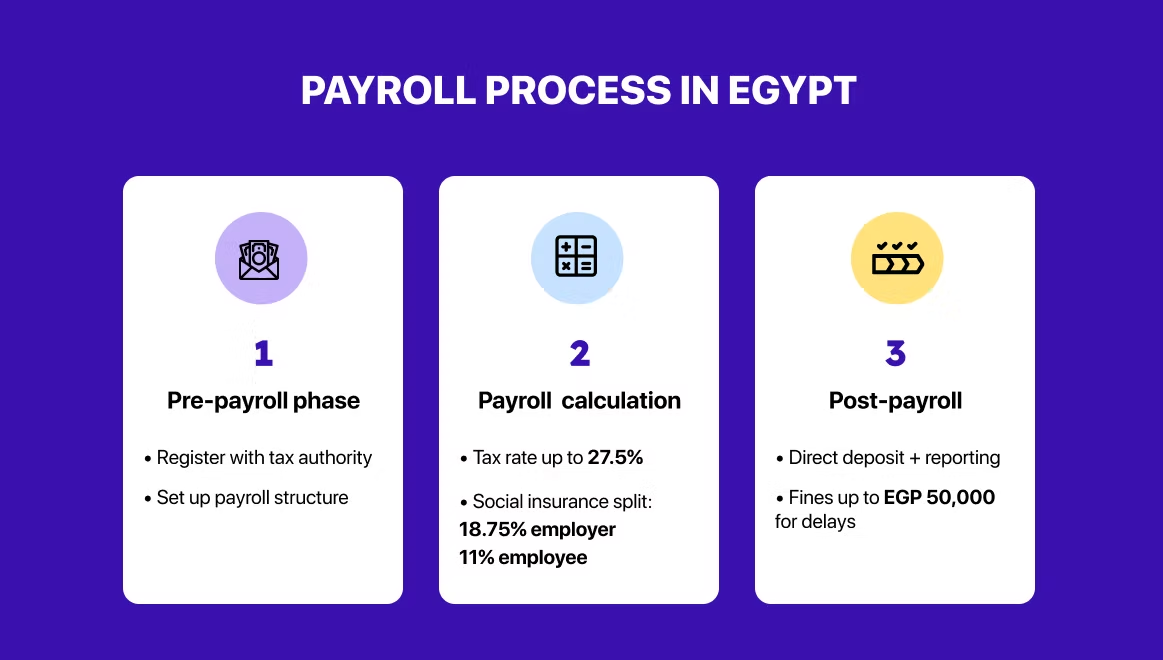
This is where PEOs actually earn their keep.
A PEO in Egypt typically handles:
- Monthly payroll calculations
- Income tax withholding
- Social insurance contributions
- Payslip generation
- Leave tracking
But here’s the important part.
If payroll is wrong, late, or misfiled, the authorities don’t call the PEO.
They call you.
Step 4: You retain full compliance risk
Even with a PEO:
- You are the employer of record in the eyes of regulators
- You are liable for labor disputes
- You are responsible for audits and penalties
This is why experienced operators use PEOs to optimize operations, not to avoid risk.
If your goal is risk transfer, you’re looking at the wrong model.
What PEO services doesnotcover in Egypt
This section saves companies real money.
A PEO in Egypt does not:
- Hire employees on your behalf
- Eliminate the need for a local entity
- Transfer legal employer status
- Protect you from labor court claims
- Absorb tax or social insurance penalties
If an employee sues, your company name is on the case.
If taxes are misreported, your tax file gets flagged.
If a termination is mishandled, your legal team handles it.
This is not a flaw. It’s just the structure.
The mistake is using a PEO when what you actually need is something else.
PEO vs Employer of Record (EOR) in Egypt
In the world of international expansion, "PEO" and "EOR" are often tossed around like they’re the same thing. They aren't. Choosing the wrong one is the difference between a smooth landing and a massive legal headache.
Here is the "no-BS" breakdown of EOR vs. PEO, specifically through the lens of the Egyptian market in 2026.
The Fundamental Difference: Who Owns the "Paperwork"?
| Feature | Employer of Record (EOR) | Professional Employer Org (PEO) |
| Legal Employer | The EOR is the sole legal employer on paper. | You and the PEO share a "co-employment" bond. |
| Local Entity | Not required. You use the EOR's entity. | Mandatory. You must have your own Egyptian LLC/Branch. |
| Liability | The EOR absorbs the majority of employment risk. | You stay on the hook for legal and labor risks. |
| Setup Time | Days (Immediate hiring). | Months (Wait for entity setup). |
| Best For | Market testing, rapid entry, or small teams. | Large, permanent teams with a local footprint. |
1. The EOR Approach: "The Soft Landing"
Think of an EOR in Egypt as a "Plug and Play" solution. You find a brilliant software developer in Cairo. You don't want to wait 6 months to register a company with GAFI just to pay them.
- How it works: The EOR hires them under their Egyptian tax ID. They handle the Arabic contracts, the 18.75% social insurance, and the monthly tax filings.
- The Reality: You manage the employee’s work, but legally, they are "leased" back to you. It’s fast, it’s compliant, and it’s the standard choice for 90% of foreign startups entering Egypt.

2. The PEO Approach: "The Efficiency Engine"
A PEO is for when you’ve already committed. You’ve gone through the pain of setting up an Egyptian legal entity, you have a local bank account, and you have 20+ employees.
- How it works: You are the legal employer, but you outsource the HR "grunt work" to the PEO. They use their scale to get you better rates on private health insurance and handle the 7,000 EGP minimum wage updates so your HR manager doesn't have to.
- The Reality: If a labor dispute happens, the employee sues your company, not the PEO. You are the one standing in front of the judge.
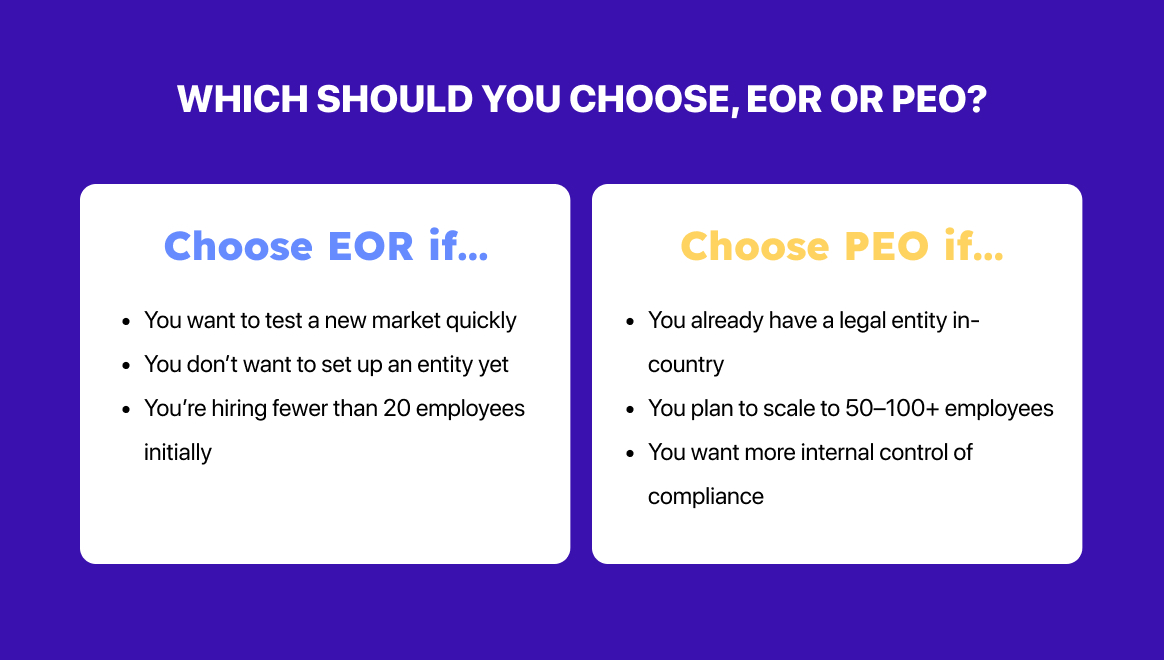
Which one should you pick for Egypt?
Go with an EOR if:
- You have zero legal presence in Egypt.
- You want to hire your first 1–10 employees quickly.
- You aren't sure if Egypt is a 10-year play yet.
- You want to bypass the 10:1 ratio (9 Egyptians for every 1 expat) for your first few hires.
Go with a PEO if:
- You already have a registered Egyptian LLC.
- You have a massive team (30+) and the flat fees of an EOR are becoming too expensive.
- You want your brand name, not a third party's name, on the employee’s official social insurance file.
Pro Tip for 2026: Most of our clients at Team Up start with an EOR to get the talent in the door within 48 hours. Once they reach a headcount of 15-20, they begin the entity registration process and transition those employees to a PEO model. It’s the smartest way to scale without the upfront risk.
When using a PEO in Egypt actually makes sense
We’re not anti-PEO. We’re anti-misuse.
A PEO is a solid choice only when these boxes are already checked:
- You have a registered Egyptian entity
- You employ 10–20+ local staff
- You plan to operate long-term
- You have legal and accounting support
- You want HR and payroll to run smoother, not disappear
Typical examples:
- A multinational with a Cairo office
- A regional company consolidating HR ops
- A business that already survived its first audit
In these cases, a PEO reduces operational drag. That’s its job.
When a PEO is the wrong choice in Egypt
This is the uncomfortable part. It’s also where founders lose money.
A PEO is a bad fit if:
- You’re testing Egypt with 1–5 hires
- You don’t have a local entity
- You need to hire fast
- You want compliance risk off your balance sheet
- You’re answering to investors or a board
In these scenarios, a PEO doesn’t reduce risk.
It concentrates it.
This is exactly why EOR exists.
PEO vs staffing agency in Egypt
Another common mix-up.
A staffing agency:
- Finds people
- Sometimes pays contractors
- Rarely owns compliance risk
A PEO:
- Does not recruit
- Does not employ
- Manages HR administration
They solve different problems.
If someone offers “PEO staffing,” ask follow-up questions. Slowly.
Common compliance traps companies hit with PEOs in Egypt

If you thought managing social insurance was the end of the road, welcome to the second half of the journey. Egypt’s labor law is a blend of modern international standards and deeply rooted cultural traditions. As a founder, you can’t just ignore these; they are the "fine print" that determines whether your local team feels valued or legally neglected.
1. The Hajj Leave: A Once-in-a-Lifetime Requirement
In Egypt, the law honors the spiritual life of the employee. Under Article 53 of the Labor Law, any employee who has been with your company for five continuous years is entitled to a one-month fully paid leave to perform the Hajj pilgrimage (or visit Jerusalem for Christian employees).
- Frequency: Once in a total career with the same employer.
- The PEO value: Your PEO tracks these long-term tenure milestones, ensuring you aren't surprised by a 30-day absence that is 100% mandatory and paid.
2. Maternity & Childcare: The 2026 Gold Standard
Egypt has significantly stepped up its protection for working mothers. As of late 2025/2026, female employees are entitled to 120 days (4 months) of fully paid maternity leave.
- The Twist: This applies up to three times during their service.
- Nursing Breaks: For two years following the birth, mothers are entitled to two 30-minute breastfeeding breaks per day (or they can "bundle" them into one hour).
- The Shield: You cannot fire a female employee while she is on maternity leave—period. Attempting to do so is the fastest way to find yourself in a Cairo labor court.
3. Termination: The "Two Months Per Year" Rule
Firing someone in Egypt is not "at-will." You cannot just wake up and decide to "part ways" without a very documented, legally sound reason (think gross misconduct or proven incompetence).
- Unfair Dismissal: If a court decides you fired someone unfairly, the standard compensation is at least two months of full salary for every year of service.
- Notice Periods: Two months for those under 10 years of service; three months for those over 10 years.
- How PEOs help: They manage the disciplinary process to ensure that if you do need to let someone go, the paper trail is bulletproof.
The 1:10 Ratio: Can You Bring Your Own Team?
Egypt is protective of its local talent. For every one foreign employee you bring in, you are generally required to hire nine Egyptians.
- The "Work Permit" Trap: Getting a work permit for an expat is a marathon of paperwork. You have to prove that no local Egyptian can do that specific job.
- The Hack: Many tech founders use a PEO to hire their local Egyptian engineering team first, reaching the required ratio before trying to bring in a foreign CTO or Manager.
Why "Global" Software Often Fails in Egypt
We’ve seen it a hundred times: a company uses a "one-size-fits-all" global HR platform that handles 100 countries. It works for London and New York, but it chokes on Egypt.
- It misses the annual 3% increment: Egyptian law mandates a minimum 3% annual raise based on the social insurance salary.
- It ignores the Arabic precedence: If your platform only generates English contracts, they are essentially void in a local dispute.
- It fails the "Casual Leave" test: Egyptians get 6 days of "Casual Leave" (Aredah) per year, which are deducted from their annual 21-day balance but can be taken without prior permission for emergencies.
The Verdict: Is a PEO Your Best Move?
If you are a founder or an Ops Manager, you have two choices:
- The Hard Way: Spend $20k+ on legal fees, wait 6 months for a GAFI registration, hire a local accountant, an Arabic-speaking HR lead, and a "Fixer" for the government offices.
- The Team Up Way: Partner with a regional expert who already has the infrastructure. You interview the talent, we handle the Egyptian bureaucracy.
Expanding into Egypt doesn't have to feel like a war crime for your taste buds. With the right partner, it’s a strategic masterstroke that taps into one of the world’s most vibrant talent pools.
The honest takeaway
A PEO in Egypt is not a shortcut.
It’s an optimization tool.
If you’re already operating locally, it can help you breathe.
If you’re entering the market, it can quietly expose you.
At Team Up, we see the same successful pattern again and again:
EOR first. Entity later. PEO when it actually makes sense.
No heroics. No gray zones. No surprises during due diligence.
If your goal is to hire in Egypt without gambling on compliance, structure beats optimism every time.
That’s where the real decisions start.
Ready to hire in Egypt without guessing or gambling?
Here’s the uncomfortable truth most providers won’t say out loud.
If you pick the wrong hiring model in Egypt, you don’t just “learn and adjust.”You inherit compliance debt. Quietly. Expensively. And usually right before something important.
An audit. A funding round. An acquisition.
That’s why teams come to Team Up.
Not because we sell buzzwords.
Because we tell you, early, when a PEO makes sense. And when it absolutely does not.
When companies work with Team Up in Egypt, they get:
- A clear recommendation. PEO, EOR, or neither. Based on your situation, not our pricing page.
- A compliant hiring structure from day one. No entity games. No contractor gray zones.
- Real local coverage.Payroll, tax, labor law, social insurance. Handled properly.
- A clean path forward. Start with EOR. Move to an entity. Add a PEO only when it’s rational.
We don’t lock you into the wrong model.
We help you sequence the right one.
If you’re considering hiring in Egypt right now
Before you sign anything.
Before you open an entity you might regret.
Before you let someone tell you “PEO and EOR are basically the same.”
We’ll look at:
- Your headcount plan
- Your timeline
- Your risk tolerance
- Your long-term goals in Egypt
And we’ll tell you, clearly, what works. And what doesn’t.

Frequently Asked Questions
What is a professional employer organization in Egypt?
A professional employer organization (PEO) in Egypt is an HR outsourcing partner that supports companies that already have a local Egyptian entity.
The PEO helps with:
- Payroll administration
- HR processes
- Compliance support
But the PEO does not employ your staff. Your company remains the legal employer under Egyptian labor law.
That distinction drives everything. Liability. Risk. Control.
What does PEO stand for in HR?
PEO stands for Professional Employer Organization.
In HR terms, it refers to a co-employment model, where:
- You employ the workers
- The PEO supports HR and payroll operations
In Egypt, this model is strictly administrative. It does not replace the employer.
What is the PEO's meaning in HR for Egypt specifically?
In Egypt, PEO meaning in HR is narrow and precise.
It means:
- Outsourced HR administration
- Payroll processing assistance
- Compliance support
It does not mean:
- Hiring employees on your behalf
- Avoiding an Egyptian entity
- Transferring legal or tax risk
If someone presents it that way, they’re oversimplifying. Or selling.
What is the difference between PEO and EOR in Egypt?
The difference between PEO and EOR in Egypt comes down to one thing.
Who is the legal employer.
- PEO Egypt: You are the employer. You must have an entity. You hold the risk.
- EOR Egypt: The EOR is the employer. No entity required. Risk shifts away from you.
This difference impacts:
- Labor law exposure
- Payroll compliance
- Audit risk
- Termination liability
They are not interchangeable models.
PEO vs EOR Egypt. Which one should I choose?
PEO vs EOR in Egypt depends entirely on your setup.
Choose a PEO if:
- You already have an Egyptian entity
- You employ a sizable local team
- You want HR efficiency, not risk transfer
Choose an EOR if:
- You are a foreign company
- You don’t have an entity
- You want to hire fast and compliantly
Most foreign companies start with EOR. Very few should start with a PEO.
Employer of Record vs PEO Egypt. Which is safer?
From a compliance perspective, employer of record vs PEO in Egypt is not a close call.
An EOR is safer for:
- Market entry
- Small teams
- Investor-backed companies
- Risk-averse operations
A PEO assumes you already know the market and accept the risk.
Safety follows structure. Not branding.
How does PEO payroll work in Egypt?
PEO payroll in Egypt means the PEO helps administer payroll, but:
- Salaries are paid under your company
- Taxes are filed under your entity
- Social insurance is your obligation
If something is filed incorrectly, authorities contact you, not the PEO.
That’s the core difference between administration and liability.
What is the PEO payroll meaning in Egypt?
PEO payroll meaning in Egypt refers to:
- Payroll calculation support
- Tax and social insurance processing
- Payslip generation
It does not mean:
- Outsourced employer responsibility
- Payroll risk transfer
Payroll execution and payroll liability are not the same thing in Egypt.
Are there PEO services in Egypt for foreign companies?
Yes. But with limits.
PEO services in Egypt for foreign companies only work after you set up a local entity.
Without an entity:
- A PEO cannot hire for you
- A PEO cannot run compliant payroll
- A PEO cannot protect you legally
Foreign companies without entities need an EOR, not a PEO.
Are there global PEO services in Egypt?
Yes, global PEO services in Egypt exist.
But global does not mean flexible.
Most global PEOs:
- Still require a local entity
- Operate through local partners
- Do not assume employer liability
Global branding doesn’t change Egyptian labor law.
.svg)