


Relocation to Egypt: Legal Requirements and Practical Steps
Tl;DR
Expanding into Egypt is a bit like driving in Cairo: it looks like absolute chaos to an outsider, but there is a very specific, unspoken rhythm to it. If you try to navigate it without knowing the local "rules of the road," you're going to get stuck, or worse, end up in a costly legal pile-up.
For decision-makers planning to start hiring in this emerging hub, the entry strategy often centers on the use of employer of record services, a mechanism that allows organizations to bypass the bureaucratic "war crimes" of entity setup while tapping into a talent pool that is as skilled as it is misunderstood.
The Egyptian market functions as the "Marmite" of international growth, for the uninitiated, the paperwork and local compliance hurdles appear as a series of punishing obstacles, yet for the savvy founder, the region offers a strategic crossroads between Europe, Africa, and the Middle East that is impossible to ignore.
People in this region can smell corporate BS from a mile away; they value transparency, directness, and a noble point of view. Consequently, the most reliable regional partner is one that acknowledges these complexities with honesty rather than masking them in corporate fluff.
Quick Navigation
- Tl;DR
- Quick Navigation
- The Strategic Landscape of the Egyptian Market
- Legal Framework: Navigating Law No. 12 of 2003
- Social Insurance and Taxation: The Compliance Engine
- Practical Relocation Steps: The Founder's Guide
- The Employer of Record (EOR) Advantage in Egypt
- The Cost of Compliance in Egypt
- Conclusion: Navigation for the Savvy Founder
- Frequently Asked Questions
The Strategic Landscape of the Egyptian Market
Egypt is no longer just a historical landmark; it is a burgeoning tech and services hub. The strategic landscape has undergone a fundamental transformation, shifting from rigid corporate localization to agile, talent-centric deployment mediated by the employer of record services in Egyptframework. This transformation is driven by a highly skilled, cost-competitive workforce that is increasingly English-proficient and specialized in high-demand fields such as AI development and software engineering.
For organizations looking to enter the North African market, the first question is rarely "if" but "how". The traditional route, setting up a local subsidiary, often feels like a war crime of paperwork for a startup or a mid-sized firm. The legal reality of the Egyptian market is that it is document-heavy and digitally enforced, yet it rewards those who understand its internal logic.

Talent Benchmarks and Economic Viability
The core appeal of Egypt lies in its human capital. Data from localized talent pools indicates that senior software developers and AI engineers in Cairo provide exceptional value compared to their counterparts in Western hubs or even other emerging markets in the Caucasus.
| Talent Role | Experience Level | Key Skills | Monthly FTE (Approx. €) |
| AI Developer | Middle | AWS Lambda, C, C++ | €2,100 |
| Software Developer | Senior | Microservices, NestJS, API | €2,500 |
| Sales Representative | Senior | B2B, CRM, Customer Support | €1,450 |
| Operations Manager | Middle | Adobe Suite, Project Management | €900 |
Source: Regional Talent Pool Data.

These benchmarks illustrate a market where high-level technical expertise is available at a fraction of the cost of European or North American talent, provided the employer can navigate the local tax and social insurance frameworks. This is where eor payroll systems become indispensable, as they bridge the gap between global salary expectations and local compliance requirements.
Legal Framework: Navigating Law No. 12 of 2003

The Egyptian labor market is governed by the Unified Labor Law No. 12 of 2003, a comprehensive piece of legislation that dictates every aspect of the employment relationship. To a founder, this law is the "rulebook" for the Cairo traffic jam. It is heavily protective of the employee, a fact that necessitates a deep understanding of compliance before the first contract is signed.
The Probationary Period and Termination "Tripwires"
The probationary period In Egypt is strictly capped at three months. Unlike other jurisdictions in the region where probation might extend to six months, Egypt’s three-month limit is a "hard limit" that cannot be renewed for the same employee with the same employer. This period is the only window where the relationship can be terminated with relatively low friction.
Once the three-month mark is passed, the employee gains significant protections. Terminating an Egyptian contract for "poor performance" is notoriously difficult and requires a documented trail of warnings, committee reviews, and, in many cases, a court order if the employee contests the dismissal. This is why companies increasingly choose employer of record services to handle the performance management and legal risk associated with Law 12.
The Mandatory 7% Annual Increase
One of the unique "rhythms" of the Egyptian market is the mandatory annual salary increase. According to the Labor Law, employees are entitled to a periodic annual increase of no less than 7% of the basic salary used for social insurance calculations. While many global firms incorporate performance-based raises, the Egyptian 7% is a statutory floor, not a ceiling. Failing to account for this in long-term budgeting is a common error for founders moving into the region.
Social Insurance and Taxation: The Compliance Engine
The Egyptian Social Insurance system (often referred to as SISI) is the primary compliance engine for any employer. It is a complex, two-sided contribution system that requires meticulous monthly reporting. For the uninitiated, managing SISI is where the "war crime" of paperwork usually begins.
Social Insurance Contributions (SISI)
The Social Insurance Law (Law No. 148 of 2019) revolutionized how contributions are calculated, moving toward a unified "comprehensive salary" model. The employer is responsible for withholding the employee's share and contributing their own portion to the National Social Insurance Authority.
| Contribution Component | Employee Share | Employer Share | Total Contribution |
| General Social Insurance | 11% | 18.75% | 29.75% |
| Emergency Subsidy Fund | N/A | 1% | 1% |
| Total Compliance Burden | 11% | 19.75% | 30.75% |
Note: Percentages are applied to the social insurance salary base, which is subject to annual minimum and maximum caps set by the government.
The "Emergency Subsidy Fund" is a particularly local nuance, it is a 1% levy on the base salary of all employees, intended to support workers during industrial crises. For a global firm, this looks like an obscure tax; for an Egyptian employer of record, it is a standard monthly line item that ensures the client remains in good standing with the Ministry of Labor.
Personal Income Tax (PIT)
Egypt utilizes a progressive tax bracket system for personal income. The tax is calculated on the "net taxable income," which is the gross salary minus social insurance contributions and a standard personal exemption.
- Tax Brackets: These range from 0% for the lowest earners up to 27.5% for high-income individuals (as per the latest amendments to Law 91 of 2005).
- Monthly Filing: Tax must be withheld and paid monthly, with an annual reconciliation (Form 4) submitted every January.
Managing these filings across a remote team requires a sophisticated eor payroll platform. The "Marmite" truth here is that the Egyptian Tax Authority is increasingly digitized; while you can no longer hide in the paperwork, the speed of filing has improved for those with the right software.

Practical Relocation Steps: The Founder's Guide
Relocating as a founder to Egypt in 2026 is a "high-friction, high-reward" move. While the bureaucracy is legendary, the strategic access to the MENA region and a massive 110M+ local market make it a hub for scale.
Here is the founder’s practical roadmap to landing and operating in Egypt.
Phase 1: The "Soft Landing" (Months 1–2)
Before moving your life, you need to establish your legal "anchor."
- Structure Your Entity: 90% of founders choose the Limited Liability Company (LLC). It allows 100% foreign ownership and requires a minimum of two partners (the second can be a 1% nominee).
- The GAFI Shortcut: All founders must pass through GAFI (General Authority for Investment). It is a "one-stop shop" that handles your Commercial Register and Tax Card in one building.
- The Banking Catch: You cannot open a corporate bank account without a physical office lease.Founder Tip: "Virtual offices" are often rejected by tax authorities. Secure a small coworking space or serviced office in Zamalek or New Cairo to pass the first inspection.
Phase 2: Residency & The "Investor" Visa
As a founder, you don't want a standard work permit (which is tied to the 1:9 local ratio). You want an Investor Residency.
| Visa Type | Threshold (Approx.) | Duration |
| Property-Linked | $50,000 USD | 1 Year (Renewable) |
| Investor Permit | Active Company Formation | 1–3 Years |
| Citizenship by Investment | $350,000 USD + $100k Donation | Lifetime |
- Security Clearance: Expect a 1–3 month wait for security vetting after your initial filing. This is standard for all foreign founders.
- The Medical Test: You must pass a health screening (including an HIV test) at a government-approved laboratory in Cairo to finalize any residency.
Phase 3: The Founder's Lifestyle (Settling In)
Cairo is a city of neighborhoods. Where you live determines your quality of life and "network."
- Maadi (Sarayat/Degla): The traditional expat hub. Leafy, walkable, and home to most international schools.
- New Cairo (5th Settlement): The "Silicon Valley" of Egypt. Modern compounds, better air quality, and close to the major tech startups.
- Zamalek: The cultural heart. Centrally located on an island in the Nile; perfect if you want to be near embassies and high-end dining.
Monthly Budget (Comfortable Founder Lifestyle):
- Rent: $1,000 – $2,500 (Spacious 3-bedroom in a prime area).
- Utilities & Fiber Internet: $100 – $150.
- Private Health Insurance: Essential. Public facilities are generally not used by the expat community.
Phase 4: Operational Reality Checks
- Digital Tax System: Egypt has migrated to a fully digital e-Invoicing system. You must appoint a local auditor (mandatory) to manage your portal on the Egyptian Tax Authority (ETA) website.
- Currency Volatility: While the EGP has stabilized in early 2026, founders should maintain a USD-denominated offshore account for international SaaS subscriptions and hardware imports.
- Connectivity: Get a local SIM (Vodafone or WE) immediately at the airport. Fiber-to-the-home is now standard in New Cairo and Sheikh Zayed, but "unreliable" is still the default for older districts.
.
The Employer of Record (EOR) Advantage in Egypt
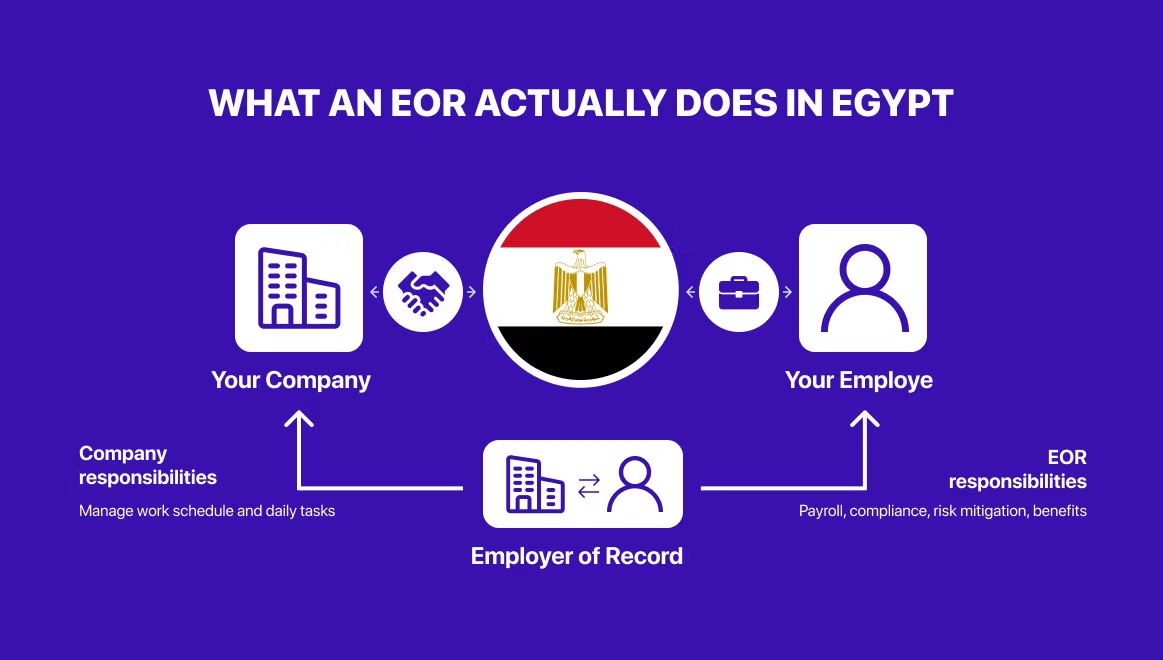
Given the complexities of Law 12, SISI contributions, and the 1:10 ratio, the employer of record services model has become the standard for companies entering Egypt. It offers a "shield" against the administrative chaos while providing the agility to hire in days rather than months.
EOR vs. Local Entity: A Comparison
For a decision-maker, the choice between an EOR and a local entity is a choice between speed and control.
| Feature | Employer of Record (EOR) | Local Subsidiary (LLC) |
| Setup Time | 48 Hours | 4-6 Months |
| Setup Cost | Zero Upfront | High (Capital + Legal Fees) |
| Compliance Risk | Borne by the EOR | Borne by the Founder |
| 1:10 Ratio | Managed by EOR | Strictly enforced on the LLC |
| Employee Benefits | Group rates provided by EOR | Negotiated individually |
Source: Strategic Hiring Guide for MENA.
Using global employer of record services allows a firm to treat Egypt as a plug-and-play talent hub. The EOR handles the "Forms 1, 2, and 6" for social insurance, the trifecta of Egyptian HR bureaucracy, while the client manages the day-to-day work of the team.
Onboarding and Managing Egyptian Teams
Managing a team in Egypt requires a blend of professional structure and cultural empathy. Team Up’s positioning as a regional partner emphasizes that "local" means more than just having a tax ID; it means understanding that "Inshallah" is not a lack of commitment, but a cultural acknowledgement of external variables.
Effective management involves:
- Clear KPIs: Egyptians value clarity and confidence. Avoid "startup buzzwords" and focus on action and value.
- Private Health Insurance: While there is a public system, providing high-quality private insurance (e.g., AXA or MetLife Egypt) is a mandatory "perk" for attracting top-tier developers.
- The "Ramadan Rhythm": Working hours typically shift during the holy month of Ramadan. Acknowledging this and adjusting meeting schedules shows the "human" side of the brand that Team Up advocates for.
The Cost of Compliance in Egypt
Budgeting for a team in Egypt involves more than just the gross salary. The "Total Cost of Employment" (TCOE) includes several statutory and traditional layers that must be calculated with precision.
Breakdown of Total Employment Cost
When using employer of record payroll services, the TCOE typically includes:
- Gross Salary: Negotiated with the candidate.
- Employer Social Insurance: ~19.75% of the base.
- Service Fee: The EOR's management fee.
- Benefits: Private medical and life insurance.
- Work Permit Fees: If sponsoring a non-Egyptian.
The strategic benefit of this transparency is that it eliminates "hidden" costs that usually plague direct hires, such as the 1% labor fund levy or the cost of annual audit representation.
The "Marmite" Reality of Egypt's Value
Is Egypt the cheapest market? No. You can find cheaper developers in parts of South Asia, but you won't find the same combination of timezone alignment with Europe, cultural affinity with the MENA region, and a "hunger" for growth that mirrors the Western startup mindset. The value is in the ROI, not just the low cost. People who "hate" the Egyptian market usually failed because they tried to ignore the local rhythm. Those who "love" it understand that the complexity is the moat that keeps their competitors out.
Conclusion: Navigation for the Savvy Founder
Relocating or hiring in Egypt is a strategic move that requires a noble POV and a commitment to transparency. The regulatory shift toward digital enforcement means that compliance is no longer optional, but the rewards for those who navigate it correctly are substantial. By leveraging employer of record services, founders can guide their organizations out of the "hard parts" of Law 12 and SISI, focusing instead on the incredible technical talent that Cairo and Alexandria have to offer.
Whether you are looking at the 1% annual subsidy fund or the 1:10 foreign labor ratio, the key is to work with a partner who doesn't feed you corporate fluff. The Egyptian market is honest, challenging, and ultimately rewarding for those who can drive through the Cairo traffic with a steady hand and a clear map.
For those ready to take the next step, comparing the top providers in the region is essential, as is understanding the long-term trends for 2026. The strategic benefits of eor services mena are clear: they provide the confident, human, and reliable bridge that modern global expansion demands.
Frequently Asked Questions
1. What are the primary types of residency permits?
Foreigners moving to Egypt typically apply for one of these categories:
- Work Residency: Tied to a specific employer who must sponsor the permit.
- Investor Residency: Linked to company formation or a minimum $50,000 bank deposit.
- Property Residency: Granted to those purchasing real estate worth at least $50,000 (for 1 year) up to $200,000 (for 5 years).
- Tourism Residency: An extension for those staying beyond their initial 30-day entry visa for up to 6 months.
2. Can I move to Egypt on a tourist visa and change it later?
Yes. Most expats enter on a 30-day Tourist Visa (available as an e-visa or on arrival for many nationalities). Once in Egypt, you can visit the Passports, Emigration, and Nationality Administration in Abbasiya, Cairo, to apply for a residency extension or a status change based on work or investment.
3. What are the mandatory medical requirements?
To obtain any long-term residency or work permit, you must undergo a medical check at a government-approved laboratory in Egypt. This strictly includes an HIV test. Some residency types also require certificates for Hepatitis B and C.
4. How do I register my local address?
By law, foreigners must register their address with the local police or immigration office within 7 days of arrival.
Practical Step: If you are staying in a hotel, they handle this for you. If you rent an apartment, your landlord should provide a "Form 1" or a registered lease contract to take to the local Mogamma or police station.
5. What is the process for opening a bank account?
Opening an account in 2026 requires patience. You will need:
- A valid passport with a residency permit (most banks will not open accounts on a tourist visa).
- Proof of address (utility bill or registered lease).
- An initial deposit (often required in the same currency as the account, e.g., USD or EGP).
- Note: International transfers for property purchases must be routed through official state-owned banks to count toward residency.
6. Do I need to pay into the Egyptian Social Security system?
If you are employed by an Egyptian entity, Social Insurance Law No. 148 requires both the employer and the foreign employee to make contributions (currently 11% for the employee). Expats can often claim these contributions back when they permanently leave the country.
7. How does property ownership work for foreigners?
Foreigners can legally own up to two residential properties in Egypt, provided each is under 4,000 square meters.
- Restricted Zones: You cannot own land or property in the Sinai Peninsula (only 99-year leaseholds are available there).
- Approval: All foreign property purchases require approval from the Council of Ministers, which includes a security clearance check taking 1–2 months.
8. Is my foreign driving license valid in Egypt?
You can drive on a valid International Driving Permit (IDP) for up to 6 months. After this, you must apply for an Egyptian driving license. If you hold a license from certain countries (like the UK or USA), you may be exempt from a driving test, but you will still need a medical eye and blood type test.
9. What should I know about the cost of living and taxes?
Your tax residency is triggered if you spend more than 183 days in Egypt within a 12-month period.
- Income Tax: Progressive rates range from 0% to 25%.
- Lifestyle: While housing and domestic help are affordable, imported goods and electronics are subject to high customs duties and luxury taxes.
10. What is the "Security Clearance" mentioned in applications?
Egypt performs background checks on all foreigners applying for long-term residency. This "security clearance" happens behind the scenes after you submit your paperwork. It can delay your final residency card by 2 to 4 months, so always keep a copy of your "submission receipt" as proof of legal stay.
.svg)


