Guide to the top 5 trends in Employer of Record services in Egypt for 2026
Introduction
An Employer of Record sounds fancy, but here’s the plain-English version you actually need. It’s the legal adult in the room, the entity that hires your team in Egypt, so you don’t have to deal with taxes, labor law, contracts, or any of the fun surprises that come with hiring abroad.
Now here’s the part nobody likes to admit.
Hiring internationally without an EOR is basically playing employment roulette. Maybe nothing happens. Or maybe you wake up to a misclassification claim, a back-tax bill written entirely in Arabic, and an ex-contractor demanding rights you didn’t even know existed.
And Egypt in 2026? It’s booming.
More talent. More foreign companies are hiring there. More government attention on who’s employing whom. Great for scaling. Terrible for anyone winging it.
That’s why EOR services in Egypt are evolving fast, because companies want the talent but not the legal heart attacks that come with it. And because someone has to carry the compliance burden, file the payroll taxes, issue the employment contracts, and make labor inspectors go away. That someone should not be you.
This guide walks you through the top trends shaping Egypt’s EOR market in 2026.
The shifts. The risks. The opportunities. The stuff founders, HR leads, and CFOs wish someone had explained before their first “quick contractor hire.”
If you’re planning to hire in Egypt this year, read on.
You’ll understand why EOR is no longer a “nice-to-have” but the default choice for any company that values clean compliance, predictable costs, and fewer phone calls from lawyers.

Why is Employer of Record Egypt a strategic market in 2026

If you’ve been paying even half-attention to global hiring over the past two years, you’ve probably noticed something interesting. Everyone suddenly has an opinion about Egypt. And not in the “great food, great diving” way. In the “we should probably hire there before our competitors do” way.
Here’s why demand for EOR in Egypt is exploding, and why the companies moving fastest aren’t doing it out of curiosity. They’re doing it because the alternative is slow, expensive, and one HR mistake away from becoming a cautionary LinkedIn post.
The talent pool in Egypt
Egypt produces more tech and operations talent each year than most “popular” hiring markets combined. We’re talking developers, QA, CX teams, designers, finance ops, the whole spectrum. And the talent pool is not just plentiful, they’re multilingual, remote-ready, and used to working with EU, GCC, and US teams. Companies love predictable scale. Egypt has it.
The advantage of the Employer of Record cost
Let’s be blunt. Hiring in Egypt costs less without costing you competence. That’s a rare combination in 2026, when half the world’s talent pools are overfished, and the other half have salary expectations that require a fundraising round of their own. Egypt gives you senior talent at sustainable monthly costs, with no discount on quality.
Nobody wants to set up a local entity anymore.
Founders aren’t waking up thinking, “You know what would make my quarter even better? Learning Egyptian labor law.” They want fast entry and faster hiring. Registering a company, doing tax setup, handling payroll filings, hiring local counsel, it’s expensive and slow. EOR is the shortcut that doesn’t feel like a shortcut. It’s the clean path in a region where “figure it out later” stops being cute once your first audit notice arrives.
EOR is becoming the default model, not the experimental one
A few years ago, using an EOR meant you were “expanding.” In 2026, it means you’re sane. Global teams want the Egypt advantage without the compliance anxiety. They want talent now, not in six months. They want the risk transferred away from their plate. And the fastest way to get all that is to let a local EOR carry the legal and tax load while you focus on actually building your team.
Egypt isn’t an emerging option anymore. It’s the strategic one.
And if you’re planning to hire even one person there, this is the moment to understand what’s changing, and why doing it without an EOR is the kind of bravado investors pretend to admire but never reward.

Trend #1: Companies are replacing contractors with full EOR employment
Contractor hiring used to feel clever. “Flexible,” “lean,” “fast to onboard”, all the buzzwords founders love. But in Egypt, 2026 is the year companies finally realized that hiring full-time people on contractor paperwork is basically playing HR Jenga with a blindfold on.
And regulators? They’ve stopped playing along.
Misclassification crackdowns are finally hitting
Governments didn’t spend years tightening labor laws just to let companies keep pretending a full-time engineer working your sprint cycles is an “independent consultant.” Egypt included. If someone looks like an employee, works like an employee, and reports to your PM… congratulations, the law thinks they’re your employee too.
IP protection is no longer optional
Contractor agreements don’t reliably transfer IP under Egyptian law. So companies woke up to the horror of realizing their mobile app was, technically, owned by the freelancer who built it. Full EOR employment fixes that instantly with compliant, enforceable contracts.
Predictable payroll beats surprises
Contractor payments swing with exchange rates, payment platforms, and whatever mood your contractor’s bank is in that week. EOR gives you one monthly invoice, clean taxes, and zero “Why was this payment flagged?” emails.
Retention improves when people feel employed, not disposable
Contractors bounce. Employees stay. It really is that simple. Teams want stability. EOR gives them that without you having to become a local entity.
For companies finally getting serious about Egypt, full EOR employment is the grown-up choice, and in 2026, the default one.
Trend #2: EOR is becoming the fastest route for hiring foreign + local talent
Here’s a fun fact about Egypt: it’s one of the easiest countries for global talent to move into… until you try to do it without structure. Then it becomes a spectacular mess of visa options, residency rules, and immigration officers who do not accept “my lawyer said it was fine.”
That’s why EOR is blowing up as the fastest, safest hiring route for both:
- Egyptian nationals, and
- Foreign talent relocating to Cairo, Alexandria, and emerging tech hubs.
Immigration support is built into the model
Companies don’t want to learn immigration procedures. EOR providers in Egypt already know the rules, and more importantly, how they’re enforced in the real world, not just how they’re written.
Faster onboarding for everyone
EOR lets you hire in days, not weeks. No entity setup. No residency bottlenecks. No “we’re waiting for tax registration” slowdowns.
Fewer immigration errors = fewer headaches
One wrong box ticked on a form can derail residency for months. EOR teams do this daily. They don’t guess.
Residency permit applications fully handled
Your new hire signs an EOR contract, and the provider handles the whole residence permit workflow. You stay out of the paperwork entirely.
Companies realized they could hire top Egyptian talent and relocate specialists, without getting trapped in bureaucracy. It’s the hiring version of taking the express lane past a line of people carrying stacks of documents they don’t understand.
Trend #3: Total cost transparency is now a buyer priority
In 2026, companies are tired. Tired of surprise fees. Tired of invoices that look like cable bills. Tired of EOR service providers in Egypt who bury half the cost in “service adjustments.”
Buyers want something radical: the actual cost of using EOR in Egypt. Upfront. No fine print.
That’s why the market is shifting toward:
Flat-rate EOR models
Companies want simple pricing per employee. No percentage-of-salary nonsense. No scale penalties. Just predictability.
All-in transparency
They want to know exactly what’s included:
- Gross salary
- Employer costs
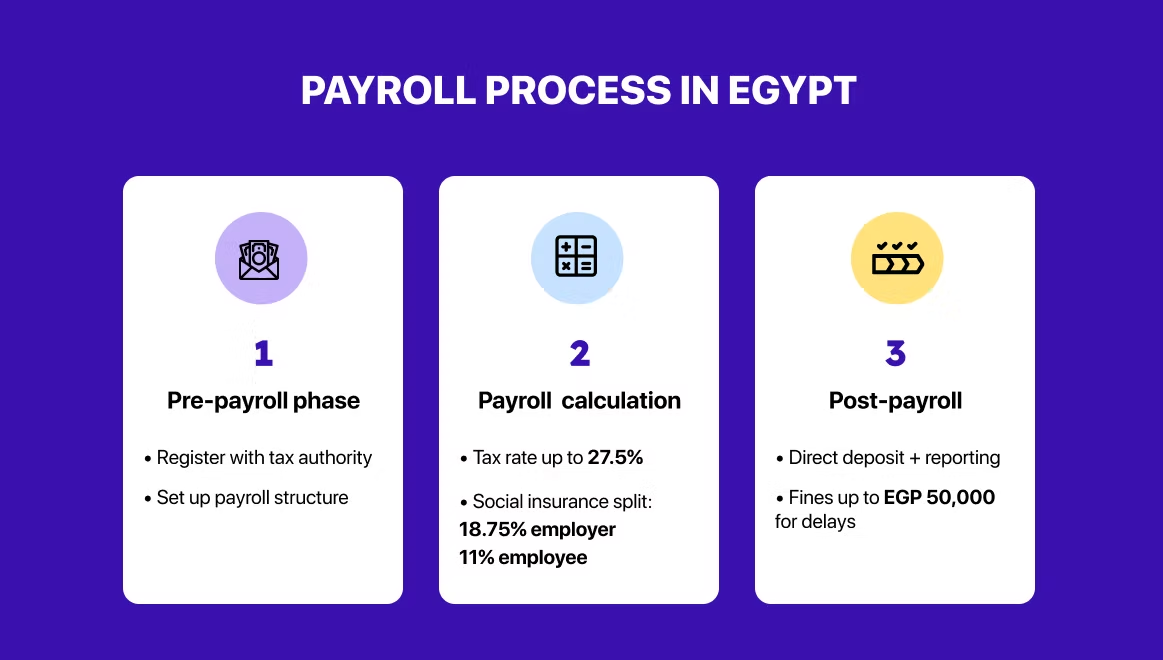
- Payroll taxes in Egypt
- Benefits
- EOR fee
Everything visible. Everything predictable.
Clear breakdowns of every cost component.
Because CFOs don’t tolerate guesswork. And start-ups with burn-rate anxiety? Even less so.
Egypt is becoming the perfect example of a market where transparency isn’t a luxury; it’s the whole selling point. Companies don’t want the cheapest provider. They want the clearest one.
Trend #4: Employer of Record payroll services as a full people-operations partner
If you still think an EOR is just a payroll vendor, you’re reading from a 2018 playbook. In Egypt, the modern EOR model has quietly evolved into something closer to a full people-operations engine, the back office global teams wish they had in-house.
Here’s what 2026 looks like:
Equipment procurement and workspace setup
Teams want equipment delivered, coworking passes arranged, and remote setups documented. EOR handles that so you don’t have to ship a MacBook across three borders.
Health insurance and benefits that match the local market
Egyptian talent expects proper coverage. Good candidates walk away from companies that skip it. EOR packages make it painless.
HR support and employee relations
Sick leave. Complaints. Questions. Local holidays. Documentation. All handled.
Performance documentation and compliant offboarding
Because nothing says “we weren’t prepared” like firing someone in a country whose labor code you’ve never read.
Onboarding workflows that don’t confuse people on day one
Clear contracts. Clear payroll. Clear point of contact.
This shift is why global teams trust EORs more deeply now. They get a fully formed HR foundation in Egypt without building one themselves.
Trend #5: Employer of Record Egypt adoption driven by regional expansion strategies
Egypt isn’t just a country to hire in anymore. It’s becoming the landing pad for companies expanding across MENA. And EOR is the infrastructure that makes that possible without requiring a stack of legal entities.
Here’s why:
Egypt is a regional hiring anchor
Its talent market covers engineering, CX, back-office operations, and multilingual support. Companies can run half their regional ops from Cairo alone.
A multilingual support hub with reach
Arabic + English + French gives companies coverage across MENA, Africa, and parts of Europe, without needing separate offices.
A technical development hub that’s growing fast
Egypt’s dev scene has exploded. Companies that used to hire in Jordan or the UAE are now shifting engineering pods to Egypt because it scales better.
And EOR makes all of it frictionless:
- No entities
- No lawyers on speed dial
- No tax registrations
- No compliance roulette
You plug in, hire, and operate without committing to long-term infrastructure before you’re sure.
Egypt’s EOR solutions in 2026: What companies want most
If you strip away the marketing fluff, companies expanding into Egypt keep asking for the same six things. None of them is extravagant. All of them are non-negotiable.
Here’s the short list:
• Predictability: one wants surprise fees, surprise audits, or surprise labor rules they somehow missed.
• Compliance certainty: You shouldn’t need a crash course in Egyptian labor law to hire one engineer.
• Fast hiring timelines: Global teams don’t have three months to wait for entity setup, banking approvals, or tax registration.
• Transparent costs: Clean monthly invoices. No “service adjustment fees.” No black-box payroll formulas.
• Ongoing HR support: Founders don’t want to answer PTO questions at 2am. EOR covers that.
• Risk reduction: leader hiring abroad has the same nightmare: “What if we get this wrong?”EOR exists to make that nightmare irrelevant.
Egypt’s EOR buyers aren’t shopping for features.
They’re shopping for peace of mind, which is exactly why Team Up’s model leans hard into clarity, EOR compliance in Egypt, and actual human support instead of software alone.
How to choose the right EOR provider in Egypt in 2026

Let’s be honest: every EOR provider claims to be “global,” “compliant,” and “trusted by leading teams.” Cute. But if you want a provider that actually works in Egypt, here’s the real checklist.
Local expertise: If they don’t understand Egyptian labor law, they’re guessing. You don’t want guessers.
Contract compliance: Employment contracts should be locally enforceable, bilingual, and airtight. IP should be yours, full stop.
Transparent pricing: Flat rate > mysterious math. If you need a calculator to understand the fee structure, run.
Benefits administration: Health insurance, paid leave, statutory benefits, all handled cleanly and consistently.
Immigration capability: Can they actually help with residence permits, or will they send you “helpful links”?
Legal presence in Egypt: No local entity = no real authority. Ask where their Egyptian entity is registered.
Tech platform maturity: Onboarding, payroll summaries, and compliance documents should be one click away, not buried in email threads.
If a provider can’t check every box without blinking, they’re not ready for Egypt in 2026.
Final takeaway: Egypt is entering a new EOR phase in 2026
Egypt isn’t just another hiring destination. In 2026, it’s becoming the regional anchor for companies scaling across MENA, Africa, and beyond. Talent is abundant. Costs are predictable. Compliance is strict enough to punish mistakes, but generous enough when you do it right.
That’s why EOR demand is accelerating.
That’s why companies are dropping the DIY approach.
And that’s why the safest, fastest, cleanest expansion model in Egypt right now is EOR.
If you want to hire in Egypt without gambling with compliance, payroll taxes, or immigration rules, TeamUp gives you one clean system that handles every legal detail behind the scenes while you focus on building your team.
Ready when you are.
FAQ
1. What is an Employer of Record (EOR) in Egypt?
An Employer of Record in Egypt is a local legal entity that hires your employees on your behalf. The EOR handles payroll taxes, employment contracts, benefits, and compliance so you can operate without setting up your own company.
2. How does EOR hiring work in Egypt?
You choose the talent. The EOR becomes their legal employer. You manage their work, while the EOR manages labor law compliance, payroll, contracts, and filings.
3. What does EOR mean for global companies hiring in Egypt?
EOR means your company avoids misclassification, tax violations, and entity setup. It’s a compliance shield that lets you hire quickly and legally.
4. Is an Employer of Record legal and recognized under Egyptian labor law?
Yes. EOR is a fully legal model in Egypt. It ensures workers are properly classified, registered, and protected under local labor regulations.
5. What’s the difference between an EOR and hiring contractors in Egypt?
Hiring contractors creates misclassification risk. EOR provides legal employment, compliant contracts, IP protection, payroll taxes, and worker benefits — all required for full-time roles.
6. Does an Employer of Record handle payroll taxes in Egypt?
Yes. The EOR calculates, withholds, and remits all payroll taxes and statutory contributions required by Egyptian law.
7. What is the Employer of Record's meaning for IP and data protection?
It means the EOR provides contracts that legally transfer IP to your company and ensure your product, code, and data stay protected.
8. When should a company use an EOR instead of opening an entity in Egypt?
Use an EOR when you need fast hiring, low risk, predictable costs, or when you’re testing the market before committing to a full legal entity.
9. How much does it cost to use an Employer of Record in Egypt?
Costs vary by provider, but companies look for transparent pricing that includes gross salary, payroll taxes, benefits, and a flat EOR fee.
.svg)