What Is a PEO? Understanding Professional Employer Organizations in Armenia
Introduction
If you’re asking what is a PEO in Armenia, you’re already dealing with a real hiring decision.
Not theory.
Not “someday expansion”.
Actual people. Actual payroll. Actual risk.
PEO often gets pitched as the safe, simple way to hire and manage teams abroad. Outsource HR. Hand off payroll. Stay compliant.
That pitch works. Right up until it doesn’t.
Because in Armenia, just like in Georgia, a PEO is a very specific tool. Used correctly, it can reduce admin. Used at the wrong stage, it quietly creates exposure.
Let’s get precise and remove the guesswork.
This guide explains what a Professional Employer Organization is in Armenia, how the model works in practice, and where its limits start to matter.

What Is a PEO in Armenia?
A Professional Employer Organization (PEO) in Armenia is a company that provides HR and payroll support through a co-employment model.
That phrase is doing a lot of work, so let’s slow down.
With a PEO:
- Your company remains the employer
- Your company signs employment contracts
- Your company holds legal responsibility
- The PEO supports HR and payroll operations
A PEO does not replace your Armenian entity.
It does not hire employees instead of you.
It does not take on employer liability.
If you do not already have a registered legal entity in Armenia, a PEO is not an option. That’s not opinion. That’s how the model works.
This is where confusion usually starts.

What Does PEO Stand for in HR and Payroll?
PEO stands for Professional Employer Organization.
In HR and payroll terms, it means:
- Shared employment responsibilities
- Administrative support across payroll and HR
- A structured operating layer for an existing company
In plain language.
A PEO helps you run employment.
It does not help you avoid becoming an employer.
That distinction matters a lot in Armenia, where labor relationships are formal and documentation-driven.
The Question Most Founders Ask Too Late about PEO Services
Can a PEO hire employees in Armenia without a local entity?
No.
If you want to hire in Armenia without setting up a local company, you are not looking for a PEO.
You are looking for an Employer of Record (EOR).
A PEO assumes you already operate locally.
An EOR exists specifically because many companies don’t.
How a Professional Employer Organization Works in Armenia
Here’s what a real PEO setup in Armenia looks like.
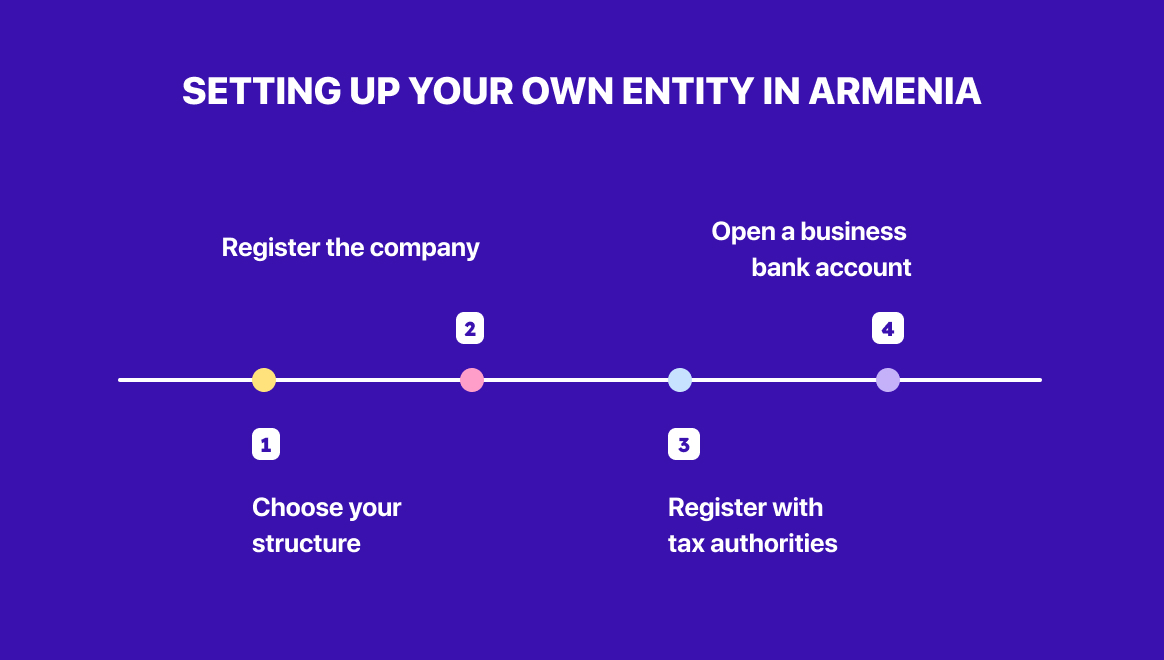
Step 1. You have an Armenian legal entity
Typically, an LLC. Properly registered. Tax accounts are active. Accounting in place.
Step 2. You hire employees under your entity
Your company signs employment contracts.
Your company is listed as the employer.
Your company carries labor law responsibility.
Step 3. You engage a PEO
You sign a service agreement covering HR and payroll administration.
Step 4. The PEO runs processes
Payroll, payslips, reporting, HR workflows. Admin work gets easier.
What does not change:
- Employer of record status
- Legal exposure
- Responsibility in disputes or audits
When authorities look at employment issues in Armenia, they don’t ask who processed payroll. They ask who employed the person.
That answer is still you.
Who Is Responsible for What? PEO vs Your Team
This is the part marketing pages gloss over. It’s also the part that decides whether PEO helps or hurts.
Let’s break it down by function.
Payroll administration
PEO typically handles:
- Monthly payroll runs
- Salary calculations
- Payslip generation
- Payroll reporting formats
Your company still owns:
- Salary structure decisions
- Bonus and commission logic
- Contract changes
- Classification of employees vs contractors
- Final responsibility for accuracy
If payroll is wrong, the employee doesn’t chase the PEO.
They chase the employer.
Tax filing and compliance
PEOs in Armenia often assist with:
- Payroll tax calculations
- Reporting support
- Filing workflows
But compliance risk does not move.
Your company remains responsible for:
- Correct tax registration
- Correct reporting
- Timing and accuracy
- Audit responses
Most compliance problems don’t come from missing filings. They come from inconsistent structures. A PEO can’t fix that retroactively.
HR management
PEOs help with:
- Onboarding paperwork
- Leave tracking
- HR documentation
- Process templates
Your team still manages:
- Performance
- Promotions
- Disciplinary actions
- Terminations
- Day-to-day people decisions
A PEO manages paperwork.
You manage people.
That distinction becomes very real the first time a termination is questioned.
PEO Payroll in Armenia. What It Covers and What It Doesn’t
PEO payroll in Armenia is about execution, not liability transfer.
A PEO can:
- Calculate payroll
- Prepare payslips
- Support payroll reporting
- Help standardize processes
What it cannot do:
- Become responsible for payroll mistakes
- Absorb misclassification risk
- Shield your company in audits
If a bonus is structured incorrectly.
If a contract does not match actual payments.
If an employment relationship is challenged.
The employer answers for it.
The Legal Reality. When a PEO Is Allowed in Armenia
Here is the rule that saves companies time and money.
A PEO in Armenia only makes sense when:
- You already have an Armenian entity
- You plan to employ people long-term
- You accept employer responsibility
- You want HR and payroll support, not substitution
A PEO is the wrong tool when:
- You do not have a local entity
- You are hiring your first employees
- You are testing the Armenian market
- You want predictable compliance ownership
That second group describes most foreign companies at the start.
That’s why EOR exists.
PEO vs Employer of Record (EOR) in Armenia. The Core Difference

The difference is not in services.
It’s the legal employer.
With a PEO:
- Your company is the employer
- You carry labor law and payroll risk
- You need a local entity
With an EOR:
- The EOR is the employer
- You do not need a local entity
- Employment risk shifts away from you
If you are early, moving fast, or unsure about long-term presence, EOR is the safer starting point.
That’s where Team Up comes in.
As a regional Employer of Record partner, Team Up helps companies hire in Armenia legally, quickly, and without building infrastructure too early. When teams mature and entities make sense, the transition is planned. Not rushed.
Got it. Here’s a continuation that actually gives the reader something to care about. No buzzwords. No filler. Clear stakes. Clear ownership.
PEO vs Your Team. Who Handles What in Armenia?
This is where most misunderstandings live.
PEO sales language talks about “shared responsibility.”That sounds comforting. It’s also vague.
What matters is this.
When something goes wrong, who is expected to fix it?
And more importantly, who carries the risk?
Let’s break it down properly.
Payroll administration
What the PEO handles
- Monthly payroll calculations
- Payslip generation
- Payroll workflows and timelines
- Standard reporting formats
This is the operational side. It saves time. It reduces manual work.
What your team still owns
- Salary structures
- Bonus, commission, and allowance logic
- Contract changes tied to pay
- Classification of employees vs contractors
- Final accountability for errors
Here’s the part people don’t like hearing.
If payroll is wrong, Armenian authorities don’t ask who processed it.They ask who employed the person.
That’s your company.
A PEO can reduce friction.It cannot absorb consequences.
Benefits administration
Benefits in Armenia are not as rigid as in some EU countries. That flexibility is useful. It’s also where mistakes hide.
What the PEO usually manages
- Enrollment in private health insurance
- Coordination with benefit providers
- Admin work around perks and allowances
What your company decides and owns
- Which benefits exist
- Who qualifies
- How benefits are documented
- What happens to benefits on termination
Once a benefit is offered, it becomes part of the employment relationship. If coverage ends late or terms are unclear, disputes don’t land on the PEO. They land on the employer.
Administration can be delegated.
Responsibility cannot.
Tax filing and compliance
This is where expectations and reality drift apart.
What PEOs in Armenia typically support
- Payroll tax calculations
- Filing assistance
- Reporting workflows
What stays with your company
- Correct tax setup
- Accuracy of filings
- Timing of payments
- Audit responses
Most compliance issues don’t come from missing a filing. They come from small structural mistakes repeated over time. Misclassified roles. Informal payments. Poor documentation.
A PEO can process clean data.
It cannot fix a messy structure.
HR management
This one is simple, but people keep missing it.
PEOs help with
- Onboarding paperwork
- Leave tracking
- HR templates and documentation
- Process reminders
Your team still manages
- Performance issues
- Promotions and role changes
- Disciplinary actions
- Terminations
- Team culture
A PEO does not manage people.
It manages HR admin.
And in Armenia, HR decisions have legal weight. Especially terminations.
| Responsibility | PEO Handles | Your Team Handles | Shared | Notes |
| Payroll processing | ✔️ | PEO runs payroll end-to-end | ||
| Payroll tax filing & compliance | ✔️ | PEO handles federal, state, and local filings | ||
| Employee benefits administration | ✔️ | PEO manages plans, enrollment, and renewals | ||
| Workers’ compensation coverage | ✔️ | PEO provides access and handles claims | ||
| HR compliance (labor laws, documentation) | ✔️ | PEO advises and implements best practices | ||
| Administrative onboarding support | ✔️ | ✔️ | ✔️ | PEO manages compliance onboarding. Your team handles internal onboarding |
| Hiring & recruiting | ✔️ | You own sourcing and interviews | ||
| Final hiring decisions | ✔️ | Always your decision | ||
| Day-to-day employee management | ✔️ | You manage performance, workload, and feedback | ||
| Company culture & values | ✔️ | Culture remains entirely internal | ||
| Performance reviews & promotions | ✔️ | Your team drives all performance cycles | ||
| Training & development | ✔️ | PEO may advise. You own execution | ||
| Employee engagement & retention | ✔️ | Engagement strategy stays internal | ||
| Disciplinary actions | ✔️ | PEO may advise. You execute decisions | ||
| Strategic HR planning | ✔️ | Long-term HR and growth strategy stays internal |
Benefits of Using a PEO in Armenia. When It Actually Helps
This is not an anti-PEO article.
It’s an anti-misuse article.
When the conditions are right, a PEO can add real value.
Reduced administrative load
Once headcount grows, payroll and HR start consuming leadership time. A PEO brings structure and routine. That matters when the team is already stable and local.
Process consistency
PEOs enforce standard workflows. That reduces ad-hoc decisions and documentation gaps.
This becomes important during:
- Audits
- Due diligence
- Internal restructuring
Local operational familiarity
A good Armenian PEO understands:
- Local payroll practices
- Labor documentation norms
- Common compliance mistakes
That local context prevents obvious errors.
The key point.
These benefits only show up after you already committed to operating locally.
Common PEO Misconceptions People Repeat on LinkedIn
Let’s clear the noise.
“PEO lets you hire in Armenia without a company.”
It doesn’t.
You need a local entity first.
Anything else is either a misunderstanding or marketing spin.
“PEO removes employer liability.”
No.
PEO helps you manage HR.
It does not become the employer.
Liability stays with the entity.
“PEO and EOR are basically the same.”
They are not even close.
PEO assumes you are ready to be an Armenian employer.
EOR exists because many companies do not.
Mixing them up is how early expansion turns into cleanup work.
A Practical Decision Checklist
Answer these honestly. No optimism.
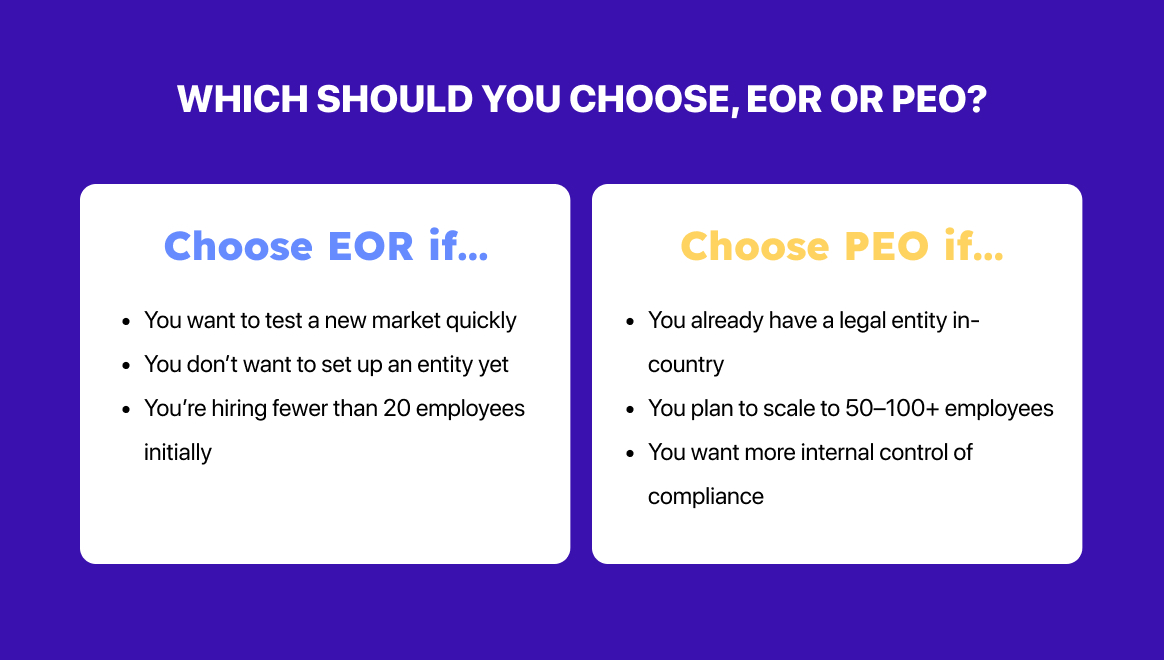
PEO in Armenia makes sense if:
- You already have an Armenian entity
- You plan long-term operations
- You are hiring a stable, growing team
- You can handle employer responsibility
- You want to streamline HR and payroll
PEO is the wrong choice if:
- You do not have a local entity
- You are hiring your first 1–5 employees
- You are testing the Armenian market
- You want clear, predictable compliance ownership
- You want speed without infrastructure
If you fall into the second list, choosing PEO doesn’t make you “more serious.”It just makes things heavier than they need to be.

Where Team Up Fits. Without the Brochure Talk
Team Up exists because most companies' remote hiring in Armenia doesn’t need an HR layer on top of a company they don’t even have yet.
They need:
- Legal employment
- Compliant payroll
- Clean contracts
- Clear risk boundaries
- No entity setup
That’s what Employer of Record services are built for.
As a regional EOR partner, Team Up becomes the legal employer in Armenia. We handle payroll, compliance, and employment risk, while you focus on the work itself.
When your presence grows and a local entity makes sense, the transition is planned. Not rushed. Not messy.
That’s the difference between deliberate expansion and fixing mistakes later.
Frequently Asked Questions
1. What is a PEO in Armenia?
A PEO in Armenia is a Professional Employer Organization that provides payroll and HR administration through a co-employment model. Your company must already have a registered Armenian legal entity. The PEO supports HR and payroll processes, but your company remains the legal employer and carries compliance responsibility.
2. What does PEO stand for in HR and payroll?
PEO stands for Professional Employer Organization. In HR and payroll, it refers to a company that manages administrative employment tasks such as payroll processing, tax calculations, and HR documentation while the client company remains the employer of record.
3. Can a PEO hire employees in Armenia without a local entity?
No. A PEO cannot hire employees in Armenia unless your company already has a registered local entity. If you want to hire in Armenia without opening a company, you need an Employer of Record (EOR), not a PEO.
4. What is the difference between PEO and Employer of Record (EOR) in Armenia?
The key difference is legal responsibility. With a PEO, your company is the legal employer and must have an Armenian entity. With an EOR, the EOR is the legal employer, allowing you to hire in Armenia without setting up a local entity and shifting employment compliance risk away from your company.
5. How does PEO payroll work in Armenia?
PEO payroll in Armenia involves the PEO running payroll calculations, generating payslips, and supporting tax reporting. Your company remains responsible for payroll accuracy, employment classification, and compliance with Armenian labor and tax laws.
6. Is PEO payroll in Armenia fully compliant?
PEO payroll can be compliant only if your underlying company structure, contracts, and classifications are correct. The PEO processes payroll, but legal and tax liability remain with the employer. Compliance risk does not transfer to the PEO.
7. What services do PEO companies provide in Armenia?
PEO services in Armenia typically include payroll processing, HR administration, leave tracking, benefits coordination, and compliance support. PEOs do not provide legal employer substitution, entity setup, or full compliance liability coverage.
8. Is a PEO cheaper than an Employer of Record in Armenia?
A PEO may appear cheaper if you already operate a local entity and have internal legal and accounting support. An EOR usually has a higher visible cost but removes entity setup, employer liability, and compliance risk. Cost comparisons should include risk, time, and administrative overhead.
9. When does a PEO make sense for companies in Armenia?
A PEO makes sense when your company already has an Armenian entity, plans long-term operations, and wants to streamline HR and payroll administration for a growing local team. It is not designed for market entry or first hires.
10. Can companies switch from EOR to PEO later in Armenia?
Yes. Many companies start hiring in Armenia through an EOR and later transition to a local entity and PEO model once operations stabilize. Starting with EOR helps avoid early compliance mistakes and makes the transition smoother.
.svg)