


Employer of Record (EOR) vs Payroll Outsourcing in the Philippines: What’s the Difference?
Introduction
The two terms appear side by side in every Philippine hiring conversation. EOR. Payroll outsourcing. Both involve a third party processing salaries. Both claim to handle compliance. Both result in Filipino employees getting paid on time.
They are not the same thing. The difference is not a matter of service scope or platform features. It is structural. And if you choose the wrong model for your situation, the consequences range from DOLE audit exposure to an employment relationship that is not legally recognized in the Philippines.
This guide makes the distinction precise. Not in abstract terms — in the specific Philippines legal and operational context where it matters. By the end, you will know exactly which model applies to your situation and why.
Employer of record services replace the need for a Philippine entity. Payroll outsourcing requires one. That single sentence resolves most of the confusion. Everything below explains why.
The One Question That Determines Everything
Before comparing features, timelines, or prices, answer one question:
Does your company have a registered Philippine entity, an SEC-registered corporation, a DTI-registered business, or a branch office, with active BIR tax registration, SSS, PhilHealth, and Pag-IBIG employer accounts?
If yes,Payroll outsourcing is available to you. You are already the registered employer. A payroll provider can process salaries, calculate contributions, and file BIR returns on your behalf.
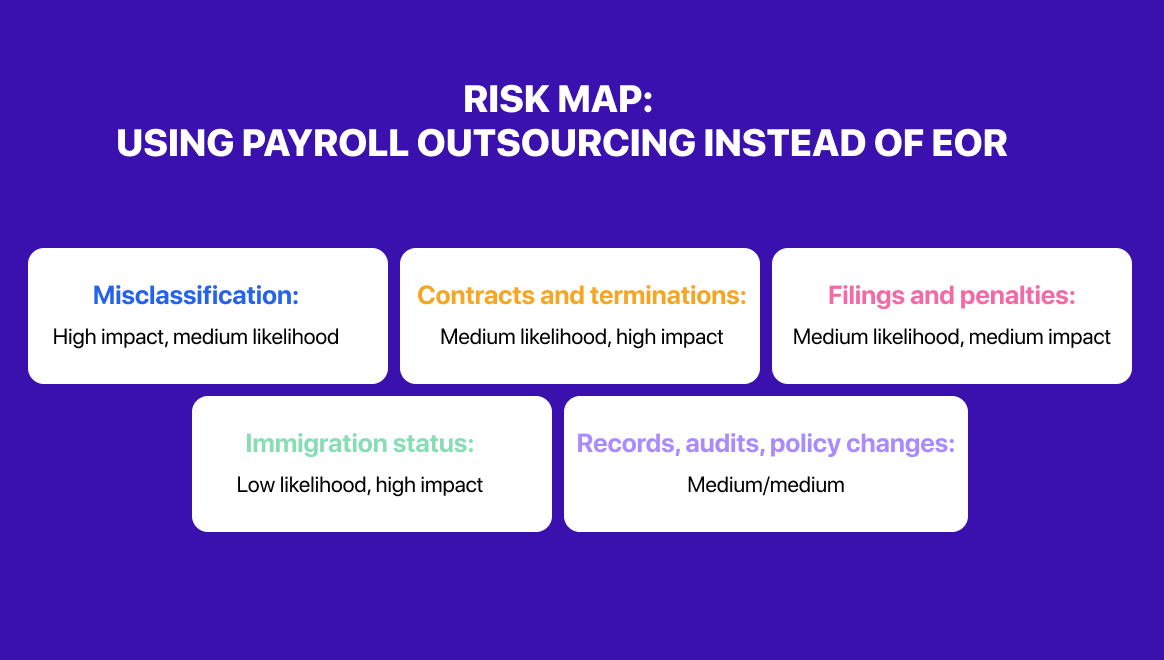
If no: Payroll outsourcing is not available to you in any meaningful sense. You are not recognized as an employer in the Philippines. There is no employment relationship to run payroll for. EOR is the only compliant path forward.
That routing covers approximately 80% of the companies that ask this question, particularly foreign companies entering the Philippines for the first time. If you do not have an entity, you need an EOR. Not a payroll provider. Not a staffing firm. Not an informal arrangement where a local "partner" pays your employees.

What Payroll Outsourcing in the Philippines Actually Is
Payroll outsourcing means delegating the administrative process of running payroll to a third-party provider, while your company retains the status of legal employer in the Philippines.
what a Philippines payroll provider does
- Calculates gross-to-net salaries based on your inputs
- Withholds income tax (withholding tax on compensation) at the correct rates under the TRAIN Law
- Calculates and remits SSS contributions (employer: ~10% of monthly salary credit; employee: ~5%)
- Calculates and remits PhilHealth contributions (employer: 2.5%; employee: 2.5%)
- Calculates and remits Pag-IBIG contributions (employer: 2%; employee: 2%)
- File BIR Form 1601-C (monthly withholding tax return) by the 10th of the following month
- Generates compliant payslips in the Philippine format
- Tracks and disburses 13th-month pay by December 24 each year
- Manages the semi-monthly Philippine payroll cycle (15th and end of the month)
The primary benefit of outsourcing payroll in the Philippines is managing four simultaneous regulatory streams — BIR, SSS, PhilHealth, and Pag-IBIG — each with its own registration, monthly contribution, and annual reporting requirements. A specialist provider integrates all four into a single monthly payroll cycle.
Here is what a payroll provider does NOT do:
- Become the legal employer of your employees
- Sign employment contracts on your behalf
- Take on liability for labor law compliance or employment disputes
- Administer statutory benefits such as security of tenure — that obligation sits with the registered employer (your entity)
- Sponsor Alien Employment Permits or 9G visas for foreign nationals
- Handle termination procedures under the Labor Code
- Register you as an employer with any Philippine government agency
A payroll provider is a processing partner for an employer that already exists in the Philippines. They execute the administrative functions on your behalf. The employment relationship — and all the legal obligations that come with it — remains yours.
The cost: Philippines payroll outsourcing typically costs PHP 3,000–8,000 per employee per month (approximately $55–$145) for a full-service payroll provider. That is significantly lower than EOR pricing. But it requires a Philippine entity to function — and entity setup costs $5,000–$210,000+ in the first year, depending on capital requirements and structure.
What Employer of Record Services in the Philippines Actually Are
An employer of record service takes a fundamentally different approach. The EOR does not process payroll for your company — it becomes the legal employer and runs payroll as that employer.
When you hire through an EOR in the Philippines
- The employment contract is between the EOR's Philippine entity and your employee, not your company
- The EOR's employer accounts with SSS, PhilHealth, Pag-IBIG, and BIR are where all contributions and filings run through
- The employment relationship for all Labor Code purposes is between the EOR and the employee
- DOLE compliance, NLRC exposure, and security of tenure obligations are the EOR's as the registered employer
Your company signs a services agreement with the EOR. You direct the employee's work day-to-day. You make hiring and performance decisions. But on every government document that defines the employment relationship, the EOR is the employer.
What Team Up's Philippines EOR covers
- Philippine Labor Code-compliant employment contracts, issued by Team Up as the legal employer
- Payroll in PHP on the semi-monthly cycle, with correct night differential, overtime, and holiday premium calculations
- SSS, PhilHealth, and Pag-IBIG enrollment from day one and monthly remittances
- 13th-month pay accruals monthly and disbursement by December 24
- BIR income tax withholding (Form 1601-C) and annual summary (Form 1604-C)
- DOLE compliance as a registered Philippine employer — including D.O. 174-17 compliance
- Probationary period tracking and 6-month regularization milestone management
- AEP and 9G visa coordination for foreign national hires
- Termination process management under the Labor Code (just cause and authorized cause)
- Final pay, pro-rated 13th-month, and unused leave payout on exit
Team Up's Philippines EOR starts from €199 per employee per month.
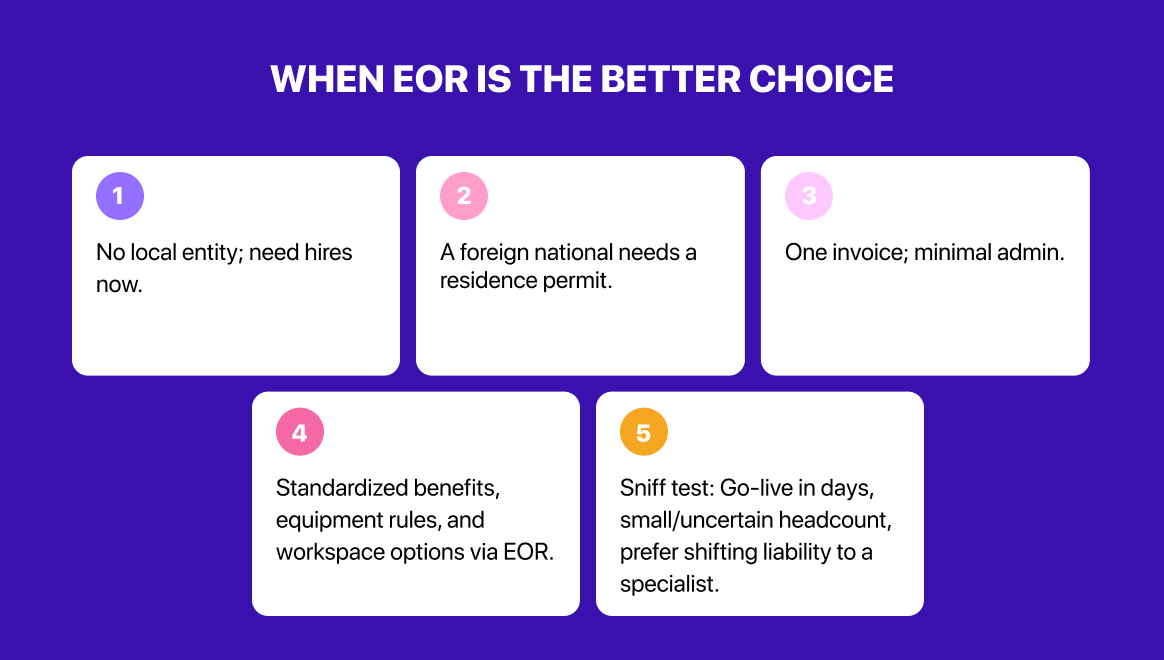
The critical difference from payroll outsourcing: Your company does not need a Philippine entity. Team Up's Philippine operations are the registered entity. The employer registration, the government accounts, the Labor Code obligations — all of it sits with Team Up, not your company.
For employer registration requirements and what it means for a company to have Philippine employer status, see our guide on employer registration and work permit requirements in the Philippines.
The DOLE Test: Where the Structural Difference Becomes Most Visible
The Philippine Department of Labor and Employment applies what is known as the "four-fold test" to determine whether an employment relationship exists — regardless of what a contract says. The four elements are: selection and engagement of the employee; payment of wages; power of dismissal; and power of control over the employee's conduct.
When you use payroll outsourcing, your company is the party that meets all four elements. You selected the employee. You effectively pay them (through the payroll provider). You have the power of dismissal. You control their work. You are the employer, and the Philippine government recognizes you as such.
When you use EOR, Team Up's Philippine entity meets all four elements. Team Up selected the employee (or formalized your selection). Team Up pays them. Team Up holds the power of dismissal (exercised on your instruction through a compliant process). Team Up issues the employment contract that governs the relationship. Team Up is the employer.
This distinction determines who is liable when things go wrong.
Liability Under Payroll Outsourcing:
- NLRC illegal dismissal complaints run against your entity
- DOLE labor standard audits apply to your employer account
- SSS penalty for missed remittance (PHP 20,000 per violation) is assessed against your employer registration
- 13th-month pay non-compliance triggers DOLE enforcement against your company
- Security of tenure violations expose your entity to reinstatement orders
Liability Under EOR
- NLRC complaints run against Team Up as the registered employer
- DOLE audits apply to Team Up's employer accounts
- SSS and BIR compliance liability rests with Team Up's Philippine operations
- Security of tenure management is Team Up's operational responsibility
This risk transfer is the core value of EOR beyond payroll processing. And it is available only when the EOR is a genuine legal employer — with real Philippine entity registration, real government accounts, and real employment infrastructure. An EOR that functions as a thin payroll passthrough — without genuine employer status — does not transfer this liability. It just moves the money.
The Cost Comparison: Why the Gap Between EOR and Payroll Outsourcing Is Narrower Than It Looks
The advertised price difference between payroll outsourcing and EOR is significant. PHP 3,000–8,000 per employee per month for payroll outsourcing versus €199+ per employee per month for EOR. At face value, payroll outsourcing looks dramatically cheaper.
That framing omits the entity requirement — and the entity requirement changes the math entirely.
True cost comparison for 5 employees at PHP 80,000/month gross, Philippines, Year 1:
| Cost Category | Payroll Outsourcing | EOR (Team Up) |
| Provider service fee | PHP 3,000–8,000/emp/month × 5 × 12 = PHP 180,000–480,000 | €199/emp/month × 5 × 12 ≈ PHP 702,000 |
| Philippine entity setup (SEC, BIR, LGU, legal) | PHP 150,000–500,000 (~$2,600–$8,700) | PHP 0 |
| Foreign capital requirement (if >40% foreign-owned) | $100,000–$200,000 (locked) | PHP 0 |
| Annual entity compliance (audit, BIR, SEC, LGU renewal) | PHP 100,000–400,000/year | PHP 0 |
| First-year total (excluding capital lockup) | PHP 430,000–1,380,000 | PHP 702,000 |
| First-year total (including $200k capital) | PHP 11.93M–12.88M | PHP 702,000 |
At 5 employees, EOR is dramatically cheaper when the entity requirement is properly accounted for.
The crossover: At approximately 20–30 employees with a long-term commitment, entity economics begin competing with EOR fees. At that headcount, the amortized entity compliance cost per employee starts falling below the EOR service fee per employee. Below that threshold — particularly in year one — EOR wins on total cost by a significant margin.
The payroll outsourcing value case: For companies that already have a Philippine entity and are transitioning from self-managed payroll to an outsourced provider, the cost equation changes. Once the entity is established and operational, payroll outsourcing at PHP 3,000–8,000 per employee per month provides meaningful administrative cost savings without requiring additional capital outlay. In that scenario, EOR's higher per-employee fee is not justified — because the entity already provides the legal employer infrastructure that EOR was replacing.
The Transition: Moving From Payroll Outsourcing to EOR (or Vice Versa)
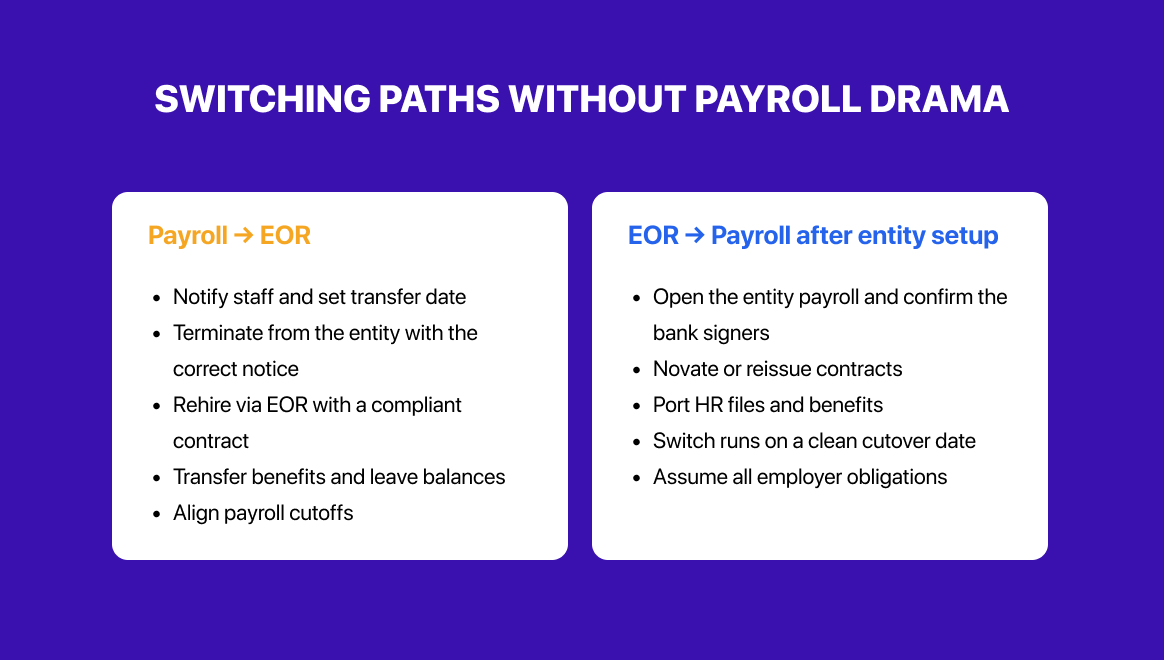
From EOR to Payroll Outsourcing
The most common transition direction: a company uses Team Up's EOR to enter the Philippines, builds a team of 15–25, registers a Philippine entity once the market is proven, and transitions employees from EOR employment to direct employment.
Where operations transition to a local entity, employee transfers should be carefully documented through termination and rehire or novation, with recognition of tenure if intended, along with the continued granting of benefits and timely release of final pay.
The transition involves:
- Registering the Philippine entity (SEC, BIR, LGU permits, SSS/PhilHealth/Pag-IBIG employer accounts)
- Choosing whether to novate employment contracts (preserving service tenure) or terminate and rehire (resetting tenure)
- Enrolling employees under the entity's employer accounts
- Engaging a payroll provider or building in-house payroll capability for the entity
- Team Up's EOR engagement concludes with the final payroll cycle under the EOR entity
Timeline: 2–4 months from entity registration to full transition. Budget legal costs for contract novation documentation.
The tenure decision matters: Under a novation, employees retain their accumulated service tenure — which means security of tenure protections and eventual separation pay calculations carry forward from the original hire date. Under a terminate-and-rehire, the tenure clock resets. The business decision depends on the size of your team and your long-term plans for them.
From Payroll Outsourcing to EOR
Less common, but it happens. A company that set up a Philippine entity, ran it with a payroll provider, and then decided to exit the market faces entity wind-down (6–12 months, legal costs) alongside employee separation.
If the exit is motivated by wanting to reduce in-country infrastructure rather than exiting the Philippines entirely, transitioning employees from entity employment to EOR employment allows the entity to be dissolved while keeping the team operational. This requires the same contract novation or terminate-and-rehire process described above, but in the reverse direction.
For relocation scenarios involving employee movement between markets — and the compliance requirements for employment transitions — see our guide on relocation legal requirements and practical steps.
The Philippines-Specific Compliance Layer Both Models Must Handle
Whether you use EOR or payroll outsourcing, the following Philippine compliance obligations apply. The difference is who is accountable for them, your entity, or the EOR.
- BIR withholding tax: Monthly Form 1601-C due by the 10th of the following month. Annual Form 1604-C by January 31. Late filing penalty: 25% surcharge plus 12% annual interest. Records must be retained for 10 years.
- SSS contributions: Employer and employee contributions are due by the 15th of the following month (different deadline from PhilHealth and Pag-IBIG). Penalty for non-remittance: PHP 20,000 per violation. SSS actively pursues employers with outstanding contributions, and employees can file SSS complaints directly.
- PhilHealth and Pag-IBIG: Both are due by the 10th of the following month. Non-compliance triggers separate enforcement from each agency.
- 13th-month pay: Due by December 24 of each year. Non-payment triggers DOLE complaints and mandatory back-payment.
- DOLE record retention: DOLE requires payroll records, including timesheets, payslips, and calculations, to be retained for a minimum of 3 years. This includes all evidence of compliance with night shift differentials, overtime, holiday premiums, and 13th-month pay calculations.
- Security of tenure: An employee who completes 6 months of continuous service becomes a regular employee with constitutional security of tenure. Termination without just cause or authorized cause, or without proper due process, creates NLRC reinstatement and back-wage exposure.
Under payroll outsourcing, these obligations sit with your entity. Under EOR, they sit with Team Up. That is the compliance liability transfer that makes EOR more than a payroll processing service.
Comparison Table: Philippines EOR vs. Payroll Outsourcing
| Criteria | Payroll Outsourcing | EOR (Team Up) |
| Philippine entity required | Yes — mandatory | No — EOR provides the entity |
| Legal employer | Your entity | Team Up's Philippine operations |
| Employment contract issuer | Your entity | Team Up |
| DOLE compliance liability | Your entity | Team Up |
| BIR 1601-C filing | Your entity (provider administers) | Team Up files |
| NLRC complaint respondent | Your entity | Team Up |
| AEP/9G visa sponsorship | Your entity (if registered and compliant) | Team Up (no client entity needed) |
| Security of tenure management | Your entity's responsibility | Team Up manages proactively |
| 13th-month pay obligation | Your entity | Team Up |
| Service cost | PHP 3,000–8,000/employee/month | From €199/employee/month (~PHP 11,700) |
| First-year total cost (5 employees) | PHP 430,000–1,380,000 (entity costs not included in low range) | ~PHP 702,000 |
| Capital requirement | $100,000–$200,000 (if foreign-owned entity) | None |
| Time to first hire | 6–10 weeks (entity setup) + payroll provider onboarding | 3–7 days |
| Exit flexibility | Entity wind-down (6–12 months) | Standard notice period |
| Best for | Established entities wanting HR admin outsourcing | Foreign companies without a Philippine entity |

The Clear Answer
If you do not have a Philippine entity, you need an EOR. Payroll outsourcing is not available to you as a meaningful option, and informal arrangements that approximate it create DOLE liability.
If you already have a Philippine entity and want to reduce administrative burden: payroll outsourcing (or PEO) is the appropriate model. An EOR is more than you need and costs more than payroll outsourcing for the same outcome.
Team Up's Philippines EOR platform starts from €199 per employee per month. It is a unified platform covering payroll, statutory contributions, BIR compliance, DOLE compliance, 13th-month pay, security of tenure management, and immigration coordination for foreign national hires. No Philippine entity required from your company. Hiring within 3–7 days of decision.
And if the Philippines is one of several markets in your expansion — alongside Georgia, Armenia, Kazakhstan, or India — the same Team Up platform covers all of them. One invoice, one compliance calendar, owned entities across the Caucasus, Central Asia, Turkey, India, and Philippines operations.
200+ businesses. 4,000+ talent placed. 92% client retention over five years.
Frequently Asked Questions
Is payroll outsourcing the same as EOR in the Philippines?
No. Payroll outsourcing processes payroll for a company that is already the registered legal employer in the Philippines. EOR replaces the need for that registered employer entirely — the EOR's Philippine entity becomes the legal employer. Payroll outsourcing requires a Philippine entity. EOR provides one. If your company does not have a Philippine entity, payroll outsourcing is not an option; EOR is.
What happens if a company uses a payroll provider without a Philippine entity?
The employment relationship is legally unrecognized. The company has no employer status in the Philippines. SSS, PhilHealth, Pag-IBIG, and BIR contributions cannot be filed on the company's behalf without an employer account. Any informal arrangement where a local partner pays employees through their own accounts creates misclassification and labor-only contracting exposure under DOLE Department Order 174-17. The consequences: labor complaints, penalties, and potential blocklisting by SSS or BIR.
Can a payroll provider sponsor an Alien Employment Permit in the Philippines?
A payroll provider cannot sponsor an AEP. AEP sponsorship requires the sponsoring entity to be a registered Philippine employer with active DOLE compliance. A payroll provider is a service vendor for your employer account — not the employer. If your entity is registered and DOLE-compliant, your entity sponsors the AEP (with or without a payroll provider's administrative support). If you have no entity, only an EOR with Philippine employer status can sponsor. For the full AEP process, see our guide on employer registration and work permit requirements.
How does Team Up's EOR compare to a Philippines payroll outsourcing provider on total cost?
At low headcount (1–15 employees), Team Up's EOR is more cost-effective on total first-year cost when the Philippine entity requirement of payroll outsourcing is properly accounted for. Entity setup costs PHP 150,000–500,000+ in registration and legal fees, plus $100,000–$200,000 in capital requirements for foreign-owned entities. Team Up's EOR at €199/month per employee has no entity setup cost and no capital requirement. The break-even crossover — where entity + payroll outsourcing becomes cheaper than EOR — typically occurs at 20–30 employees with a long-term commitment.
When should a company transition from EOR to payroll outsourcing?
When the company registers a Philippine entity and the entity becomes fully operational as a registered employer. The transition involves novating or re-executing employment contracts under the new entity, enrolling the entity with SSS/PhilHealth/Pag-IBIG/BIR as an employer, and engaging a payroll provider for ongoing administration. Budget 2–4 months for the transition and appropriate legal support for contract documentation. Team Up supports this transition as part of the EOR engagement lifecycle.
.svg)


