Local vs Global Employer of Record (EOR) in Armenia: A Comprehensive Guide
TL;DR
In the world of international expansion, "Global" is often sold as a synonym for "Easy." But if we are being honest here: "Global" is usually just a very expensive interface for a very messy reality. When you see a platform claiming they can hire in 180 countries, they are not actually in 180 countries. They are essentially a travel agent booking your employees into "hotels" in Yerevan or Gyumri that they do not own and have never visited.
If you choose the wrong one, you are not just dealing with a bad UI; you are inviting hidden markups, compliance "hallucinations," and a fractured employee experience that can kill your culture before it even takes root. This is not an operational choice; it is a strategic decision about who holds your legal liability in Armenia when things get messy.
The 2026 Pivot: As of January 1, 2026, digital employment contracts are mandatory via the State Revenue Committee (SRC) platform. Paper is dead.
The "Entity" Trap: A PEO in Armenia requires you to have a local CJSC or LLC. If you don't have one, you need an EOR.
Global vs. Local: Global aggregators often struggle with Armenia’s specific "Yes em" digital ID requirements and 2+2+2 pension logic.
The Bottom Line: If Armenia is a strategic hub for your tech team, you need a partner who owns the local infrastructure, not a reseller.
Let us look under the hood of the two models dominating the Armenian market in 2026.
Quick Navigation
- TL;DR
- Employer of Record (EOR) meaning
- Why Armenia attracts global teams. And where they misjudge it
- Local vs Global Employer of Record (EOR) in Armenia
- Legal employment in Armenia. What breaks deals later
- Payroll and tax compliance in Armenia. Where mistakes surface fast
- Benefits, leave, and what Armenian employees really expect
- Why local EOR execution matters more in Armenia than founders assume
- The 2026 digital mandate: Navigating the unified employment portal
- Ready to choose the right EOR model in Armenia? Don’t guess. Decide with data
- Frequently asked questions
Employer of Record (EOR) meaning
At its core, an Employer of Record exists to solve one very specific problem.
How do you legally hire someone in Armenia without becoming an expert in the Armenian Labor Code, payroll reporting, social contributions, and tax filings overnight?
An EOR is not a workaround. It is not “global payroll with a local twist.” In Armenia, an Employer of Record is a legal operating model. One that either holds up under scrutiny or quietly becomes your weakest link.
Here’s what that actually means in practice.

What an Employer of Record really does
When you hire through an EOR in Armenia, the EOR becomes the official legal employer of your team member under Armenian law. You control the day-to-day work. The EOR carries the legal responsibility.
That responsibility is not symbolic.
A compliant Employer of Record in Armenia must:
- Employ the individual through a registered Armenian legal entity
- Issue an employment contract governed by the Armenian Labor Code
- Register the employee with the tax and social authorities
- Run payroll locally and file monthly statutory reports
- Administer mandatory social contributions and leave
- Handle terminations in line with Armenian enforcement practice
This structure is what allows you to hire in Yerevan or Gyumri without setting up your own entity, opening local bank accounts, or navigating government portals yourself.
But only if it’s done properly.
Why “global payroll” is the wrong mental model
Many companies still approach Armenia assuming an EOR is just a payroll layer. That assumption causes problems later.
In Armenia:
- Employment contracts are enforceable and reviewed
- Payroll reporting is systematic, not casual
- Social contributions and insurance payments are tracked
- Termination disputes look closely at documentation and process
An Employer of Record is not just paying salaries. It is acting as your legal shield inside the Armenian system.
If the EOR cuts corners, the risk does not disappear. It leaks back to you during audits, disputes, or due diligence.
Legal employment in Armenia. The non-negotiables
A proper EOR setup in Armenia ensures:
- The employment relationship is legally valid under Armenian law
- The employee is fully registered with the authorities
- Compensation is classified correctly
- Intellectual Property is assigned cleanly
- Employment terms are enforceable in Armenian courts
This is what determines:
- Who owns the work product
- Whether a termination holds up
- Whether investors flag issues during diligence
- Whether compliance problems surface months later
Armenia is business-friendly. It is not careless. Precision matters here.
Where EOR providers start to differ in Armenia
On paper, most EORs claim they can “cover” Armenia. The difference shows up in execution.
Strong EORs:
- Draft contracts specifically for Armenian enforcement practice
- Run payroll and reporting in-country
- Track regulatory updates as they happen
- Take direct responsibility when issues arise
Weak EORs:
- Adapt regional templates and hope they fit
- Route payroll through global systems
- Rely on third-party partners for local answers
- Delay decisions when something goes wrong
In Armenia, those differences are not cosmetic. They compound over time.
The takeaway for operators
An Employer of Record service in Armenia is not about speed. It’s about defensibility.
If your Armenian hire becomes employee number one, five, or twenty, the EOR structure you choose determines whether growth stays clean or becomes something you have to unwind later.
In the next section, we’ll look at why companies hire in Armenia in the first place, and where even experienced founders tend to underestimate the compliance reality on the ground.
Why Armenia attracts global teams. And where they misjudge it

Armenia’s rise wasn’t accidental. It was structural.
Why companies hire in Armenia
- Deep engineering culture rooted in math and physics
- Strong software, AI, and embedded systems talent
- Competitive salaries relative to Eastern Europe
- Favorable tax treatment for IT companies
- Mature startup ecosystem in Yerevan
- Cultural compatibility with EU and US teams
On paper, Armenia looks flexible. That’s where teams get careless.
The misjudgment
Many founders assume Armenia is “light-touch” because it’s business-friendly. In reality, Armenia is process-driven. Payroll reporting, social contributions, and contracts are enforced consistently. Errors are not dramatic. They are cumulative.
The risk in Armenia is not aggressive regulators.
The risk is clean enforcement applied quietly over time.

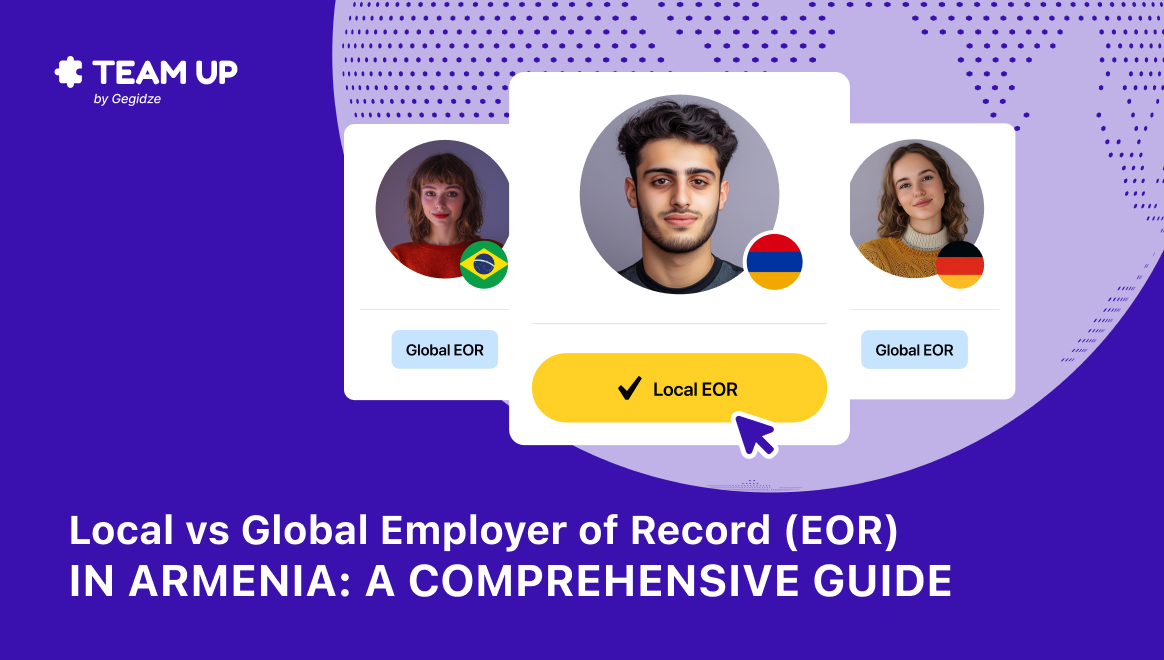
Local vs Global Employer of Record (EOR) in Armenia
If you have spent five minutes on LinkedIn recently, you have seen the ads: "Hire in Armenia in 5 minutes!" It sounds like magic. But as any seasoned COO will tell you, when something in global compliance sounds like magic, there is usually a very expensive trick happening behind the curtain.
The choice between a Global EOR platform and a Local EOR specialist is not just about which logo looks better on your "About Us" page. It is about who actually answers the phone when the Armenian State Revenue Committee (SRC) flags a discrepancy in your digital filings. In 2026, Armenia has transitioned to a high-accountability model where "Global" convenience often hits a "Local" wall.

The 2026 Digital Mandate: The end of "Generic" compliance
As of January 1, 2026, the Armenian government has made the Unified Digital Employment-Contract Platform mandatory. Every new hire, amendment, and termination must be time-stamped and signed with a qualified electronic signature (QES) via the state portal.
- The Global Model: Often relies on "off-platform" paper templates or generic electronic signatures (like standard DocuSign) that are not recognized by the Armenian SRC portal. This leaves your "legal" contracts in a state of limbo—unrecognized by the state and exposing you to fines for "illegal employment."
- The Local Model: We operate directly within the Armenian digital infrastructure. We ensure every employee has their "Yes em" (Ես եմ) digital ID or mobile e-signature ready before day one. We do not just give you a PDF; we execute the legal relationship inside the system where the Armenian Labor Inspectorate actually looks.
Advantages of Utilizing Local Employer of Record (EOR) Services
When your team in Yerevan grows beyond a single "test hire," the advantages of a local specialist become your competitive edge.
- Direct Entity Ownership: Local EORs like Team Up own the Armenian legal entity. There is no middleman. When you have a question about a 155-day complicated maternity leave calculation or a 44x daily salary severance payout, you are talking to the legal employer, not a customer success manager in a different hemisphere.
- Deep Tax Optimization: Armenia offers incredible incentives for the tech sector, including 10% PIT for certified companies and 60% reimbursements for new hires. Global platforms rarely qualify for these because they lack the "local substance" required by Armenian law. A local expert ensures these savings stay in your pocket.
- Surgical Payroll Accuracy: Armenian payroll is not just "Salary - 20%." It involves tiered pension funds (5% vs 10%), Military Stamp Duty bands, and strict 150% overtime rates. A local provider handles the AMD (Dram) transfers and SRC filings with the precision that a global "one-size-fits-all" algorithm misses.
- Real-Time Compliance Updates: Whether it is a shift in the minimum wage to 75,000 AMD or new Labor Code amendments regarding digital signatures, a local partner implements changes the day they are enacted. You aren't waiting for a global legal team to "review" a country they’ve never visited.
Advantages of Global EOR Services
Global platforms have their place, primarily for companies with a "scattered" hiring strategy.
- One Dashboard for the World: If you are hiring 1 person in Armenia, 1 in Brazil, and 1 in Japan, the consolidated invoicing and single UI of a global platform provide a unified view for your Finance team.
- Standardized Procurement: Large enterprises often prefer a single Master Service Agreement (MSA) that covers 180 countries, even if it means paying a premium for the "convenience" of not vetting local partners.
- Speed for "Micro-Hiring": If you only need to hire a single contractor for a three-month project and don't care about long-term tax incentives or high-touch support, the self-service nature of a global platform is hard to beat.
The Strategic Pivot: Who owns the risk?
In 2026, compliance is the only currency that matters in the Caucasus. If you use an aggregator and a digital filing error occurs, the platform points to the "Local Partner." The Local Partner points to the platform's API. You, the client, are left in the middle of a finger-pointing exercise while the Armenian authorities pause your payroll registration.
Choosing a local specialist means the buck stops with the person you signed the contract with. No middleman. No "partner network." Just direct, ironclad accountability in the Armenian market.
Legal employment in Armenia. What breaks deals later
Employment contracts under Armenian law
Employment contracts in Armenia are not optional. They are central.
A compliant Armenian employment contract must:
- Be governed explicitly by Armenian labor law
- Clearly define role, compensation, working hours, and work format
- Correctly structure probation terms
- Include valid notice and termination clauses
- Address IP ownership without ambiguity
This is where global EOR templates start to crack.
Armenian courts do not care that a clause worked in Poland or Romania. They care whether it aligns with Armenian enforcement practice. Local drafting matters.
IP ownership in Armenia. A quiet but real risk
Armenia is a built market. Code. Algorithms. Infrastructure. That makes IP protection non-negotiable.
Under Armenian law:
- IP assignment must be explicit and precise
- Vague “work made for hire” language is risky
- Poorly structured IP clauses get flagged during diligence
This is where experienced investors dig. And where sloppy EOR contracts cause last-minute deal friction.
Local EORs draft contracts for Armenian scrutiny. Aggregators adapt templates and hope no one looks too closely.
Payroll and tax compliance in Armenia. Where mistakes surface fast

If you are expanding into Armenia in 2026, the rules of the game have fundamentally changed. The "move fast and break things" approach to HR no longer works in a country that has digitized its entire labor framework.
As of January 1, 2026, Armenia has mandated a Unified Digital Employment-Contract Platform. This means every new hire, every contract amendment, and every termination must be executed through a state-monitored digital system using qualified electronic signatures. For global aggregators relying on outdated paper processes or "offline" onboarding, this is a compliance nightmare. For you, it means your payroll must be surgical.
1. The 20% flat tax trap
Armenia uses a flat 20% Income Tax rate. On the surface, it looks simple. However, the complexity lies in the withholding and monthly remittance cycles.
- The Deadline: Taxes must be remitted by the 20th of the following month.
- The Risk: In 2026, the State Revenue Committee (SRC) now uses pre-filled returns based on your digital contract data. If your payroll calculation and your digital contract do not match to the last Dram, the system flags it instantly.
2. The "2+2+2" and tiered pension mechanics
While some regions have simple social security, Armenia’s Funded Pension System is tiered and capped. For employees born after 1974, the math changes based on their income bracket:
- Up to 500,000 AMD: A straight 5% contribution.
- Above 500,000 AMD: A calculation of 10% minus a fixed 25,000 AMD offset.
- The Cap: For high-earners (1,125,000 AMD and above), the contribution is capped.
Many global platforms struggle with these specific Armenian tiers, often defaulting to a "flat percentage" that either over-taxes your employee or leaves you with a compliance gap.
3. The Military Stamp Duty: A localized nuance
Often missed by international providers, the Military Stamp Duty is a mandatory, fixed-fee deduction that varies according to salary bands (ranging from 1,500 AMD to 15,000 AMD monthly). Because this is a fixed amount rather than a percentage, it frequently breaks generic global payroll software that isn't configured for the Armenian Defense Fund requirements.
4. IT sector incentives: 10% PIT and 60% reimbursements
If you are a tech founder, this is where the right EOR partner pays for itself. In 2026, certified IT companies can access:
- 10% Personal Income Tax for certified research and development roles.
- 60% PIT reimbursements for newly hired professionals and labor migrants.
A global aggregator will often charge you the full 20% because their "partner" isn't certified or their platform isn't set up to handle Armenian state-support claims. A local expert ensures you actually receive these incentives, often saving you more than the cost of the EOR service itself.
Benefits, leave, and what Armenian employees really expect
Statutory compliance is the floor. Not the ceiling.
A compliant EOR in Armenia manages:
- Statutory paid annual leave
- Public holidays
- Sick leave rules
- Maternity and parental leave
- Mandatory social contributions
But competitive remote hiring in Armenia requires more.
What benefits Armenian professionals expect in 2026:
- Private health insurance that actually covers local clinics
- Transparent bonus structures
- Flexibility around remote or hybrid work
- Clear treatment of overtime and on-call work
- Equipment and home office allowances
Global EORs often deliver legal minimums. Local EORs deliver market reality. That difference shows up fast in retention.
Why local EOR execution matters more in Armenia than founders assume
Armenia is not a spray-and-pray market. It is relationship-driven and detail-sensitive.
When you use an aggregator-style global EOR:
- Contracts are adapted, not authored
- Payroll questions escalate through global queues
- Local nuance depends on third-party partners
- Accountability fragments under pressure
When you use a local EOR in Armenia:
- The employing entity is owned locally
- Payroll and tax filings are handled in-country
- Legal interpretation reflects Armenian enforcement reality
- Issues are resolved without handoffs
This matters when:
- You terminate an employee
- You restructure compensation
- You face a tax or labor inquiry
- You go through fundraising or acquisition diligence
- Armenia becomes more than a test market
Local execution reduces noise. It also reduces risk.
The 2026 digital mandate: Navigating the unified employment portal
If you are hiring in Armenia today, the most important acronym you need to know isn't "ROI"—it is "SRC" (State Revenue Committee). As of January 1, 2026, Armenia has officially retired the era of paper-based "desk drawer" contracts. The transition from voluntary to mandatory digital contracting is now in full effect, and the implications for your EOR strategy are massive.
The Unified Digital Employment-Contract Platform (hosted at file-online.taxservice.am) is now the only legal gateway for establishing employment relations.
1. The "Real-Time" Compliance Trap
The biggest shift isn't just that the contract is digital; it is that it is time-stamped and transparent.
- No More Backdating: In the past, a global platform might have "fixed" a late hire by backdating a paper contract. In 2026, the SRC portal records the exact second a contract is signed. Any delay between a start date and a digital signature is an immediate, visible violation.
- The "Yes em" (Ես եմ) Gateway: Armenian citizens must sign via the national identification platform. This requires an ID-enabled SIM (Mobile-ID) or a chip-enabled national ID card. A global EOR that doesn't have a local team to walk your new hire through this technical setup will see their onboarding timelines grind to a halt.
2. Mandatory Fields vs. Generic Templates
The portal uses a standardized template with rigid, mandatory fields that must be completed before the system allows a signature. These include:
- Exact workplace location and position code.
- Detailed salary calculation methods (including the tiered 2+2+2 pension logic).
- Specific probation terms (capped at 3 months).
- Working hours and leave entitlements.
While the system allows for "Additional Terms" annexes (like NDAs or IP assignments), these are now secondary to the core digital filing. If your EOR is trying to "shoehorn" a generic global contract into this portal, the system will simply flag it as an error.
3. The 2026 "Clean-Up" Deadline
If you already have a team in Armenia, you are on a ticking clock. The Armenian government has granted a 12-month grace period (ending December 31, 2026) for employers to digitize every single existing paper contract.
- The Workload: Every legacy contract must be manually entered into the portal with its original terms.
- The Employee Action: Every current employee must log in to the self-portal and confirm these digital records with their own electronic signature.
This is where the "Global Aggregator" model often breaks. They do not have the administrative bandwidth in Yerevan to handle a manual migration for hundreds of employees. At Team Up, we treat this as a strategic project, ensuring your entire Armenian history is "portal-ready" before the 2027 enforcement cliff.
4. Direct Access for Supervisory Bodies
In 2026, the Health and Labor Inspection Body no longer needs to visit your office to conduct an audit. They have direct, real-time access to the portal data. They can see:
- Who is on probation?
- Who hasn't signed their termination order?
- Whether your salary payments match the contract values.
This level of transparency means that "minor" compliance errors are now major liabilities. Choosing a local EOR who lives inside this portal every day isn't just a preference; it's your best defense against automated fines.
Ready to choose the right EOR model in Armenia? Don’t guess. Decide with data

You now have the framework. The only thing left is applying it to your exact hiring map in Yerevan. Choosing an Employer of Record in Armenia is not about finding the most recognizable logo; it is about finding the shortest distance between a problem and a solution.
In 2026, the most successful companies are not those with the most flags on their map. They are the ones with the deepest roots in the countries that matter. Armenia is a high-stakes, high-reward market where the talent is specialized and the digital legal environment is rigorous. Your team in Armenia deserves more than a generic "global" contract and a bot-led support queue.
Final Verdict: Local vs. Global
| Feature | Local EOR (Team Up) | Global EOR Platform |
| 2026 Digital Mandate | Direct integration with the SRC portal | Often reliant on non-compliant "offline" signatures |
| Tax Incentives | Experts in securing 10% PIT and 60% rebates | Often defaulted to 20% standard rates |
| Pricing | Transparent, flat monthly fee | High base fee or percentage-of-salary markup |
| Accountability | The buck stops with us—no middlemen | A chain of "partners" and "account managers." |
Advantages of Local EOR Services
- Direct Entity Ownership: We own the Armenian entity. There is no "partner network" to blame when things get complicated.
- Surgical Compliance: We live inside the Armenian State Revenue Committee (SRC) portal. We handle the 2026 digital contract transition manually so you don't have to.
- Cost Efficiency: With a flat fee model starting at €199/month, you keep your margins as your team scales.
Advantages of Global EOR Services
- Consolidated Dashboard: Useful if you are hiring one person in 15 different countries simultaneously.
- Single Vendor Billing: One invoice for your global "scatter" team.
- Procurement Simplicity: One master agreement for low-headcount, low-risk experiments.
At Team Up, we don’t offer a travel agent’s version of Armenia. We offer an operator’s version. We provide the boots on the ground, the electronic signatures, and the deep tax knowledge that turns a hiring task into a long-term strategic advantage.
Stop Guessing. Decide with Data.
The 2026 mandate is here, and the Armenian Labor Inspectorate is no longer waiting. Whether you are migrating a legacy team or hiring your first senior dev in Yerevan, do it with the team that actually owns the infrastructure.
Frequently asked questions
Which model is better for a growing team in Armenia: Local or Global EOR?
Local EORs (like Team Up) are almost always superior for scaling teams. They provide direct accountability, specialized support for the 2026 Digital Mandate, and access to local tax incentives that global platforms often miss. Global EORs are better suited for "one-off" hires in countries where you have no plans to build a permanent hub.
What happens if we don’t use the Unified Digital Employment-Contract Platform?
As of January 1, 2026, paper contracts for new hires are no longer legally enforceable for state registration. Failing to use the SRC portal can lead to fines (starting at 50,000 AMD for repeat violations) and risks your employees being flagged as "unregistered," which can trigger a full labor audit.
Can an EOR help me get the 10% IT tax incentive in Armenia?
Yes, but typically only a Local EOR with "International Company" or "IT Start-up" certification can pass these savings on to you. Many global aggregators do not hold these specific Armenian certifications, meaning you end up paying the standard 20% income tax instead of the incentivized 10% rate.
What is the "2+2+2" pension rule I keep hearing about?
It refers to Armenia's funded pension system, where contributions are split: 2% from the employee’s gross salary, a matching 2% from the employer (though the state often offsets a portion), and a 2% contribution from the government. However, the math changes significantly for salaries above 500,000 AMD, requiring a local expert to handle the tiered calculations correctly.
How long does it take to onboard an employee in Armenia via EOR?
With a local EOR, you can typically have a contract ready for digital signature in 2–3 business days. The bottleneck is usually the employee obtaining their "Yes em" mobile ID or e-signature, which a local partner can help fast-track. Global platforms often take 1–2 weeks because they have to coordinate through a third-party Armenian partner.
Does a Global EOR cost more than a Local one?
In 2026, the "Global Tax" is real. Global platforms usually charge a flat $599+ USD per month or a percentage of the salary. Local specialists in Armenia typically charge between €199 and €450, offering a direct cost saving of up to 60% while providing better legal protection.
Is it difficult to terminate an employee in Armenia?
Yes. Armenia’s Labor Code is protective. You cannot dismiss an employee without a specific legal basis (e.g., liquidation, staff reduction, or repeated breach of discipline). A local EOR manages this high-risk process by ensuring all "warnings" and documentation are filed correctly in the digital portal to prevent wrongful termination lawsuits.
.svg)