


Free Guide
EOR Sponsored Visas
With this guide, learn a faster and safer way to onboard international talent without setting up local entities, while avoiding costly compliance mistakes and hiring delays.
With this guide, learn a faster and safer way to onboard international talent without setting up local entities, while avoiding costly compliance mistakes and hiring delays.
This free guide breaks down how visa sponsorship actually works when hiring internationally, including the role of an Employer of Record and the full process from start to finish. It gives you a clear, practical view of timelines, compliance, and real-world hiring scenarios across key markets.

In this report you will learn about:
✅ What visa sponsorship for employment actually means
✅ The most common mistakes companies make
✅ How visa sponsorship differs across key hiring markets
✅ How to evaluate an EOR provider
✅ A step-by-step breakdown of the full process
✅ When EOR sponsorship is not the best, and what to do instead

.svg)


✓ First candidates in 72h
✓ 98% retention
✓ Compliance handled
FREQUENLTY ASKED QUESTIONS
It means a candidate doesn't have an independent right to work in the destination country and needs a registered local employer to formally petition immigration authorities for a work permit on their behalf. The sponsor, typically an EOR if you don't have a local entity, takes legal accountability for the employment relationship.
A Professional Employer Organization (PEO) typically operates as a co-employer, sharing employment responsibilities with the client company. This model requires the client to already have a legal entity in the country. An EOR is the sole legal employer; the client company has no employment presence in the country. For international markets where the client lacks a local entity, EOR is the only viable model for compliant visa sponsorship.
In almost every market covered in this guide, work permits are employer-specific. If your hire moves from one company to another, even if both are EOR clients, a new permit application is typically required. This is an important consideration for workforce planning: don't structure roles that are likely to need employer transitions within the permit's validity period.
The EOR must initiate renewal at least 30 days before expiry. In some markets (Azerbaijan), failure to pay the state fee within 30 days of the renewal decision results in automatic cancellation. In most markets, the employee has a limited exit window if the permit lapses without renewal. The EOR is responsible for tracking these deadlines; this is a core function, not an optional service.
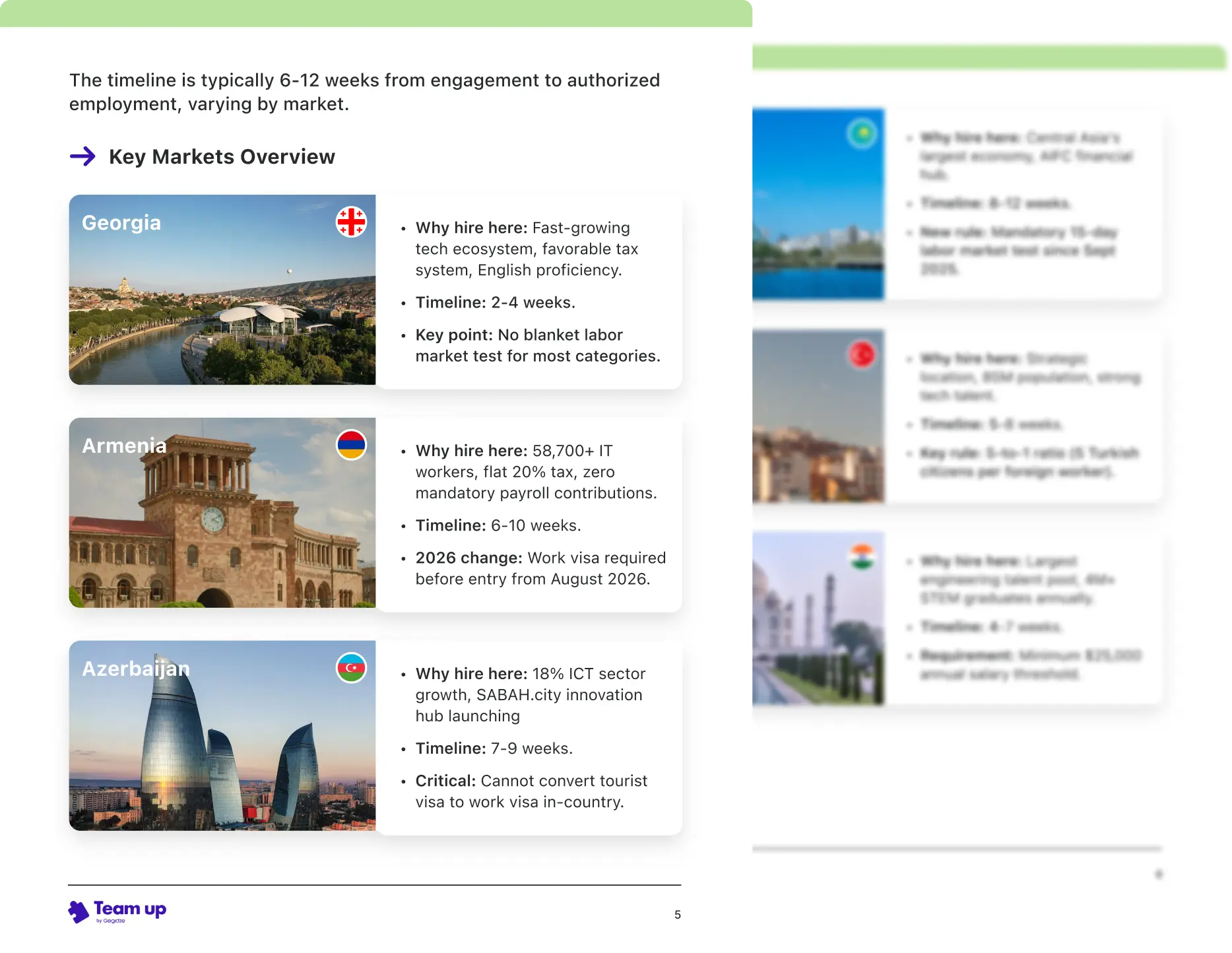
It varies significantly by market. Georgia: 2–4 weeks. Armenia: 6–10 weeks (including TRC). Azerbaijan: 7–9 weeks. Kazakhstan: 8–12 weeks. Turkey: 5–8 weeks. India: 4–7 weeks. Urgent-track options exist in some markets but cost more. Always plan for the standard timeline and treat the fast track as contingency.
Local employees with the right to work in their home country don't need immigration sponsorship. Sponsorship applies to foreign nationals who don't have an existing work authorization in the destination country.
No. EOR sponsorship is only available in countries where immigration law permits a third-party employer to be the legal sponsor. Most countries in the Caucasus, Central Asia, Turkey, and India allow this. Some markets restrict sponsorship to the direct operational employer. Always verify with your EOR or immigration counsel before committing to a hiring plan.
Visa sponsorship status refers to the formal legal relationship between an employer (or EOR) and a government immigration authority in which the employer has applied for and holds responsibility for a foreign national's work authorization. The visa "status" the employee holds is conditional on that sponsorship relationship remaining active.
This phrase appears on job postings to identify whether a candidate needs the employer to obtain a work visa on their behalf, or whether they can already work in the country without employer assistance. Candidates who "require sponsorship" need an active visa sponsorship arrangement, which, without a local entity, means an EOR partnership.